
Crwth Unbound: Wales’s Bowed Lyre, From Court Music to Modern Revival
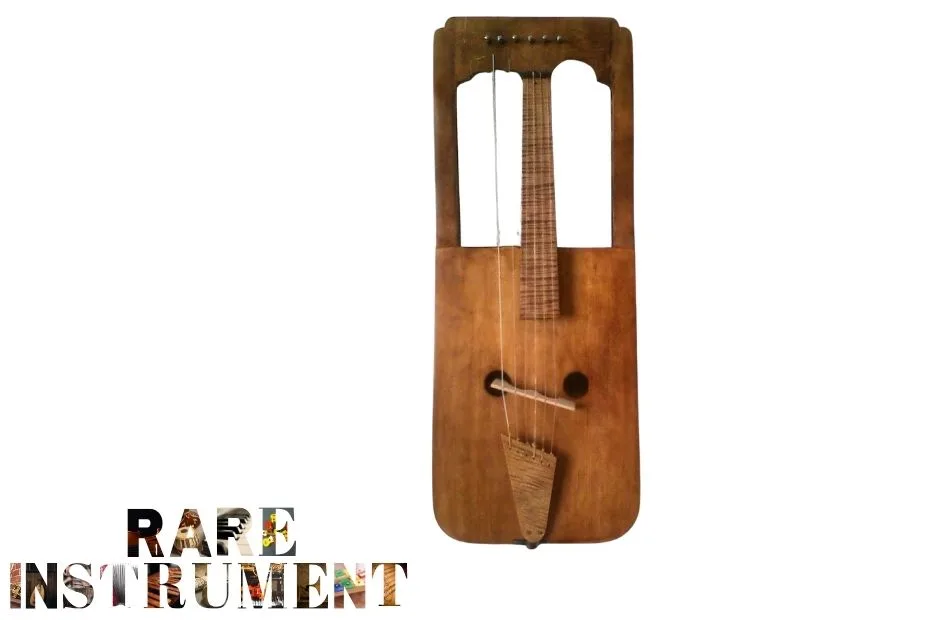
The crwth, also known historically in English as the crowd, is a Welsh bowed lyre whose mature form combines six strings, a flat fingerboard, an open yoke-like upper frame, and an unusually shallow rectangular soundbox. Four strings pass over the fingerboard for bowed playing, while two run beside it where they can be plucked by the left thumb. Only three historical Welsh crwths of this developed type are known to survive in Britain.
| Feature | Description |
|---|---|
| Instrument family | Bowed lyre; chordophone with an integral yoke-like frame |
| Historical center | Wales |
| Surviving historical form | Six strings: four over the fingerboard and two positioned to its side for left-thumb plucking |
| Body | Oblong, shallow soundbox with flat back, sides, and soundboard; the main body and upper frame are formed from a single piece of wood on surviving examples |
| Fingerboard | Flat board extending through the central opening of the upper frame |
| Documented size | The 1742 St Fagans instrument measures 550 mm long, 240 mm wide, and 70 mm deep |
| Historical evidence | Welsh documentary references reach the Middle Ages; crwth playing was included at the recorded eisteddfod held at Cardigan Castle in 1176 |
| Modern status | Historical practice died out, but reconstructed instruments returned to performance during the modern Welsh traditional-music revival |
Why the Crwth Is a Bowed Lyre
The crwth differs structurally from a fiddle or viol because the upper body retains the open frame associated with the lyre family. Two arms rise from the soundbox and join across the top, while a fingerboard occupies the center of the opening. The strings run from the lower part of the instrument toward tuning points in the upper frame.
The three surviving historical Welsh examples share a recognizable layout: an oblong six-string body, two sound holes, flat surfaces, and a fingerboard extending through the rectangular opening. Their construction is sufficiently distinctive that the mature Welsh crwth is better treated as its own bowed-lyre tradition rather than simply as an early-shaped violin.
The original page’s approximate body length of 30–40 cm was too small for the best-documented surviving example. The Richard Evans crwth of 1742 at St Fagans is 55 cm long, with a width of 24 cm and depth of 7 cm.
Four Bowed Strings and Two Thumb Strings
The mature Welsh crwth carries six strings. Four lie above the fingerboard, where the left hand changes their sounding length while the bow sets them into vibration. Two additional strings pass to the side of the fingerboard and can be plucked by the player’s left thumb.
This arrangement gives the player two forms of articulation within the same instrument. Bowed strings can sustain a melody or several notes together, while the lateral strings can add recurring open pitches or short plucked accents. Historical descriptions sometimes refer to these side strings as drones, but their defining physical feature is that they sit away from the fingerboard and remain accessible to the thumb.
Common Confusion: The crwth did not simply have six strings bowed in the same way. Four belonged to the fingerboard playing system, while two were displaced to the side and could be plucked independently with the left thumb.
The Flat Bridge and Multi-String Sound
The bridge is much flatter than a modern violin bridge. That geometry reduces the bow-angle separation between strings, making simultaneous contact with several strings a normal part of the instrument’s possibilities rather than an exceptional effect.
The resulting texture can combine stopped melody notes with sustained open pitches. A player approaching the crwth as though it were a violin may therefore find the instrument awkward: clean isolation of a single bowed string is not the central mechanical assumption behind the surviving design.
The shallow soundbox receives the vibration through the bridge and soundboard. Museum conservation has also revealed another less obvious feature. Beneath the fingerboard of the St Fagans instrument is a tapering hollow cavity extending along the neck. Examination of the other two surviving historical crwths found evidence of a related construction feature.
Amgueddfa Cymru has proposed that this hollow space may have affected resonance, but its precise acoustic contribution has not been demonstrated experimentally. It is therefore safer to treat the cavity as a documented construction feature rather than claim that the crwth definitively possessed a separate second resonator.
Medieval Evidence and Changing Social Roles
Written evidence for the crwth in Wales predates the surviving instruments by centuries. Amgueddfa Cymru identifies a reference in the medieval Laws of Hywel Dda, where the crwth appears with the harp and pipes among instruments associated with high-status musical life.
A crwth competition was recorded at the eisteddfod organized by Lord Rhys at Cardigan Castle in 1176. Later Welsh poetry also refers to crwth players in the households of wealthy patrons. These references establish a long Welsh performance tradition, but they do not prove that every medieval instrument had the exact six-string construction preserved in eighteenth-century examples.
The crwth appears in Welsh legal and literary evidence and is associated with professional musical activity and elite households.
Crwth performance formed part of the recorded eisteddfod held by Lord Rhys at Cardigan Castle.
Welsh literary descriptions provide evidence for the developed instrument and its string arrangement.
The instrument’s social setting shifted increasingly toward folk and dance music as older courtly systems changed.
The fiddle became dominant in Welsh dance music, contributing to the decline of crwth playing and making.
Copies of surviving instruments and renewed study of historical evidence returned the crwth to performance after the original playing tradition had disappeared.
The Three Surviving Historical Welsh Crwths
Physical evidence is unusually valuable because only three authentic historical Welsh crwths of the developed type are known to survive in Britain. They differ in condition and detail, but together they establish the basic six-string construction far more securely than later speculative reconstructions alone.
| Instrument | Documented History | Condition and Evidence |
|---|---|---|
| St Fagans crwth | Made by Richard Evans at Llanfihangel Bachellaeth, Caernarfonshire; inscribed 1742 | Complete six-string form; 550 × 240 × 70 mm; conservation imaging revealed a tapering cavity beneath the fingerboard |
| National Library of Wales crwth | Donated when the Library opened in 1907; possibly associated with Rev. John Jenkins of Ceri | Survives substantially complete but has undergone repair; two lateral strings are missing; examination revealed a similar hollow beneath the neck |
| Warrington crwth | Purchased in Wales by antiquarian Dr James Kendrick in 1843 and donated to Warrington the same year | Less complete, with tailpiece, strings, fingerboard, and nut missing; the exposed neck provides evidence for the same tapering hollow construction |
The St Fagans instrument also contains blocked tuning-pin holes offset from its present arrangement. Such evidence matters because historical instruments can be altered during their working lives. The current setup of a museum object should not automatically be assumed to represent its only historical stringing.
Tuning: Historical Evidence Rather Than One Fixed Standard
A single universal crwth tuning cannot be established safely from the surviving instruments alone. Late eighteenth- and early nineteenth-century writers recorded different tuning schemes, and modern reconstructions have had to interpret those descriptions alongside physical evidence.
Edward Jones recorded one tuning procedure and string relationship, while William Bingley later described another arrangement. The difference is useful evidence in itself: the instrument should not be reduced to a generic modern scordatura or presented as though all Welsh players used one standardized concert tuning.
The flat bridge, four fingerboard strings, and two thumb strings are more securely documented than a single absolute pitch system. Reconstructed instruments may therefore be tuned according to the historical source, repertory, or performance method being explored.
Playing Technique on a Reconstructed Crwth
The crwth was commonly held against the torso and supported with a strap or other body contact. The left hand worked the fingerboard while retaining access to the two lateral strings, and the right hand controlled the bow.
The flat bridge allows several strings to respond under one bow stroke. Open strings can remain sounding around stopped notes, producing a texture that differs strongly from normal single-string fiddle playing.
The two strings beside the fingerboard can be sounded without releasing the bowing pattern. This gives the player a second attack type within a sustained bowed texture.
Four strings cross the fingerboard and provide the main stopped-note system. Historical playing details were lost when the living tradition disappeared, so modern technique combines written evidence, surviving instruments, and practical reconstruction.
Small changes in bow position alter how many strings speak at once. The instrument rewards control of multi-string balance rather than the pronounced string-to-string separation familiar from a modern violin bridge.
Reconstructing a Lost Playing Tradition
By the time serious revival work began, continuous transmission from historical crwth players had been broken. Makers could examine surviving instruments, dimensions, documentary descriptions, paintings, and early technical accounts, but there was no uninterrupted school of traditional teachers preserving every detail of bowing and fingering.
An important twentieth-century reconstruction survives in the Horniman Museum and Gardens. The instrument was probably made by Arnold Dolmetsch after the historic Welsh example from Y Foelas, now associated with St Fagans. Dolmetsch played a crwth at the 1934 Haslemere Festival, placing the instrument within an early phase of practical revival.
Later Welsh performers and makers continued the process. Amgueddfa Cymru specifically identifies Cass Meurig among musicians associated with the modern revival. Current playing therefore represents a reconstructed tradition informed by historical evidence rather than an unchanged technique passed continuously from eighteenth-century performers.
Crwth, Jouhikko, Talharpa, and Fiddle
Six-string bowed lyre with an open upper frame, four fingerboard strings, two lateral thumb-plucked strings, and a flat bridge suited to multi-string playing.
Finnish bowed lyre with an open hand-hole and a much smaller string complement. It belongs to the broader northern European bowed-lyre tradition but uses a different stopping technique and construction.
Estonian and related bowed-lyre tradition using a frame-like body and bow. Its modern forms share the bowed-lyre principle without reproducing the mature Welsh crwth’s six-string fingerboard-and-thumb layout.
Uses a neck projecting from the body and a curved bridge designed for much easier individual string selection. Its spread in Wales during the eighteenth century coincided with the crwth’s decline.
These similarities are useful for classification, but they should not be turned into a simple line of descent. Surviving bowed lyres represent related solutions to bowed-string playing across different regions and periods.
Care and Reconstruction Considerations
An original eighteenth-century crwth is a museum object rather than a routine performance instrument. Old wood, repaired joints, missing components, altered tuning holes, and uncertain historical string tensions make aggressive restringing or setup changes inappropriate without conservation assessment.
- Base a reconstruction on a named surviving instrument rather than mixing measurements from unrelated copies.
- Record bridge position, string spacing, fingerboard geometry, and lateral-string clearance before altering a playable replica.
- Avoid assuming modern violin string tensions are suitable for a reconstructed crwth.
- Treat the hidden neck cavity as a documented structural feature; its exact tonal effect remains uncertain.
- Distinguish replacement parts and later repairs from original construction when studying museum examples.
Terminology
Crwth: Welsh name for the bowed lyre discussed here; pronounced approximately “crooth.”
Crowd: Historical English name related to crwth and used for bowed instruments of this broad type.
Crythor: Welsh term for a crwth player.
Bowed lyre: Lyre-form chordophone whose strings are sounded primarily with a bow.
Lateral strings: The two strings positioned beside the crwth’s fingerboard and accessible to the left thumb.
Drone: A sustained or recurring pitch used as a tonal foundation. The crwth’s open and lateral strings can serve drone-like functions depending on tuning and technique.
Scordatura: Deliberate alternative tuning. Historical crwth sources describe more than one tuning arrangement, so the term is useful when discussing modern reconstructions but should not imply one universal Welsh tuning.
High-Quality Sources
- Amgueddfa Cymru – Museum Wales: Richard Evans Crwth, 1742
- Amgueddfa Cymru – Museum Wales: Conservation Study of the Three Surviving Historical Crwths
- People’s Collection Wales – Historical Welsh Crwth
- National Library of Wales – Welsh Music Archive, 17th–18th Centuries
- National Library of Wales – Archival Material Relating to the Crwth
- Horniman Museum and Gardens – Arnold Dolmetsch Crwth Reconstruction