
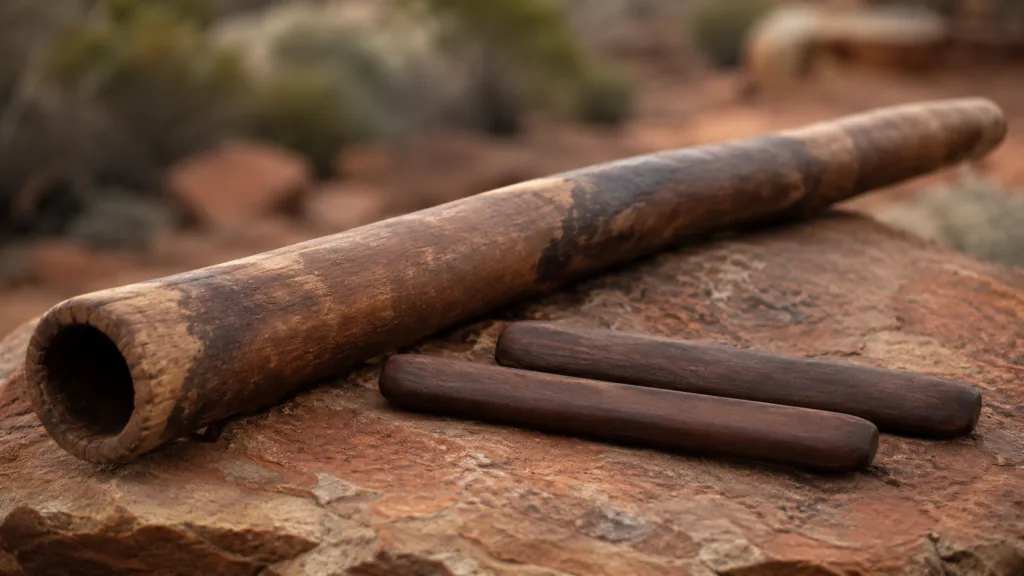
Cultural Sound Snapshot
Aboriginal Australian musical traditions are not one uniform system. Clapsticks are found across many regions, while the didgeridoo developed in northern Australia and carries different names, uses, and custodial meanings among particular communities. In song and ceremony, these instruments often work with voice, dance, language, and movement rather than functioning as isolated concert objects.
Clapsticks and the didgeridoo are often presented together as symbols of Aboriginal Australian music, yet they do not have the same geographic spread or cultural function. Clapsticks are paired wooden percussion instruments used in many communities under different local names and forms. They can mark a steady beat, accent a singer’s phrasing, signal changes in movement, or shape the energy of a dance.
The didgeridoo, also written didjeridu, is a long open tube sounded by vibrating the lips. It is associated most strongly with northern Australia. The English term is not an Aboriginal word, and names such as yidaki, artawirr, djibolu, and rirtakki belong to particular language and cultural settings. Using yidaki as a universal substitute can erase those distinctions.
Ritual sound is also easy to misunderstand. The sound is not an abstract “mystical effect” produced by an instrument alone. In many settings, meaning comes from the relationship between song text, ancestral narrative, Country, kinship, authorised knowledge, dancers, singers, rhythm, and the people responsible for the performance. Some material is public and teachable; other knowledge may be restricted by community, age, gender, family, place, or ceremonial standing.
Clapsticks: Pulse, Accent, and Musical Authority
Clapsticks are usually played as a pair, with one stick held as the receiving surface and the other used as a striker. Their musical role can sound simple at first: wood meets wood, producing a short, dry attack. In practice, the spacing, force, rebound, and placement of each strike can carry detailed information about the song and dance.
Not every pair is identical. Makers may select dense hardwood for a focused click, shape one stick differently from the other, leave natural contours in the timber, or carve forms linked to a local tradition. Arrernte examples known as twererre show that regional designs can be highly distinctive. In some genres, both men and women play clapsticks; rules differ across communities and performance settings.
| Playing Choice | Audible Effect | Musical Function |
|---|---|---|
| Firm central strike | Focused, dry click with clear projection | Marks the main pulse or reinforces group timing |
| Lighter edge contact | Thinner, softer attack | Adds variation without overpowering the voice |
| Rapid repeated strokes | Dense burst of wooden articulation | Emphasises a phrase, gesture, or transition |
| Wider spacing | Open rhythmic field | Leaves room for text, breath, and movement |
| Changing accent pattern | Shifts the perceived centre of the rhythm | Coordinates singers and dancers through a section |
Listening Tip: Follow the clapsticks before focusing on the drone. They often reveal the pulse, phrase boundaries, and changes in dance energy more clearly than the sustained instrument.
The Didgeridoo as a Northern Australian Aerophone
The didgeridoo produces sound through lip vibration, much like a brass instrument without valves or a conventional mouthpiece. The player excites the air column inside the tube, creating a fundamental drone with upper resonances. Tongue movement, cheek pressure, throat shape, breath pulses, and voiced sounds can alter the texture without stopping the underlying tone.
Circular breathing allows an experienced player to maintain the drone while taking air through the nose. Air stored in the cheeks is pushed through the lips as the lungs refill. Circular breathing is a technique, not the musical language itself. Timing, articulation, vocal calls, rhythmic breath, and knowledge of the song setting matter just as much.
Names Belong to Places and Peoples
“Didgeridoo” is a widely used English label. Aboriginal names vary by language group. Yidaki belongs to Yolŋu culture in north-east Arnhem Land and should not be treated as a generic Indigenous word for every instrument of this type. Other northern communities use their own terms, and those names may carry local histories that do not transfer neatly into English.
Common Confusion: The didgeridoo is not a traditional instrument of every Aboriginal nation across Australia. Its older cultural roots are in northern regions, although the instrument later travelled into wider Australian and international performance settings.
Tube Length, Bore, and Playing Response
A longer air column usually gives a lower fundamental pitch, but length alone does not determine how an instrument feels or sounds. Internal taper, wall shape, bore irregularity, mouth opening, bell width, and timber density affect back-pressure, overtone response, attack, and projection.
Traditional wooden instruments are often made from eucalyptus branches or trunks hollowed by termites. The maker searches for a piece with a suitable natural cavity, trims it, clears loose internal material, shapes the ends, and may add a beeswax or resin mouth rim. Some early northern examples were made from bamboo, and bamboo remained part of practice in certain areas after wooden forms became common elsewhere.
How Materials Shape the Sound
Material does not act alone. A dense wood can still sound muted if the bore is poorly shaped, while a lighter tube can project well when its dimensions support a responsive air column. For clapsticks, hardness, dryness, thickness, and contact area control the attack. For didgeridoos, the interior cavity and mouthpiece geometry often affect playability more directly than decorative surface finish.
| Element | Typical Sound Influence | What to Inspect |
|---|---|---|
| Dense clapstick timber | Sharp attack, dry decay, strong rhythmic definition | Cracks, unstable splits, heavy lacquer that dulls contact |
| Thicker clapstick profile | Fuller impact and a lower-feeling wooden knock | Balance in the hand and clean striking surfaces |
| Termite-hollowed eucalyptus | Irregular bore with an individual pattern of resonance and back-pressure | Loose debris, thin weak walls, repaired splits, mouth comfort |
| Bamboo tube | Often lighter, direct, and distinct from thicker wooden examples | Node treatment, splitting, bore continuity, dry storage damage |
| Wax or resin mouth rim | Changes lip seal, comfort, and control of the initial buzz | Clean fit, secure adhesion, comfortable opening size |
| Wide terminal opening | Can alter projection, overtone balance, and the feel of the returning air | Symmetry is less important than stable response and sound walls |
Collector’s Note: Age, decoration, or a claimed tribal label does not prove cultural authenticity. Provenance, maker identity, community connection, lawful sale, condition, and documented history matter more than exotic appearance. Sacred or restricted objects should not be traded as ordinary décor.
Sound as Coordinated Action
In many Aboriginal performance traditions, musical meaning is distributed across several actions at once. A singer may carry the text and melodic contour. Clapsticks organise pulse and accent. A didgeridoo player may supply drone, rhythmic pressure, vocal colour, and responses to the lead. Dancers turn the musical structure into visible movement.
Song Establishes the Verbal and Melodic Line
Words, language, melodic shape, and authorised knowledge give the performance its identity. The instrumental parts support that identity rather than replacing it.
Clapsticks Define Pulse and Change
The wooden strikes create a shared timing reference. Accent shifts can mark a new phrase, intensify movement, or clarify the singer’s structure.
The Drone Creates a Moving Ground
The didgeridoo holds a continuous tonal field, but the sound is rarely static. Breath accents, tongue patterns, overtones, and vocal sounds create motion inside the drone.
Dance Makes Structure Visible
Footwork, gesture, body painting, objects, spatial arrangement, and group movement can connect the audible pattern with story and place.
This interaction explains why a museum label or isolated audio sample can only describe part of the practice. The instrument is an object, but performance is relational. Who plays, what is sung, where it occurs, who may witness it, and who holds authority over the knowledge can shape the meaning of the sound.
Clapsticks and Didgeridoo: Different Jobs in the Ensemble
Sound type: Short wooden attacks with quick decay.
Main musical job: Pulse, accent, phrase marking, and coordination.
Geographic use: Found in many regions under different names and designs.
Construction focus: Timber hardness, shape, balance, and striking surface.
Sound type: Sustained drone shaped by breath, lips, tongue, throat, and voice.
Main musical job: Tonal ground, rhythmic propulsion, timbral response, and support for song.
Geographic use: Older traditions are centred in northern Australia.
Construction focus: Bore shape, tube length, wall condition, mouth rim, and back-pressure.
Ritual Sound, Ceremony, and Cultural Limits
The word ritual can flatten many different practices into one vague category. Aboriginal Australia contains hundreds of nations and language groups, each with its own laws, histories, places, and forms of cultural authority. Public celebration, community dance, mourning, initiation, healing, teaching, and restricted ceremony cannot be treated as interchangeable.
Some performances carry knowledge about ancestral beings, travel routes, water, animals, seasonal change, kinship duties, or particular sites. Song, dance, objects, and visual design may work together to hold and transmit that knowledge. A rhythm that sounds repetitive to an outsider may be tied to text, movement, sequence, or responsibility that is not audible without cultural instruction.
Cultural Practice Note: Publicly available recordings do not make every song, name, design, or ceremonial technique free for reuse. Permission should come from the relevant community, cultural organisation, artist, family, or custodian when material has a known cultural owner.
Why “Sacred Didgeridoo” Is Too Broad
Commercial descriptions often call every didgeridoo sacred. That wording can be misleading. Some instruments and performances have ceremonial meaning; others are made for public music, teaching, tourism, contemporary composition, or personal practice. Cultural standing comes from the people, place, knowledge, and use—not from the tube shape alone.
Gender Rules Are Local, Not a Single Internet Rule
Didgeridoo practice is traditionally male in many northern communities, and some cultural institutions describe it in direct terms. Public debate becomes confused when one rule is applied to every Aboriginal group, every public workshop, and every contemporary setting. Respectful learning starts with the protocol stated by the community or teacher connected to that tradition.
Regional Variation and Terminology
Local names are not decorative synonyms. They identify language, place, ownership, and musical practice. A term may refer to a particular instrument form, a way of playing, or a tradition held by a named people. Careful writing keeps the community name beside the instrument name whenever that connection is known.
A Yolŋu term from north-east Arnhem Land. It belongs within Yolŋu cultural knowledge and should not replace “didgeridoo” in unrelated regional contexts.
A name recorded from the Cobourg Peninsula area of western Arnhem Land. Historical bamboo examples from this region show that northern construction traditions were not limited to eucalyptus.
An Arrernte term associated with clapsticks. Distinctive forms from the Charlotte Waters area include shaped and forked profiles that differ from plain paired sticks.
In some Western Australian ceremonial settings, boomerangs may be struck together in a clapstick-like role, showing that musical function does not always follow a single object category.
Historical Change Without a Single Origin Story
Clapsticks are deeply established across many Aboriginal musical traditions, but no single continent-wide date can describe their beginning. Wooden percussion leaves a limited archaeological trace, and living knowledge is regional. The safest historical account joins material evidence with community-held history rather than forcing one universal timeline.
The didgeridoo has a more concentrated northern history. Research has linked early forms to the north-west of the Northern Territory and the adjoining Western Australian region, where native bamboo grows. Later wooden forms became strongly associated with Arnhem Land. Nineteenth-century collections from Port Essington include a bamboo instrument described as the oldest known surviving didgeridoo.
Paired wooden percussion supports song and dance in many Aboriginal communities, with local names, forms, and playing rules.
Bamboo instruments appear in northern histories and visual records before some later wooden forms.
Objects taken during colonial encounters entered overseas collections, often detached from the people and knowledge that gave them meaning.
The didgeridoo moved beyond its older northern range through touring, broadcasting, tourism, education, and cross-cultural performance.
Aboriginal artists use clapsticks and didgeridoo in community ceremony, public cultural events, popular music, classical composition, theatre, and new collaborative work.
Listening for Structure Rather Than Stereotype
A useful listening approach separates several layers without pretending they are independent. Begin with the pulse, then notice how the singer places words against it. Listen for changes in the drone’s pressure, brightness, and vocal colour. Watch how dancers respond to accents or phrase endings when a performance is publicly available with permission.
- Identify whether the clapsticks hold a constant beat or change their accent pattern.
- Notice whether the didgeridoo drone is smooth, pulsed, growled, voiced, or interrupted by sharper articulations.
- Listen for call-and-response between the lead singer, group voices, and drone player.
- Pay attention to moments where movement changes before the rhythm settles into a new pattern.
- Use the community, language, place, and artist information supplied with the recording.
- Avoid treating every low drone as representative of all Aboriginal music.
Buying, Learning, and Collecting Responsibly
A playable instrument and a culturally important object are not the same purchase. A contemporary didgeridoo made for general performance may be suitable for learning. An older object with uncertain provenance, sacred markings, or a vague claim of community ownership may raise ethical and legal concerns.
A stable tube with a comfortable mouth rim, clear maker information, honest material description, and no unsupported ceremonial claims.
A documented maker, known place of production, lawful ownership history, condition record, and clear permission for sale and display.
Anonymous “tribal” labels, invented age claims, restricted imagery, no maker history, fresh artificial ageing, or pressure to buy a supposedly sacred object.
Learn from Aboriginal players, community-led programs, cultural centres, and teachers who explain the regional context as well as the physical technique.
Basic Care
Keep wooden instruments away from rapid humidity changes, strong heat, and prolonged damp. Wipe clapstick contact areas with a dry soft cloth and inspect developing splits. Let moisture leave a didgeridoo after playing, but do not bake it in direct sun or place it beside a heater. Repairs to culturally important pieces should be discussed with a qualified conservator and, where relevant, the maker or community custodian.
Mini FAQ
Are clapsticks and the didgeridoo used across all of Aboriginal Australia?
No. Clapsticks are widespread in many regional traditions, while the didgeridoo has older roots in northern Australia. Local instruments, names, and performance rules vary greatly.
Is yidaki simply the Aboriginal word for didgeridoo?
No. Yidaki is a Yolŋu term connected to north-east Arnhem Land. Other language groups use other names, and “didgeridoo” remains the broad English label.
Do clapsticks only keep a basic beat?
No. They can control pulse, accents, phrase boundaries, transitions, and the relationship between song and dance. Skilled playing is responsive rather than mechanical.
Is circular breathing required to make a didgeridoo sound?
No. A basic drone comes from relaxed lip vibration and controlled air. Circular breathing extends the sound without a break, but it is learned after a stable tone and comfortable breath support.
Is every didgeridoo a sacred ceremonial object?
No. Meaning depends on maker, community, design, context, ownership, and use. Some instruments are ceremonial, while others are made for public performance, teaching, contemporary music, or general practice.
Can old Aboriginal instruments be collected safely?
Only with careful provenance and cultural due diligence. Some objects may have been removed without consent, may contain restricted designs, or may belong with a community rather than in private trade.