
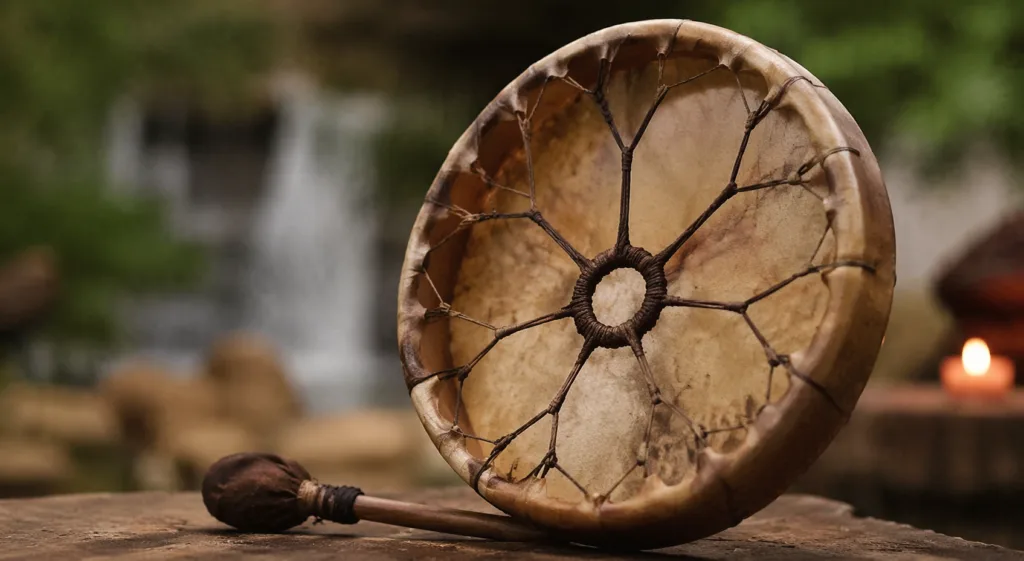
Anatomy of Siberian and Central Asian Ritual Frame Drums
| Part | What Usually Appears | Why It Matters |
|---|---|---|
| Drum Body | Single-headed frame drum with an open back | Gives a direct attack, a dry decay, and clear hand contact with the rear structure |
| Frame | Bent wood hoop, round or oval depending on region | Shape changes balance, grip feel, and how the air moves inside the shell |
| Head | Animal hide such as reindeer, deer, horse, or other locally available skin | Hide thickness changes pitch, softness, and the amount of upper click in the stroke |
| Back Grip | Carved central handle, iron ring, or cord-thong grip | This is not a minor detail; it changes balance, rebound, and playing posture |
| Fittings | Iron rods, bells, disks, rings, ribbons, or hanging pieces | They add rattle, shimmer, and a rough edge to the beat |
| Surface | Plain or painted head | Paint layout can help identify origin, workshop habit, or ritual reading |
A Siberian or Central Asian ritual frame drum is easy to flatten into one broad label. That broad label hides too much. What matters is the build logic: a single skin pulled over a shallow frame, an open back, and a rear grip system that often tells more about the instrument than the painted front does. These drums do not speak with the long bloom of a large studio frame drum. They answer faster, drier, and closer to the hand.
In English, the word shaman is usually linked to the Tungusic form saman, yet the instruments gathered under that label are not one fixed model. Some are closer to round. Some lean oval. Some carry a carved central handle like a keeper figure. Others rely on cords, thongs, or an iron ring. The shared frame-drum family does not make these instruments structurally identical.
When judging one of these drums, do not start with the front painting alone. Look first at the back architecture—handle, thong pattern, iron ring, and hanging metal. That is often where regional character becomes easiest to read.
Wood, Hide, and Air: Why the Drum Speaks the Way It Does
- Wood shapes stiffness, weight, and hand feel.
- Hide shapes pitch ceiling, softness, and attack noise.
- Open-back design keeps the response immediate.
- Humidity and heat can move the sound more than many modern players expect.
The frame is usually shallow, which keeps the note from swelling too long. A deeper shell can thicken the body of the sound, but many historic Siberian examples keep things fairly lean. That gives the stroke a woody edge and a short after-ring. The result is a focused stroke with limited after-ring.
Hide choice matters just as much. Reindeer and deer skins appear again and again in the northern and Altai record, while horse and other hides also appear in documented examples. Thicker hide can hold a darker, denser tone, but it may also slow the response. A lighter skin often reacts faster and lets the beater click speak through. On a ritual frame drum, that click is part of the voice, not a flaw to hide.
Dry conditions can tighten the hide noticeably.
Older descriptions note that the head could be warmed over fire to tighten the skin and raise the pitch. That single detail explains a lot about this instrument family. The sound is never just about diameter. It is about tension in the moment. In cold or damp air, the voice softens and drops. In drier conditions, the attack firms up, the pitch rises, and the whole drum feels more alert in the hand.
Reindeer and Deer Hide Compared with Goat and Modern Alternatives
| Material Choice | What It Tends to Do | Where It Fits Best |
|---|---|---|
| Reindeer / Deer | Dryer attack, earthy body, strong link to northern and Altai practice | Historically grounded builds and museum-led reconstruction work |
| Horse | Can feel tighter and a little firmer under the beater | Selected regional traditions and later remakes |
| Goat / Commercial Hides | Often easier for modern makers to source; response depends heavily on thickness | Contemporary workshop builds and export models |
This is where many modern replicas drift away from the old regional feel. The drum may still look the part, yet the skin-to-frame relationship changes if the hide, thickness, and mounting style no longer match local habit. A similar silhouette can therefore produce a different response.
Spindle Grips and Thong Grips
A carved central grip and a thong-crossed rear grip do not merely change appearance. They change the center of pull in the hand. A spindle-like handle can make the drum feel more anchored and sculptural. A thong system can feel lighter and springier, with a different kind of give under impact. That rear geometry also changes how freely the shell vibrates after the strike.
Collector’s Note: On older drums, the handle is often one of the best clues to origin. Scholars use shape, grip type, and visual layout to sort provenance, not just decoration or later museum labels.
Regional Forms Across Siberia and Central Asia
- Altai area: often described with large shallow bodies, carved inner handles, hanging iron pieces, and hides such as maral deer.
- Eastern Siberian variants: oval tendencies appear more often, with thong-based or cord-based grip systems in some groups.
- Khakas-related museum examples: drumhead imagery and handle shape can help trace origin and workshop logic.
- Broader Central Asian line: the family resemblance stays clear, but names, painting habits, fittings, and exact form change from one people to another.
The Altai descriptions are especially revealing because they preserve both sound and structure. One well-known ethnographic account describes a drum around 75 cm at its longest point and roughly 8 to 12 cm deep, with maral deer skin on one side and a carved inner figure acting as the rear grip. Under that grip sit iron rods and bells. Together, those details describe a shallow shell, a strong hand center, tensioned hide, and light metal noise layered over the main beat.
In a Koryak-type example, the head may be reindeer skin and the grip can be formed by crossed cords tied to the frame rather than by a carved upright handle. The family resemblance remains, but the engineering differs. Treating every “shamanic drum” as a round, plain, one-note object obscures these regional construction differences. The rear structure is part of the acoustic design.
Scholars have also separated Siberian ritual drums into broader oval and round streams, though the line is not absolute. Some descriptions blur the boundary. Real instruments do not always fit neatly into catalog categories.
Across the Central Asian zone, English spelling also shifts from source to source, and museum language often smooths away local names in favor of the umbrella term shaman’s drum. The term is useful for broad classification, but it is not always precise. For organology, the frame, skin, fittings, and back grip provide more specific information.
Why Painted Heads Deserve a Second Look
Paint on these drums is often read only as symbol. Painted layout can also help identify provenance, workshop habit, or regional visual conventions. For museum study, the front surface and the back handle can be considered together when assessing where a drum may belong.
A plain head can be equally informative.
A plain surface can point attention back to sound, materials, and attachments. It can also reflect a regional choice rather than absence of craft. Decoration is not the only place where meaning sits. Some identifying details appear in metal attachments, grip construction, and other structural features.
What the Metal, Ribbons, and Carved Back Actually Do
| Feature | Visual Role | Sound Role |
|---|---|---|
| Iron rods / bells | Add movement and layered detail | Create a rattle effect close to a light snare-like shimmer |
| Carved inner handle | Can carry figural meaning and visual identity | Changes balance, grip pressure, and shell response |
| Iron ring / cross grip | Makes the back layout more open and mechanical | Feels different in the hand and can free the shell in another way |
| Ribbons and hanging pieces | Carry visual identity and ceremonial emphasis | May add soft incidental motion-noise around the main stroke |
Metal fittings on Siberian frame drums are often treated as decoration first. From an acoustic standpoint, that treatment is incomplete. They change the attack. A bare skin strike gives one kind of pulse; a strike colored by light metal chatter gives another. The second sound has a rougher, more grainy edge. In close listening, that grain is part of the instrument’s identity.
The carved back can matter just as much. A rear figure or central keeper-like grip adds weight and stiffness where the hand meets the frame. That shifts the feel of the instrument because vibration passes through the skin, frame, grip, attachments, and the player’s hand.
If a modern copy sounds unusually smooth, inspect its fittings and rear construction. Removing jingles, metal attachments, regional grip structures, or using a generic padded beater can reduce the grain heard in many older ritual frame drums.
Construction Differences Across Ritual and Modern Frame Drums
Historic Ritual Frame Drum and Modern Studio Frame Drum
| Point of Contrast | Historic Ritual Frame Drum | Modern Studio / Wellness Market Drum |
|---|---|---|
| Frame Logic | Built around regional material habit and grip type | Often standardized for easier production and export |
| Response | Dry, immediate, textured | Often softer, rounder, and more uniform |
| Back Structure | A major part of identity | Sometimes simplified to a generic cross handle |
| Surface Treatment | Plain or painted according to local habit | May use standardized decorative treatments intended for a broad retail market |
Historic ritual drums often preserve region-specific choices in frame construction, hide, grip, fittings, and surface treatment. Modern retail versions may standardize some of those details for easier production and export, which can make regional construction traits harder to identify.
Oval and Round Regional Forms
Oval forms can feel more directional in the hand. Round forms can feel more centered and even. These are tendencies rather than fixed rules. The categories overlap, so shape should be read together with grip type, hide, fittings, and regional construction practice.
Single-Headed and Double-Headed Ceremonial Drums
The single-headed Siberian type is easier to hold one-handed and keeps the back available for a grip system, iron ring, or thong cross. A double-headed frame drum closes that back, changes the hold, and changes the air behavior inside the shell. Two instruments can therefore look related in outline while behaving differently in the hand. Construction provides a more reliable distinction than outline alone.
FAQ
Is It Hard to Tell Whether a Drum Is Truly Based on Siberian or Central Asian Traditions?
It can be hard if the drum is judged only by its front painting. Start with the back: grip type, iron ring, thong pattern, shell depth, hide choice, and hanging metal parts usually reveal more than a generic design on the head.
How Do I Know If the Sound Is Historically Closer to Older Ritual Frame Drums?
Listen for a dry, direct attack with a short decay and some grain around the edge of the beat. Older forms often sound less smooth than modern studio drums, especially when metal fittings or a firmer rear structure are present.
What Size Should I Look For If I Want a Lower and More Grounded Tone?
A larger diameter usually helps, but size alone is not enough. Hide thickness, shell depth, and room humidity can shift the sound a great deal. A larger drum with a light skin may still speak faster and higher than expected.
Are Painted Heads Always Part of the Tradition?
No. Some historical drums are painted and some are plain. A plain head does not mean the drum is less rooted in tradition; it may simply reflect a different regional habit, a different workshop choice, or a different ceremonial use.
Why Does the Drum Sound Different on Dry and Humid Days?
Natural hide reacts to moisture. In humid air it often loosens, which lowers pitch and softens the stroke. In dry or warmer conditions it tightens, which raises pitch and makes the drum answer with more snap.