
Cultural Practice Profile
Inuit drum dancing joins a handled frame drum, sung text, patterned movement, memory, and social participation. The drum is not merely accompaniment: its rim-struck pulse organizes the performance while the dancer’s gestures can carry stories, humor, ceremony, personal experience, and community identity.
What Inuit Drum Dancing Is
Inuit drum dancing is a performance practice in which a singer-dancer uses a handled frame drum to shape rhythm while singing and moving before a gathered audience. Depending on place, occasion, and repertoire, the song may recall a hunt, describe an event, imitate an animal, honor a person, carry humor, support a ceremony, or invite others into a shared social moment.
The practice should not be reduced to one fixed format. Inuit communities across Greenland, Nunavut, Nunavik, Nunatsiavut, and the Inuvialuit Settlement Region have their own repertoires, movement vocabularies, performance customs, and names. Some older accounts emphasize male performers, while present-day groups often include women, men, and children as drummers, singers, and dancers.
The frame drum is central because the sound and motion are linked. A performer does not simply hold the instrument still and beat a regular pulse. The drum can move through space as the dancer shifts weight, turns the torso, bends the knees, or acts out details from a song. The audience may answer vocally, laugh at a familiar story, recognize a family song, or join the event through attention and response.
Common Confusion: Inuit drum dancing is not the same practice as Inuit throat singing. They may appear in the same cultural program, but drum dancing centers on a frame drum, sung narrative or dance song, and bodily gesture. Throat singing is a separate vocal practice with its own regional forms and social settings.
How the Frame Drum Is Built
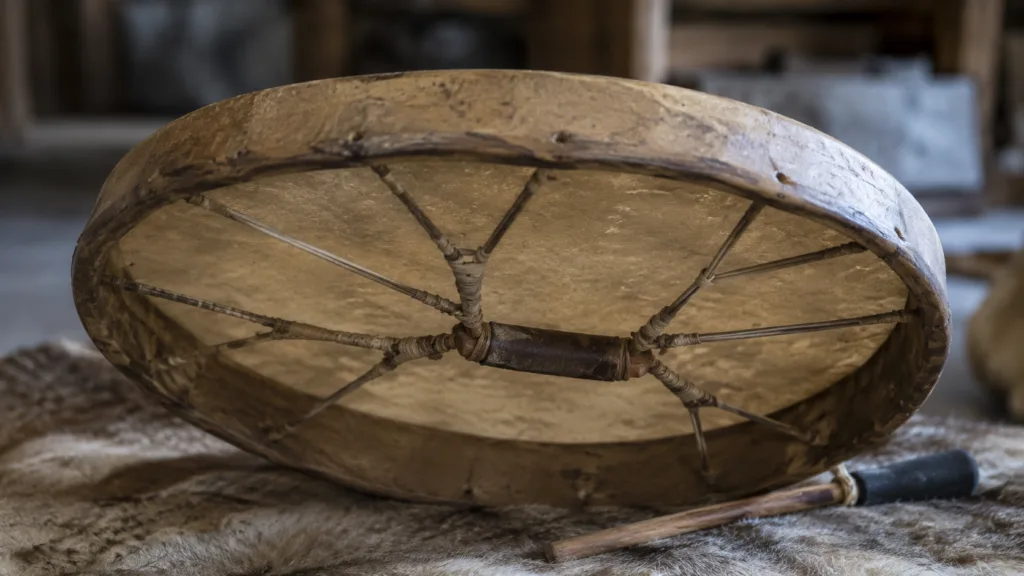
The instrument is a single-headed frame drum with a shallow circular or slightly irregular rim and a projecting handle. Many traditional examples use a bent wooden frame with an animal-skin membrane. Historic objects also show regional use of bone and other locally available materials. Contemporary performers may use cotton, plastic, or other synthetic heads when hide is difficult to obtain, maintain, or transport.
| Part | Typical Form | Effect on Playing and Sound |
|---|---|---|
| Frame | Shallow bent rim, often wood and sometimes bone in historic examples | Produces the hard attack when struck and supports the membrane’s vibration |
| Membrane | Hide or a modern substitute stretched across one side | Adds a low, loose resonance rather than a tightly pitched drum note |
| Handle | Short projection attached to the frame | Lets the performer tilt, swing, lift, and rotate the drum during the dance |
| Beater | Wooden or bone stick, wand, or narrow striker | Contacts the rim and creates a crisp pulse that carries through group singing |
| Outer Membrane Edge | May extend beyond the frame | Can move visibly and adds a soft flutter or changing resonance as the drum turns |
Maker’s Note: Diameter alone does not predict the sound. Frame mass, membrane thickness, tension, humidity, grip pressure, and the point of impact all change the balance between wooden knock, low resonance, and decay.
Why the Rim Is Struck Instead of the Drumhead
One of the instrument’s most distinctive traits is that the beater commonly strikes the frame edge rather than the center of the membrane. The impact gives a direct wooden click or thump, while the skin or modern head responds indirectly. This produces a layered sound: a sharp attack followed by a broader, lower vibration.
Rim striking also suits a moving performance. As the drum is turned or rocked, the player can alternate contact points without aiming at the center of a large flexible head. A relaxed grip allows the frame and membrane to move; gripping too tightly can reduce resonance and make the motion stiff.
The Beater Meets the Frame
A short impact marks the pulse with a dry, woody attack.
The Membrane Responds
Energy travels through the frame and sets the head into a low, less pitch-focused vibration.
Movement Changes the Resonance
Tilting and rotating alter how the sound projects toward the room and how freely the membrane moves.
Voice and Gesture Complete the Phrase
The drum pulse supports sung text and gives the dancer a physical timing surface for motion.
Sound Character and Listening Profile
An Inuit frame drum does not usually sound like a tightly tuned orchestral drum or a modern tom. Its identity comes from the contrast between the hard rim attack and the looser membrane bloom. Large drums can feel broad and physical, while smaller examples may speak faster and project a more compact knock.
The bars below describe common listening tendencies, not laboratory measurements. Individual drums, rooms, membranes, and playing styles vary.
What to Listen For
- The separation between the beater’s wooden impact and the membrane’s lower response
- Small tempo changes that follow the singer’s breath, words, or movement
- Changes in projection as the drum turns toward and away from the listeners
- How gesture illustrates the song rather than serving as decoration
- Audience reactions that show recognition, humor, encouragement, or shared memory
Ritual, Story, and Community Expression
Drum dancing can carry ceremonial meaning, but not every performance is a sacred rite. Inuit repertoires also include social songs, personal songs, humorous scenes, accounts of travel or hunting, and pieces performed for celebration. The same frame drum can serve different roles according to the song, performer, season, and community setting.
Songs can preserve events, family histories, observations, and experiences that remain meaningful because they are performed rather than stored only as text.
Some traditions connect drumming with ceremonial action, healing, hunting luck, or relations with spiritual beings. Such meanings are local and should not be assigned to every drum dance.
Performance may include imitation, teasing, exaggeration, or comic storytelling. Laughter can be part of the social exchange rather than a sign that the event lacks seriousness.
Group practice gives younger performers a way to learn songs, language, timing, gesture, and community history directly from experienced dancers and Elders.
A drum dance often works because the boundary between performer and audience remains porous. One person may lead, but recognition, response, and shared knowledge give the event its social force. The drum’s repeated pulse makes room for memory to become public action.
Regional Variation and Naming
Inuit names a group of related peoples and cultures, not one uniform performance system. Vocabulary, drum size, membrane material, gender roles, dance posture, song form, and ceremonial meaning differ by region. Even the instrument name appears in several spellings, including qilaut and qilaat.
| Region or Context | Common Emphasis | Useful Caution |
|---|---|---|
| Greenland | Drum singing and dancing may combine solo performance, sung narrative, humor, social commentary, and older ceremonial memory | Greenlandic terminology and song forms should not be treated as identical to Canadian Inuit usage |
| Nunavut and Other Eastern Canadian Inuit Regions | Handled frame drums support songs, community events, cultural education, and staged or informal performance | Practice differs among communities; one Nunavut style does not represent all Inuit regions |
| Inuvialuit Settlement Region | Group drumming and dancing carry family memory, seasonal celebration, enacted stories, and revival work led by Elders and community performers | Inuvialuit movement styles and repertories have their own history and should be named accurately |
| Contemporary Urban Inuit Groups | Performance can support language learning, intergenerational connection, public education, and cultural pride away from northern home communities | Stage presentation may be adapted to a venue without losing its connection to community teaching |
What We Know: Greenlandic Inuit drum dancing and singing was added to UNESCO’s Representative List of the Intangible Cultural Heritage of Humanity in 2021. The listing recognizes a living practice, not a museum reconstruction frozen in one historical form.
Interruption, Survival, and Revival
Colonial contact changed drum-dance traditions in uneven ways. Missionary pressure, Christian conversion, settlement policies, residential schooling, language disruption, and the replacement of local entertainment by imported instruments all affected transmission. In some communities the practice continued quietly; in others it became rare or disappeared from public life for a period.
Revival has often depended on Elders who still remembered songs, movements, drum-making methods, and the social rules surrounding performance. Community groups then created spaces for rehearsal, teaching, travel, public presentation, and family participation. The result is not simply recovery of an old artifact. It is a present-tense practice shaped by inherited knowledge and current Inuit life.
Drum dances formed part of winter gatherings, storytelling, celebration, personal song, ceremony, and social exchange, with forms varying by region.
Some communities faced direct discouragement or suppression, while new settlement patterns and imported music altered where and how people gathered.
During the twentieth century, Elders and performers in several regions taught songs and dances to younger generations and rebuilt public performance groups.
Drum dancing appears in homes, schools, community halls, festivals, cultural programs, film, theatre, and touring ensembles, with Inuit artists deciding how it is shared.
Inuit Frame Drum vs a Typical Hand Frame Drum
Usually held by a projecting handle and moved actively through space. The beater commonly strikes the rim, producing a wooden attack with membrane resonance. Song, dance, gesture, and social context are inseparable from the instrument’s identity.
Often held directly by the rim or an internal grip and played mainly on the head. Techniques may include finger strokes, rolls, damping, or stick patterns. Musical function depends on the culture, but the drum may be treated more as accompaniment than as a moving dance object.
Reading a Drum as a Cultural Object
An Inuit drum may be a working musical instrument, a teaching object, a family-made item, a stage instrument, a souvenir, or an older cultural object with ceremonial associations. Appearance alone cannot reveal its status. A plain modern drum made for community use may hold more living meaning than an ornate object produced for sale.
Collector’s Note: Ask who made the drum, where it was made, what materials were used, whether it was intended for performance or sale, and whether the maker permits public display or playing. Marine-mammal materials and older cultural objects may also involve transport, ownership, or trade restrictions that require careful verification.
Inspection Points for a Playable Drum
- The frame should not show fresh splits, loose joints, or severe twisting
- The handle should feel secure without forcing the hand into a rigid grip
- The membrane should be attached evenly, with no active tearing around the rim
- The beater should match the frame and should not have a sharp edge that cuts the head
- The drum should respond when held loosely; a dead sound may come from damage, excess tension, or unsuitable humidity
- Provenance and maker information should be recorded rather than guessed from visual style
Care, Storage, and Respectful Handling
Hide-headed drums react to humidity and temperature. Dry air can shrink and tighten a membrane, while damp air can loosen it. Rapid shifts place stress on the attachment points and frame. Synthetic or cloth heads are often more stable, but the wooden structure can still warp or crack.
Keep the drum in a stable indoor environment, away from radiators, direct sun, damp basements, and hot vehicles.
Use a clean, soft, dry cloth. Do not apply household polish, leather conditioner, oil, or water unless the maker or a conservator has approved it.
Inspect the rim, handle, membrane edge, and beater before use. Stop if a split opens, the handle moves, or the membrane begins to tear.
Do not assume every drum may be played, photographed, copied, or displayed without permission. Ask the owner, maker, performer, or community representative.
Care Warning: Do not force a loose hide head toward a heat source. Fast heating can create uneven tension, brittle edges, and frame distortion. Slow environmental adjustment is safer than improvised tightening.
Mini FAQ
What is the Inuit frame drum called?
Qilaut is common in Inuktitut, while qilaat is used in Greenlandic. Spelling and related terms vary across Inuit languages and dialects.
Is the drumhead struck directly?
Often the beater strikes the rim rather than the center of the head. The frame supplies the sharp attack, and the membrane adds a lower resonant response.
Is every Inuit drum dance a ritual?
No. Some performances have ceremonial or spiritual associations, while others center on storytelling, humor, celebration, personal experience, community gathering, or public cultural education.
Who performs Inuit drum dancing today?
Women, men, and children perform in many present-day groups. Historical roles differed by region, and local customs remain more useful than broad rules about gender.
Why does the dancer move the drum?
Movement shapes projection, timing, visual expression, and the relationship between rhythm and gesture. The drum functions as both sound source and moving performance object.
Can an old Inuit drum be played?
Not automatically. Age, condition, ownership history, cultural status, and the wishes of the maker or community all matter. A conservator and an appropriate cultural authority should be consulted before playing an older object.