
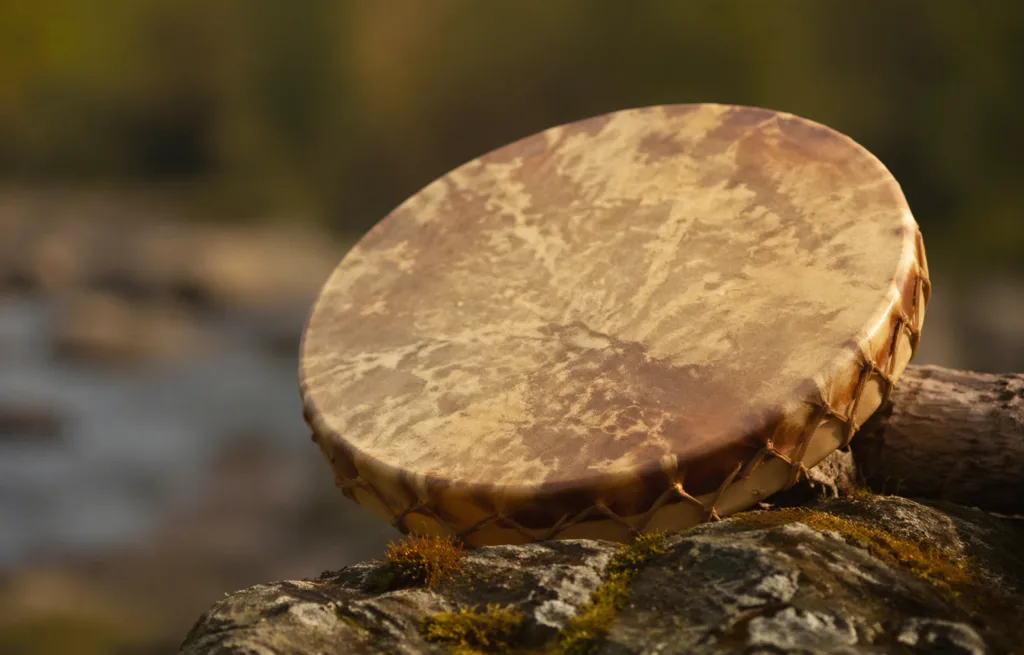
No single Native American frame drum exists. The label is useful, but only up to a point. A Plains hand drum, a Lakota square hand drum, a Yup’ik hand drum with its long handle, and a Cherokee water drum do not share one fixed design language, one fixed sound, or one fixed setting. They belong to different communities, different performance habits, and different ways of holding rhythm in the body.
That matters musically. It also matters culturally. Many short articles flatten these drums into one pan-Native object, then drift into vague spiritual language. The better approach is simpler: look at the nation-specific build, listen for the voice of the head and frame, and keep in view that many songs and ceremonial uses are community-held, not fully public.
Forms Commonly Grouped Under This Label
| Form | Typical Build | What The Ear Hears | Context |
|---|---|---|---|
| Plains Hand Drum | Bent wood hoop, rawhide head, laced back | Round pulse, direct attack, strong center tone | Song, dance, intertribal and community use |
| Lakota Square Hand Drum | Hide, wood, paint, sometimes horn elements | Firm, focused strike with strong visual identity | Historic Plains use and symbolic display |
| Yup’ik Hand Drum | Ring form with long handle; gut or similar membrane | Light, quick response, crisp edge articulation | Dance song and regional performance traditions |
| Cherokee Water Drum | Wooden body with skin head and water inside | More contained, rounded, tuned-by-water feel | A nearby relative, but not a frame drum in the strict sense |
🥁 What The Name Covers and What It Misses
- Frame drum points to a shallow drum with a head stretched over a frame rather than a deep shell.
- Native American is a wide umbrella, not a single style mark.
- Tradition sits in construction, song use, handling, community meaning, and local teaching.
The first thing to clear away is the museum-shop idea of a universal “tribal drum.” There is no such neat category. Some Native drums are round and open-backed. Some are square. Some use a handle. Some rely on water inside the body rather than a shallow frame. Even when two drums look close from a distance, their touch response can differ sharply once the beater lands.
And that is where good organology begins: not with a slogan, but with build.
🪶 Materials, Build, and The Shape of The Voice
- Head Material: rawhide, skin, or gut-based membrane depending on region and maker
- Frame Material: bent wood hoop or carved ring
- Lacing: back-laced, stitched, or tied depending on form
- Beater Contact: soft mallet, wrapped stick, or light striking method tied to local practice
A frame drum tells the truth fast. Strike it once and the drum reveals how tight the head sits, how stiff the frame is, how much air it keeps moving, and how much of the note lives in the center versus the rim. Timbre is not one trait here. It is the sum of membrane thickness, hoop rigidity, head tension, humidity, and the style of stroke.
How The Head Changes The Sound
A thinner rawhide head usually answers faster. The note rises more quickly, upper overtones show earlier, and the stick feels less delayed under the hand. A thicker head tends to slow the attack, darken the center tone, and give the drum a denser, woodsmoke-like weight. Not louder, exactly. More grounded.
Humidity matters too. A rawhide head can loosen in damp air and tighten in dry air, which shifts both pitch and surface feel. That small change is part of the instrument’s life, not a flaw.
How The Frame Changes The Feel
The frame does more than hold the head. It decides how the instrument sits in the hand and how the strike travels through the rim. A lighter hoop can feel quick and open. A stiffer or heavier rim often gives the player a firmer rebound and a cleaner edge between one beat and the next. On some historic examples, the frame is visually quiet and the membrane does most of the talking. On others, painted surfaces, horn details, or the handle itself become part of the instrument’s identity before a note is even heard.
Pro Tip
When reading an older hand drum, inspect the head before the paint. Uneven translucency, hardened edges, repaired lacing, and a head that has gone glassy with age will tell more about the present voice of the instrument than surface decoration alone.
🎵 Sound, Pulse, and Playing Feel
- Center Strike: fuller body, stronger fundamental
- Near-Rim Strike: quicker attack, drier edge
- Soft Beater: rounder contact, less click
- Firm Beater: clearer definition, more surface detail
In many Native traditions, the drum is not treated as a solo object detached from the voice. The song and the beat belong together. That old distinction matters: in several Plains contexts, the people around the drum are thought of first as singers, not merely drummers. The drum does not decorate the song. It carries it.
That changes how the ear should listen. The finest examples are not always those with the most ring or the longest sustain. Often, the best drum for a song is the one that supports a stable pulse, leaves space for voices, and keeps the rhythm legible even when the group lifts in volume.
Short note. Clear center. No wasted motion.
Ceremony, Social Dance, and Respectful Limits
- Some drum uses are public and intertribal.
- Some belong to a specific nation, season, society, or ceremony.
- Some songs are taught openly; others are not.
This is where many articles lose their footing. They treat all Native drumming as either public performance or vague ritual. Neither is accurate. There are social dances, public gatherings, powwow settings, family events, staged cultural presentations, and ceremonial contexts that do not invite full outside explanation. A careful article should not pretend those boundaries do not exist.
So the most honest reading is this: the Native American frame drum is both a musical tool and a cultural carrier, but its exact role changes from one community to another. That difference is not a side note. It is the point.
How History Stays Audible
- Museum collections preserve historic drums with local material details.
- Early sound archives captured Native songs and drum-linked performance practice.
- Present-day drum groups keep the tradition alive as a living practice, not a closed chapter.
For older instruments, history does not survive only in wood and hide. It survives in recordings, remembered repertories, family teaching, and public performance. Early twentieth-century archives preserved many Native songs, and those holdings still matter because communities have used recordings and archival materials in cultural teaching and renewal work. An antique drum behind glass may show build. A sung tradition shows motion, tempo, emphasis, breath, and community memory.
That is why a purely collector-style reading falls short. The object is real, yes. The living line around it is just as real.
Regional Traditions That Change The Instrument
Plains Hand Drums
Plains-related hand drums are often what many listeners picture first: a circular wood hoop, a skin head, and back lacing that also helps the hand grip and balance the drum. Their sound tends to favor a steady, legible pulse rather than flashy tonal play. In group use, that directness helps the beat stay centered under the singers.
Yup’ik Hand Drums
Yup’ik hand drums shift the silhouette at once. The handle changes the mechanics of holding and striking, and the membrane choice can produce a lighter, quicker response than many heavier rawhide examples farther south. The result is not just a new timbre. It is a new body relationship between dancer, singer, and instrument.
Square Plains Forms
Square Lakota hand drums make the point even more clearly: shape itself can carry meaning. Their painted surfaces and added features can give the instrument a strong symbolic face before the first beat lands. Acoustically, the corners and visual geometry also alter how the player reads the instrument, even when the central membrane field remains the main speaking surface.
Vs. Nearby Instruments and Modern Versions
Native American Frame Drum Vs. Cherokee Water Drum
- Frame Drum: shallow, open or lightly built around a frame; sound depends heavily on head tension and strike point
- Water Drum: enclosed body with water inside; pitch and feel can shift with water level and internal response
- Playing Result: the frame drum speaks with more surface openness, while the water drum often sounds more concentrated and rounded
These two are often lumped together by non-specialists because both are Native drums and both may appear in ceremonial settings. But their acoustic logic is different. The frame drum breathes through a shallow membrane-and-rim design. The water drum works with an inner chamber, which changes resonance from the inside out.
Native American Frame Drum Vs. Modern Tunable Frame Drum
- Traditional Rawhide Drum: weather-sensitive, touch-responsive, visually organic
- Modern Tunable Drum: more stable across climate shifts, easier pitch control, often more standardized in feel
- Trade-Off: convenience rises, but the surface character and tactile irregularity can change
A modern synthetic-head frame drum can be practical, especially for travel or stage consistency. But a rawhide Native hand drum offers a different sort of response. The head has grain, the strike has drag, and the note carries tiny variations that a machine-even membrane often smooths out. Cleaner, perhaps. Less alive, sometimes.
Round Hand Drum Vs. Square Hand Drum
- Round Form: even visual symmetry, familiar rebound, widely seen across many traditions
- Square Form: stronger graphic identity, different handling cues, tighter visual framing of the membrane field
- Player Experience: the ear still follows the head, but the hand and eye read the object differently
That difference may seem minor until the drum is held. Then it becomes obvious. Shape changes not just appearance but orientation, balance, and the way a player locates the striking zone without looking down for long.
🏛️ What Collectors and Careful Buyers Should Notice
- Provenance: nation, region, maker, date, and use history matter more than generic labels
- Head Condition: check brittleness, clouding, edge separation, and past repairs
- Frame Integrity: look for warping, shrinkage cracks, or later reinforcement
- Lacing Logic: original pattern and wear often tell whether the drum was played often or rebuilt later
- Surface Work: paint and ornament should be read with care, not treated as automatic proof of age
Age alone does not make a better drum. That idea misleads collectors again and again. Some older examples have tired heads and weak response. Some contemporary drums, made within community practice and built for actual singing or dance, carry more musical life than a century-old object that now functions mainly as a document.
Collector’s Note
The most trustworthy description is rarely “old Native drum.” A better description names the people, place, build, and use. When those details are missing, caution is part of good collecting.
Why The Instrument Still Feels Current
Because it is current. Native drum traditions are not frozen in museum time. Intertribal drum groups, community singers, dancers, teachers, and makers continue to carry them forward. Some forms stay close to older build habits. Others adapt to travel, stage conditions, teaching needs, or new generations of players. The line holds, even when the surface changes.
And that may be the finest way to hear this instrument: not as a relic, not as a vague symbol, but as a working body of sound shaped by hand, memory, song, and local practice.
FAQ
Is It Hard To Learn a Native American Frame Drum?
Show Answer
Basic pulse is not hard to start, but style matters. The real challenge is not simply striking the head. It is learning how a specific community places the beat under the song, how the drum supports voices, and how the instrument is held and approached in that tradition.
How Do I Know if a Drum Is Traditional or Just Native-Inspired?
Show Answer
Start with provenance. A solid description should name the nation or community, the maker when known, the place, the materials, and the use context. Generic labels, vague “spirit drum” language, or decorative features without local detail usually call for more caution.
Why Does Rawhide Sound Different From a Synthetic Head?
Show Answer
Rawhide usually gives more surface variation, a less uniform attack, and a stronger reaction to weather. Synthetic heads tend to be steadier and easier to manage across changing humidity, but they often smooth out some of the tactile grain and tonal irregularity that players value in natural hide.
What Size Should I Choose if I Want a More Traditional Feel?
Show Answer
There is no single traditional size for all Native American frame drums. The better question is which community style you want to study. Larger heads usually lean lower and broader in response, while smaller drums often react faster and feel easier to control with one hand.