
Instrument Snapshot
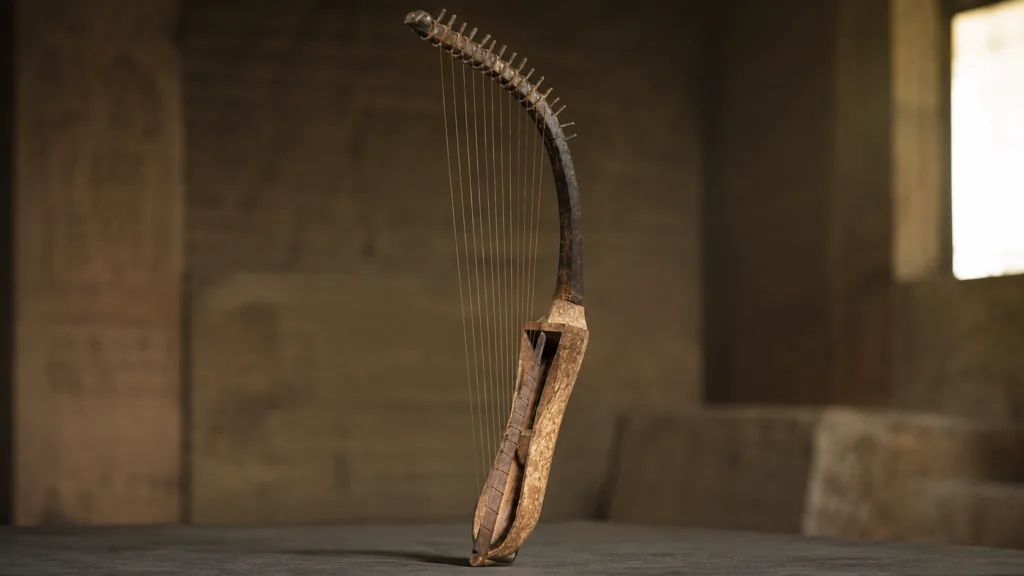
The ancient Egyptian arched harp was an open, pillarless harp whose curved neck rose directly from a hollow soundbox. It appears in Egyptian art from the Old Kingdom onward and became one of the most recognizable instruments in tomb banquets, funerary performances, temple service, and festival ensembles.
The arched harp, often called a bow harp, is defined by the continuous curve between its soundbox and neck. Its strings run from that curved neck to a rod or anchoring system associated with the soundbox. Unlike a modern pedal harp, it has no front pillar completing a triangular frame. That open construction gives the instrument its distinctive silhouette but also limits how much string tension the frame can safely carry.
Ancient Egyptian texts and modern catalogues use several spellings for the instrument’s name, commonly rendered as benet or bnt. The term does not point to one fixed model. Egyptian harp makers produced short shovel-shaped forms, deeper ladle-shaped instruments, boat-like shoulder harps, and large harps that stood beside a seated or kneeling player.
Its history is known through two kinds of evidence: surviving wooden instruments and images made for tombs, temples, stelae, statues, models, and papyri. The objects reveal joints, peg holes, skin coverings, painted surfaces, and decorative schemes. The images reveal posture, ensemble placement, gender, costume, ritual setting, and the social meaning assigned to musical performance. Neither source preserves the full sound of the instrument, so reconstructions must separate measured evidence from informed experiment.
Why the Harp Is So Visible in Egyptian Art
The harp suited Egyptian visual composition. Its long curve framed the musician’s body, while its strings created a field of parallel lines that remained readable even in a crowded register. A seated harper could fill a compact area beneath offering tables or beside banquet guests. A tall harp could mark the front of an ensemble and direct the viewer’s eye toward singers, dancers, or ritual participants.
Its presence also carried meaning beyond entertainment. In tomb chapels, music helped construct an ideal life of food, perfume, companionship, festival attendance, and continued remembrance. In funerary scenes, a harper could accompany words addressed to the deceased. In temple and festival imagery, the instrument joined singing, clapping, pipes, lutes, lyres, sistra, and rattles as part of organized ceremonial sound.
What the Evidence Can and Cannot Tell Us: Wall paintings show who played, where the instrument was placed, and how it was held. They do not preserve pitch, tuning intervals, tempo, string material, or the exact relationship between every painted string and the playable instrument.
Anatomy and Build
Egyptian arched harps were lightly built chordophones. A hollow soundbox amplified the vibration of the strings, while a stretched skin covered an open face on many surviving examples. The curved neck carried pegs or holes used to secure and tension the strings. Some instruments were carved from several joined pieces; others used a central structural element with side pieces fitted around it.
| Part | Typical Form | Musical or Archaeological Value |
|---|---|---|
| Soundbox | Shovel-, ladle-, spoon-, or boat-shaped wooden cavity | Its volume and wall thickness affected resonance, projection, and weight. |
| Soundboard | Animal skin stretched across an open face | Skin can give a quick response and a dry, focused decay, though ancient examples are often incomplete. |
| Curved Neck | Long wooden arc continuing above the soundbox | Its shape defines the arched harp and bears the pull of the strings without a forepillar. |
| String Pegs or Holes | Drilled positions along the neck | These offer firmer evidence for string count than painted lines alone. |
| Suspension Rod | Rod or anchoring element near the soundbox | It organized the lower string ends and distributed tension across the covered body. |
| Surface Finish | Plaster, paint, inlay, bone, ivory, or glazed composition | Decoration can connect an instrument with elite display, divine imagery, or royal ideology. |
Strings and Tension
The strings are usually the least secure part of a reconstruction because organic material rarely survives in playable condition. Gut, plant fiber, and other organic cords are plausible in different contexts, but a specific material should not be assigned to an instrument unless its archaeological record supports it. Modern nylon or fluorocarbon can make a replica stable, yet it changes the relationship between tension, attack, and decay.
Older arched harps often carried only a small set of strings. Later Egyptian makers developed instruments with more strings and a wider visual span. More strings did not automatically mean a modern scale or chromatic system. Without tuning notation, the pitch layout remains open to several practical solutions.
A History Shaped by Changing Forms
Arched harps appear in mastaba scenes at sites such as Saqqara and Giza. The familiar early form has a shallow shovel-like soundbox, a thick curved neck, and a small number of strings. Male musicians are often shown seated or kneeling near singers and wind players.
The instrument remains prominent while body shapes become more varied. Surviving bow harps and images show deeper spoon- or ladle-like soundboxes, usually with a limited string set. Figurines and tomb scenes also show women playing harps.
Surviving wooden instruments provide direct evidence for hollow soundboxes, skin coverings, curved necks, and peg systems. The harp continues as a leading accompaniment instrument while Egypt’s musical scene expands.
Harp iconography becomes especially varied. Small shoulder harps, boat-shaped portable harps, large floor harps, and highly decorated examples appear beside lutes, lyres, pipes, singers, dancers, and percussion. Banquet and festival scenes place both male and female harpers in carefully arranged ensembles.
Harp imagery continues, though forms and contexts shift. Arched harps coexist with angular harps and other imported or adapted chordophones, showing that Egyptian musical culture was not isolated from neighboring regions.
From Arched Harps to Angular Harps: Saqqara’s Tomb of the Harps
A 2026 account of the Saqqara find brought renewed attention to a Nineteenth Dynasty burial known as the Tomb of the Harps. More than 100 string instruments are known from New Kingdom tombs, while this burial preserved fragments of four cedar angular harps of different sizes together with hand-shaped wooden castanets.
The find makes the shift from arched to angular harp construction easier to see. In an arched harp, the neck continues from the resonator in a bow-like curve. In an angular harp, the neck and soundbox meet at a clear angle. That geometry can accommodate many more strings than the older arched form, allowing a broader musical range.
The four differently sized angular harps show that this later design was not limited to a single standardized format. Their presence in one Saqqara burial, alongside castanets, adds direct archaeological evidence for the wider variety of string instruments used in New Kingdom Egypt.
How to Read an Arched Harp in Egyptian Iconography
A harp scene is not a technical drawing. Egyptian artists arranged bodies, objects, and inscriptions according to visual order, social rank, available wall space, and the purpose of the monument. A useful reading therefore begins with the entire scene rather than the instrument alone.
Identify the Setting
Offering tables, banquet guests, perfume cones, lotus flowers, dancers, priests, deities, and processional objects can distinguish a domestic-looking feast from a temple rite or funerary performance.
Observe the Player’s Posture
A musician may sit cross-legged, kneel, stand, carry a shoulder harp, or lean toward a tall floor harp. Posture helps estimate the instrument’s real scale and likely portability.
Check the Hands
Both hands often approach different parts of the string field. This supports finger-plucking and register division, but a frozen image cannot reveal a complete technique or rhythmic pattern.
Read the Ensemble
A harp beside a singer suggests melodic or vocal support. A harp leading lutes, pipes, and dancers points to a larger entertainment or festival group. Clappers and sistra add rhythmic or ritual meaning.
Look for Text
Captions, titles, and song inscriptions can identify a performer, employer, deity, festival, or funerary theme. Text is more reliable than guessing from costume alone.
Why Painted String Counts Need Caution
Artists sometimes simplified thin strings, adjusted spacing, or omitted lines that would make a small figure unreadable. A painting may show fewer strings than the instrument once carried, while a decorative model may exaggerate string spacing. Peg holes, attachment points, and surviving suspension rods usually provide stronger evidence for a specific object.
Banquets, Tomb Chapels, and the Blind Harper
New Kingdom banquet scenes offer some of the best-known harp images. In the tomb of Nakht at Thebes, a male harper performs near seated guests in a scene dated to the Eighteenth Dynasty. His closed or unseeing eye has led to his identification as a blind musician. The scene combines music with food, drink, fragrance, dress, and social memory, all presented as part of the tomb owner’s desired existence.
Blindness became closely associated with Egyptian harpers in modern writing, but the label should not be applied to every seated male musician. Some images clearly emphasize impaired sight; others use profile conventions, damage, or reduced facial detail that cannot support a medical reading. Blind musicians may have held real professional roles, yet the motif also carried visual and literary associations that extended beyond biography.
Common Confusion: “The Harper’s Song” is not one fixed composition, and not every tomb harper is blind. The name covers a group of funerary or reflective texts linked with harp performance. Their attitudes range from confidence in mortuary tradition to reminders that the living should enjoy the present.
Harper’s Songs and Funerary Thought
Harper’s Songs are known from tomb inscriptions and literary copies. Their placement beside a musician gives poetry a performed setting rather than presenting it as silent text. Some songs praise the deceased and the durability of burial rites. Others question how much the living can know about death and urge enjoyment of food, fragrance, music, and celebration.
This tension is one reason the harper became such a memorable funerary figure. He could voice continuity with tradition while also speaking from the fragile position of the living. The instrument’s image therefore belongs to both music history and the study of Egyptian ideas about memory, mortality, and commemoration.
Women, Men, and Musical Roles
Egyptian harp iconography does not assign the instrument to one gender. Old Kingdom ensembles often feature male musicians, while New Kingdom banquet and processional scenes frequently show women playing portable harps alongside lutes, lyres, pipes, and percussion. Female musicians may appear richly dressed, lightly clothed, or nude except for jewelry, depending on the scene’s period, setting, and artistic convention.
Costume should not be read as a simple record of everyday performance clothing. In elite tomb art, youth, beauty, jewelry, wigs, and bodily display helped shape an ideal festival atmosphere. In temple-linked contexts, titles and inscriptions may connect women with divine cults, especially as singers or players of ritual percussion. A harp in the same ensemble does not automatically carry the same cultic function as a sistrum.
Men are shown as seated accompanists, professional performers, temple personnel, and funerary singers. One Eighteenth Dynasty monument identifies Amenemheb as a “harpist of Amun,” showing that harp performance could be attached to temple office rather than treated only as banquet entertainment.
Portable, Floor-Standing, and Decorated Harps
| Form | Visual Traits | Typical Playing Position | Iconographic Use |
|---|---|---|---|
| Shovel or Spade Harp | Shallow pointed soundbox with a thick rising curve | Seated or kneeling, held close to the body | Common in early tomb ensembles and offering scenes |
| Ladle or Spoon Harp | Rounded hollow body with a long curved neck | Resting on the ground or against the player | Middle Kingdom and later funerary or musical scenes |
| Naviform Shoulder Harp | Portable boat-shaped soundbox and compact arc | Carried against the shoulder or torso | New Kingdom processions and female ensembles |
| Tall Floor Harp | Large body and high string field beside the performer | Played seated, kneeling, or standing nearby | Banquets, elite display, and large musical groups |
| Ceremonially Decorated Harp | Paint, inlay, carved heads, divine or captive imagery | Depends on the underlying harp form | Elite ownership, political symbolism, or ritual display |
Decoration as Political and Religious Language
Decoration could transform a musical tool into a statement about order and power. A surviving New Kingdom shoulder harp has a carved Nubian captive at the end of its frame, positioned so that the strings appear to bind the figure. The motif adapts the Egyptian image of defeated foreign peoples to an instrument used in ceremony and display. It should not be treated as standard decoration on all harps.
Other examples use royal crowns, falcon heads, lotus patterns, colored plaster, bone strips, ivory, and glazed inlay. These details may refer to kingship, deities, rebirth, foreign tribute, or elite taste. Their meanings depend on the complete object and its archaeological setting; a carved head alone does not identify the music that was played.
Sound, Technique, and the Limits of Reconstruction
No playable pharaonic harp survives with a documented original tuning. The most defensible sound experiments begin with the body dimensions, soundboard material, peg positions, string lengths, and estimated structural tolerance of a specific museum object. Even then, the choice of string material and tension can alter the result sharply.
A skin-covered soundbox is likely to respond quickly and produce a more focused, less lingering resonance than a heavy modern wooden soundboard. A small five-string bow harp may offer a narrow pitch set suited to vocal support, repeated patterns, or melodic fragments. A larger New Kingdom harp with many strings allows a broader register, but it still lacks the pedals, levers, and high-tension frame of a concert harp.
Images show plucking with the fingers of both hands. They do not confirm a single fingering system, scale, or division between melody and accompaniment. Players may have tuned for a singer, a ritual piece, or the range of an ensemble rather than to a universal standard.
What a Responsible Replica Should State
- The museum object, relief, or painting used as the model
- Which dimensions are measured and which are estimated
- The chosen string material and why it was selected
- The number of strings supported by physical evidence
- The tuning system used for performance
- Which decorative details are copied, restored, or newly designed
Arched Harp vs Angular Harp, Lyre, and Lute
A curved neck rises directly from the resonator. The frame remains open, with no front pillar. Strings are plucked without stopping them against a fingerboard.
The neck and soundbox meet at a clear angle rather than forming one bow-like curve. Angular forms appear beside arched harps in later Egyptian musical culture.
Two arms support a crossbar or yoke. The strings span between that yoke and a soundbox, creating a different outline and tension path.
A neck extends from the body, and the player changes pitch by stopping strings along the neck. New Kingdom images often place lutes and harps in the same ensemble.
Mini FAQ
When did the arched harp appear in ancient Egypt?
Secure tomb depictions are known from the Old Kingdom in the third millennium BCE. The instrument was already developed by that point, but claims for an earlier Egyptian origin depend on less direct evidence.
Why is it called an arched harp?
The neck forms a continuous curve above the soundbox. Modern instrument classification distinguishes this arched structure from an angular harp, where the neck and body meet at a sharper angle.
Did ancient Egyptian harps have a front pillar?
No. They were open harps. The absence of a forepillar separates them from the rigid triangular frame of many later European harps.
Were all ancient Egyptian harpers blind?
No. Blind male harpers form a famous tomb motif, but Egyptian art also shows sighted men and women playing harps in banquets, festivals, processions, and temple-linked settings.
How many strings did an Egyptian arched harp have?
There was no single number. Early and small surviving forms may have four or five strings, while later harps could carry many more. Peg holes and attachment points are safer evidence than counting every line in a painting.
Can the original music be reconstructed?
The instrument’s physical behavior can be explored through replicas, but exact melodies, tuning intervals, string materials, and performance practice remain uncertain. A reconstruction is an evidence-based interpretation, not a recovered recording of pharaonic sound.