
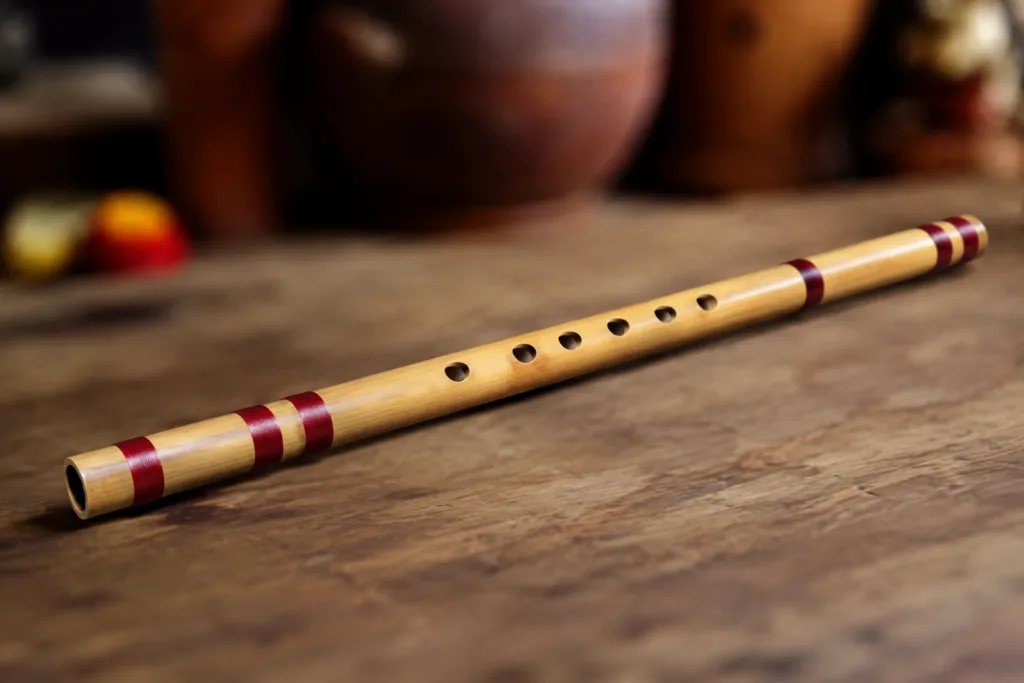
Instrument Snapshot
The bansuri is a side-blown bamboo flute from the Indian subcontinent, heard in Hindustani classical music, devotional song, folk traditions, and film music. Its sound is shaped by breath, finger control, bamboo density, and raga phrasing rather than keys or mechanical parts.
What the Bansuri Is
The bansuri is a simple-looking flute with a demanding musical voice. It is made from a hollow length of bamboo, with one blowing hole and usually six or seven finger holes. The player blows across the side opening, and the air column inside the bamboo tube vibrates to create pitch.
Unlike the modern Western concert flute, the bansuri has no keys, pads, metal body, or headjoint mechanism. Its intonation depends on the maker’s hole placement, the bamboo’s internal shape, and the player’s breath angle. This gives the instrument a direct connection between hand, breath, and note.
In Indian classical music, the bansuri is not only a folk flute. It is a concert instrument capable of slow raga development, ornamented phrases, fast runs, and subtle pitch bends. In folk and devotional settings, it keeps a more direct melodic role, often carrying songs, dances, pastoral themes, and regional tunes.
Anatomy and Build
A bansuri has few visible parts, but small differences in each part change the playing feel. The bore, wall thickness, hole spacing, and bamboo maturity affect tuning stability, resistance, projection, and tonal color.
| Part | What It Does | Why It Matters |
|---|---|---|
| Bamboo body | Forms the resonating air column. | Density, bore shape, and wall thickness affect warmth, response, and pitch steadiness. |
| Blowing hole | Receives the player’s air stream. | Its cut and position shape attack, volume, and ease of tone production. |
| Finger holes | Change the effective length of the air column. | Hole size and spacing control tuning, reach, and ornamentation. |
| Seventh hole | Appears on many concert-style bansuris. | Can extend pitch options and support certain classical phrasing needs. |
| Thread binding | Reinforces sections of bamboo on some instruments. | Helps reduce cracking risk and can give grip without changing the flute into a mechanical instrument. |
Materials and Sound Character
The bansuri’s main material is bamboo, but “bamboo flute” does not mean every instrument behaves the same way. Mature, even-walled bamboo tends to produce a steadier tone. Thin or uneven bamboo can respond quickly but may feel less stable in pitch.
The inner bore matters as much as the outer finish. A straight, clean bore helps the note speak clearly. Natural irregularities can add grain to the tone, but too much unevenness may make certain notes weak or difficult to tune.
| Feature | Typical Effect | Player Experience |
|---|---|---|
| Larger flute size | Lower, deeper, rounder tone. | More stretch between holes and more breath support needed. |
| Smaller flute size | Brighter, quicker, more penetrating sound. | Easier finger reach, but high notes can feel sharper. |
| Thicker bamboo wall | More focused tone with controlled resonance. | Can feel slightly more resistant under the breath. |
| Thin bamboo wall | Fast response with a lighter tone. | May feel easy at first but less settled in strong playing. |
| Well-cut blowing edge | Clean attack and stable note center. | Helps beginners produce sound with less wasted air. |
How It Produces Sound
The bansuri produces sound when the player directs air across the blowing hole. Part of the air enters the flute, and part of it breaks against the far edge of the hole. This split air stream sets the air column inside the bamboo into vibration.
Opening and closing the finger holes changes the vibrating length of the tube. A longer air column gives lower notes; a shorter one gives higher notes. The player can also change register by increasing breath speed and adjusting the air angle.
Breath Angle
A slight change in air direction can move the tone from airy and soft to focused and clear. This is one reason the bansuri responds strongly to small embouchure adjustments.
Finger Coverage
Because there are no keys, the fingers must seal the holes directly. Even a small leak can make a note weak, sharp, flat, or unstable.
Ornament Control
Slides, half-holes, quick taps, and curved finger movements create phrases that can resemble the movement of the human voice.
Playing Feel and Technique
The bansuri rewards breath control more than force. A strong player does not simply blow harder; they control pressure, angle, and note color. Low notes need a relaxed air stream, while upper notes need faster air and steadier support.
Indian classical bansuri playing often uses ornaments such as meend, gamak, murki, and fast finger articulations. These techniques help the flute follow raga phrases without sounding stiff or overly mechanical.
Player Tip: On a bansuri, clean tone begins with a stable blowing angle and fully covered holes. Speed should come after the low notes speak clearly and evenly.
These tone bars describe common listening impressions, not laboratory measurements.
Traditional Use and Musical Context
The bansuri is strongly linked with North Indian classical music, especially Hindustani performance. In that setting, it can present a raga through slow melodic expansion, ornamented movement, and rhythmic interaction with tabla or other accompaniment.
The instrument also has deep folk and devotional associations. In many Indian traditions, the flute is connected with pastoral imagery and with Krishna, whose iconography often includes a flute. Folk bansuris may be smaller, brighter, and more direct than large concert flutes.
Modern bansuri appears in classical concerts, film scores, fusion projects, meditation music, and global acoustic recordings. In each setting, its identity remains tied to bamboo tone and breath-shaped melody.
Bansuri, Venu, and Western Flute
The bansuri is often compared with other flutes, but the differences are not only geographic. The playing system, materials, pitch handling, and musical phrasing all shape how each flute behaves.
A North Indian bamboo transverse flute, often used in Hindustani classical music and folk traditions. It is valued for warm tone, flexible pitch, and vocal-like slides.
A South Indian bamboo flute associated with Carnatic music. It shares a bamboo body and side-blown design, but its playing system and repertoire follow a different classical tradition.
A metal keyed flute designed for chromatic precision, projection, and orchestral use. It offers mechanical reach and a brighter, more polished tone than most bamboo flutes.
Buying or Collector Notes
A good bansuri should not be judged by polish alone. Playability depends on tuning, hole comfort, bamboo quality, and how evenly the notes respond across registers. A beautiful-looking flute can still be difficult to play if the hole spacing is awkward or the blowing hole is poorly cut.
Choose a pitch and size that your hands can cover comfortably. A very low bansuri may sound appealing, but wide finger spacing can slow early progress.
Look for stable tuning, even response, and a teacher-recommended pitch. Many students begin with a middle-range flute before moving to larger concert sizes.
Inspect cracks, repairs, bore cleanliness, maker marks if present, and whether the instrument is playable or mainly decorative.
Collector’s Note: Older bamboo is not automatically better. Condition, tuning, response, and crack stability matter more than age alone.
Care and Storage
Bamboo reacts to dryness, heat, and sudden humidity changes. A bansuri should be stored away from direct sun, heaters, damp walls, and closed cars. After playing, moisture near the blowing hole and inner bore should be allowed to dry naturally.
- Keep the flute in a padded sleeve or case when not in use.
- Avoid sudden movement from cold outdoor air to hot indoor air.
- Do not soak the bamboo or use harsh cleaning chemicals.
- Check thread binding and small hairline cracks before they spread.
- Let the flute dry after long playing sessions before sealing it in a case.
Care Warning: Cracks often begin when bamboo dries too quickly or is exposed to sharp temperature changes. Repair can help in some cases, but prevention is safer for tone and tuning.
Common Myths
A bansuri is easy because it has no keys.
The simple build leaves more responsibility to the player. Breath angle, hole coverage, and pitch control require careful practice.
Any bamboo flute can be used for Indian classical music.
A concert bansuri needs reliable tuning, suitable hole spacing, and enough tonal control for raga phrasing.
Mini FAQ
Is the bansuri the same as a bamboo flute?
It is a bamboo flute, but not every bamboo flute is a bansuri. The name usually refers to the Indian side-blown flute used in classical, folk, and devotional music.
How many holes does a bansuri have?
Many traditional bansuris have six finger holes, while many concert-style instruments use seven. The exact layout can vary by maker and musical need.
Is the bansuri hard to learn?
The first challenge is producing a stable tone. After that, clean hole coverage, breath control, and ornamentation become the main learning areas.
What pitch should a beginner choose?
A middle-range bansuri is often easier than a very low one because the finger holes are closer together. The best choice also depends on hand size and teacher preference.
Can the bansuri play Western music?
It can play many melodies, but chromatic passages may require half-holing and careful pitch control. It is not as mechanically chromatic as a keyed Western concert flute.