
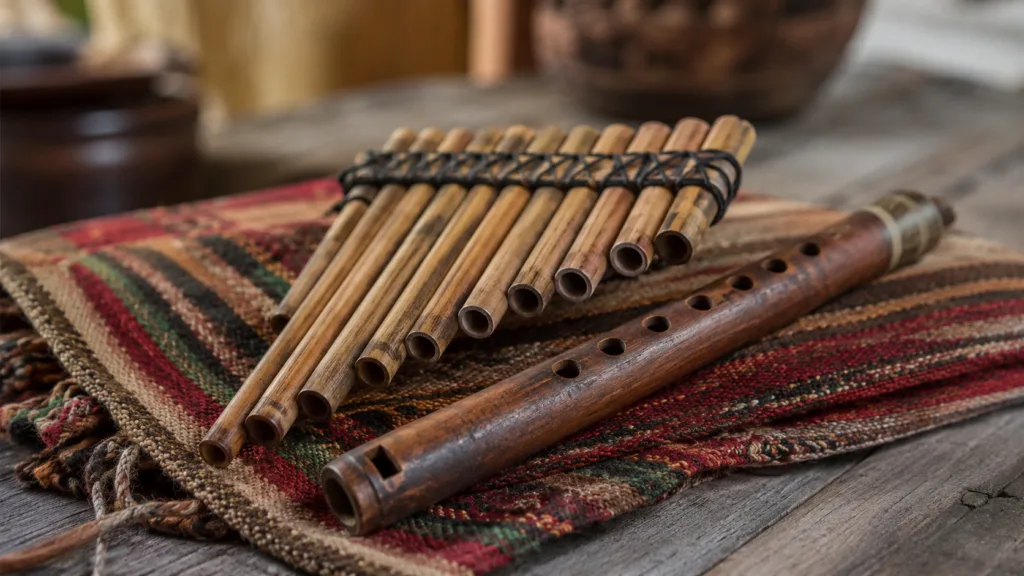
Siku vs Quena: Andean Panpipe and Notched Flute
The siku and quena are two of the most recognizable Andean wind instruments, but they work in different ways. The siku is a panpipe made from tuned tubes, while the quena is an end-blown notched flute with finger holes. Together, they define much of the breathy, open-air sound associated with Andean music from Peru, Bolivia, Ecuador, northern Chile, and nearby highland regions.
What the Siku and Quena Are
The siku is an Andean panpipe. It produces sound when the player blows across the open rim of a pipe. Each pipe gives one main pitch, so melodies are built by moving the mouth from tube to tube. Many siku traditions use two complementary rows or paired instruments, allowing players to share a melody rather than perform it alone.
The quena is a notched vertical flute. It has finger holes and a cut notch at the blowing edge. Instead of blowing across separate pipes, the player directs air against the notch while opening and closing holes to change pitch. This gives the quena a more flexible melodic line, with bends, slides, ornaments, and expressive breath control.
Common Confusion: The quena is often grouped with Andean panpipes in casual descriptions, but it is not a panpipe. A siku uses separate tubes for separate notes; a quena uses one tube with finger holes.
Siku vs Quena
| Feature | Siku | Quena |
|---|---|---|
| Instrument Type | Panpipe with multiple tuned tubes | End-blown notched flute |
| Pitch Method | One pipe usually gives one main note | Finger holes change pitch on one tube |
| Playing Motion | The mouth moves across the pipe row | The fingers move while the mouth position stays steady |
| Typical Sound | Breathy, direct, open, and ensemble-friendly | Focused, plaintive, flexible, and ornamented |
| Ensemble Role | Often played in groups or paired response patterns | Often carries solo melody or lead melodic lines |
| Beginner Challenge | Finding the correct tube cleanly | Finding the notch angle and stable tone |
How These Andean Wind Instruments Produce Sound
Air Meets an Edge
Both instruments depend on a narrow stream of air striking an edge. On the siku, that edge is the rim of each pipe. On the quena, it is the notched mouth end of the flute.
The Air Column Vibrates
The tube contains an air column. Longer tubes tend to produce lower notes; shorter tubes tend to produce higher notes. The internal bore, wall thickness, and end shape also affect response.
The Player Shapes the Tone
Breath pressure, lip angle, head position, and finger control shape the final sound. A small change in air direction can make the tone clearer, softer, sharper, or unstable.
Build, Materials, and Tone
Traditional examples are often associated with cane or bamboo-like materials, although wood, bone, and other materials appear in older, regional, or modern versions. The material does not only change the look of the instrument. It affects how quickly the note speaks, how much breath noise remains in the tone, and how stable the pitch feels under pressure.
A dense, smooth tube can give a focused response. A lighter cane tube may feel more open and airy. Handmade instruments can vary because bore shape, pipe length, hole placement, binding tension, and finishing all influence the final voice.
| Element | Effect on Sound or Playability |
|---|---|
| Cane or Bamboo Tubes | Often gives a light, breathy tone with quick response and natural grain. |
| Wooden Body | Can feel warmer, smoother, and more focused depending on density and bore finish. |
| Pipe Length | Controls pitch on the siku; longer pipes generally sound lower. |
| Finger Hole Placement | Shapes tuning and hand comfort on the quena. |
| Notch Cut | Controls how easily the quena speaks and how sharp or soft the attack feels. |
| Binding and Alignment | Affects comfort, stability, and how quickly a siku player can move between pipes. |
Sound Character and Listening Notes
The siku often sounds wide and communal because several players can divide or answer melodic fragments. Its tone has a dry edge, a clear attack, and a breathy surface that works well outdoors and in dance settings.
The quena usually feels more vocal. A skilled player can shape phrases with bends, ornaments, soft attacks, and stronger accents. The tone can be mellow in low notes and sharper in higher notes, especially when the player increases breath pressure.
These tone bars describe general listening tendencies, not laboratory measurements.
Traditional Use and Musical Context
In Andean music, wind instruments are often tied to place, season, community, and dance. Siku ensembles can use interlocking patterns where players divide a melody between complementary parts. This creates a social sound: the full tune depends on more than one player.
The quena often carries a more continuous melodic role. It can appear with drums, charango, guitar, bombo, harp, or other regional instruments, depending on the style. Modern groups may tune these instruments for stage performance, recording, or collaboration with Western instruments.
What We Know: Regional names, tunings, sizes, and playing customs vary. A museum piece, a village ensemble instrument, and a modern concert instrument may share the same general name while feeling different in the hands.
Playing Feel and Beginner Challenges
The first challenge is clean pipe targeting. Beginners often blow too hard or slide past the correct tube. A steady breath and small mouth movements produce a cleaner line.
The quena can feel silent at first because the air stream must meet the notch correctly. Small changes in head angle and lower lip position make a large difference.
Both instruments can vary by maker and tradition. A modern tuned instrument is easier to combine with guitar, keyboard, or orchestral instruments.
Clear tone comes from controlled air, not force. Strong breath can help projection, but too much pressure may sharpen pitch or make the tone harsh.
Choosing Between Siku and Quena
You like panpipe sound, group playing, clear note separation, and melodies built from movement across tubes. It is also a good choice for learning how pipe length relates to pitch.
You want a more flute-like melodic instrument with finger holes, ornaments, bends, and expressive solo phrasing. It rewards patient tone work.
Buyer and Collector Notes
A playable Andean wind instrument should be judged by tuning, response, comfort, and build quality rather than decoration alone. Bright colors, carved details, or tourist-market styling do not guarantee a good instrument.
- Check whether the instrument is decorative, student-grade, or performance-ready.
- On a siku, inspect pipe alignment, binding tightness, cracks, and whether the notes respond evenly.
- On a quena, inspect the notch, finger hole finish, bore cleanliness, and comfort of hand spacing.
- Ask about tuning standard if the instrument will be played with guitar, piano, or ensemble instruments.
- Avoid instruments with loose bindings, rough splinters, unstable pitch, or blocked tubes.
Collector’s Note: Older or regional examples may be culturally interesting even when they are not ideal for modern stage tuning. Collecting value and playing value are not always the same.
Care and Storage
Cane, bamboo, and wooden wind instruments react to moisture and sudden temperature changes. Breath moisture is normal during playing, but trapped dampness can affect smell, surface condition, and long-term stability.
- Let the instrument dry naturally after playing before sealing it in a case.
- Keep it away from strong heat, direct sun, and very damp storage spaces.
- Do not soak cane or wooden instruments in water.
- Use a soft dry cloth for the exterior.
- Store fragile panpipes where the pipe rims cannot be crushed.
Similar Instruments
A common Spanish-language name often used for Andean panpipes. In many contexts it overlaps with siku, though local naming can vary.
Another Andean panpipe term with strong historical and regional associations. Shape, tuning, and use can differ by tradition.
An Andean duct flute family. It differs from the quena because the air is guided through a duct rather than shaped directly by the lips against a notch.
A Romanian pan flute. It shares the multi-pipe principle with the siku but belongs to a different musical tradition and performance style.
Mini FAQ
Is the quena a type of panpipe?
No. The quena is a notched end-blown flute with finger holes. The siku is the Andean panpipe.
Are siku and zampoña the same instrument?
They are closely related terms in many contexts. Zampoña is often used broadly for Andean panpipes, while siku can refer to specific Aymara and Andean panpipe traditions.
Which is easier for beginners, siku or quena?
The siku may produce a first sound more easily, but moving cleanly between pipes takes practice. The quena can be harder at the start because the notch angle must be controlled before a stable tone appears.
What are siku and quena usually made from?
Many examples use cane, bamboo, or wood. Historical, regional, and modern versions may use other materials, including bone or synthetic materials.
Can these instruments play with modern bands?
Yes, especially when made to a clear tuning standard. Many modern performers use siku and quena with guitar, charango, percussion, keyboards, and studio arrangements.