
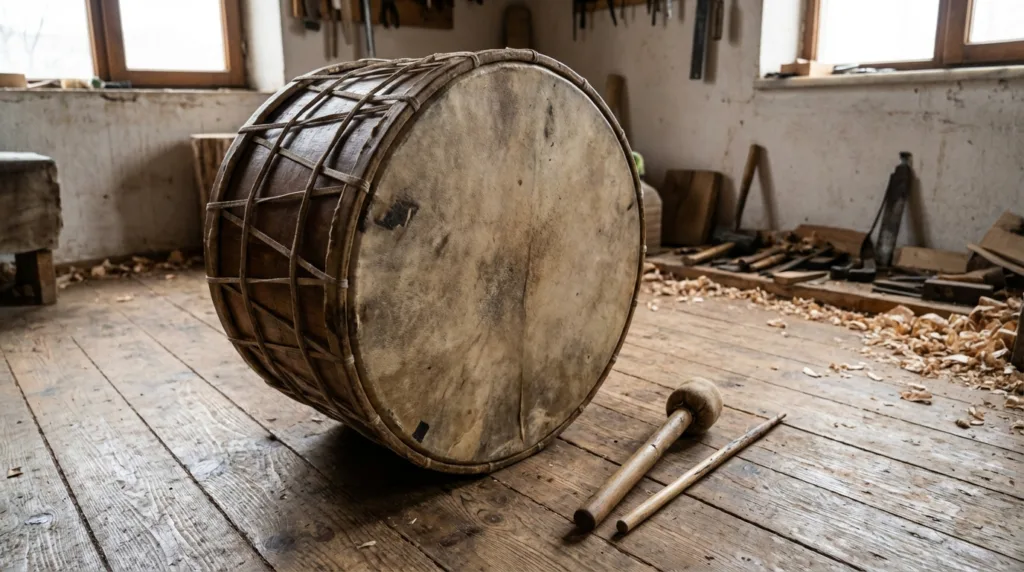
- Anatolian Davul is a large, double-headed, cylindrical drum built for outdoor projection and dance-driven rhythm.
- It is usually played with two different beaters: a heavy tokmak for the low pulse and a lighter çubuk for crisp articulation.
- Its character comes from the skin heads, the shell wood, and the rope tension system working as one.
A good Anatolian Davul does not just sound loud; it sounds alive. The first stroke often feels like a door opening: you get a broad, airy low end, then a fast snap that rides on top. That mix is the instrument’s identity—its timbre, its resistance under the stick, and the way the shell breathes between beats.
🥁 Anatomy Of The Anatolian Davul
| Part | What It Does | What To Notice In Hand |
|---|---|---|
| Shell (wood cylinder) | Shapes the low end, sustain, and how “open” the drum feels | Weight, stiffness, seam quality, and how evenly it resonates when tapped |
| Heads (skin or synthetic) | Define attack, warmth, and the core timbre | Grain pattern, thickness, and how quickly the head “speaks” |
| Rope Lacing 🧵 | Controls tension feel and tuning stability; adds a soft “give” under pressure | Even spacing, fraying, knots, and how smoothly it tightens |
| Hoops / Rings | Distribute tension; affect edge response and slap clarity | Roundness, warping, corrosion (if metal), and seating on the head |
| Strap / Harness | Determines playing angle; affects rebound and low-frequency transfer to the player | Influences balance point, comfort, and overall stability during movement |
On an Anatolian Davul, each part is audible. A slightly heavier shell can make the low end feel anchored, while a thinner shell can make the same drum feel more breathy. Even the rope lacing matters: it often adds a tiny cushion to the tension, which changes how the stick rebounds and how the drum “pushes back.”
This is a drum you do not merely strike. You lean into it.
🪵 Shell Woods and Their Specific Sound
- Dense woods often feel more focused and controlled in the lows, with a slightly quicker “stop.”
- Lighter woods can feel more open, with an airy bloom that travels well in open spaces.
- Stiffer shells often give a clearer attack, while more flexible shells can soften edges and add warmth.
| Common Shell Wood | Feel In The Hands | Sonic Tendency (General) |
|---|---|---|
| Walnut | Often heavier, firm, confidence-inspiring | Tighter low end, defined punch, less “fluffy” bloom |
| Chestnut | Balanced weight, slightly springy | Warm lows with clear mids; a versatile timbre |
| Poplar | Often lighter, easy to carry long hours | Open resonance, broad low bloom, softer edges |
| Beech | Firm, steady, consistent | Clear attack, stable projection, slightly brighter presence |
| Mulberry | Often resonant and lively to the touch | Rich overtones, textured midrange, expressive response |
Wood choice in an Anatolian Davul is not about “better” in a vacuum. It is about the kind of bass you want: a compact thump that sits neatly under dancers, or a wider wave that fills the air. When you tap the bare shell, listen for a clean, even ring—uneven dead spots can show hidden cracks, loose joints, or warped thickness.
Pro Tip 🔧
If two Anatolian Davul shells look similar, pick them up with one hand at the edge and lightly press the rim. A shell that feels stiff but not brittle often supports a more stable tuning and a clearer low “center.”
🐐 Heads, Lacing, and The Feel Under Your Hands
- Natural skins can sound complex and “human,” with small variations across the head that add character.
- Synthetic heads often feel consistent and practical, especially across changing humidity.
- Rope tension typically gives a different rebound than bolt-lug drums; it can feel elastic rather than rigid.
The skin head is where the Anatolian Davul becomes personal. A thinner, well-mounted skin can speak fast, giving you a bright “tick” on light strokes. A thicker skin can slow the attack and deepen the body of the sound, giving you a rounder bass that feels almost vocal. When you play, notice the resistance: some heads “yield” under the tokmak, making the bass feel cushioned; others push back with a firmer spring.
Rope lacing is not only a tuning system; it is a touch system. A well-set rope layout keeps tension even, which helps the Anatolian Davul avoid a papery slap on one side and a dull thud on the other. Even without measuring tools, your hands can confirm it: press gently around the rim and feel for consistent firmness.
What Changes The Sound Most
- Head thickness: affects attack speed and warmth.
- Head seating at the rim: affects ring and unwanted buzz.
- Tension balance: affects pitch stability and clean articulation.
- Shell stiffness: affects how long the low end blooms.
Collector’s Note 🕰️
On older Anatolian Davul examples, tiny repairs at the rim can be normal. What matters is whether the shell still holds an even circle and whether the head edges sit flat. A drum with honest wear but healthy geometry often ages better than a “perfect-looking” drum with hidden warps.
🪓 Tokmak and Çubuk: Two Tools, One Voice
| Beater | Typical Role | Feel and Sound |
|---|---|---|
| Tokmak | Carries the pulse, anchors dancers, drives the low end | Heavier swing, deeper compression, big thump |
| Çubuk | Adds detail, syncopation, and bright accents | Light rebound, fast articulation, clean “click” and slap |
The magic of an Anatolian Davul is the conversation between these two beaters. The tokmak can sound huge, but only if it stays controlled; too much force can choke the head and turn the bass into a blunt hit. The çubuk, on the other hand, needs a relaxed wrist—let it bounce so the drum speaks quickly without harshness.
When the balance is right, the low end feels like a floor and the highs feel like sunlight.
🎶 Timbre Map: What To Listen For
Simple Listening Drill
- Strike one clean tokmak note and count how long the low “air” stays present.
- Add a light çubuk tap: check if it stays crisp or turns papery.
- Play soft, then medium: confirm the timbre opens up instead of collapsing.
A well-made Anatolian Davul keeps its identity at different dynamics. Soft strokes should still carry shape; loud strokes should not explode into chaos. Listen for three zones: a deep foundation, a mid “body,” and a high click. If the mids vanish, the drum can feel hollow. If the highs bite too hard, the drum can feel tiring over a long session. The best examples keep a clear center while staying warm.
Touch Cues While You Play
- Rebound: does the head return the stick smoothly, or does it feel “sticky”?
- Resistance: does the bass stroke feel supported, or does it sink and smear?
- Edge response: do rim-area taps stay clean, with a controlled snap?
These touch cues are not small details. On an Anatolian Davul, they decide whether you can play for hours with ease, or whether every rhythm feels like a struggle against the instrument’s resistance.
🆚 Anatolian Davul Vs. Modern Bass Drum
Comparison Box
- Anatolian Davul: rope-tension feel, two-beater language, airy low bloom, vivid click layer.
- Modern Bass Drum: lug-tuned precision, pedal-driven consistency, tighter decay control with muffling.
A modern bass drum is built for repeatable control in a kit. The Anatolian Davul is built for presence—sound that travels, breathes, and reacts to your hands. Rope tension often gives a softer “give,” which can make fast patterns feel more organic but also asks for a more sensitive touch. If you want a drum that behaves like a machine, you pick the bass drum. If you want a drum that behaves like a living surface, you pick the Anatolian Davul.
🆚 Goat Skin Vs. Synthetic Head
| Head Type | What You Gain | What You Manage |
|---|---|---|
| Goat Skin | Textured highs, complex overtones, classic timbre | Humidity sensitivity, natural variation, more careful storage |
| Synthetic | Consistency, stability, easy replacement and maintenance | Sometimes less complexity; can sound “clean” but less aged |
For many players, natural skin is the emotional center of an Anatolian Davul. It can produce a layered attack where the click sits on top of a warm body, with tiny micro-variations that make repeated patterns feel human. Synthetic heads can be the right call if you need predictable behavior, but if you are chasing that slightly smoky, textured grain, skin often delivers it.
🆚 Rope Tension Vs. Hardware Tension
Where The Feel Changes
- Rope: smoother tension curve, more “give,” tuning can be gradual and tactile.
- Hardware: direct mechanical control, fast micro-adjustments, more rigid rebound.
Rope systems suit the Anatolian Davul because they keep the instrument responsive without turning it into a rigid plate. That slight softness can help the bass feel deep rather than sharp. The trade-off is that tuning becomes a craft: you read the head with your fingers and ears. In return, the drum gives you a flexible voice that can shift from dry pulse to singing boom with small changes.
🔧 Tuning and Setup That Actually Helps
- Check seating: confirm both heads sit flat and the hoop is not tilted.
- Balance tension: tighten or settle evenly around the circumference; avoid one “hot” spot.
- Find the bass center: strike with tokmak and adjust until the low end has body without flab.
- Confirm clarity: add çubuk strokes; aim for clean click without harsh slap.
- Re-check after playing: rope systems can settle; a short second pass can lock in stability.
Tuning an Anatolian Davul is less about chasing a specific pitch and more about shaping response. If the drum feels slow, you often need a touch more evenness and a slightly firmer surface. If it feels tight and brittle, you may be choking the skin and losing the warm body that makes the instrument feel wide.
Pro Tip 🧵
Use your fingertips around the head edge like a map. You are not hunting “perfect.” You are hunting even. On a strong Anatolian Davul, evenness makes the lows fuller and the highs cleaner at the same time.
🧍 Playing Angle, Body Feel, and Endurance
- Higher angle can sharpen articulation and make çubuk work clearer.
- Lower angle can deepen the bass feel and make tokmak strokes heavier.
- Balance point decides whether the drum feels stable or constantly swinging.
The Anatolian Davul is a physical instrument. You feel its bass in your torso and its high click in your fingertips. A strap that places the shell slightly off-center can reduce shoulder fatigue and help the tokmak land with less effort. If the drum keeps moving, your wrists compensate, and the instrument’s resistance starts to feel bigger than it is.
Comfort is tone.
🕰️ Reading An Antique Anatolian Davul Like A Curator
Hands-On Checklist
- Shell roundness: sight along the edge; confirm it does not “egg.”
- Seams and joints: look for stable joins rather than fresh, rushed glue lines.
- Hoop integrity: check for warping; confirm even contact with the head.
- Rope health: look for even wear and safe knots; avoid brittle, powdery fibers.
- Head condition: look for cracks, stiff “glassiness,” or overly thin spots.
Age alone does not determine durability or stability. A well-maintained older Anatolian Davul can remain structurally sound, as seasoned wood may stabilize over time and long-term use can confirm the reliability of its construction. The key factor is predictable structure: a round shell, consistent tension, and heads that respond clearly without excessive wear.
What Often Signals Real Quality
- Clean low center: bass is present without sounding “loose.”
- Clear click layer: the high attack stays crisp without becoming sharp.
- Even feel: the head does not change character drastically as you move around it.
- Quiet hardware: hoops and lacing do not rattle or buzz under strong strokes.
Collector’s Note 🧿
Patina is part of the story, but it should never hide damage. On an older Anatolian Davul, light surface wear can be fine. What deserves caution is any deep shell crack that follows the grain and opens under pressure. Always confirm the drum stays structurally calm when you tighten tension.
🛠️ Restoration Choices: Preserve Or Replace?
| Element | Preserve When… | Replace When… |
|---|---|---|
| Shell finish | It is stable and not flaking; it supports the wood without sealing it too heavily | It traps moisture, feels sticky, or clearly harms resonance |
| Rope lacing | Fibers are strong, knots are secure, tension is even | It is brittle, frayed, or uneven enough to distort tuning |
| Heads | They still respond; no spreading cracks; tone remains rich | They are stiff, cracked, or too thin to hold stable tension |
| Hoops | They stay round and seat evenly | They are warped and cause uneven pressure and harsh slap |
The goal is not to make an antique Anatolian Davul look new. The goal is to make it play true. A careful restoration respects the instrument’s original voice while removing only what blocks sound: unstable tension, unsafe rope, or a head that can no longer vibrate cleanly. When the structure is healthy, the drum’s timbre often returns quickly.
📏 Sizing and Handling: What “Right” Feels Like
- Large diameter often means bigger low bloom and slower response.
- Smaller diameter often means faster articulation and tighter control.
- Deeper shell can add body, while a shallower shell can feel quicker and more direct.
Sizes of Anatolian Davul vary widely by maker and region, so it helps to choose with your body rather than with numbers. If the drum pulls your shoulder forward, it will change your swing and make the bass inconsistent. If it sits balanced, the tokmak can land with a relaxed arc and the çubuk can stay light and precise.
❓ FAQ About The Anatolian Davul
Is it hard to learn the Anatolian Davul if I already play drums?
It is usually approachable, but it asks for a different touch. The biggest shift is learning the two-beater language—tokmak for weight and çubuk for detail—while working with rope-style rebound rather than a rigid drumhead feel.
How do I know if an antique Anatolian Davul is structurally healthy?
Confirm the shell is round, the hoops seat evenly, and the tension feels consistent around the rim. A healthy Anatolian Davul stays stable as you tighten, without sudden dead spots or buzzing. Small cosmetic wear is fine; unstable cracks and warps are the real warning signs.
What head material should I choose for my Anatolian Davul?
If you want the classic, textured timbre, natural skin is often the first choice. If you prioritize stability and easy maintenance, synthetic heads can fit well. The right choice depends on your environment, how often you play, and how much you want the drum to react to subtle changes in touch.
Why does my Anatolian Davul sound papery on the high strokes?
Papery highs often come from uneven tension, a head that is too loose at one edge, or a hoop that is not seating flat. Start by balancing tension around the rim, then re-check how the çubuk responds near the edge. Clean seating often brings back a sharper, more controlled click.
What size should I start with for a comfortable Anatolian Davul setup?
Because Anatolian Davul sizes vary by maker, start with what balances on your strap without pulling your shoulder forward. A comfortable drum lets the tokmak swing naturally and keeps the çubuk hand relaxed. When the instrument feels balanced, your sound usually becomes more consistent right away.