The dundunba does not behave like a generic “bass drum.” It sits low, yes, but not in a blurry way. A good one lands with a dry, wooden push, then leaves space for the djembe, the sangban, and the bell to speak around it. That is why the drum matters so much inside a West African ensemble: it is not there just to make the floor shake. It gives weight, spacing, and direction.
One point needs to stay clear from the start. Dunun can name the whole family of cylindrical bass drums used in the Mandé ensemble. Dundunba names the largest member of that family—the lowest voice, the broadest body, the one that tends to speak with the widest interval between strokes. When that distinction gets blurred, the sound world gets blurred with it.
| Instrument | Job in the Ensemble | Pitch Feel | What the Ear Notices First |
|---|---|---|---|
| Dundunba | Depth, lift, and broad punctuation | Lowest | Air, weight, and roomy spacing between hits |
| Sangban | Phrase-defining pattern, often the clearest shape of the groove | Middle | The line that tells the rhythm who it is |
| Kenkeni | Timekeeping and forward motion | Highest | Short, steady pulse |
Collector’s Note
On older or heavily used drums, the first place to study is not the decoration. It is the bearing edge, the ring seating, and the way the shell meets the head. A handsome shell with tired edges often gives a bass note that spreads too wide and loses its center.
🥁 Where the Dundunba Sits in the Family
The usual three-drum set moves from kenkeni to sangban to dundunba. On paper that sounds simple. In the room, it is more alive than that. The kenkeni keeps the pulse narrow and plain. The sangban shapes the identity of the rhythm. The dundunba opens the lower register and gives the whole texture a back wall.
Not every tradition assigns the drum the exact same social job, though. In some settings the larger dununs do more than support; they can lead, answer, and even take a more exposed part than many short descriptions suggest. That matters, because a player who thinks of the dundunba as “just bass” will strike too much, fill too much, and flatten the dance feel.
Less is often the wiser move.
- In a dense ensemble, the dundunba helps the rhythm breathe by leaving measured gaps.
- In a dance setting, it can act like a weight shift under the feet, marking where the body settles.
- In a teaching room, it is often the drum that reveals whether the group is really listening or merely counting.
🏛️ History Without Blur
The dundunba belongs to the Mandé musical sphere, where the djembe and dunun family developed as linked ensemble voices rather than isolated objects. That point changes how the drum should be understood. A museum label may treat it as a single instrument. A player or maker cannot. Its shape, tuning, and phrasing make full sense only when heard beside the companion parts.
Over time, regional practice changed details of setup and playing method. In some places three dununs with bells form the sound many listeners now know best. In other areas, players work with fewer drums, no mounted bells, or different skin choices. Some Malian practice also favors setups where the bell is held by hand or where the larger drum carries more melodic authority than outsiders expect. The family is stable. The local accent is not.
That is a healthy thing. Traditional instruments stay alive by keeping their grammar while allowing local speech.
🪵 How the Shell, Skin, and Bell Shape the Tone
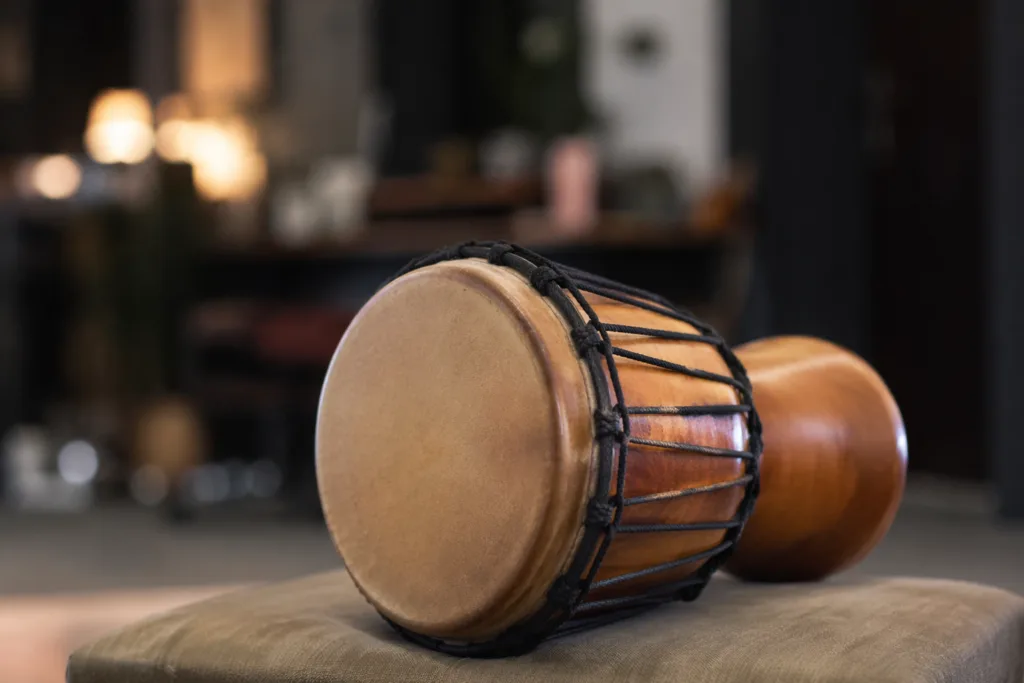
Most readers are told that the dundunba is a wooden cylinder with skins on both ends. True—but too thin a description to be useful. The sound is decided by shell mass, wall thickness, head thickness, rope tension, and the voice of the iron bell. If one of those is off, the whole instrument shifts.
The Wooden Shell
A well-cut shell gives the drum its body. Dense hardwood tends to hold the note in a firmer lane, with a more focused push at the front of the stroke. A lighter or thinner shell can feel quicker and more open, but sometimes less grounded. The wood species matters, yes, yet the practical difference a player often hears first is not the species name written on a sales label. It is whether the shell walls are even, whether the bearing edges are clean, and whether the drum has enough mass to support a low note without turning hollow.
Put plainly: poor edge work ruins more bass than a fancy wood name can rescue.
The Head Material
Cowhide is common on the dundun family for good reason. It is usually thicker than the goat skin many players associate with djembes, so it favors a heavier, lower response. When the hide is thick and well seated, the sound gains weight and loses extra ring. Some hair-on heads push that even further, giving a darker hit with less upper shimmer. Goat skin, where used, can feel quicker and a bit more open, but also less massive under the stick.
The Iron Bell
The bell is not a side accessory. It changes how the whole drum is perceived. Hand-forged iron bells can carry lots of overtones and a long sustain, which means the high metal voice is painting above the low drum voice all the time. A stockier, heavier bell tends to feel more blunt and compact. A longer bell can sound more extended and bright. When the bell and the dundunba fit each other well, the player gets contrast without clutter.
Pro Tip
If a dundunba sounds muddy, do not blame the shell first. Check the head thickness, the edge contact, and whether the bell is masking the attack. A low drum can be healthy and still seem dull if the metal voice is too wide for the setup.
🎼 The Timbre: What the Ear Feels, Not Just What the Tuner Hears
The dundunba has a sound that is easier to feel in the ribcage than to describe with a pitch label. It is broad, but it should not be lazy. It is low, but it should not be soft around the edges. The best examples carry a woody knock at the front of the note, then a short, dark bloom under it. That front edge matters. Without it, the drum stops speaking and starts smearing.
In ensemble work, the timbre matters as much as the note. A more controlled head gives a tighter, dryer articulation. A looser head may sound bigger for a moment, but it can also swallow the rhythm line. That is why skilled players tune for function, not for the biggest possible bass.
Different, too, is the way the stick changes the voice. A harder beater sharpens the front of the note and helps the stroke cut through dancers, voices, and djembes. A softer stick rounds the edge and can make the drum feel older, thicker, almost padded. Neither is always right. The right choice depends on the room, the ensemble, and the job of that part in that piece.
🛠️ How Technique Changes the Character
The standard image is familiar: the drum lies horizontally on a stand or hangs from a strap, the player strikes the head with one hand and manages the bell with the other. That is still the clearest starting point. But even within that setup, the dundunba can sound blunt, springy, dry, roomy, clipped, or almost vocal depending on where the stick lands and how the phrase is spaced.
- Center strikes tend to give the fullest low body.
- Slightly off-center hits can add a clearer wooden edge.
- Short, spaced phrases make the drum feel larger than busy phrasing does.
- Bell placement and timing can either sharpen the groove or crowd it.
A player new to the instrument often tries to prove the size of the drum by hitting it too often. The better move is restraint. Let the drum’s length of note work for you. In a strong ensemble, the dundunba rarely needs to chatter.
Another point many write-ups skip: listening technique is part of playing technique. The dundunba player must hear the sangban clearly enough to avoid stepping on the phrase, and must leave enough air for the djembe lead to rise above the low bed. It is ensemble craft, not solo muscle.
Dundunba Vs. Sangban and Kenkeni
The three drums are related, but they do not feel interchangeable under the hand.
| Point of Comparison | Dundunba | Sangban | Kenkeni |
|---|---|---|---|
| Musical Weight | Broad and grounding | Shaping and defining | Driving and steady |
| Stroke Spacing | Often wider | Often more patterned | Often more repetitive |
| What It Changes First | The body of the groove | The identity of the groove | The pulse of the groove |
| Common Player Mistake | Overplaying | Forcing every phrase too hard | Losing steadiness |
If the sangban tells the listener, “This is the rhythm,” the dundunba tells the listener, “This is how the rhythm stands.” Those are not the same job.
Dundunba Vs. Yoruba Dùndún Talking Drum
This confusion shows up often, so it deserves its own place. The dundunba of the Mandé ensemble is a cylindrical bass drum. The Yoruba dùndún talking drum family is built around flexible tension drums that can bend pitch to follow speech patterns. They are different instruments with different playing logic, different sound goals, and different ensemble behavior.
- Dundunba: low, cylindrical, struck for groove weight and structural support
- Yoruba dùndún: tension-based talking drum, used to shape pitch movement and speech-like contour
- Main practical difference: one anchors the rhythmic floor; the other can imitate language through pitch change
So when a page treats them as if they were one instrument with a spelling issue, the reader loses both histories at once.
Collector’s Note
If you collect across West African drum families, label them carefully. A dundunba and a Yoruba talking drum do not belong in the same drawer just because the names look close on paper.
Traditional Build Vs. Modern Stage Build
Modern workshop drums and export models often aim for steadier dimensions, cleaner hardware fit, and quicker setup. Traditional village-made shells can vary more from one drum to the next—wall thickness, edge shape, bell shape, and even the exact feel of the hide may shift. That variation is not a flaw by itself. Often, it is where the personality lives.
Still, the choice changes the user experience.
- Traditional-style build: more individual voice, more variation, sometimes more setup care
- Modern stage build: more predictable fit, sometimes easier transport, sometimes a less earthy response
- Synthetic options: practical in unstable weather, but many players still prefer natural skin for the grain and push of the attack
For a collector, individuality can be the attraction. For a working teacher or touring player, consistency may matter more. Different need, different answer.
What to Listen for When Judging a Good Dundunba
A fine dundunba does not need many strokes to prove itself. Two or three will do.
- Listen to the front edge. The note should speak clearly before the bass opens.
- Check the decay. It should feel full, not cloudy.
- Hear the bell with the drum. The contrast should help the rhythm, not smear it.
- Test dynamic range. A soft hit should still have shape.
- Watch the shell response. If the drum rattles, chokes, or blooms unevenly, setup or build may be at fault.
Rarely does a healthy drum sound vague at low volume. That is usually the first warning sign.
How the Drum Holds Dancers and Djembes Together
In performance, the dundunba helps join three things that can drift apart if the ensemble is weak: the dancer’s weight, the sangban’s phrasing, and the djembe’s energy. When it is placed well, the whole group looks calmer. Even when the lead part becomes busy, the floor under the music stays firm.
That is why the drum deserves more respect than the usual “lowest of the three” label. Its job is architectural, physical, and social all at once. It supports the dancers. It frames the phrasing. It teaches the ensemble where the ground is.
FAQ
Is It Hard to Learn the Dundunba If I Already Play Djembe?
See Answer
It is usually easier to start than many people expect, but it asks for a different mindset. A djembe player often has to unlearn the urge to fill every space. The dundunba works best when the strokes are placed with patience, clear timing, and close attention to the sangban and bell.
How Do I Know If a Dundunba Sounds Healthy?
See Answer
A healthy drum gives a clear front edge, a full low body, and a decay that stays controlled rather than cloudy. The head should respond at soft and medium volume, and the shell should not buzz, choke, or feel oddly uneven from one stroke to the next.
Why Does One Dundunba Sound Drier Than Another?
See Answer
That usually comes from a mix of head thickness, tension, shell build, edge quality, and stick choice. Thicker cowhide and hair-on heads often give a heavier and less ringy tone, while a different shell or looser setup can make the note feel wider and more open.
Should I Choose a Traditional Natural-Skin Drum or a More Modern Version?
See Answer
Choose based on use. A traditional natural-skin drum often offers the grain, weight, and attack many players want most. A more modern version can be easier to maintain and more predictable from one instrument to the next. For collecting and tonal character, natural materials usually hold the stronger pull.