
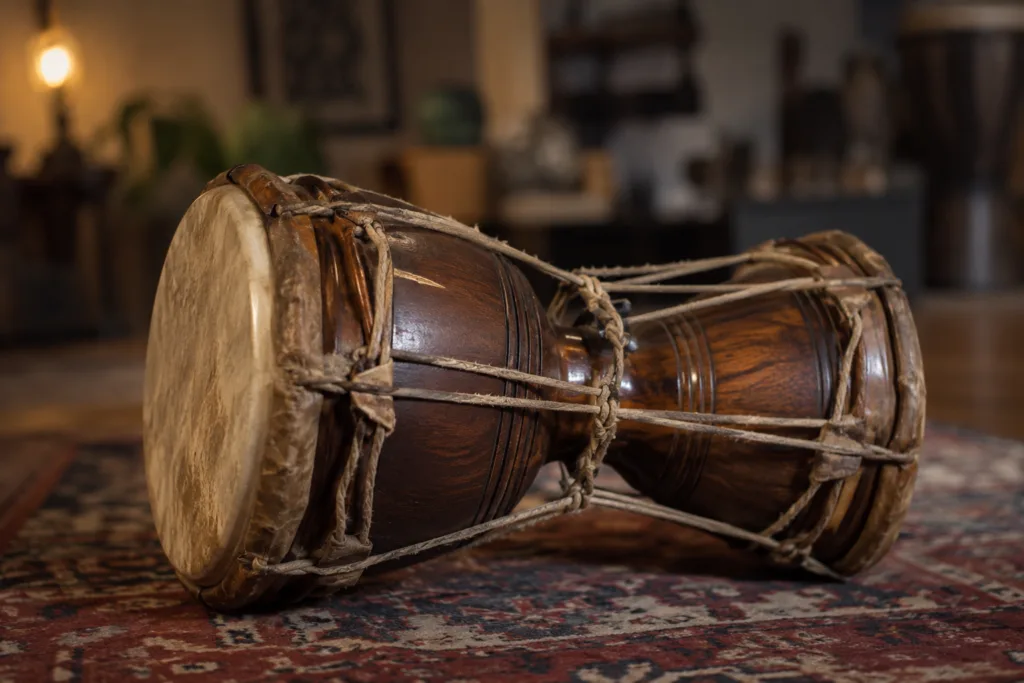
Batá Drum: Construction, Ensemble Roles, and Afro-Cuban Practice
The batá is a family of double-headed drums with Yoruba roots and major traditions in Nigeria and across the African diaspora. A batá shell narrows between two heads of unequal diameter, giving the player contrasting registers from the same instrument. In Afro-Cuban Lucumí practice, batá are most widely recognized as a three-drum ensemble of iyá, itótele, and okónkolo.
| Feature | Description |
|---|---|
| Instrument family | Double-headed membranophone |
| Cultural origin | Yoruba musical traditions of present-day Nigeria and neighboring areas, with major diasporic development in Cuba and elsewhere |
| Shell | Wooden body with a narrowed center and two unequal openings |
| Heads | Two membranes of different diameters, producing contrasting registers and stroke responses |
| Afro-Cuban ensemble | Iyá, itótele, and okónkolo |
| Performance roles | Interlocking drum parts, lead-and-response interaction, song accompaniment, dance, ceremonial repertory, and secular performance |
The Unequal Heads Define the Instrument
Batá are not simply hourglass-shaped drums. Their defining structure combines a waisted wooden shell with two heads of unequal size. The larger and smaller membranes create different tonal ranges, and both sides participate in the rhythmic language of the instrument.
Traditional construction uses animal skin stretched over the two openings. Tensioning methods vary by place, period, and maker. Historical Yoruba drums commonly use hide lacing, while many modern Afro-Cuban and commercial instruments use rope, mechanical hardware, or other systems designed for stable adjustment.
The internal profile, bearing edges, membrane thickness, head diameter, and tension all affect response. These factors matter more than broad claims that one wood species automatically produces a specific tone.
Documented Example: The Metropolitan Museum of Art’s early twentieth-century Yoruba ìyáàlù bàtá from Nigeria is made of wood, hide, and fabric. It measures 61 cm long, with head diameters of approximately 27.9 and 17.8 cm, directly illustrating the unequal-head construction.
How Two Heads Create Multiple Drum Voices
Each membrane has its own diameter, tension, and playing area. The larger head can support lower and fuller responses, while the smaller head provides a higher register and a different attack. The exact stroke vocabulary changes between traditions and between individual drums in an ensemble.
Because the heads share one shell, their vibrations interact through the wooden body and enclosed air space. A player’s control comes from stroke placement, damping, hand shape, force, and timing rather than from striking every note in the same way.
Some Yoruba batá traditions use combinations of hands and beaters. Afro-Cuban batá are commonly played by hand on both heads. The instrument should therefore not be described with one universal hand technique detached from its regional practice.
Yoruba Batá in Nigeria
Batá have a long history in Yoruba musical life. The Metropolitan Museum of Art describes the Yoruba ìyáàlù, or mother bàtá, as the largest member of a set that can contain three or four drums. The repertory has been associated with Ṣàngó, Oya, Egungun, Esu, and other Yoruba orisha traditions.
Historical Smithsonian Folkways recordings from Nigeria demonstrate that the ensemble is not restricted to a single deity. Separate recorded pieces are identified for Shango, Oya, Egungun, Shapana, Orishanla, and Eshu. Other recordings document dance and praise repertory in which a lead bàtá interacts with supporting drums.
Yoruba ensemble names are not identical everywhere, and they should not be replaced automatically with the three names familiar from Cuba. Sources document terms including ìyáàlù, omele, kudi, and locally specific supporting-drum names.
How Batá Developed in Cuba
Yoruba musical and religious traditions reached Cuba through the forced migration of Africans during the Atlantic slave trade. Cuban Lucumí communities preserved and reshaped songs, ritual sequences, dance, and drum practice. Batá became a central ensemble within this Afro-Cuban tradition.
Field recordings made in Havana in 1957 preserve batá accompaniment for a large repertory of orishas. They also document the orú, an ordered cycle in which drum patterns and songs address multiple orishas rather than treating the ensemble as belonging to only one.
Batá later entered concert, folkloric, educational, jazz, popular, and studio contexts. Sacred and secular instruments can look similar from a distance, but their cultural status and intended use are not the same.
The Afro-Cuban Trio: Iyá, Itótele, and Okónkolo
| Drum | Relative Size | Ensemble Function | Documented Modern Example |
|---|---|---|---|
| Iyá | Largest | Lead drum; introduces, answers, varies, and directs important rhythmic exchanges | Smithsonian 1999 LP example: 6.5-inch and 12.5-inch heads |
| Itótele | Middle | Interlocks with iyá and supporting patterns; answers and completes phrases | Smithsonian 1999 LP example: 5.75-inch and 9-inch heads |
| Okónkolo | Smallest | Maintains a repeating structural pattern that stabilizes the ensemble texture | Smithsonian 1999 LP example: 5-inch and 6.75-inch heads |
The dimensions above document one matched modern set, not a universal sizing standard. Traditional and workshop-built batá vary in scale, shell contour, head diameter, tensioning system, and materials.
The three parts are interdependent. Studying one drum can develop stroke control, but the musical grammar of Afro-Cuban batá emerges most clearly when the three instruments interlock.
Lead, Response, and Repeating Patterns
The iyá has the broadest leadership role in the Afro-Cuban trio. Its player shapes exchanges, responds to singing and dance, and signals changes. Itótele forms an active middle voice rather than functioning as a simple metronome. Okónkolo supplies a more repetitive pattern that anchors the texture.
This layered organization can create the impression of a rhythmic conversation. The effect comes from coordinated patterns, timbral contrasts between the two heads, and controlled variation across the ensemble.
Yoruba traditions also use lead-and-support relationships, but their instrumentation and names should be described on their own terms. Similar musical logic does not make the Nigerian and Cuban ensembles mechanically identical.
Sacred Batá, Fundamento, and Secular Sets
In Cuban Lucumí practice, some batá are consecrated ritual instruments. Smithsonian documentation describes these sacred sets as fundamento and records the belief that Añá resides within consecrated batá. Their use is governed by religious protocols and community authority.
Not every batá set is fundamento. Unconsecrated instruments are widely used for teaching, rehearsal, stage performance, folkloric presentation, recording, and other secular settings. Construction alone does not establish whether a set is consecrated.
Identification Note: Do not label a drum “sacred,” “fundamento,” or “consecrated” from appearance alone. Those descriptions depend on documented ritual history and community context, not shell shape or decorative features.
Changó Is One Repertory Context, Not Another Name for Batá
Batá have strong historical associations with Ṣàngó, known as Changó in Cuban Spanish usage, but the drum family serves repertory connected with many orishas. Museum records and field recordings document this broader role in both Yoruba and Afro-Cuban contexts.
This distinction is useful when cataloging instruments. “Batá” identifies the drum family. “For Shango,” “for Changó,” or similar wording identifies a piece, salute, ceremonial association, or repertory context.
For a fuller explanation of that naming issue, see Changó Drum: What the Term Actually Refers To.
Documented Museum Examples
The Metropolitan Museum of Art preserves a Nigerian Yoruba mother bàtá made from wood, hide, and fabric. Its unequal heads measure approximately 27.9 and 17.8 cm across, and the drum is 61 cm long.
The Met holds a matched three-drum set by Brandon Rosser. The museum identifies the drums as iyá, itótele, and okónkolo and documents sweet maple shells, deer-skin heads, hardware, and attached bells.
The Smithsonian National Museum of American History holds a matched commercial set consisting of iyá, omele/itótele, and oconcolo/okónkolo. The records provide individual head measurements for all three drums.
Setup, Heads, and Tension
Skin heads react to humidity and temperature. A drum that is balanced in one room can change pitch or response after transport or a large weather shift. Mechanical hardware offers convenient adjustment on many modern sets, while rope- or hide-tensioned instruments require methods appropriate to their construction.
- Inspect both heads for tears, broad thinning, uneven seating, and damage around the bearing edge.
- Check the shell for active cracks, open joints, distortion, or repairs that move under tension.
- Adjust tension gradually and evenly when the drum’s construction permits tuning.
- Do not assume that maximum head tension produces the best response; usable articulation depends on the entire setup.
- Keep documentation with older or culturally important drums, especially when heads, ropes, hardware, or other parts have been replaced.
Batá Compared with Related Drums
Double-headed drum with unequal heads and a waisted body. The pitch relationship between the two membranes is set by the instrument’s tuning and construction.
Also double-headed and waisted, but its pitch can be changed during performance by squeezing the tension cords. That variable-tension mechanism is not the defining system of batá.
Separate Afro-Cuban drum traditions used in orisha-related music. In parts of Matanzas, bembé ensembles can serve ceremonial functions comparable with batá, but the drums and local ensemble terminology differ.
Single-headed Afro-Cuban drum with a tall open shell. Its construction and normal playing system differ from the two-headed batá family.
Terminology
Batá / Bàtá: Yoruba-origin family of double-headed drums with unequal heads.
Iyá: “Mother”; name of the largest and lead drum in the common Afro-Cuban trio.
Itótele: Middle drum of the common Afro-Cuban trio.
Okónkolo: Smallest drum of the common Afro-Cuban trio, strongly associated with repeating support patterns.
Ìyáàlù: Yoruba term used for a principal or mother drum in documented Nigerian bàtá traditions.
Omele: Name used for supporting drums in several Yoruba bàtá contexts; terminology varies regionally.
Lucumí: Cuban Yoruba-derived religious and cultural tradition in which batá music has an established role.
Fundamento: Term used for consecrated batá in Cuban Lucumí religious practice.
Añá: Sacred presence associated in Lucumí belief with consecrated batá and their ritual authority.
Orú: Ordered cycle of drum patterns or musical salutes for multiple orishas in Afro-Cuban practice.
Documented Records and Collections
- The Metropolitan Museum of Art — Yoruba Bàtá (Ìyáàlù) Drum
- The Metropolitan Museum of Art — Three Batá Drums by Brandon Rosser
- Smithsonian National Museum of American History — LP Iyá Batá Drum
- Smithsonian National Museum of American History — LP Omele / Itótele Batá Drum
- Smithsonian National Museum of American History — LP Okónkolo Batá Drum
- Smithsonian Folkways — Drums of the Yoruba of Nigeria
- Smithsonian Folkways — Havana, Cuba, ca. 1957: Rhythms and Songs for the Orishas