
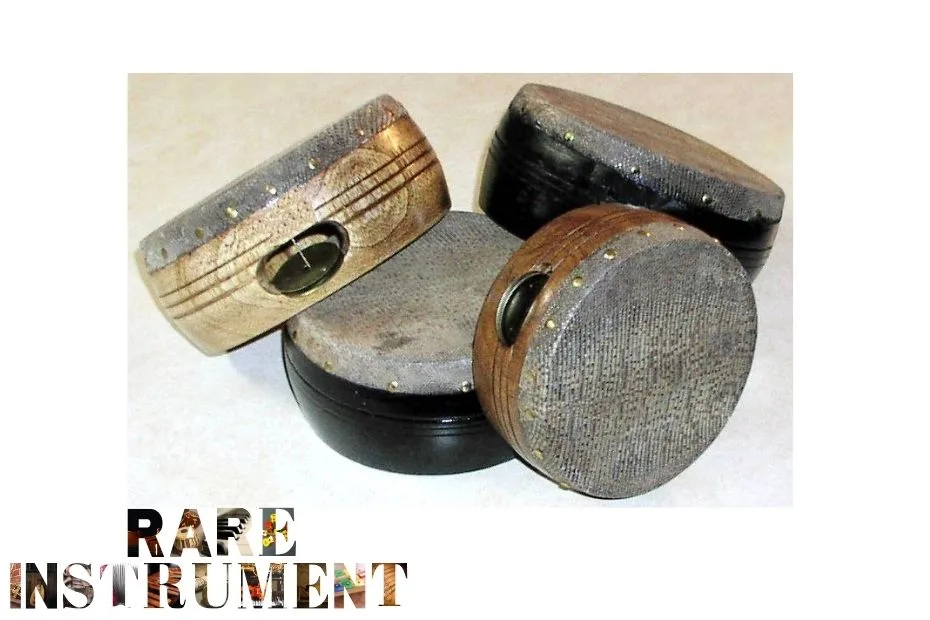
Detailed Features of the Kanjira
| Feature | Traditional Form | Modern Variations | Notes |
|---|---|---|---|
| Origin and Context | South India; established in Carnatic concert practice | Used internationally in fusion, jazz, and world-percussion settings | The modern concert kanjira developed from a wider family of Indian frame-drum traditions |
| Diameter | About 7–9 inches (18–23 cm) | Custom sizes are also made | The compact frame supports one-handed control and rapid articulation |
| Depth | About 2–4 inches (5–10 cm) | Depth varies by maker and model | A shallow frame contributes to the instrument’s immediate response |
| Head Material | Monitor-lizard skin was used historically | Goat skin, other legal natural skins, and synthetic heads | Modern makers avoid protected wildlife materials; each substitute responds differently to pressure and moisture |
| Frame | Jackfruit wood is strongly associated with traditional construction | Other hardwoods, laminated wood, and composite materials | Wall thickness, stiffness, and weight affect feel, projection, and handling |
| Jingles | A single jingle slot holding a small set of metal discs, often three or four | Disc material and weight vary, including brass and steel | The jingles add a short metallic shimmer without functioning like the multiple jingle pairs of many tambourines |
| Playing Position | Commonly held vertically in the left hand and struck with the right | Players may reverse the hold or adapt the angle to technique and setting | The support hand also changes membrane tension for pitch bends and damping |
| Tuning | Membrane response is adjusted through moisture, hand pressure, and playing technique | Some modern instruments use mechanically tunable or synthetic-head systems | Traditional-style heads can change noticeably with humidity and temperature |
| Primary Role | Supporting percussion in Carnatic concerts | Solo, fusion, and percussion-ensemble use | The instrument is valued for fast articulation, bass bends, dry slaps, and close rhythmic dialogue with the mridangam |
Historical and Cultural Background
The kanjira belongs to a wider family of Indian frame drums and became established in Carnatic classical music in South India. Folk and devotional frame-drum traditions predate its concert use, while the modern Carnatic form took shape during the late nineteenth and early twentieth centuries.
As the instrument entered the classical concert stage, it became one of the supporting percussion voices heard with the mridangam and, depending on the ensemble, instruments such as the ghatam or morsing. Its small frame did not limit its role: hand pressure on the membrane allows a player to move rapidly between dry attacks, ringing strokes, and low pitch bends.
Historically, kanjira heads were made from monitor-lizard skin, prized for its thinness and responsiveness. Bengal monitor and other monitor species are protected under Indian wildlife law, and the Bengal monitor is also listed in CITES Appendix I. Contemporary instruments therefore use legal alternatives such as goat skin and synthetic membranes, whose tension, moisture response, and tonal behavior differ from historical heads.
The kanjira is an important percussion instrument in Carnatic performance practice. Its rhythmic vocabulary, pressure-based pitch control, and interaction with the main percussion line make it both an accompanying instrument and a featured voice during percussion exchanges.
Construction and Acoustic Design
The Compact Frame
The kanjira’s small, lightweight frame is traditionally associated with jackfruit wood, although modern makers also use other woods and engineered materials. Frame stiffness, wall thickness, and overall mass affect handling and projection, while the membrane remains the main source of pitch and tonal variation.
The Head
Historical monitor-lizard skin was highly responsive to changes in tension, moisture, and hand pressure. By pressing the membrane from behind, a player can lower the pitch, shape bass bends, shorten decay, or tighten the response between strokes.
Goat-skin and synthetic heads do not behave exactly like historical reptile skin. Goat skin can soften and become more flexible with use, while synthetic heads usually offer better stability across changing humidity. Players often adapt pressure, stroke placement, and moisture control to the head material rather than expecting every kanjira to react identically.
The Jingle Slot
The characteristic jingle sound usually comes from several small metal discs mounted in a single slot in the frame. Their contribution is brief and bright, adding a metallic edge to attacks without dominating the membrane tone.
Terminology and Playing Techniques
Kanjira training is closely connected with solkattu, the spoken rhythmic syllables used in Carnatic percussion pedagogy. Stroke names and their exact hand movements can vary by teacher and lineage, so syllables should not be treated as a single universal notation system.
- Tha / Ta: often used for a dry or sharply articulated stroke.
- Dhi / Di: commonly associated with a more open or resonant articulation in some teaching systems.
- Dhom / Tom: often used for a lower, more rounded sound shaped by membrane tension.
- Nam: commonly taught as a controlled or muted articulation, though execution varies by school.
The striking hand supplies attack and articulation while the supporting hand changes membrane tension from behind. Combining those actions produces pitch bends, bass inflections, muted strokes, and short resonant tones, giving the kanjira a speech-like rhythmic character.
Technique Note: Solkattu syllables describe rhythmic language as well as instrumental articulation. A syllable used by one teacher may not correspond to exactly the same stroke in another lineage.
Musical Context
In Carnatic Ensembles
The kanjira commonly supports the mridangam, answering phrases, reinforcing rhythmic subdivisions, and adding a contrasting timbre. During a tani avartanam, the percussion section can move into extended rhythmic improvisation, giving the kanjira space for rapid exchanges and solo passages.
Global Adaptations
The instrument is also used outside South Indian classical performance. Its compact size and wide expressive range suit fusion, jazz, and world-percussion ensembles, where it may appear alongside tabla, cajón, Middle Eastern frame drums, or drum set.
Amplified settings change the balance between membrane and jingles. A microphone that is too close to the jingle slot can make the metallic attack dominate, while a position aimed more toward the membrane usually captures bass bends and hand articulation more evenly.
Notable Masters
G. Harishankar (1958–2002) is widely regarded as one of the most influential modern kanjira players. His speed, control of pitch modulation, and command of complex rhythmic phrasing helped establish the instrument as a powerful solo voice as well as a supporting one.
V. Selvaganesh has carried the kanjira into international fusion settings through work connected with John McLaughlin, Remember Shakti, and Shakti. His performances show how Carnatic rhythmic language can remain recognizable even when the instrument is placed in a different ensemble format.
Practical Advice for Learners
Some natural-skin kanjiras are lightly moistened to lower the pitch and increase flexibility. Use only the amount appropriate for the specific head material and avoid soaking the membrane.
Build practice time gradually. Fast repeated strokes can irritate fingertips and the heel of the hand, so technique and relaxed motion matter more than forcing volume.
Choose a frame that can be held securely while the support hand still reaches the back of the membrane. The smallest available diameter is not automatically the easiest instrument to control.
Use microphone placement before heavy EQ. Capturing the membrane clearly while keeping the jingle slot slightly off-axis usually gives better control over bass bends and bright attacks.
Care and Maintenance
Natural heads react to humidity, heat, and repeated wetting. Store the kanjira in stable indoor conditions, keep it away from prolonged direct sunlight or strong heat sources, and allow a dampened head to dry naturally before closed storage.
Do not assume that every natural membrane needs the same amount of water. Goat skin, other legal natural heads, and historical-style materials can respond differently. Excess moisture can over-soften a head, weaken adhesive joints, or leave the instrument temporarily difficult to control.
Synthetic-headed kanjiras are usually more stable when climate changes, but they can differ from natural heads in attack, pitch-bend range, surface feel, and decay. For players choosing between them, the useful comparison is not simply traditional versus modern, but responsiveness versus environmental stability.