
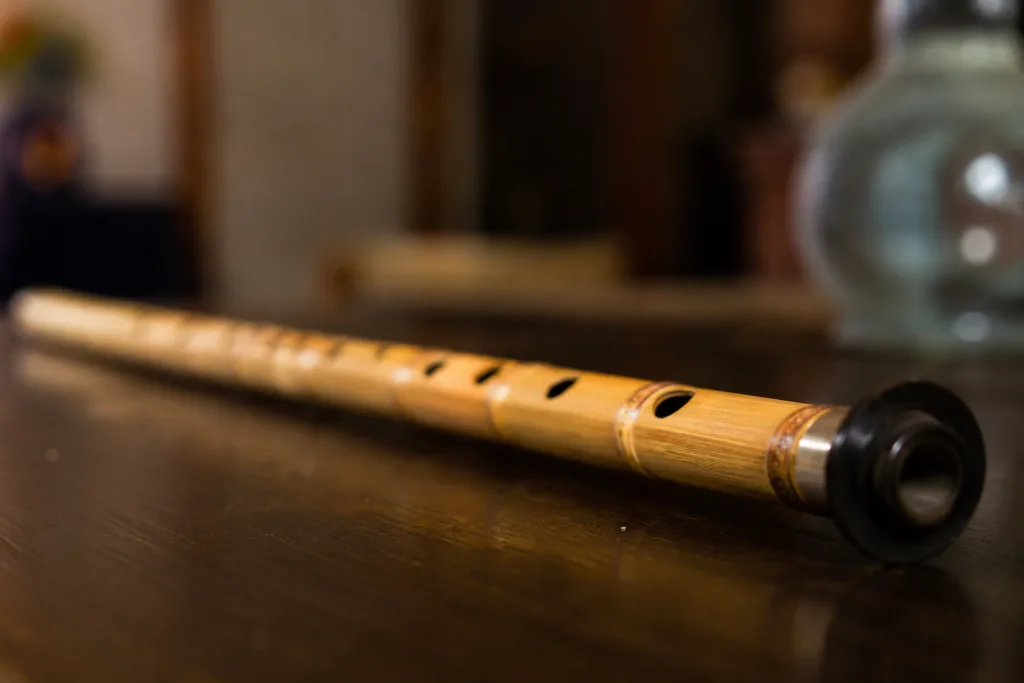
Instrument Snapshot
The ney is a Persian reed flute from the end-blown flute family, known for a breathy, reedy tone that can move from soft vocal shading to focused melodic lines. In Persian music and Sufi listening traditions, it is valued not for volume, but for its close link between breath, pitch, silence, and expressive ornament.
What the Ney Is
The Persian ney is a simple-looking instrument with a demanding voice. It is made from a hollow reed tube, open at both ends, and played by directing air against the top edge. Unlike a recorder, it has no fipple or built-in windway. The player must form the sound with breath angle, mouth position, embouchure control, and finger movement.
The word is often written as ney, nay, or nāy. These names can point to related reed flutes in Persian, Arabic, Turkish, Kurdish, and nearby traditions, but the Persian ney has its own playing method and tonal identity. It should not be treated as interchangeable with every instrument carrying a similar name.
Its musical value comes from controlled instability. A skilled player can shade notes with microtonal inflection, small pitch bends, breath color, and changes in register. The result is a tone that often feels close to a human voice: direct, exposed, and full of fine grain.
Main Features
| Feature | Details |
|---|---|
| Instrument Family | End-blown flute, classed as an aerophone because the vibrating air column produces the sound. |
| Body | A narrow reed or cane tube, usually open at both ends, with natural nodes shaping the structure. |
| Finger Holes | Persian examples commonly use five front finger holes and one thumb hole, though details vary by maker and tradition. |
| Tone Production | The player blows across the upper rim; tone depends strongly on air speed, angle, embouchure, and tube length. |
| Musical Setting | Used in Persian classical music, regional traditions, solo playing, and spiritual listening contexts linked with Sufi practice. |
| Learning Curve | The first stable tone can be hard for beginners because the instrument gives little mechanical help. |
How It Produces Sound
The ney speaks when the player’s breath splits against the top rim of the tube. Part of the air stream enters the bore, part passes across the edge, and the air column inside the reed begins to vibrate. Small changes in angle can alter the response more than a beginner expects.
Because the tube is open and narrow, the sound has a direct attack but a soft edge. The lower notes can feel woody and hollow. Higher registers can become brighter, more nasal, and more penetrating. The instrument rewards careful breath rather than force.
Player Tip: On the ney, louder air is not always better air. A clear note usually comes from a focused stream, steady angle, relaxed throat, and patient adjustment of the upper rim position.
Build, Materials, and Tone
Reed is not just a convenient material. Its wall thickness, internal diameter profile, density, dryness, and natural nodes can affect response and tuning behavior. Unlike a machined tube with tightly controlled dimensions, a natural cane body retains small geometric differences from one specimen to another.
Traditional makers select reed for straightness, internal shape, node spacing, and stability. Some instruments include rings or protective fittings near the blowing edge. These do not turn the ney into a different instrument, but they can protect fragile areas and change how the rim feels against the player.
| Element | What It Can Change | Listening Result |
|---|---|---|
| Reed Structure | Response, resistance, stability, and physical consistency | Natural variation means two reeds of the same general type may not behave identically. |
| Bore and Diameter Profile | Air-column resonance, tuning behavior, and register balance | Small dimensional differences can shift resonance and absolute pitch. |
| Wall Thickness | Mechanical behavior and playing resistance | Its effect interacts with the rest of the reed geometry rather than acting alone. |
| Blowing Edge | Attack, stability, and tone clarity | A clean edge helps the player form a controlled air stream against the rim. |
| Hole Placement | Effective acoustic length and pitch relationships | Position changes can alter the frequencies produced by individual fingerings. |
2026 Acoustic Research: Why Two Mansour Nays Do Not Tune Exactly the Same
A 2026 Acta Acustica study examined 26 Mansour nays, a Turkish ney type made from single pieces of giant reed (Arundo donax). The researchers recorded the instruments, modeled their vibroacoustic behavior with finite-element methods, and used PCE-Kriging to examine which measured differences were most closely associated with pitch variation between specimens.
The sample was deliberately varied. The giant reeds came from Hatay, Antalya, Adana, and Aydın in Türkiye and represented different cutting-age groups. All had been dried for at least two years before manufacture. Even though the finished instruments followed the same Mansour nay type and were judged suitable for professional performance, their measured pitches were not identical.
What Changed the Pitch Most
The analysis placed the top and bottom diameter measurements among the strongest contributors to differences in pitch frequency. Finger-hole distances also affected the results, followed by total instrument length. The pattern shows why nominal length alone cannot describe the tuning behavior of a natural reed flute: the diameter profile changes the acoustic tube, while the locations of open finger holes change its effective sounding length.
The work also helps separate construction variability from playing technique. A performer can adjust pitch through embouchure, blowing angle, and air control, but instruments still begin with slightly different acoustic geometries. For makers, selecting reeds with more consistent dimensions and placing finger holes carefully can reduce variation before the performer makes those adjustments.
The experiment concerned the Turkish Mansour nay rather than the Persian ney described on this page, so its numerical results should not be transferred directly to Persian instruments or Persian tuning practice. It does provide measured evidence from a closely related natural-reed flute showing how tube geometry and finger-hole placement can produce instrument-to-instrument pitch differences even when the instruments belong to the same defined type.
Sound Character and Listening Notes
The Persian ney is often described as breathy, but that word only covers part of the sound. A good tone can contain air, reed grain, pitch focus, and a narrow vocal edge at the same time. The sound is not polished like a silver concert flute. It keeps contact with the breath that makes it.
Listeners should pay attention to the start of each note. Some notes arrive with a dry whisper before the pitch blooms. Others enter cleanly and bend into place. In Persian classical performance, these small movements are part of the expression, not tuning errors by default.
These bars describe common listening impressions, not laboratory measurements. Each instrument and player can sound different.
History and Cultural Role
Reed flutes have a long presence across Iran, West Asia, and neighboring regions. Museum examples and written traditions show that flute-like instruments were used in rural, courtly, and spiritual settings. The ney belongs to this broad family, but the Persian form developed a special place through its connection with modal music and expressive solo playing.
In Persian culture, the ney is more than a pastoral flute. It appears in art music, poetry, spiritual practice, and teaching lineages. Its exposed tone made it a natural symbol for breath, longing, separation, and disciplined listening. This symbolic layer is one reason the instrument is often linked with Sufi music.
Simple reed and bone flutes appear across old musical cultures. Their basic design made them useful for pastoral life, ritual, and melodic performance.
Names related to nāy appear in written sources, though not every historical use refers to the same rim-blown instrument known today.
The rim-blown ney gained a strong place in spiritual listening circles and later became part of refined art-music practice.
Today the ney is heard in Persian classical music, cross-cultural recordings, conservatory teaching, and devotional settings.
The Ney in Sufi Music
In Sufi contexts, the ney is often heard as a breath instrument with symbolic weight. Its sound can seem close to a sung line, but without words. That wordless quality allows the instrument to support meditation, ceremony, poetry, and slow melodic unfolding.
The ney’s association with Sufi practice is not only about mood. The instrument’s physical action matters: breath is shaped into tone through discipline. Silence, attack, decay, and pitch bending all become part of the musical meaning. A phrase can feel incomplete without the soft breath around it.
What We Know: Historical references to the ney are not always simple. Some older uses of nāy refer to different reed instruments. For Persian ney history, it is safer to distinguish the modern rim-blown flute from earlier instruments that shared related names.
Playing Feel and Technique
The first challenge is sound production. Many beginners can cover the holes correctly and still produce only air. The embouchure must aim the breath at the rim with enough focus to set the tube vibrating. The Persian ney is also known for a demanding mouth position that differs from many Arabic and Turkish approaches.
Once the tone is stable, the next challenge is control. Finger holes do not simply give fixed piano-like notes. Players use partial covering, breath pressure, angle changes, and ornament to shape modal pitches. This makes the ney expressive, but it also means that early learning can feel slow.
Find the Rim Angle
The player tests small changes in angle until the breath catches the edge and produces a stable tone.
Stabilize the Air Stream
The tone needs steady air, not a hard blast. A narrow stream usually works better than heavy pressure.
Shape the Register
Higher notes need control of breath speed, mouth position, and internal resonance.
Add Ornament
Slides, turns, grace notes, and pitch shading bring the instrument closer to Persian vocal phrasing.
Persian Ney vs Similar Flutes
Usually associated with Persian classical music and a distinct reed-flute tone shaped by breath, rim control, and modal ornament. It often has five front holes and one thumb hole.
Strongly linked with Ottoman classical music and Mevlevi practice. It often uses a lip rest called a başpare, and its technique differs from the Persian ney. The Mansour nay examined in the 2026 acoustic study belongs to this Turkish tradition.
Used in Arabic classical and regional music. It is also an end-blown reed flute, but hole layout, tuning practice, and tone goals may differ by region.
A related end-blown flute found in parts of Turkey, the Balkans, and nearby regions. Some forms are wooden rather than reed, with a different playing culture.
Buying or Collector Notes
A good ney should be judged by response, tuning behavior, physical condition, and fit for the musical tradition you want to study. A beautiful old reed is not automatically a better instrument. Cracks, weak nodes, uneven holes, or a damaged blowing edge can make the flute unstable.
Natural variation in reed geometry is another reason to judge an individual instrument by how it actually plays rather than by length or appearance alone. Diameter profile, hole placement, and the condition of the bore can influence tuning behavior even among instruments made to the same general pattern.
For a beginner, the best choice is often a playable, stable instrument from a maker or seller who understands the specific Persian style. Buying a Turkish or Arabic ney by mistake may lead to a different technique and tuning layout than expected.
The top rim should be clean and playable. Chips, rough cuts, or weak fittings can make tone production harder.
Small cracks can spread with dryness or pressure. Cracks near holes and nodes need extra care.
Persian, Turkish, and Arabic instruments can look related, but their technique and tuning habits are not the same.
Neys come in different sizes and pitch centers. Ask how the individual instrument has been tuned and tested rather than relying on size alone.
Care and Storage
Reed is sensitive to dryness, moisture, heat, and sudden impact. A ney should be stored where it will not bend, crack, or absorb excess humidity. After playing, it should be allowed to dry naturally before being sealed in a tight case for a long time.
Cleaning should be gentle. Harsh chemicals, soaking, or forcing cloth through a narrow bore can damage the reed or disturb the inner surface. If a valuable instrument has a crack or loose fitting, repair should be handled by someone familiar with reed flutes.
Care Warning: Do not leave a reed ney in direct sun, near heaters, or inside a hot car. Fast dryness changes can split the reed and alter the response.
- Store the instrument in a rigid or padded case when not in use.
- Let moisture evaporate after playing before long storage.
- Avoid sudden temperature and humidity changes.
- Keep the blowing edge protected from impact.
- Do not sand, drill, oil, or alter holes without expert advice.
Common Confusions
Common Confusion: The ney is sometimes described as one instrument across the Middle East, but Persian, Turkish, and Arabic forms can differ in hole layout, mouth contact, tuning habits, repertoire, and tone ideals.
Any reed flute called ney will work for Persian music.
A Persian-style instrument is the safer choice for Persian technique, ornament, and repertoire.
The ney is easy because it has few parts.
The simple body leaves tone production almost entirely to the player’s breath and embouchure.
Practical Listening Notes
When listening to the Persian ney, follow the air around the pitch. The breath is not background noise; it is part of the tone color. Notice how notes begin, bend, settle, and fade. In slow passages, the space after a note can be as important as the note itself.
In ensemble settings, the ney may not dominate the texture. It often cuts through because of its narrow, reedy edge rather than raw loudness. Against strings, percussion, or voice, it adds a dry wind color that can make the melody feel more exposed.
Listening Checklist
- Listen for the breath before the pitch fully forms.
- Notice small pitch bends rather than expecting equal-tempered notes.
- Compare the lower woody register with the brighter upper register.
- Pay attention to pauses, decays, and soft attacks.
- Listen for vocal-like ornament in slow melodic lines.
Mini FAQ
Is the ney a Persian instrument?
The Persian ney is a Persian form of a wider family of end-blown reed flutes found across West Asia and nearby regions. Related instruments also exist in Turkish, Arabic, Kurdish, and other musical cultures.
What does a ney sound like?
It often sounds breathy, reedy, warm, and slightly nasal. The tone can be soft and airy in low passages or more focused and bright in higher registers.
Why is the ney linked with Sufi music?
The ney’s breath-led sound, vocal quality, and symbolic link with longing and disciplined listening made it important in Sufi musical and poetic settings.
Is the Persian ney hard to learn?
Yes, the first stable sound can be difficult. The instrument has no fipple, so the player must create the tone through breath angle, mouth position, and steady control.
Is a Turkish ney the same as a Persian ney?
No. They are related end-blown flutes, but their playing techniques, fittings, hole layouts, pitch habits, and musical contexts can differ. The Mansour nay examined in the 2026 acoustic research is a Turkish type and should not be treated as a measured Persian ney.
Why can two reed neys have different tuning?
Natural reed does not form a perfectly identical tube in every specimen. Research on Mansour nays found that top and bottom diameter measurements were among the strongest contributors to pitch variation, with finger-hole distances and total length also affecting the result.
What is the ney usually made from?
Many traditional neys are made from reed or cane. Some examples include metal rings or protective fittings, and modern practice may include other materials for study or durability.