
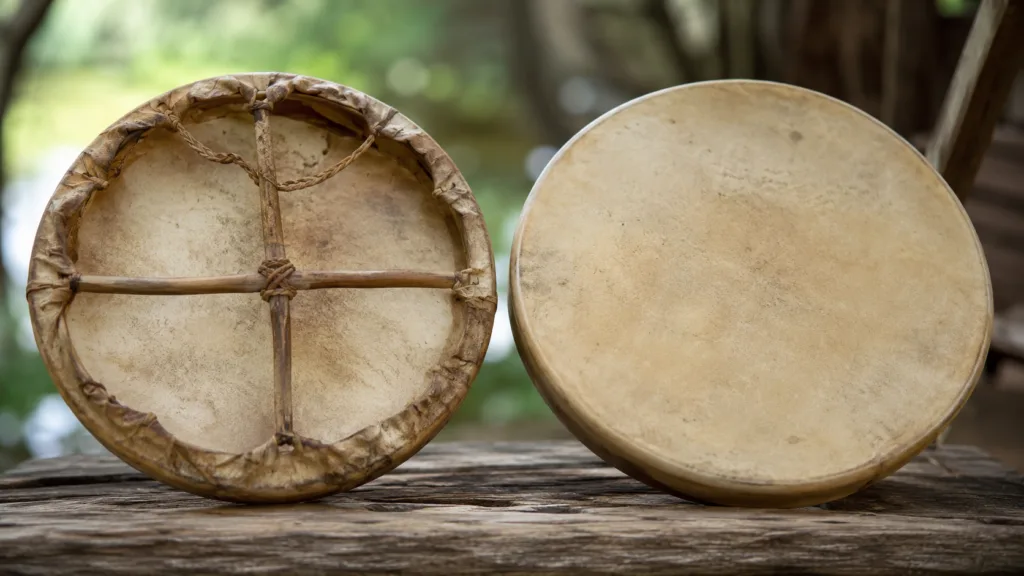
Drum Comparison
A shamanic drum and a Native American frame drum may share a round wooden frame, a stretched membrane, and a padded beater, but the names do not describe the same cultural category. Shamanic drum is a broad use-based label connected with ritual practice in several regions and with modern spiritual drumming, while Native American frame drum points toward distinct Indigenous North American traditions that should be identified by nation, community, maker, and musical setting whenever possible.
The Main Difference Is Cultural Identity, Not Shape
The two drums can look almost identical in a shop photograph. Both may be circular membranophones with a wooden hoop, a natural-hide or synthetic head, a rear handhold, and a separate stick. The stronger distinction comes from who made the drum, what tradition it belongs to, how it is played, and what the object means within that setting.
“Shamanic drum” does not identify one fixed instrument design. The term may refer to frame drums used by ritual specialists in Siberian, Central Asian, Arctic, or other traditions, but it is also widely applied to newly made drums sold for meditation, sound sessions, neo-shamanic practice, and personal ceremony. Two instruments sold under this name may differ in frame depth, hide, handle structure, decoration, tuning behavior, and cultural basis.
“Native American frame drum” is also broad, but it carries a more specific cultural claim. Indigenous nations across North America have their own names, construction methods, songs, permissions, and relationships with drums. A Plains hand drum, a Northwest Coast drum, and a Yup’ik dance drum should not be treated as regional versions of one universal Native instrument.
Common Confusion: A round hide drum is not automatically Native American, and a drum decorated with feathers, animals, medicine-wheel colors, or geometric symbols does not gain cultural authenticity from appearance alone. Reliable identification depends on the named maker, nation or community, documented origin, and intended use.
Shamanic Drum vs Native American Frame Drum
| Point of Comparison | Shamanic Drum | Native American Frame Drum |
|---|---|---|
| Meaning of the Name | A broad label based on ritual, meditative, or spiritual use | An umbrella description for frame drums associated with particular Indigenous North American peoples |
| Cultural Range | May refer to several Eurasian, Arctic, Indigenous, reconstructed, or modern spiritual practices | Should be linked to a named nation, community, artist, or regional tradition rather than treated as one pan-Native type |
| Construction | Often a bent or segmented wooden frame with one hide head and a rear cross-grip or wrapped handle | May be single-headed or double-headed, shallow or deeper framed, laced, tacked, tied, or otherwise finished according to maker and tradition |
| Membrane | Goat, deer, horse, reindeer, elk, buffalo, or synthetic heads may appear in modern trade | Hide species and preparation vary by region, period, availability, maker, and cultural practice |
| Primary Rhythm | Steady repeated pulses are common in contemporary journeying and meditation settings | Rhythm follows specific songs, dances, ceremonies, social events, and local performance conventions |
| Decoration | May feature personal, symbolic, commercial, or tradition-inspired imagery | Painted or attached elements may hold public, personal, ceremonial, or restricted meanings; decoration is not merely ornamental |
| How It Is Learned | Often taught through workshops, private practice, spiritual groups, or contemporary wellness settings | Often learned through family, community, cultural teachers, song groups, ceremonies, or nation-specific instruction |
| Responsible Description | Name the actual tradition when known; otherwise describe it as a modern frame drum used for spiritual or meditative practice | Name the artist and nation when known, and avoid assigning sacred meaning without community-based information |
How Their Construction Overlaps
Both categories commonly use the basic architecture of a frame drum: a membrane stretched across a hoop whose depth is smaller than its diameter. The head vibrates after the beater strike, while the frame supports the membrane and shapes the air movement behind it. A rear grip allows the player to hold the drum away from the body so the head and open back can resonate.
That shared architecture explains the tonal overlap. Many examples produce a quick, rounded attack, a low central pulse, a dry edge response, and a short-to-medium decay. Strike position matters: the center tends to emphasize the fundamental thump, while strokes nearer the rim bring out higher overtones and a firmer click.
A larger head can support a lower-feeling pulse, but hide thickness, tension, frame depth, and humidity may change the result as much as diameter.
A deeper shell may give the strike more enclosed resonance and weight. A shallow hoop often feels lighter in the hand and can speak with a drier response.
Thin, tight hide usually gives a quicker and brighter attack. Thicker or less tightly tensioned hide often favors a darker pulse and softer bloom.
A broad padded head softens the attack. A smaller, firmer beater gives more definition and may reveal more high-frequency slap.
Why Similar Construction Does Not Make Them Interchangeable
Musical classification and cultural identity answer different questions. Organology may place two objects in the same frame-drum family because both use a membrane over a shallow frame. Cultural identification asks who recognizes the drum, what it is called, who may make or play it, which songs belong with it, and whether its imagery or use carries community obligations.
This difference is especially important with older museum pieces and online listings. Historical catalogues sometimes use broad labels such as “Indian,” “Sioux,” “Alaska,” or “Plains,” even when the original maker or community was not recorded. Modern sellers may also use “Native,” “tribal,” “medicine,” and “shamanic” as visual marketing terms rather than as evidence of origin.
What the Object Can Tell You: The frame joint, lacing, tacks, handle, hide preparation, paint, wear, repairs, and beater can support identification. They rarely prove a cultural origin by themselves. Maker records, community knowledge, acquisition history, and nation-specific comparison carry more weight.
Playing Style and Musical Function
Contemporary practice often centers on an even repeated beat intended to support breathing, concentration, guided imagery, movement, or group ritual. The player may seek continuity rather than rhythmic complexity, using subtle changes in force, spacing, and strike position to shape intensity.
The drum may accompany specific songs, dances, healing practices, social gatherings, or ceremonies. Pulse, accent, vocal relationship, posture, and participation rules depend on the nation and setting. A generic “heartbeat rhythm” should not be presented as the universal Native American way to play.
Some Native frame drums are played by one person holding both drum and beater. Others appear in ensembles or alongside singing and dance. Some drums are personal objects; others belong to a family, society, community, or ceremonial role. Public performance practice cannot be assumed to reveal private or restricted uses.
Materials and Sound Character
| Element | Possible Effect | What to Check |
|---|---|---|
| Natural Hide | Complex overtones, organic grain, and strong response to temperature and moisture | Even tension, thin spots, splits, edge lifting, and climate behavior |
| Synthetic Head | More stable pitch and response across changing indoor conditions, though often with a cleaner and less irregular overtone profile | Bonding, wrinkles, surface wear, and compatibility with the frame |
| Wooden Frame | Weight, stiffness, wall thickness, and depth influence handling, projection, and resonance | Warping, open joints, cracks, loose tacks, and rough interior edges |
| Rear Handle | Changes balance and how freely the back of the head can move | Comfort, secure attachment, hand clearance, and cord wear |
| Padded Beater | Produces a rounded attack with less surface click | Straight shaft, secure wrapping, resilient padding, and suitable weight |
Choosing the Right Description and Drum
A well-made modern frame drum may be the clearest choice. Look for honest maker information, comfortable weight, stable construction, and language that does not invent an Indigenous identity.
Begin with the nation, community, or teacher rather than with a generic product category. Learn the drum’s name, songs, context, and participation expectations from Indigenous-led sources.
Choose by tone, projection, durability, beater response, and climate stability. A synthetic-headed frame drum may be practical when reliable tension matters more than historical materials.
Prioritize maker attribution, documented ownership, community identification, legal and ethical provenance, condition, and evidence that sale is appropriate.
Collector’s Note: “Native American style” usually describes appearance, not authorship. A drum should not be attributed to a nation because of painted symbols, hide type, or seller language alone. For a culturally identified piece, retain the artist’s name, nation, date, place, materials, original invoice, and any maker statement supplied with the instrument.
Buyer and Inspection Notes
Confirm the Maker’s Description
Look for a named artist or workshop, location, materials, construction method, and intended use. Be cautious when a seller combines unrelated terms such as “Siberian Native American medicine shaman drum.”
Test Balance and Hand Clearance
The drum should sit securely without forcing the wrist backward. Rear cords or crossbars should not pinch the hand, and the fingers should not press tightly against the vibrating head.
Listen Across the Head
Strike the center, mid-zone, and near-rim area at moderate force. Uneven pitch is normal in natural hide, but dead patches, rattles, loose hardware, or sharp buzzing may reveal a construction or repair issue.
Check Climate Response
Natural hide may tighten in dry warmth and slacken in humidity. Ask how the maker recommends restoring playable tension, and avoid unapproved heat methods that can split or permanently distort the head.
Separate Playability from Provenance
An older drum can be culturally important yet too fragile to play. A recent drum may be musically excellent without carrying collector value or community attribution.
Care and Storage
- Store the drum in a stable indoor environment away from radiators, hot vehicles, damp basements, and prolonged direct sun.
- Support the frame rather than placing weight on the membrane.
- Use a dry soft cloth for loose dust unless the maker gives material-specific cleaning instructions.
- Do not apply oil, leather conditioner, water, alcohol, or household cleaner to the head without approval from the maker or a qualified conservator.
- Allow a cold drum to reach room temperature gradually before playing it hard.
- Keep provenance labels, artist information, and original documentation separate from the drum but stored nearby.
- Consult community representatives or a conservator before repairing culturally sensitive decoration, attachments, or older Indigenous objects.
Common Myths
All Native American drums are played with the same steady heartbeat rhythm.
Indigenous drum practices differ by nation, song, dance, ceremony, and social setting. No single beat represents every Native community.
A shamanic drum is a standardized historical instrument.
The label covers several culturally distinct traditions as well as modern drums made for meditation and personal spiritual practice.
Natural hide always produces a better drum.
Natural hide offers complex response but changes with climate. Synthetic heads can provide useful stability, especially for travel, teaching, and amplified performance.
Mini FAQ
Are shamanic drums and Native American frame drums physically different?
Not always. Both may use a round wooden frame, one hide head, a rear grip, and a padded beater. Cultural origin, maker, terminology, performance practice, and meaning provide a stronger distinction than shape alone.
Can a Native American frame drum be called a shamanic drum?
That description may be inaccurate or culturally careless unless the maker or community uses it. Many Native nations have their own terms and ceremonial roles, and “shamanic” should not replace nation-specific identification.
Is every hand-held Native American drum a frame drum?
No. Indigenous North American drum traditions include several constructions, and not every hand drum fits the narrow organological definition of a shallow frame drum. Large communal drums and other vessel or shell forms are separate types.
Which drum is better for meditation?
A comfortable, responsive modern frame drum with an honest description is often suitable. Tone, weight, handle comfort, climate stability, and the maker’s intended use matter more than attaching a Native identity to the instrument.
How can a buyer verify that a drum is Native-made?
Look for the artist’s full name, tribal nation or community affiliation, direct seller information, and retained documentation. Avoid relying on motifs, feathers, product titles, or vague claims such as “tribal made.”
Why does a hide drum sound different from day to day?
Natural hide absorbs and releases moisture. Higher humidity can soften the head and lower its response, while dry warmth can tighten it and raise the pitch. Safe adjustment methods depend on the maker and construction.