
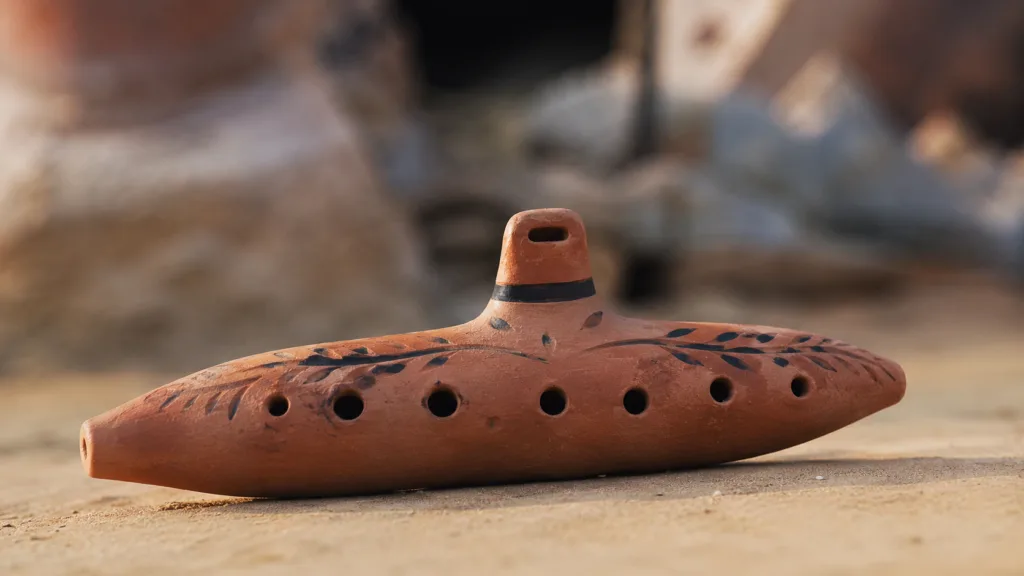
Instrument Snapshot
The Boreendo, also written Bhorindo, is a small clay vessel flute associated with Sindh and the Thari community of southern Pakistan. Its hollow rounded chamber, exposed blowing opening, finger holes, and movable playing angle produce a compact, earthy tone that can shift in pitch and color under the player’s breath. The instrument is also an endangered body of craft knowledge: clay preparation, forming, firing, perforation, tuning, decoration, fingering, melody, and teaching must all survive together.
The Boreendo does not use a long tube like a bansuri, ney, or transverse flute. Its resonator is the air trapped inside a rounded clay vessel. The player directs breath against the edge of a large opening, covers and uncovers smaller holes, and changes the angle between the mouth and instrument. These movements alter the way air enters the chamber and help shape both pitch and timbre.
The name appears in English as Boreendo, Bhorindo, Bareendo, and Borrindo. These spellings usually describe the same Sindhi clay flute rather than separate instrument families. Boreendo is used here as the main spelling, with Bhorindo retained because it appears in the instrument’s UNESCO listing.
Pakistan nominated the Boreendo as a living practice rather than as a single museum object. The listed element includes the instrument, its melodies, making methods, performance skills, and the social knowledge around them. It was placed on UNESCO’s List of Intangible Cultural Heritage in Need of Urgent Safeguarding on December 9, 2025. That status records vulnerability; it does not mean UNESCO declared the Boreendo a World Heritage object or certified it as the oldest flute on earth.
Boreendo, Bhorindo, Bareendo, and Borrindo
Boreendo and Bhorindo are alternate transliterations. Bareendo and Borrindo also occur in English-language records. A spelling change does not by itself indicate a different construction, region, or playing method.
Why the Boreendo Is a Vessel Flute
A vessel flute stores its main vibrating air volume inside a closed or nearly closed chamber. In the Boreendo, that chamber is a hollow ball or egg-like clay form. The player’s breath excites the air at the main opening, while the finger holes change the effective venting of the chamber.
This design behaves differently from a tubular flute. A long flute organizes pitch around the length of an air column. A vessel flute depends more heavily on chamber volume, opening area, hole size, and how several openings interact. A larger Boreendo generally tends toward a lower fundamental pitch, but wall form, opening geometry, and the maker’s final adjustments also matter.
The rounded internal cavity acts as the main resonator. Its volume influences the instrument’s basic pitch region and response.
The player aims a controlled air stream toward the opening edge. Small changes in distance and direction can determine whether the note speaks clearly.
Opening and closing the smaller holes changes the acoustic loading of the vessel. More holes can provide additional note combinations but make placement and tuning harder.
The spherical form supports tilting and rotation during performance. Hand position and mouth angle therefore become part of pitch control.
How the Boreendo Produces Sound
Breath Meets an Exposed Edge
The Boreendo is commonly described as a clay vessel flute with an exposed blowing opening. The player does not simply blow into a sealed mouthpiece and wait for a fixed air channel to form the note. Breath must be aimed. If the air stream misses the effective edge, the result may be weak, noisy, unstable, or silent.
A clean attack depends on lip shape, air speed, distance from the opening, and the angle of the instrument. Stronger breath can increase volume, but it may also raise the pitch or harden the tone. Control matters more than force.
The Chamber and Holes Work as One System
Each open hole adds an outlet to the enclosed air space. Covering a hole changes that relationship. The Boreendo therefore cannot be understood by treating each hole as an isolated note button. Hole diameter, spacing, chamber volume, and the total area of all open holes combine to set the response.
Tilting Is Part of the Technique
Records from Sindh describe tone adjustment through movement of the mouth angle. Tilting changes how the air jet strikes the edge and may also alter how the lips partially shade the opening. This gives the player a narrow but useful field of pitch correction, inflection, and tonal shading beyond ordinary fingering.
Playing note: A Boreendo responds best to a narrow, directed air stream. If the sound collapses when the instrument is moved, steady the breath and make very small angle changes rather than blowing harder.
Sound Character and Listening Cues
The Boreendo’s tone is often soft in projection and compact in sustain. The clay body does not ring like a metal bell; most of the audible identity comes from the enclosed air, the breath edge, and the small resonant cavity. A well-speaking note can sound rounded and focused, while a less centered air stream introduces a dry, airy grain.
The profile below is a general listening description, not a laboratory measurement. Individual instruments vary with size, wall form, firing, hole layout, and player technique.
What to Listen For
- A short, centered attack followed by a quick decay
- A soft breath layer around the pitch rather than a completely pure flute tone
- Small bends or color changes when the player tilts the instrument
- Differences between fully covered holes, open holes, and partially shaded openings
- A close, intimate projection suited to small gatherings rather than high-volume ensembles
From Local Clay to a Playable Boreendo
Making a Boreendo requires more than producing a hollow ceramic shape. A visually convincing vessel can still fail as an instrument if the cavity, openings, or edge do not cooperate. The maker must manage pottery behavior and acoustic response at the same time.
Prepare the Clay
The clay must be workable enough to form a hollow body without collapsing, yet even enough to dry with limited distortion. Stones, trapped air, and irregular moisture can create cracks or weak spots.
Form the Hollow Body
The rounded chamber may be shaped with pottery methods suited to the maker and local practice. Wall thickness must remain controlled around the vessel so that the body dries and fires evenly.
Create the Main Opening
The blowing opening needs an edge that can split the air stream. Its shape is acoustically active, not merely decorative.
Place the Finger Holes
Hole position and diameter affect the available notes. A small error can create weak response, poor spacing between pitches, or a fingering that is uncomfortable to seal.
Dry and Fire the Vessel
Traditional descriptions identify sun drying followed by kiln firing. Shrinkage during these stages can change the final cavity and opening dimensions.
Test, Adjust, and Decorate
The playable result must be checked by ear and by hand. In documented Thari practice, women have taken part in decorating the fired instrument with clay paint, while performance has commonly been associated with men.
| Construction Element | What It Changes | Possible Result |
|---|---|---|
| Internal chamber volume | The amount of enclosed air | Larger chambers generally favor a lower basic pitch |
| Main opening geometry | How the breath meets and splits at the edge | Cleaner attack, excessive air noise, or unstable speech |
| Finger-hole diameter | The amount of acoustic venting | Pitch spacing, response, and tuning balance |
| Hole placement | Both tuning and hand comfort | Playable combinations or difficult sealing |
| Wall consistency | Drying, firing stability, and physical strength | Reduced cracking and a more predictable finished form |
| Firing outcome | Final hardness and shrinkage | A durable instrument or a distorted, acoustically altered vessel |
Traditional Hole Patterns and the Eight-Hole Boreendo
Boreendo examples do not follow one industrial specification. Simpler traditional forms are often described with a large blowing opening and a small number of finger holes. UNESCO documentation also records a modern eight-hole Boreendo developed by master musician Faqeer Zulfiqar.
The extra holes widen the available musical range, but they also raise the demands on the maker. More openings create more acoustic interactions. Each hole must be positioned for pitch, sized for response, and placed where the hand can cover it without leakage.
Fewer-Hole Forms and the Eight-Hole Version
Uses a smaller set of fingered openings and supports a narrower group of note combinations. The simpler layout may be easier to form and seal, but it should not be treated as an unfinished version of the instrument.
Extends the fingering possibilities and supports a broader melodic range. It represents innovation within the living tradition rather than proof that the same hole pattern existed in the Bronze Age.
Preservation should document both approaches. Teaching only the expanded model could make older layouts less visible, while refusing all adaptation could reduce the instrument’s usefulness for new performers. Separate records of dimensions, fingerings, tuning behavior, and repertory allow multiple forms to remain identifiable.
Playing Position, Fingering, and Pitch Control
Grip Without Blocking the Main Opening
The instrument must be held securely enough to move as one unit with the hands, but the fingers should not shade openings unintentionally. Because the body is rounded, balance depends on contact across several fingers rather than a single rigid grip.
Seal the Holes Fully Before Exploring Partial Coverage
Air leakage at a finger hole can weaken a note or make it unstable. A learner needs to establish full seals first. Partial coverage may later be used for inflection or intermediate pitch effects, but it is difficult to control on a small curved surface.
Use Mouth Angle for Fine Adjustment
The player can rotate or tilt the vessel slightly while keeping breath steady. This motion changes the air-edge relationship and may help center a note, alter color, or create a small pitch movement. Large motions usually break the tone.
Treat Each Boreendo as an Individual Instrument
A universal fingering chart would be unreliable unless the instruments were built to the same dimensions and hole pattern. Handmade examples can differ in chamber volume, hole diameter, spacing, and response. Fingerings should be learned from the actual instrument and, where possible, from a practitioner who knows its intended melodic system.
Village Life, Mach Kachehri, and Musical Memory
The Boreendo belongs to social settings as well as to instrument classification. It has been documented in Thari village life, winter bonfires, weddings, festivals, and communal celebrations. The term Mach Kachehri refers to winter gatherings around a fire where conversation, storytelling, and music share the same space.
In such a setting, the Boreendo’s modest projection is not necessarily a weakness. Its close sound suits a small circle in which listeners are near the performer. Melody can sit beside spoken narrative instead of competing with amplified instruments.
Traditional transmission relied on observation, listening, imitation, and repeated practice within families and communities. That method carries details that notation alone cannot preserve: how the player shapes the lips, where the instrument rests, how much breath is used, which ornament belongs to a melody, and when a tune is appropriate within a gathering.
Clay selection, kneading, forming, perforation, drying, firing, and final testing.
Clay-paint motifs and finishing practices associated with village participation.
Breath direction, mouth angle, fingering, melodic control, and recovery from unstable notes.
Melodies, occasions, local meanings, and the relationships between musician and listeners.
The Mohenjo-daro Connection and the 5,000-Year Claim
Sindh heritage records associate the Boreendo with an earlier clay form excavated at Mohenjo-daro and describe the tradition as about 5,000 years old. This connection explains why the instrument is often presented as a surviving sound of the Indus Valley Civilization.
The claim needs careful wording. An archaeological resemblance can support a relationship between old clay vessel forms and the modern Boreendo. It does not automatically prove an unbroken, player-to-player chain with identical hole patterns, fingerings, melodies, and making methods across five millennia.
What We Know: A living Boreendo tradition is documented in Sindh; the instrument uses a hollow clay chamber with sound holes; heritage records connect it with a Mohenjo-daro find; and the Thari community treats the instrument as part of its inherited cultural memory. The exact continuity between an excavated object and every feature of the present instrument remains a separate archaeological and musicological question.
UNESCO proved that the present eight-hole Boreendo has been played unchanged for 5,000 years.
UNESCO listed the living practice in 2025. Its documentation records extra holes as a recent innovation and does not certify an unchanged eight-hole design from the Indus Valley period.
The Boreendo is a UNESCO World Heritage instrument.
It is an element on the List of Intangible Cultural Heritage in Need of Urgent Safeguarding. The listing concerns knowledge, skills, melodies, and community practice, not ownership of a single artifact.
Faqeer Zulfiqar, Allah Jurio, and the Knowledge Chain
Late-2025 official descriptions identified Ustaad Faqeer Zulfiqar as the sole master musician and Allah Jurio as the remaining master craftsman carrying the complete tradition. UNESCO’s May 2026 account described Zulfiqar as the only known practitioner and master trainer during an educational workshop in Mithi. Such counts are time-sensitive, but they show how narrowly concentrated the advanced knowledge had become.
Faqeer Zulfiqar’s Role
Zulfiqar carries performance knowledge, melodic memory, breath technique, and teaching practice. UNESCO photographs also identify him with the innovation of the eight-hole Boreendo. His work shows that a tradition can retain cultural identity while adapting its musical range.
Allah Jurio’s Role
Allah Jurio’s work joins pottery and acoustics. Documentation shows him kneading clay, shaping a Boreendo on a pottery wheel, and preparing a vessel for Zulfiqar to perforate. This division of labor reveals why preserving only finished instruments is not enough. A player needs a maker, and a maker needs feedback from someone who can judge response, range, and tuning.
Clay Knowledge
Material preparation and control of moisture, texture, and workability.
Vessel Construction
Forming a stable hollow chamber that can survive drying and firing.
Acoustic Perforation
Locating and opening holes so the vessel responds as a musical instrument.
Performance Testing
Checking attack, pitch relationships, hand comfort, and breath response.
Melody and Teaching
Passing on fingerings, phrasing, social setting, and repertory through practice.
Why the Boreendo Tradition Is Endangered
The danger is not limited to a shortage of clay instruments. A Boreendo can be copied as a decorative object while the musical practice still disappears. Endangerment occurs when the chain between maker, player, repertory, community setting, and learner becomes too thin to repair itself.
When refined technique rests with one or two people, illness, age, distance, and limited teaching time can interrupt transmission.
A potter cannot maintain specialist instrument-making skill without repeated commissions, testing, and payment for the work.
Fewer occasions for small, unamplified village performance reduce the places where young listeners encounter the instrument naturally.
Recordings without dimensions, fingerings, maker notes, local terminology, and performance context preserve only part of the practice.
Economic pressure also shapes survival. If a playable Boreendo is valued only as a souvenir, makers may be rewarded for surface decoration rather than acoustic accuracy. If musicians cannot earn, teach, or perform regularly, learning the instrument becomes difficult to sustain beside other work.
UNESCO Inscription and the Safeguarding Work After 2025
The Boreendo was inscribed on December 9, 2025, during the twentieth session of UNESCO’s Intergovernmental Committee in New Delhi. The urgent list is intended for living practices whose continued transmission faces serious pressure. It calls attention to the need for teaching, documentation, community participation, and viable conditions for practitioners.
Community inventory work in Sindh recorded the instrument, its locations, makers, players, and cultural setting.
The Boreendo, Bhorindo element was placed on the List of Intangible Cultural Heritage in Need of Urgent Safeguarding.
Public safeguarding plans emphasized training young artisans, education, community workshops, and livelihood opportunities connected with Keti Mir Muhammad Lund.
A two-day session in Mithi tested educational tools for intangible heritage. Faqeer Zulfiqar demonstrated Boreendo making within an experiential workshop.
Pakistan’s first periodic report for the listed element is due in December 2029, allowing later assessment of transmission and safeguarding activity.
The May 2026 pilot included a resource book, an experiential workshop module, a digital documentation guide, and an ICH journal for students. This matters because awareness and skill transfer are different tasks. A lecture can explain why the Boreendo matters; a hands-on session can begin to transmit clay handling, hole placement, breath technique, and observation of a master practitioner.
What Effective Documentation Should Record
A useful archive must preserve more than the appearance of a finished Boreendo. It should make later comparison possible and retain the decisions that turn pottery into an instrument.
- Maker, player, location, community permission, and recording date
- External dimensions and estimated internal chamber volume
- Wall thickness at several points where measurement is possible
- Clay preparation, forming method, drying conditions, and firing method
- Main opening shape, finger-hole diameters, and hole positions
- Finished pitch behavior with each documented fingering
- Breath direction, mouth distance, tilt angle, and hand position
- Melody names, social setting, phrasing, ornaments, and local terminology
- Failed or rejected instruments and the maker’s reason for rejecting them
- Differences between fewer-hole forms and the eight-hole form
Failed instruments are especially informative. A cracked body, an opening that will not speak, or a badly spaced note can reveal the maker’s diagnostic knowledge. Recording only successful examples hides the decisions that apprentices most need to learn.
How the Boreendo Differs from Similar Vessel Flutes
The Boreendo belongs to a broad acoustic family that includes clay vessel flutes from several regions. Similar resonator shapes do not make the instruments culturally interchangeable. Blowing design, fingering, construction, repertory, and social use remain distinct.
| Feature | Boreendo | Typical Ducted Ocarina | Chinese Xun |
|---|---|---|---|
| Primary form | Small spherical or egg-like clay vessel | Rounded vessel in many shapes | Usually egg-shaped clay vessel |
| Air delivery | Breath aimed at an exposed opening edge | Internal duct directs breath to the edge | Breath directed across an open blowing hole |
| Pitch control | Finger holes, breath, and mouth angle | Finger holes and breath pressure | Finger holes, embouchure, and breath |
| Cultural setting | Sindhi and Thari village traditions | Historical and modern repertories across many regions | Chinese ceremonial, historical, and concert contexts |
| Standardization | Handmade and variable by maker | Often available in standardized modern tunings | Varies across historical and modern forms |
The most useful distinction is not which vessel flute came first. It is how each culture organizes breath, holes, making knowledge, musical language, and performance setting around a similar acoustic idea.
Collector, Buyer, and Museum Evaluation
A decorated clay object should not automatically be described as a playable Boreendo. Collectors and curators need to separate decorative appearance, cultural provenance, acoustic function, and documented maker history.
Playable Boreendo Inspection Checklist
- The body has no structural crack passing through the chamber wall
- The main opening has a deliberate, clean sound-producing edge
- Finger holes can be sealed comfortably without awkward hand strain
- The instrument produces a stable tone at moderate breath pressure
- Hole combinations create usable pitch changes rather than only air noise
- Decoration does not block, narrow, or roughen the playing openings
- The maker, place, approximate date, and intended hole pattern are documented
- Any repair is visible in the condition record and does not conceal a major crack
Collector’s Note: Rarity does not guarantee playability, and playability does not prove archaeological age. A modern instrument made within the living tradition may carry stronger cultural documentation than an unproven object marketed as “Indus Valley style.”
Care and Storage
Fired clay is hard but brittle. Store the Boreendo where it cannot roll, fall, or strike another ceramic object. A padded cradle is safer than a flat shelf. Avoid soaking, sudden temperature changes, and aggressive cleaning around painted surfaces or hole edges.
Dust can be removed with a soft, dry brush. Any deeper treatment should account for the clay body, firing level, pigment, previous repairs, and museum value. Tape, household glue, and filler can obscure cracks and alter the chamber, so structural repair belongs with a conservator familiar with ceramics and musical objects.
Mini FAQ
Is Boreendo the same as Bhorindo?
Yes. Boreendo and Bhorindo are common English spellings for the same Sindhi clay vessel flute. Bareendo and Borrindo also appear in published records.
Is the Boreendo an ocarina?
It belongs to the broader vessel-flute family, as does the ocarina, but the names should not be treated as interchangeable. The Boreendo has its own Sindhi construction, exposed blowing method, repertory, and cultural setting.
How old is the Boreendo?
Sindh heritage records and UNESCO materials connect it with the Indus Valley Civilization and describe a tradition of about 5,000 years. The safest wording distinguishes that archaeological and community connection from a claim that every modern feature continued unchanged for five millennia.
How many holes does a Boreendo have?
The count varies. Simpler forms have fewer finger holes, while Faqeer Zulfiqar is documented as having developed an eight-hole version to widen the musical range.
Why is the Boreendo endangered?
Advanced making and playing knowledge became concentrated among very few people. Low demand, changing performance settings, limited teaching opportunities, and incomplete documentation place the whole transmission chain at risk.
What did the 2025 UNESCO inscription change?
It placed the living practice on the List of Intangible Cultural Heritage in Need of Urgent Safeguarding and supported attention to training, education, documentation, community participation, and livelihoods. It did not declare the instrument a World Heritage artifact.