
Instrument Snapshot
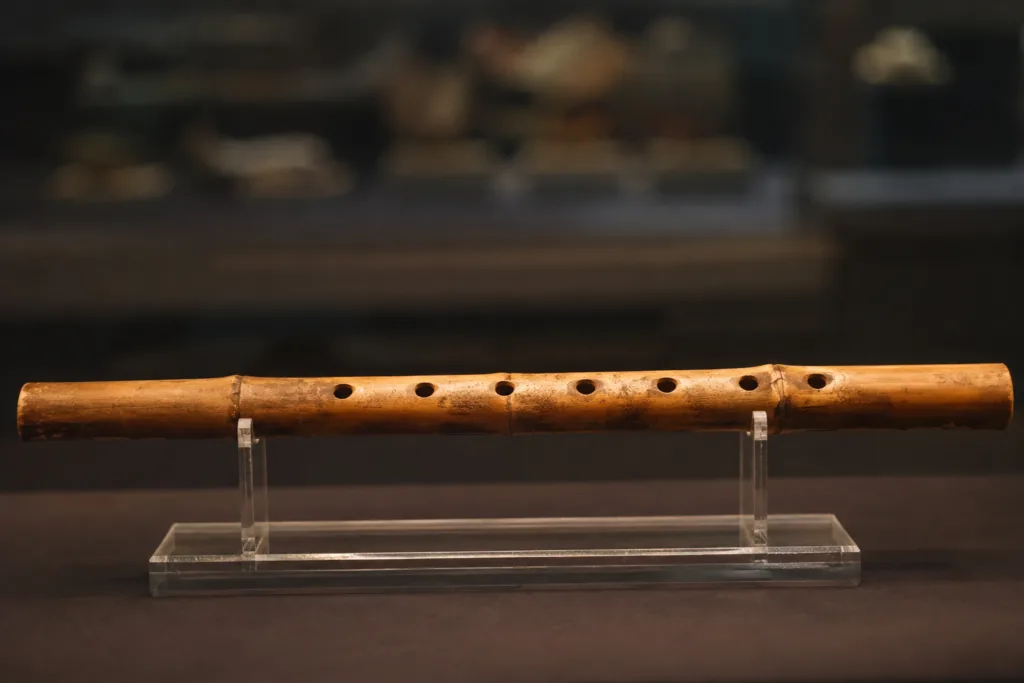
The Baekje transverse flute from Gwanbuk-ri is a damaged bamboo side-blown flute recovered from the palace area of Sabi, Baekje’s final capital in present-day Buyeo, South Korea. The surviving artifact is 22.4 cm long and preserves an embouchure opening and three finger holes, while research-based reconstruction suggests that the complete instrument was longer and carried additional holes.
What the Gwanbuk-ri Flute Is
The instrument was recovered during excavation of the Gwanbuk-ri archaeological site in Buyeo, an area widely identified with the royal palace of Sabi-period Baekje. Baekje moved its capital to Sabi in 538 and remained there until the kingdom fell in 660.
The bamboo object was not found intact. It had been crushed and flattened, and one portion of the tube was missing. Even in that condition, investigators could distinguish deliberately formed openings rather than accidental cracks or natural damage in the bamboo.
X-ray examination and the arrangement of the openings supported its identification as a transverse flute: an instrument held sideways so that the player directs air across an embouchure opening. Korean researchers describe it as a hoengjeok, a term referring to a horizontally played flute.
The find gives researchers something that texts and artistic representations cannot provide on their own: the physical spacing of holes, preserved bamboo dimensions, construction traces and an archaeological object that can be measured for reconstruction work.
What We Know: The excavated object itself measures 22.4 cm. That is the surviving length, not the confirmed original length of the complete flute. Estimates of a roughly 31–32 cm instrument with additional finger holes belong to the reconstruction process.
What Survived of the Instrument
The surviving bamboo tube preserves four clearly recognizable openings in total: one interpreted as the embouchure hole and three as finger holes. A broken end shows that part of the original instrument is missing.
| Feature | Status | What Can Be Said |
|---|---|---|
| Material | Observed | The surviving instrument body is bamboo. |
| Surviving length | Observed | The excavated section measures 22.4 cm. |
| Embouchure | Observed and interpreted | One preserved opening is identified as the blowing hole. |
| Finger holes | Partly observed | Three finger holes survive on the excavated section. |
| Original length | Reconstructed | Researchers have proposed a complete length of about 31–32 cm. |
| Original hole count | Reconstructed | A six-finger-hole form has been proposed using the surviving layout and historical comparison. |
| Original owner | Unknown | No surviving evidence identifies a particular player. |
This distinction matters because the reconstructed flute is more complete than the archaeological object. A playable replica can test a hypothesis about the instrument’s form, but the added section and missing holes are not pieces that were physically excavated.
Why Researchers Identify It as a Transverse Flute
The Position of the Blowing Hole
A transverse flute produces sound when the player directs a narrow stream of air across the edge of an opening cut into the side of the tube. The location of the probable embouchure on the Gwanbuk-ri object fits this arrangement better than a flute designed to be blown through one end.
X-Ray Evidence and the Closed End
Non-destructive examination helped researchers study features that were difficult to read from the flattened exterior alone. Analysis indicated a closed end near the blowing area, supporting the interpretation of a side-blown instrument rather than a simple end-blown pipe.
Finger-Hole Placement
The surviving finger holes follow the tube in a controlled sequence. Their spacing provides data for estimating how much of the lower portion is missing and for testing possible complete forms.
Air Crosses the Embouchure Edge
The player blows across, rather than directly into, the opening. The air jet interacts with the edge of the hole and excites the air column inside the bamboo tube.
The Bamboo Tube Acts as the Resonating Air Column
Tube length, internal diameter, wall geometry and the position of the openings influence the frequencies that the instrument can produce.
Finger Holes Change the Effective Tube Length
Opening and closing tone holes changes the acoustic length of the vibrating air column, allowing different pitches to be produced.
The Missing Section and the 31–32 cm Reconstruction
The broken condition of the artifact creates one of the central problems in studying it. The 22.4 cm piece cannot be treated as a complete musical tube because the surviving edge shows that more material originally extended beyond it.
Researchers have used the physical layout of the preserved openings together with historical descriptions, including material associated with the Samguk Sagi, to propose a complete flute measuring approximately 31–32 cm with six finger holes. A full-size reconstructed model was produced from these estimates.
The reconstruction is useful because a physical model allows researchers to examine reach, finger spacing, possible pitch relationships and the behavior of the air column. It remains a model. Small changes in bore diameter, hole size, wall thickness or the length of the missing portion can affect pitch and response.
What Bamboo Tells Us About Its Construction
Bamboo is naturally suited to flute construction because its hollow culm forms a lightweight tube with a relatively regular bore. Natural nodes can close or divide sections of the tube, while the wall provides enough thickness for carefully cut embouchure and finger holes.
For a transverse flute, the material is only one part of the acoustic system. The diameter of the bore, distance between openings, dimensions of the embouchure and total vibrating length all affect how easily notes speak and where their pitches fall. Because the Gwanbuk-ri bamboo has been flattened after burial, measurements taken from the artifact must be interpreted with its deformation in mind.
This is also why assigning a precise ancient timbre would go beyond the evidence. A reconstructed bamboo flute may reveal plausible acoustic behavior, but it cannot reproduce every original variable after roughly fourteen centuries of burial and damage.
How the Reconstructed Flute May Have Sounded
The original instrument cannot be played, so its sound is studied through reconstructed models. Experiments with a life-size replica indicate that the flute can function as a playable transverse instrument rather than merely resembling one visually.
A musician who demonstrated the reconstructed model described it as operating in a lower register than the modern sogeum and with a narrower usable range. That observation belongs specifically to the replica tested under modern playing conditions. It should not be treated as an exact recording of Baekje-era tuning, pitch standard or performance practice.
Changes of only a few millimeters in tone-hole placement or reconstructed tube length can shift tuning. Embouchure shape and the player’s air angle also influence response and pitch, so acoustic testing is most useful for identifying plausible behavior rather than declaring a single exact historical sound.
Common Confusion: The Gwanbuk-ri flute is often compared with the modern sogeum because both are transverse bamboo flutes. The comparison does not establish that the archaeological instrument was a modern-style sogeum or that the two instruments had identical tuning, dimensions or playing technique.
Gwanbuk-ri Flute and the Modern Sogeum
The sogeum offers a useful modern comparison because it demonstrates the same basic side-blown principle within Korean flute tradition. The resemblance is structural rather than proof of direct identity.
| Feature | Gwanbuk-ri Flute | Modern Sogeum |
|---|---|---|
| Playing position | Transverse | Transverse |
| Main body material | Bamboo | Typically bamboo |
| Evidence | Incomplete archaeological artifact | Living and directly playable instrument tradition |
| Complete dimensions | Partly reconstructed | Measurable on complete instruments |
| Hole layout | Three preserved finger holes; further holes reconstructed | Complete modern layout |
| Sound evidence | Studied through replicas | Directly playable and measurable |
The surviving Baekje object also differs from the sogeum in the relationship between its embouchure and finger-hole positions. Researchers therefore use the modern instrument as a comparison point, not as a template that automatically explains every feature of the archaeological flute.
Why the Flute Was Found in a Deep Pit
The archaeological context is unusual. The flute came from a rectangular pit near a structure interpreted as a jodang, a hall associated with state deliberation and official activity within the palace complex.
The pit measured roughly 2 meters by 1 meter and was about 2 meters deep. Analysis identified abundant human parasite eggs, and excavators also recovered wooden implements comparable with hygiene sticks found at other ancient toilet sites. Taken together, these findings support the interpretation that the pit functioned as a toilet connected with the administrative area.
What they do not explain is why the flute was there. It may have been discarded after breaking, lost accidentally or deposited under circumstances that can no longer be reconstructed. There is no evidence identifying a musician who owned it or showing that an individual deliberately threw it into the pit.
The location is still informative. A musical instrument recovered close to an official palace building places the object within an elite administrative setting, even though its precise use within that setting remains unresolved.
Was It a Baekje Court Instrument?
The Gwanbuk-ri site makes a court connection plausible, but the wording needs care. The flute was recovered inside a palace complex associated with Sabi-period government activity, and its context lies close to a hall linked with official affairs.
That does not prove that the instrument belonged to the king, to a named court musician or exclusively to a palace ensemble. Archaeological location can establish context more confidently than ownership.
The object is therefore best understood as physical evidence for transverse-flute use within the environment of the Baekje capital and palace. More specific claims about repertoire, ceremony or individual performers remain unsupported.
A Different Flute from the One Shown on the Baekje Incense Burner
Baekje musical instruments were already known from visual evidence before the Gwanbuk-ri discovery. The famous Baekje gilt-bronze incense burner includes musician figures, including a player holding a wind instrument.
The depicted pipe is held vertically. The Gwanbuk-ri instrument, by contrast, is interpreted from its physical construction as a flute held sideways.
This difference is useful because it cautions against reducing Baekje wind music to a single flute form. Artistic and archaeological evidence together suggest that musicians could have used more than one type of blown instrument, even when the exact historical names and playing systems cannot always be matched securely.
Baekje, Japan, and Early Transverse Flutes
The Gwanbuk-ri flute is also being examined within a wider East Asian context. Archaeological transverse bamboo flutes are known from Japan, including later examples associated with sites in Miyagi and Fukushima. Researchers have compared these objects with the Baekje instrument to study construction and possible channels of musical exchange.
Historical records also describe Baekje musicians and musical traditions reaching the Japanese court. The newly excavated flute adds physical evidence that can be placed beside those written accounts.
Similarity alone cannot establish a simple line of descent from one instrument to another. Bamboo construction, transverse playing position and tone-hole layouts can be compared in detail, but cultural transmission requires archaeological, documentary and chronological evidence to be considered together.
How the Dating Was Established
The flute is commonly described as a seventh-century Baekje instrument, but the archaeological dating has more nuance. Radiocarbon analysis of material associated with the find produced a range of approximately 568–642 CE.
That range covers the late sixth century and the first half of the seventh century. It places the instrument securely within the Sabi period, while avoiding the claim that the bamboo itself can be assigned to one exact year.
This distinction is useful when describing ancient organic artifacts. Archaeological dating normally provides a supported period or range rather than a maker’s date comparable with the label inside a later historical instrument.
From Excavated Fragment to Playable Reconstruction
Reconstructing the flute requires several different forms of evidence. The surviving bamboo provides direct measurements, the broken end indicates lost material, imaging reveals structural details, historical descriptions offer comparative information, and replica testing shows whether a proposed form behaves like a functional flute.
A successful reconstruction does not mean every missing dimension has been recovered with certainty. Instead, it creates a testable physical interpretation. Researchers can change the estimated length, hole placement or bore geometry and observe how those choices affect fingering and acoustic behavior.
This approach turns the Gwanbuk-ri find into more than a display object. It provides measurable data for experimental work on Baekje instrument construction and performance possibilities.
The 2026 Research Has Moved Beyond Identification
The initial public presentation in February 2026 focused on identification, archaeological context and the first reconstructed model. Research continued after the announcement.
In July 2026, the Buyeo National Research Institute of Cultural Heritage hosted an international academic meeting devoted to musical instruments and wooden tablets from Gwanbuk-ri. Korean and Japanese specialists examined the flute’s origins, structure, acoustic properties and reconstruction, together with comparisons to ancient Japanese transverse flutes.
The meeting shows that several questions remain open. The complete original dimensions, acoustic behavior, relationship to other East Asian flute traditions and the best reconstruction method are research subjects rather than settled details.
Baekje moved its capital from Ungjin to Sabi, the city associated with present-day Buyeo.
Dating of associated archaeological material places the flute within this broad Sabi-period range.
The 16th excavation campaign at Gwanbuk-ri recovered the bamboo flute along with 329 wooden tablets.
The flute and its reconstructed model were publicly presented, drawing attention to the first known physical Baekje bamboo transverse flute.
An international research meeting examined its construction, acoustics, reconstruction and relationship to other East Asian transverse flutes.
What the Artifact Can and Cannot Tell Us About Baekje Music
Bamboo material, surviving tube length, preserved openings, deformation, broken edges and construction details can be examined directly on the archaeological object.
The arrangement of the embouchure and finger holes supports identification as a transverse flute used within the Sabi-period Baekje environment.
The proposed complete length, missing finger holes and playable acoustic form depend partly on reconstruction rather than surviving material alone.
The exact owner, repertoire, tuning standard, performance occasion, original tone and reason the damaged flute entered the pit remain unknown.
Before this find, evidence for Baekje wind instruments depended heavily on written accounts and visual representations. The Gwanbuk-ri flute adds a physical tube whose dimensions and hole spacing can be studied experimentally.
It does not reveal a complete Baekje musical system. It provides something narrower and more concrete: an excavated instrument that allows hypotheses about construction, fingering and acoustics to be tested against surviving material.
Mini FAQ
How old is the Gwanbuk-ri Baekje flute?
Associated archaeological dating gives a range of approximately 568–642 CE. It is generally described as a seventh-century Baekje flute because it belongs to the Sabi-period context and much of that range falls within the seventh century.
Is 22.4 cm the flute’s original length?
No. The excavated fragment measures 22.4 cm, but one end is broken. Researchers have proposed a complete length of roughly 31–32 cm for the reconstructed instrument.
How many finger holes were found?
Three finger holes survive clearly on the archaeological object, along with one embouchure opening. A six-finger-hole complete form belongs to the reconstruction proposed for the missing portion.
Is the Baekje flute the same instrument as a modern sogeum?
No. Both are transverse bamboo flutes, which makes comparison useful, but their hole arrangement, dimensions and acoustic behavior should not be assumed to be identical.
Can researchers know exactly what the original flute sounded like?
No. Playable replicas can test likely acoustic behavior, but the original flute is incomplete and deformed. Reconstructed dimensions, player technique and other variables prevent an exact recovery of its ancient sound.
Why was the flute found in what may have been a toilet?
The pit contained evidence consistent with toilet use, including human parasite eggs and hygiene-related wooden objects. How the broken flute entered the pit is unknown.