
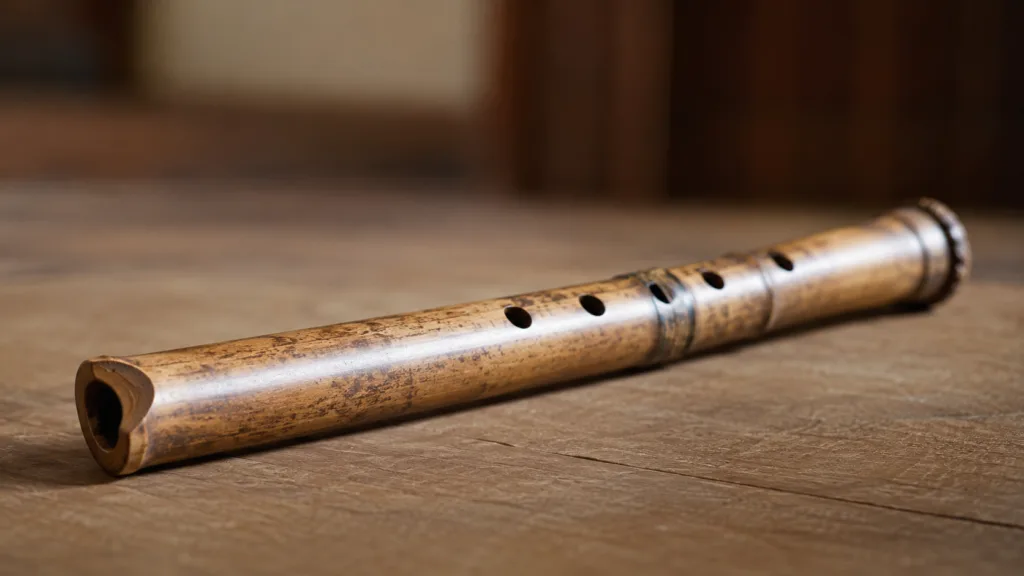
Instrument Snapshot
The shakuhachi is a Japanese end-blown bamboo flute known for its breathy tone, flexible pitch, and close link with Zen Buddhist practice. It is played in solo honkyoku pieces, traditional Japanese ensembles, contemporary composition, film music, and meditative performance.
What the Shakuhachi Is
The shakuhachi is a vertical flute played by blowing across a cut edge at the top of the bamboo tube. Unlike a recorder or whistle, it has no fipple mouthpiece to direct the air. The player shapes the sound with the lips, breath angle, jaw position, head movement, and finger-hole coverage.
Most traditional shakuhachi have five finger holes: four on the front and one thumb hole on the back. This simple layout does not make the instrument limited. Through half-holing, breath control, and head movement, skilled players can produce chromatic notes, pitch bends, ornaments, and wide tone changes.
The name is linked to the length of the common instrument: isshaku hassun, or one shaku and eight sun. In practical terms, the standard 1.8 shakuhachi is commonly treated as a D instrument, though shakuhachi are made in many lengths and tunings.
Main Features
| Feature | What It Means for the Player |
|---|---|
| End-blown design | The sound depends heavily on breath angle and lip control, making tone production personal and expressive. |
| Five-hole layout | The basic finger system is visually simple, but pitch control requires refined embouchure and partial hole coverage. |
| Bamboo body | Wall thickness, bore shape, node placement, and root-end density all affect resonance and response. |
| Open blowing edge | The player can move between pure notes, airy noise, pitch bends, and breath-textured attacks. |
| Meri and kari | Lowering or raising the head changes pitch and color, giving the flute its vocal, sliding quality. |
| Honkyoku tradition | Solo pieces often treat breath, silence, and tone shape as musical material, not just melody. |
History and Zen Background
The shakuhachi has older roots in East Asian flute culture, but the instrument recognized today is strongly tied to Japan. Earlier bamboo flutes appeared in court and religious settings, while the later Fuke-style shakuhachi became associated with Zen practice, wandering players, and solo meditative repertoire.
During the Edo period, the shakuhachi was closely linked with komusō, mendicant members of the Fuke tradition often remembered for their basket-like tengai hats and their use of the flute as a spiritual practice. Their music was not only entertainment. In that setting, blowing the flute could function as suizen, or blowing meditation.
The Fuke sect was later abolished in the Meiji period, and the shakuhachi moved more openly into secular performance, teaching lineages, ensemble playing, and new composition. Modern shakuhachi culture now includes classical honkyoku, sankyoku chamber music, folk settings, jazz, contemporary concert music, and film scoring.
What We Know: The Zen image of the shakuhachi is real, but it should not be treated as the instrument’s only identity. The same flute can be a meditation tool, a concert instrument, a folk instrument, a collector object, or a modern composer’s color source.
Historical Development
Bamboo flutes connected with court and religious music helped create the setting in which later shakuhachi forms developed.
Different lengths and designs existed before the modern five-hole Fuke shakuhachi became dominant.
The shakuhachi became strongly linked with komusō players, Fuke Zen practice, honkyoku pieces, and the root-end bamboo style.
Religious restrictions changed, and the instrument entered broader public music life through teaching, performance, and new schools.
Players now use shakuhachi in classical Japanese repertoire, solo concerts, cross-cultural projects, recording studios, and contemporary composition.
Anatomy and Build
A traditional shakuhachi is often made from madake bamboo, especially a thick-walled section that may include the root end. This root-end construction can give the lower part of the flute extra mass, an uneven natural shape, and a bore that responds differently from a straight tube.
The top edge is cut into a blowing notch called the utaguchi. Many instruments reinforce this edge with horn, bone, or another hard material, though details vary by maker and school. The bore may be left more natural in some styles or carefully shaped and lacquered in others.
| Part | Function | Effect on Sound |
|---|---|---|
| Utaguchi | Blowing edge at the top of the flute | Controls attack, clarity, pitch response, and breath noise |
| Finger holes | Four front holes and one thumb hole on many traditional models | Set the basic pitch pattern and allow partial-hole shading |
| Bore | Internal air channel through the bamboo | Affects tuning, resistance, resonance, and register balance |
| Root end | Dense lower bamboo section used on many traditional instruments | Can add weight, depth, and a grounded low-register feel |
| Nodes | Natural bamboo divisions | Influence construction, bore shaping, and visual character |
| Interior finish | Natural or shaped surface inside the bore | Changes response, projection, tuning stability, and tonal focus |
Materials and Sound Character
Bamboo does more than provide the instrument’s shape. Its density, age, wall thickness, dryness, and internal geometry affect how quickly the note speaks and how much resistance the player feels. Two shakuhachi with the same length can respond very differently.
A thicker flute may feel more stable and weighty, while a lighter flute may answer faster but offer less depth in the lower notes. Interior work also matters. A bore shaped for concert tuning may feel cleaner and more even, while a more natural bore may have a rougher, older voice with extra grain and resistance.
These listening bars describe common tonal tendencies, not laboratory measurements. Individual instruments vary by maker, length, bore, and player technique.
How It Produces Sound
The shakuhachi produces sound when the player directs a narrow stream of air against the utaguchi. Part of the air enters the flute and part passes over the edge, setting the air column inside the bamboo into vibration.
This exposed blowing system is why the instrument can sound clear, airy, rough, soft, or sharply focused. A small change in angle can shift the pitch, weaken the note, brighten the tone, or add breath texture. For beginners, the first challenge is not fingering. It is producing a steady note at all.
Set the Mouth Position
The lower lip rests near the blowing edge while the flute angles downward. The exact position varies by player and instrument.
Shape a Narrow Air Stream
The lips form a controlled opening, directing air across the utaguchi rather than into a fixed mouthpiece.
Balance Breath and Angle
Too much air can make the tone noisy; too little air may fail to start the note. Angle and pressure must work together.
Use the Head to Bend Pitch
Lowering the head creates meri notes; raising the head creates kari notes. These movements also change color and intensity.
Zen, Honkyoku, and Breath
In the honkyoku tradition, the shakuhachi is often treated as a solo voice. Long notes, silence, breath attacks, ornaments, and small pitch movements carry much of the meaning. The music may feel spacious, but it is not empty. The player listens to the start, body, and decay of each tone.
The Zen link is strongest in pieces associated with Fuke practice and komusō transmission. These pieces often value tone quality, breath awareness, and phrase shape over fast display. A single note can include a soft opening, a focused center, a pitch bend, and a fading tail.
Common Confusion: Shakuhachi music is not always slow meditation music. The instrument also appears in ensemble settings, folk-influenced playing, modern chamber music, jazz projects, and soundtracks.
Playing Feel and Beginner Technique
The shakuhachi can feel difficult at first because it gives the player no mechanical help at the mouthpiece. A beginner may spend early practice sessions searching for a stable tone. This is normal. Once the sound starts, the player begins learning how much the flute responds to tiny changes in posture and breath.
The basic fingering system is easier to see than to master. Covering holes cleanly matters, but the real character of the instrument comes from meri, kari, breath pressure, ornaments, and tone color. A plain note and an expressive shakuhachi note are not the same thing.
Player Tip: Early practice should favor a quiet, repeatable tone over loud playing. A smaller, steadier air stream usually teaches more than forcing volume.
Beginner Practice Priorities
- Produce one stable open note before rushing into scales.
- Keep the shoulders relaxed so breath can move freely.
- Check that each finger hole is fully sealed before blaming the flute.
- Practice low notes slowly; they reveal breath control problems quickly.
- Learn meri and kari as tone-color movements, not only pitch tricks.
- Use short daily sessions instead of long sessions with tense lips.
Meri, Kari, and Pitch Shading
Meri and kari are central to shakuhachi expression. In simple terms, meri lowers the pitch by changing the head angle and embouchure, while kari raises or opens the pitch. These actions also change the tone. A meri note often sounds darker, more covered, and more inward; a kari note can sound clearer and more open.
This is one reason Western staff notation does not fully explain shakuhachi playing. The written pitch may be only part of the event. The path into the pitch, the breath noise, the bending motion, and the decay can be just as important.
| Concept | Plain Meaning | Musical Result |
|---|---|---|
| Meri | Lowering the pitch through head and embouchure adjustment | Darker tone, lower pitch, shaded expression |
| Kari | Opening or raising the pitch through angle and breath position | Clearer tone, brighter pitch center, stronger projection |
| Half-holing | Partially covering a finger hole | Intermediate pitches, bends, and ornamental movement |
| Overblowing | Using breath speed and angle to reach a higher register | Octave shifts, brighter tone, added intensity |
| Breath attack | Starting a note with controlled air rather than a tongued attack | Soft bloom, grainy entrance, or sharper note start depending on style |
Traditional Use and Musical Context
The shakuhachi is strongly associated with honkyoku, the solo repertoire connected with older Zen-based practice. These pieces often use space, asymmetrical phrasing, and detailed tone shaping. They are not built around the same expectations as Western flute melodies or fast folk tunes.
The instrument also appears in sankyoku, a chamber setting often involving koto and shamisen. In this role, the shakuhachi must blend, answer, and support melodic lines rather than stand alone as a meditative voice. The same flute can therefore feel private in one piece and conversational in another.
Modern players have expanded the instrument into orchestral works, electroacoustic music, jazz, ambient music, and cinema. Its breathy attack and pitch flexibility make it useful when a composer wants a tone that can move between note and noise without sounding artificial.
Similar Instruments
A Japanese end-blown bamboo flute with a notched blowing edge, flexible pitch, and a strong solo repertoire. Best for players interested in breath control, tone color, Japanese music, and expressive pitch movement.
A duct flute with a fixed windway that directs the air for the player. Easier to sound at first, but less flexible in raw breath shading and pitch bending.
A Chinese vertical bamboo flute with its own construction, repertoire, and tone world. It shares the end-blown principle but should not be treated as the same instrument.
A transverse metal flute with keys, strong projection, and a different embouchure angle. It offers even chromatic control but a different relationship to breath noise and finger shading.
Buying or Collector Notes
A good shakuhachi is not judged only by age, color, or visible bamboo roots. Playability matters. Tuning, response, bore condition, cracks, mouthpiece wear, and register balance are more important than a dramatic exterior.
Beginners often do better with a reliable student instrument than a fragile antique. Bamboo has character, but it can crack when humidity changes. Synthetic or wooden practice instruments may lack some traditional appeal, yet they can be stable, affordable, and easier to maintain for early learning.
Collector’s Note: A visually beautiful root-end shakuhachi is not automatically a strong player’s instrument. Inspection should include the utaguchi, bore, cracks, joint fit if present, tuning behavior, and response across registers.
Inspection Checklist
- Look for cracks near the finger holes, root end, and mouthpiece.
- Check whether any binding or repair is stable rather than cosmetic.
- Examine the utaguchi for chips, uneven wear, or poor repair work.
- Confirm the instrument’s length and pitch before buying.
- Ask whether the bore is natural, shaped, lacquered, or repaired.
- For playing use, prioritize response and tuning over decorative appearance.
Care and Storage
Bamboo reacts to dryness, heat, and sudden humidity changes. A shakuhachi should not be left in direct sun, near heaters, inside a hot car, or in very dry indoor air for long periods. Cracking is one of the main risks with bamboo flutes.
After playing, moisture should be removed gently with a suitable swab or cloth. The outside can be wiped with a dry soft cloth. Strong cleaners, oils, and aggressive polishing can damage the surface, binding, lacquer, or mouthpiece area.
Care Warning: Do not soak a bamboo shakuhachi or treat it like a washable plastic flute. Water, heat, and rapid drying can damage bamboo and repairs.
| Care Area | Safe Habit | Avoid |
|---|---|---|
| Moisture | Swab gently after playing and let the flute air naturally. | Sealing the wet flute in a case for long periods. |
| Temperature | Store away from direct sun and heaters. | Hot cars, radiators, and sudden heat changes. |
| Humidity | Keep conditions moderate and stable where possible. | Very dry rooms followed by sudden damp conditions. |
| Cleaning | Use a soft cloth and instrument-safe swab. | Alcohol, harsh cleaners, soaking, or abrasive polishing. |
| Handling | Protect the utaguchi and finger-hole edges. | Dropping the flute mouthpiece-first or storing it loose in a bag. |
Who the Shakuhachi Suits
You enjoy slow tone work, breath awareness, Japanese music, flexible pitch, and instruments where small physical changes matter.
You want instant sound production, fixed tuning with little pitch movement, or a beginner instrument that behaves the same way every day.
Learn to produce a stable tone on several basic fingerings before focusing on repertoire speed or ornament details.
The instrument teaches breath control, listening patience, pitch awareness, and a close link between body position and musical color.
Mini FAQ
Is the shakuhachi hard to play?
It can be hard at the beginning because the player must create the sound without a fixed mouthpiece. The first stable note may take time, but the finger layout is not visually complex.
Is the shakuhachi only used for Zen meditation?
No. Zen and honkyoku are central to its history, but the shakuhachi is also used in chamber music, folk settings, modern composition, jazz, ambient music, and film scoring.
Why does the shakuhachi have only five holes?
The traditional five-hole system gives a basic pitch set, while meri, kari, half-holing, and embouchure changes allow many additional pitches and tone colors.
What is a 1.8 shakuhachi?
A 1.8 shakuhachi refers to the common length of one shaku and eight sun, often about 54.5 cm. It is commonly associated with D as its base pitch, though exact tuning depends on the maker and instrument.
Can beginners start with a synthetic shakuhachi?
Yes. A well-made synthetic or wooden student flute can be practical for early learning because it is usually more stable and less vulnerable to cracking than bamboo.
What should a buyer check before choosing a bamboo shakuhachi?
Check the utaguchi, cracks, bore condition, tuning, response, length, repair history, and whether the instrument is intended for playing, collecting, or display.