
Instrument Snapshot
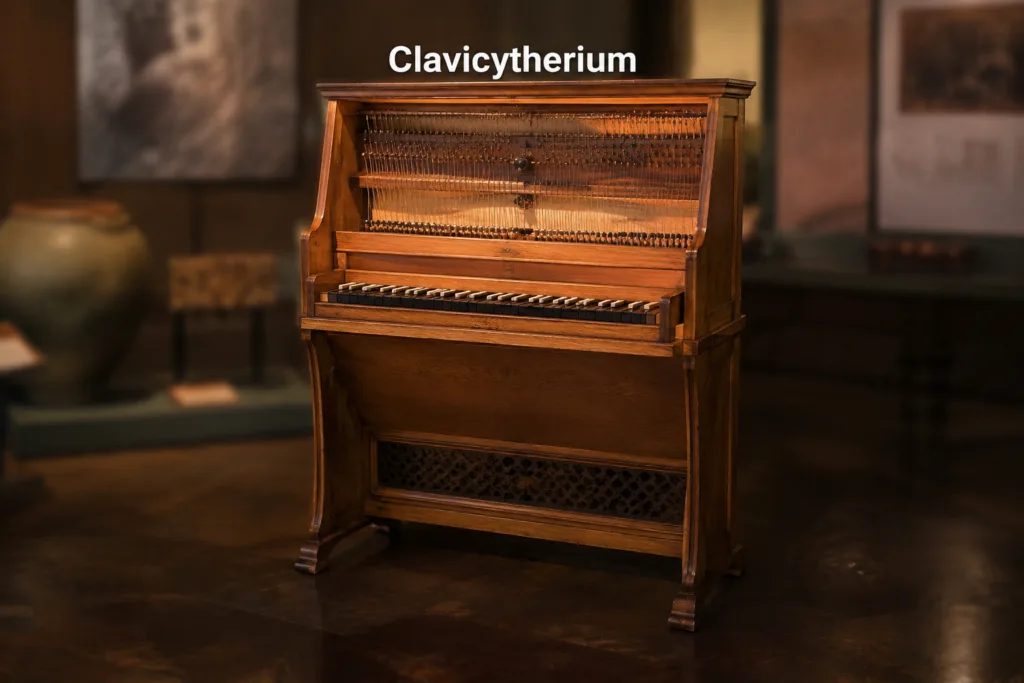
The clavicytherium is an upright form of harpsichord in which the strings and soundboard stand vertically rather than extending horizontally behind the keyboard. Its strings are still plucked by plectra, but turning the instrument upright creates a mechanical problem: the jacks can no longer rely on gravity in the same way as those of a conventional harpsichord.
A clavicytherium can look surprisingly modern from a distance because its tall case places the strings above the keyboard, much as an upright piano does. Mechanically, however, the resemblance is misleading. A piano strikes its strings with hammers. A clavicytherium belongs to the harpsichord family and produces a note when a plectrum plucks a string.
The vertical layout affects far more than appearance. In a conventional harpsichord, a jack rises when a key is pressed and can fall back under its own weight when the key is released. A clavicytherium turns much of this action sideways. Builders therefore had to devise ways to move and return the jacks reliably while keeping the plectrum, tongue, string and damper working together.
The best-known surviving clavicytherium is held by the Royal College of Music Museum in London. Long described as an instrument from around 1480, it has been reassessed through dendrochronological study, with the RCM now placing its manufacture at approximately 1470. That early instrument provides rare physical evidence for the design of plucked keyboard instruments in the late medieval period.
What Makes a Clavicytherium an Upright Harpsichord?
The defining feature is the orientation of the string plane. On a familiar wing-shaped harpsichord, the keyboard sits at one end while strings extend horizontally away from the player. On a clavicytherium, the long stringing area rises vertically above the keyboard.
The sound-producing principle remains harpsichord-like. Pressing a key sets an action in motion that causes a plectrum to pass across a string. The string vibrates, the bridge transfers that vibration to the soundboard, and the soundboard radiates the note into the surrounding air.
This distinction places the clavicytherium with plucked keyboard instruments rather than hammer-action instruments. Its unusual case geometry is a rearrangement of harpsichord technology, not an early version of the upright piano.
Common Confusion: Vertical strings do not make a clavicytherium a piano ancestor in the mechanical sense. Its strings are plucked rather than struck, so its closest relationship is with the harpsichord.
The Mechanical Problem Hidden Inside the Upright Case
Turning the string plane upright changes the direction in which the action must operate. This creates one of the most interesting engineering problems in the instrument.
The Key Is Pressed
The player depresses the front of a key. The rear portion of the key or an attached linkage transfers that motion toward the jack system.
The Jack Moves Toward the String
Instead of simply rising vertically as in a conventional harpsichord, the upright geometry requires the action to redirect the movement. The exact arrangement differs between surviving instruments and later designs.
The Plectrum Plucks
A small plectrum mounted in the jack catches the string and releases it. The note begins with the quick, defined attack associated with plucked keyboard instruments.
The String Vibrates Through the Bridge
The vibrating string transfers energy through the bridge into the wooden soundboard. The soundboard provides the radiating surface that gives the instrument useful acoustic output.
The Action Must Return
When the key is released, the jack has to return without plucking the string strongly a second time. Because its movement is not assisted by gravity in the same manner as a normal harpsichord jack, builders used mechanical return solutions suited to the upright action.
Anatomy of the Clavicytherium
Historical examples are not mechanically identical, yet several parts define the basic system. Their arrangement explains why a clavicytherium can share the sound principle of a harpsichord while requiring very different action geometry.
| Part | Function | Why It Matters in the Upright Design |
|---|---|---|
| Keyboard | Controls the individual notes through levers. | Its motion must be transferred toward an action positioned against a vertical string plane. |
| Jacks | Carry the plectra that activate the strings. | Their movement and return system are among the main mechanical differences from a horizontal harpsichord. |
| Plectra | Pluck the strings as the action moves. | Their material, stiffness and adjustment affect attack and reliability. |
| Strings | Generate the primary vibration. | They run vertically through the tall case rather than horizontally behind the keyboard. |
| Bridge | Transfers string vibration to the soundboard. | Its position and shape are tied to string length and the layout of the vertical soundboard. |
| Soundboard | Radiates and reinforces the vibrations transmitted by the strings. | It becomes a large vertical acoustic surface within the case. |
| Return Mechanism | Helps the action return after a note is released. | It compensates for the reduced help of gravity in a sideways or redirected jack movement. |
Why Gravity Matters to the Action
A normal harpsichord jack works in a mechanically convenient direction. When the player presses a key, the rear of the key lifts the jack. The plectrum passes the string on the way up. When the key is released, the jack drops again, while the pivoting tongue allows the plectrum to pass the string without producing another full pluck.
That straightforward vertical return cannot simply be copied into an upright instrument. The clavicytherium places the strings perpendicular to the key levers, forcing the action to redirect movement. A builder must therefore control both the forward motion toward the string and the return away from it.
Different clavicytheria solved this problem in different ways. Later instruments could use springs or more elaborate linkages. The early 17th-century Italian clavicytherium now in The Metropolitan Museum of Art, for example, has jacks fitted with brass leaf springs. Such details show that the name clavicytherium describes a family of upright harpsichord solutions rather than one frozen mechanical pattern.
The c. 1470 Royal College of Music Clavicytherium
The anonymous clavicytherium at the Royal College of Music Museum is central to the history of the instrument because it is regarded there as the earliest surviving stringed keyboard instrument. It is associated with southern Germany and preserves physical evidence from a period in which complete keyboard instruments are exceptionally scarce.
For many years the instrument was commonly dated to around 1480. More recent dendrochronological work examined the growth-ring patterns in its wood and provided evidence supporting a manufacturing date of approximately 1470.
What We Know: The RCM clavicytherium is unsigned and does not carry a simple maker-and-date inscription that settles its origin. Its age and history are reconstructed through the surviving object, its timber, later documentary material inside the case and comparison with other historical evidence.
Why Older Descriptions May Still Say c. 1480
Museum catalogues and older publications can preserve earlier dating long after new research begins to refine an object’s chronology. For that reason, the same RCM clavicytherium may appear under dates such as c. 1480 in older material even though current RCM research supports approximately 1470.
The difference does not indicate that two separate famous early clavicytheria are being discussed. It reflects changing evidence for the dating of the same instrument.
What Dendrochronology Can Reveal
Dendrochronology compares patterns in annual tree growth rings. When enough usable rings survive, their sequence can be matched against established timber chronologies. This can help researchers determine when the wood was growing and place limits on when an object could have been made.
The method does not work like reading a printed manufacturing date. Timber can be stored before use, outer portions of a board may be removed, and different pieces of an instrument can have different histories. The value of the RCM study lies in adding physical dating evidence to an instrument whose chronology previously depended more heavily on other forms of assessment.
Was the Earliest Surviving Clavicytherium Made in Ulm?
Ulm is closely associated with discussions of the RCM instrument, but the connection requires careful wording. Documentary fragments found glued inside the case appear to come from a later repair. They point toward Ulm in southern Germany, yet they do not function as a surviving maker’s label.
The evidence allows more than one interpretation. The instrument may have been made in Ulm, or it may have travelled there by the early 16th century and received work there. Describing Ulm as a possible place of manufacture is therefore more accurate than presenting the city as proven fact.
This distinction matters because early keyboard instruments often survive with altered components, repairs and additions accumulated across generations. A piece of documentary material inside a case can reveal part of an object’s journey without necessarily identifying the workshop in which it was first built.
Body Shape, Soundboard and String Layout
The tall silhouette of a clavicytherium is a direct consequence of its stringing. Bass strings require greater sounding length than treble strings, so the case cannot simply be a narrow rectangular box with identical string lengths from top to bottom.
Many examples therefore preserve some form of the asymmetry familiar from wing-shaped harpsichords, although the shape is rearranged into a vertical format. Other surviving instruments place the working instrument inside a larger cabinet, allowing the exterior to resemble furniture while the string layout remains hidden behind doors or panels.
The soundboard is just as important as the strings themselves. A plucked string has little surface area and cannot move much air alone. Its vibration passes through the bridge into the soundboard, whose much larger area produces the audible acoustic response. Wood species, board thickness, bracing, bridge position, string scaling and the condition of the instrument all influence the resulting sound.
Historical clavicytheria vary enough that no single material recipe should be treated as universal. Surviving cases may use softwoods such as fir or related timbers for resonant structural areas, with denser woods appearing in keyboards and action components. Plectrum materials also differ across periods, restorations and reconstructions.
How a Clavicytherium Sounds
The note begins with a clear plucked attack rather than the rounded impact of a felt-covered piano hammer. The initial transient can be crisp and articulate, followed by a decay determined by string length, string material, soundboard response and the register being used.
Like other harpsichords, the clavicytherium offers little direct control of volume through how hard a single key is pressed. Pressing the key more forcefully does not make the plectrum progressively strike the string harder in the manner of a piano hammer. Differences in registration, articulation, timing and texture are therefore more important to musical shaping than touch-controlled loudness.
It is risky to describe every clavicytherium with one fixed tone profile. An instrument from the late 15th century, a cabinet clavicytherium from the early 17th century and a modern reconstruction may differ in stringing, scaling, plectra, registers, action setup and restoration history. Their shared identity comes from the upright plucked-keyboard concept, not from an identical voice.
Clavicytherium vs Harpsichord, Clavichord and Upright Piano
| Instrument | How the String Is Activated | Typical String Orientation | Direct Dynamic Control by Touch | Closest Mechanical Relationship |
|---|---|---|---|---|
| Clavicytherium | Plucked by a plectrum | Vertical | Very limited | Harpsichord |
| Harpsichord | Plucked by a plectrum | Horizontal | Very limited | Other plucked keyboard instruments |
| Clavichord | String contacted by a metal tangent | Horizontal | Yes, within a relatively quiet dynamic range | Clavichord family |
| Upright Piano | Struck by a hammer | Vertical | Yes | Piano |
The comparison with an upright piano is useful visually but weak mechanically. Both instruments save horizontal depth by placing their strings vertically, yet the similarity ends before the sound-producing action is considered.
The clavichord is also easy to confuse by name. A clavichord uses small metal tangents that contact its strings and can respond to differences in finger pressure. A clavicytherium plucks its strings and behaves much more like a harpsichord.
Why Build a Harpsichord Vertically?
An upright string plane changes the instrument’s footprint. A conventional harpsichord projects a long case into the room, while a clavicytherium places much of that length above the keyboard. This can reduce the amount of floor area occupied by the instrument.
Space alone should not be treated as a proven explanation for the invention of every clavicytherium. The upright arrangement also gave makers a different surface for visual design and encouraged experimentation with keyboard action geometry. Later cabinet instruments demonstrate how the working harpsichord could be integrated into decorative furniture.
The design came with a tradeoff. A smaller horizontal footprint required a more difficult action. Makers accepted the mechanical inconvenience because the upright format offered possibilities that a conventional wing-shaped case did not.
Clavicytheria Were Never a Single Standard Design
The RCM instrument is often treated as the defining clavicytherium because of its age, but later surviving instruments show that the idea continued to develop. The term does not describe one exact medieval blueprint copied unchanged for centuries.
An early 17th-century Italian clavicytherium in The Metropolitan Museum of Art illustrates the difference clearly. Its wing-shaped working instrument is built into a tall rectangular cabinet with painted doors. The museum records two 8-foot registers as well as jacks using brass leaf springs and leather plectra.
That arrangement is mechanically and visually different from the much earlier RCM instrument. The shared feature is the upright adaptation of plucked harpsichord technology. Case construction, decorative treatment, action details, registers and string layout could change substantially from one maker or period to another.
From the Late Middle Ages to Later Upright Harpsichords
The surviving South German clavicytherium now in the Royal College of Music Museum provides the earliest known physical example of the upright harpsichord concept and is regarded by the RCM as the earliest surviving stringed keyboard instrument.
Upright plucked keyboard construction remained part of the wider development of European keyboard instruments, although surviving complete examples from the earliest period are rare.
Surviving Italian examples show that the clavicytherium could be adapted into elaborate cabinet forms with multiple registers and spring-assisted action components.
Later makers continued to explore upright harpsichord actions, producing instruments whose mechanical arrangements could differ considerably from medieval examples.
Copies of early instruments allowed makers and performers to test action geometry, playing posture and possible performance practices without placing irreplaceable originals under regular playing stress.
What Could Have Been Played on an Early Clavicytherium?
There is no large, clearly separated medieval repertoire labelled exclusively for clavicytherium in the way a modern instrument can have a dedicated published literature. Early keyboard music also circulated in a culture where pieces, intabulations and improvisatory practices were not always tied to one exact keyboard type.
For that reason, assigning a surviving 15th-century keyboard composition to the clavicytherium simply because the dates overlap can go too far. More useful questions concern range, tuning, action response, available registers and whether the musical texture works convincingly on a reconstructed instrument.
Modern performance research uses replicas to investigate such questions. The Royal College of Music commissioned a copy of its early clavicytherium from Derek Adlam and Adlam Burnett between 1970 and 1973. That reconstruction and later copies make it possible to explore playing technique and repertoire without treating the original museum object as an ordinary concert instrument.
What a Reconstruction Can and Cannot Tell Us
A carefully researched copy can answer practical questions that photographs and measurements cannot. A player can feel key resistance, test the speed of the action, examine how quickly repeated notes speak and explore how the vertical mechanism behaves over a full piece of music.
A reconstruction can also expose design problems. If a return spring is too strong, touch may become heavy. If it is too weak, a jack may return slowly or unreliably. Plectrum stiffness changes the attack, while string choice and soundboard construction affect the instrument’s response.
None of this means that a modern copy reproduces the exact sound heard in the 15th century. Missing parts may need interpretation, historical materials can behave differently from modern substitutes, and surviving originals may themselves contain repairs or alterations. Reconstruction is best understood as a controlled way to test plausible historical solutions.
Why the Clavicytherium Matters in Keyboard Instrument History
The clavicytherium preserves evidence that late medieval keyboard making was capable of more than one case geometry. Builders were not limited to placing a conventional horizontal action inside a familiar box. They could rethink the path between key, jack, plectrum and string when the physical arrangement demanded it.
The RCM example is especially informative because of its age. A surviving instrument from around 1470 offers evidence that cannot be recovered from paintings or written descriptions alone: actual timber, stringing layout, bridge placement, keyboard construction and traces of alteration survive together in one object.
Later clavicytheria add another layer. Their spring systems, cabinet forms and register arrangements show that the upright harpsichord remained open to redesign. The instrument is therefore best understood as a recurring solution to the problem of building a vertically arranged plucked keyboard, rather than as one short-lived medieval curiosity.
Mini FAQ
What is a clavicytherium?
A clavicytherium is an upright harpsichord. Its strings and soundboard are arranged vertically, while its strings are plucked by plectra through a keyboard-operated action.
Is a clavicytherium the same as an upright piano?
No. Both can have vertically arranged strings, but an upright piano uses hammers to strike its strings. A clavicytherium plucks its strings and belongs to the harpsichord family.
How old is the earliest surviving clavicytherium?
The clavicytherium in the Royal College of Music Museum is currently dated to approximately 1470 following dendrochronological research. Older descriptions often place the same instrument around 1480.
Was the earliest clavicytherium made in Ulm?
Possibly, but the evidence does not prove it. Documentary fragments associated with a later repair connect the instrument with Ulm. It may have been made there or may have reached the city during its early history.
Why is the clavicytherium action unusual?
A normal harpsichord jack can rise and fall vertically, with gravity helping its return. In a clavicytherium, the upright string layout forces the action to redirect that movement, so builders need another way to return the jacks reliably.
Do all clavicytheria use the same mechanism?
No. Surviving instruments span different periods and workshops, and their return systems, registers, case forms, plectra and other mechanical details can differ. The shared feature is the upright adaptation of a plucked harpsichord action.