
Baryton: Bowed Viol, Resonating Wires, and Haydn’s Esterházy Repertoire
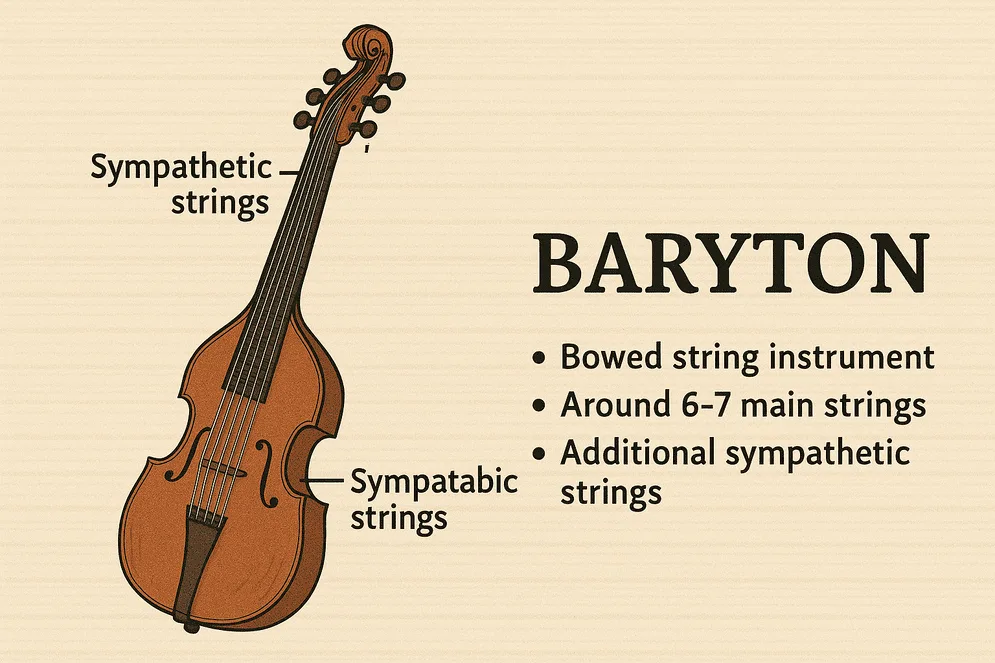
The baryton is a bass-register bowed chordophone related to the viola da gamba, distinguished by a second group of metal strings running behind the fingerboard. These strings can resonate sympathetically with the bowed notes and, on instruments designed for the technique, can also be plucked by the player’s left thumb. The result combines a viol-like bowed voice with a quieter metallic layer that can function as resonance, accompaniment, or both.
| Feature | Description |
|---|---|
| Instrument family | Bowed chordophone related to the viola da gamba, with additional metal strings behind the neck |
| Historical period | Documented from the 17th century; most strongly associated with 18th-century Central European court music |
| Bowed strings | Often six or seven gut strings, though historical instruments vary |
| Additional strings | Metal strings positioned behind the fingerboard; their number and arrangement vary considerably between surviving instruments |
| Playing position | Held between the legs in a manner comparable to a bass viol |
| Dual technique | Main strings are bowed while selected rear strings may be plucked with the left thumb |
| Best-known repertory | Closely associated with Prince Nikolaus Esterházy and Joseph Haydn, who wrote about 175 works involving the instrument |
What Separates the Baryton from an Ordinary Bass Viol
From the front, a baryton can resemble a bass viola da gamba. It has a deep wooden body, bowed gut strings, a long neck, and a low playing position. The unusual part sits largely behind the fingerboard: a bank of thin metal strings with a separate tuning system.
These rear strings can respond when a bowed note excites a matching or related frequency. Their resonance extends the decay and adds a fine metallic component around the main gut-string tone. The player can also reach behind the neck with the left thumb and pluck suitable strings directly, allowing a melodic bowed line and a second plucked texture to emerge from one instrument.
Common Confusion: Calling every rear baryton string simply a sympathetic string hides part of the instrument’s design. They can vibrate sympathetically, but historical baryton technique also uses accessible metal strings as directly plucked accompaniment strings.
Two String Systems Inside One Instrument
The upper string set carries the bowed musical line. These strings run over the fingerboard and bridge much like those of a viol. Below and behind them sits the second string system, usually made from metal and attached to its own tuning pins or pegs.
The rear of the neck is opened or hollowed so that the player’s thumb can reach the metal strings. Historical makers solved the routing and tuning problem in different ways. Some instruments have broad, pierced pegboxes, separate rows of tuning pins, special anchoring bars, or covered compartments incorporated into the neck.
A surviving 1715 baryton by Daniel Achatius Stadlmann in the Museum für Musikinstrumente der Universität Leipzig has six gut fingerboard strings and fifteen metal accompaniment strings. Its total length is documented as 129 cm. A later instrument attributed to Johann Joseph Stadlmann and dated 1779 in The Metropolitan Museum of Art carries seven bowed strings and twenty metal strings.
Those two instruments alone show why a fixed formula such as “six strings plus twelve sympathetic strings” is unreliable. String counts, total dimensions, tuning hardware, body construction, and the balance between resonance and direct plucking changed between makers and periods.
How the Metal Strings Change the Sound
When a bowed gut string vibrates, energy travels through the bridge and body. Rear strings tuned near frequencies present in that note can begin vibrating without being struck. This sympathetic response does not create a separate loud melody; it adds sustain and upper-frequency detail around the bowed tone.
Direct thumb plucking produces a clearer transient. The attack is faster and more metallic than the bowed strings, so even a short bass note or arpeggiated figure can remain perceptible beneath a sustained bowed phrase.
The baryton therefore has two related acoustic behaviors. Resonance occurs passively when the hidden strings answer the bowed system, while accompaniment occurs actively when the player plucks them. Their relative prominence depends on tuning, string material, setup, repertory, and the particular instrument.
From the Seventeenth Century to the Esterházy Court
The baryton was already established before its famous association with Haydn. The Royal College of Music identifies a 1647 instrument by Magnus Feldlen in its collection as the earliest surviving baryton. Its existence places the instrument firmly in the seventeenth century rather than making it solely an eighteenth-century invention.
The Royal College of Music preserves a baryton by Magnus Feldlen that it identifies as the earliest surviving example.
Daniel Achatius Stadlmann made the baryton now preserved in Leipzig, with six gut playing strings and fifteen metal strings.
Prince Nikolaus Esterházy’s enthusiasm for the baryton created an unusually concentrated repertory at the Esterházy court. Joseph Haydn supplied music suited to the prince’s instrument and chamber ensemble.
A baryton attributed to Johann Joseph Stadlmann survives in The Metropolitan Museum of Art with seven bowed strings and twenty metal strings.
Museums, performers, instrument makers, and early-music ensembles have reconstructed playable barytons so that surviving repertory can again be performed on an instrument with the intended string layout.
Prince Nikolaus Esterházy and Haydn’s Baryton Music
The baryton’s most documented period of patronage centers on Prince Nikolaus Esterházy, an enthusiastic player of the instrument. Joseph Haydn served the Esterházy family for decades and wrote extensively for his employer’s musical interests.
The Metropolitan Museum of Art states that Haydn wrote 175 pieces for Prince Nikolaus to play on the baryton. Much of this repertory places the baryton with viola and cello, giving the prince the featured part while the accompanying strings support and answer its melodic material.
More than one hundred of Haydn’s works are baryton trios, catalogued within Hoboken group XI. He also wrote other combinations involving the instrument. The amount of surviving music is unusual for an instrument that never became a standard member of the Classical orchestra.
The repertory also explains why the baryton cannot be understood only as an organological curiosity. Its rear strings were part of a working performance technique. Passages can exploit bowed melody, chordal or arpeggiated thumb-plucking, and the lingering response of metal strings within the same musical texture.
Documented Surviving Barytons
| Instrument | Date | Documented Features | Collection |
|---|---|---|---|
| Magnus Feldlen baryton | 1647 | Identified by the museum as the earliest surviving baryton; used as the basis for a modern playable replica | Royal College of Music Museum, London |
| Daniel Achatius Stadlmann baryton | 1715 | Six gut fingerboard strings, fifteen metal accompaniment strings, gamba-like body, total length 129 cm | Museum für Musikinstrumente der Universität Leipzig |
| Baryton attributed to Johann Joseph Stadlmann | 1779 | Seven bowed strings, twenty rear metal strings, 66.4 cm body, 72.3 cm bowed string length | The Metropolitan Museum of Art, New York |
The 1779 Metropolitan Museum instrument is particularly useful for examining the separation of the two string systems. Its twenty metal strings are arranged in two groups of ten, with copper and steel wires passing behind the fingerboard to their own supports and tuning hardware.
Museum records also remind us that surviving instruments can be altered. Parts may have been replaced, modified, or reconstructed during later centuries. Dimensions and current stringing therefore need to be read together with curatorial notes rather than treated automatically as untouched eighteenth-century specifications.
Playing Technique: Bow in the Right Hand, Plucked Strings in the Left
The right hand bows the upper strings while the left hand stops the notes on the fingerboard. The extra task falls to the left thumb, which reaches through the open rear side of the neck to pluck selected metal strings.
The main gut strings carry sustained melody, bass movement, and chord tones. Bow speed and pressure determine the attack and weight much as they do on a viol.
The left thumb can strike rear strings while the remaining fingers continue stopping the bowed strings. The technique permits bass notes, arpeggios, and short harmonic figures without a second player.
Metal strings not being plucked can still answer frequencies produced by the bowed system. Their tuning influences which notes create the strongest after-ring.
Because many strings can remain active at once, clean articulation depends partly on controlling unwanted resonance. The amount of damping needed changes with the instrument and musical passage.
Tuning Was Not One Fixed Standard
Historical baryton tuning is less uniform than the old page’s description of a general “D major pattern” suggests. Bowed-string tunings, the number of metal strings, and the pitches assigned to those strings varied with instrument design and repertory.
The rear strings could be arranged diatonically or otherwise selected to favor useful bass notes, chord tones, or resonances. Retuning them changes both what the thumb can reach musically and which bowed notes stimulate the strongest sympathetic response.
This makes surviving instruments and original repertory especially valuable to reconstruction. A modern maker cannot determine an authentic setup from body outline alone; string count, pitch range, tuning hardware, neck geometry, and the requirements of the music all matter.
Modern Reconstructions and Playable Copies
Original barytons are rare museum objects, and preservation requirements often prevent routine playing. Modern reconstruction allows musicians to test the relationship between Haydn’s notation and the instrument’s unusual mechanics without placing historical objects at risk.
The Royal College of Music acquired a playable copy of its early Magnus Feldlen baryton for its handling collection. Such replicas provide more than a visual impression. They allow researchers and performers to investigate thumb access, string spacing, bow clearance, resonance, tuning behavior, and the physical coordination required to operate both string systems.
Modern barytons are not automatically identical to one another. A reconstruction modeled on a seventeenth-century instrument may differ materially from one intended for the Esterházy repertory of the later eighteenth century. The source instrument should therefore be part of any description of a modern copy.
Baryton, Viola da Gamba, and Viola d’Amore
A bass-sized bowed instrument with additional metal strings behind the fingerboard. These can resonate sympathetically and may also be plucked directly with the left thumb.
Shares the between-the-legs playing position and much of the baryton’s viol ancestry, but a normal bass viol does not have the baryton’s accessible rear string bank.
Often combines bowed strings with sympathetic strings running beneath the fingerboard. Those sympathetic strings are normally left to resonate rather than being used as the baryton’s thumb-plucked accompaniment system.
Uses sympathetic strings beneath the bowed strings to enrich resonance. Its violin-family construction, tuning practice, repertory, and playing position are otherwise very different from the baryton.
Care and Setup
A reconstructed baryton combines the maintenance concerns of a historical bowed instrument with the added complexity of a second string system. Gut bowed strings react strongly to humidity, while numerous thin metal strings create additional tension points and tuning hardware that must remain stable.
- Check bridge position and bowed-string alignment before correcting problems by changing rear-string tension.
- Inspect metal strings for corrosion, kinks, and contact with neighboring strings or neck surfaces.
- Keep tuning pins and pegs functional without forcing historical-style fittings beyond their intended friction.
- Maintain stable humidity to reduce movement in the body, neck, fingerboard, and glued joints.
- Document the complete tuning before removing a large group of rear strings from a reconstruction.
Instrument Care: Surviving museum barytons may contain later repairs, replacements, or reconstructed components. Their setup should not be altered simply to reproduce a modern performing configuration.
Terminology
Baryton: Viol-related bowed chordophone with an additional bank of metal strings behind the fingerboard.
Sympathetic string: A string that begins vibrating in response to frequencies produced by another sounding string without being directly bowed or plucked.
Thumb-plucked strings: Rear baryton strings positioned so that the left thumb can reach and sound them directly during bowed playing.
Gut strings: Traditional bowed strings made from processed animal intestine and used on historical viol-family instruments.
Scordatura: A tuning that differs from another established or usual tuning in order to change fingering, resonance, available notes, or tonal response.
Baryton trio: Chamber scoring strongly associated with Haydn, normally combining baryton, viola, and cello.
Hob. XI: The Hoboken catalogue group containing Haydn’s baryton trios.
High-Quality Sources
- The Metropolitan Museum of Art — Baryton Attributed to Johann Joseph Stadlmann, 1779
- Musical Instrument Museums Online — Daniel Achatius Stadlmann Baryton, 1715
- Royal College of Music Museum — Historical Musical Instrument Collection
- Royal College of Music Museum — Documentation of the Playable Baryton Replica
- Haydn Festspiele — Joseph Haydn and Baryton Research