
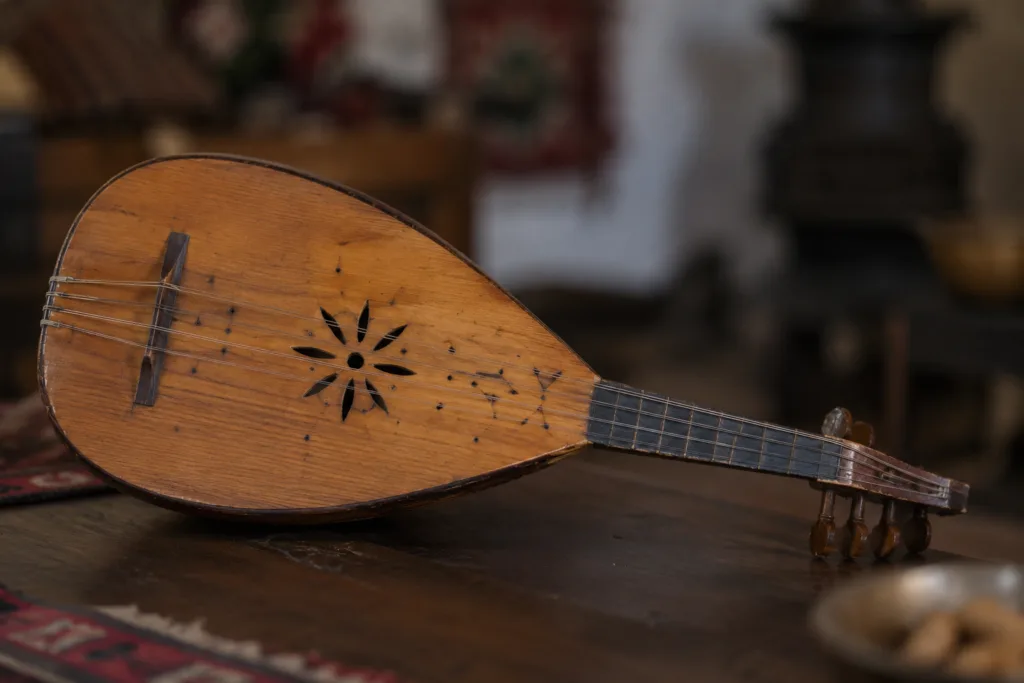
The cobza is a short-necked plucked lute associated especially with the traditional music of Romania and the Republic of Moldova. Its rounded rib-built body, very short neck, grouped strings and fast-decaying attack are closely tied to its musical role: shaping rhythm and harmony inside dance music, songs and small traditional ensembles rather than producing the long, sustained chordal texture expected from a guitar.
Traditional cobzas are not defined by one fixed string count or one universal setup. Historical and regional instruments differ in dimensions, stringing and tuning practice. A commonly documented configuration uses multiple strings organized into four courses, often tuned around D–A–D–G, while octave reinforcement inside a course can add extra weight to the sound. The result is a dry, grainy and immediately articulated accompaniment voice that fits the rhythmic language of Romanian and Moldovan folk performance.
The Construction That Gives the Cobza Its Character
The cobza belongs visually and acoustically to the lute family, but its proportions distinguish it from long-necked folk lutes and from guitar-like instruments. A broad bowl supplies the resonating air volume while the neck remains unusually short. That geometry favors grouped-string accompaniment and compact left-hand movement rather than an extended chromatic fingerboard.
A Rib-Built Bowl Rather Than a Flat Back
The resonator has a pyriform, or pear-shaped, outline and a convex back assembled from separate wooden staves or ribs. Traditional documentation from the Republic of Moldova describes walnut and maple among the woods used for these ribs. Individual makers may use other suitable hardwoods, so one species should not be treated as mandatory for every historical cobza.
The curved bowl does more than establish the instrument’s recognizable silhouette. Rib thickness, bowl depth, internal volume and the stiffness of the completed shell all influence how efficiently the soundboard is driven and how quickly the energy of a plucked course is dispersed.
The Flat Soundboard Carries Most of the Vibrational Work
A flat wooden top closes the rounded bowl. Spruce is documented in traditional construction and suits this role because a relatively light soundboard can respond quickly to repeated attacks. Cobzas may have decorative and functional openings arranged as rosettes, small pierced patterns or other local forms rather than one standardized sound-hole design.
This top-and-bowl relationship helps explain why the instrument can respond strongly at the moment of attack without producing the same long after-ring as many modern guitars. The cobza needs clarity between repeated strokes, especially when its accompaniment is subdividing a dance pulse.
Why the Neck Is So Short
The traditional neck is short, broad and commonly fretless. That makes sense when the instrument is understood through its musical task. The cobza historically serves rhythm, chord formation and accompaniment formulas; it was not built around a long fretted scale intended for extended single-note guitar-style fingering.
Later instruments may depart from this arrangement. Some modernized cobzas use a longer neck, frets or other changes intended to expand chromatic access and make the instrument easier to integrate into formal ensembles. Those instruments belong to the cobza’s modern development, but their construction should not be projected backward onto every village-made example.
The Angled Pegbox
At the end of the short neck, the pegbox bends noticeably backward. Traditional wooden tuning pegs and the grouped string layout give this area a dense appearance compared with the small size of the neck itself.
The steep pegbox is one of the fastest ways to recognize the Romanian-Moldovan cobza form. Combined with the rounded bowl and abbreviated neck, it creates a profile very different from a guitar, mandolin or long-necked Balkan lute.
String Count and Course Count Are Not the Same Thing
Describing a cobza simply as an “eight-string instrument” can be misleading. Traditional documentation includes instruments with 8 to 12 strings, while those strings are organized into grouped courses rather than treated as twelve independent melodic strings.
| Element | Traditional Pattern | What Can Vary |
|---|---|---|
| Total strings | Multiple strings rather than four single strings | Examples with 8–12 strings are documented |
| Course layout | Commonly organized around four main groups | Number of strings within each group can differ |
| Strings per course | Pairs and triple groupings occur | Setup depends on instrument and player |
| Octave reinforcement | A thicker string may reinforce a course below the thin string | Not every course must use the same arrangement |
| Tuning | D–A–D–G is a common documented reference | Regional and performer-specific alternatives occur |
The course structure matters acoustically. When two or three strings respond to one stroke, the attack becomes broader and denser than a single-string pluck. Small differences in gauge, octave placement and tuning inside the course contribute to the cobza’s textured chordal sound.
How D–A–D–G Tuning Works on a Multi-String Cobza
The tuning commonly written as D–A–D–G should be understood as a course-based tuning reference, not as proof that the instrument has only four strings. Romanian note names may present the same sequence as re–la–re–sol.
D
One course may contain more than one physical string.
A
Paired or grouped strings can reinforce the same harmonic function.
D
Octave reinforcement may change the internal voicing.
G
Exact setup can vary with instrument and performer.
This sequence provides a useful reference for understanding the instrument, but it is not a universal tuning law. Traditional cobza practice developed through local musicians, individual makers and ensemble needs. Pitch arrangement could be adapted to repertoire, the singer’s range, string gauges and the tonal center required by the group.
Common Confusion: D–A–D–G describes a widely documented cobza tuning pattern, not four individual strings and not the only acceptable tuning for every Romanian or Moldovan instrument.
Burdoaie and Octave Reinforcement
Traditional Moldovan documentation uses the term burdoaie for thicker strings that may be placed within a group and tuned an octave below a thinner string. This changes the way a chord speaks. The listener hears the immediate brightness of the thinner strings together with a lower reinforcement produced in the same stroke.
That arrangement adds weight without requiring long sustain. A course can therefore sound broad at the moment of attack and still leave rhythmic space for the next articulation.
Why the Cobza Sounds Dry, Fast and Rhythmic
A cobza is not expected to behave like a steel-string guitar held on an open chord. Its plucked energy is damped relatively quickly, producing a dry and short-decaying response. Traditional descriptions also characterize the tone as rough or biting in some setups.
That short decay is musically useful. Repeated strokes remain distinct instead of merging into a wash of resonance. Fast dances can therefore carry dense rhythmic accompaniment without every previous chord continuing underneath the next one.
These bars describe the traditional tonal tendency rather than laboratory measurements. Individual cobzas can sound brighter, softer, sharper or more resonant depending on construction, stringing and playing technique.
The Goose-Quill Attack Changes How the Instrument Speaks
The traditional cobza is commonly strummed with a folded goose feather or quill. Modern players may also use manufactured plectra, but the quill remains closely associated with established playing practice.
A feather plectrum behaves differently from a thick rigid pick. Its flexibility allows it to pass across grouped strings with a responsive, slightly yielding contact. That suits patterns built from repeated sweeps, accents and rapid alternation across courses.
The right hand therefore controls more than volume. Attack placement, direction, speed and the selection of course groups all affect the rhythmic shape. The left hand organizes the required harmonic material while also controlling how clearly the grouped strings speak and stop.
Playing Detail: Cobza accompaniment is defined as much by the timing and repetition of attacks as by the chord itself. A sustained chord name on paper does not describe the full performance pattern.
Țiituri: The Rhythmic-Harmonic Language of Cobza Accompaniment
One of the most useful terms for understanding traditional cobza playing is țiituri. The term refers to accompaniment formulas in which harmonic material is organized rhythmically and can also contain melodic movement.
A țiitură is therefore more informative than a simple chord symbol. It determines how a harmony is distributed through time: which course groups are activated, where accents fall, how the pulse is subdivided and how the accompaniment relates to the melodic performer.
Chord Material Is Prepared
The left hand establishes the required harmonic relationship rather than treating every note as an isolated melodic event.
Courses Are Activated in Pattern
The right hand does not need to strike every string group identically on every beat. Different portions of the grouped strings can be brought into the pattern at different moments.
Short Decay Opens Rhythmic Space
The sound falls away quickly enough for the next stroke to retain its own shape and accent.
The Pattern Follows the Musical Form
Dance type, melodic phrasing, tempo and local style determine how the accompaniment breathes around the lead line.
This is why reducing the cobza to a folk instrument that “strums chords” misses much of its musical function. Harmony, rhythm, articulation and limited melodic motion operate together.
The Cobza’s Place in a Taraf
Within a traditional taraf or lăutari ensemble, the cobza often supports a melodic instrument or singer while organizing the underlying pulse. Its short attack can establish the meter without occupying the same musical space as the lead melody.
The instrument can support harmony, reinforce dance rhythm, respond to melodic phrasing and provide dynamic changes. Historical ensemble formats were not identical from village to village, so the cobza should not be assigned one rigid position inside every taraf. In smaller groups, however, its accompaniment role could carry much of the rhythmic-harmonic structure.
Dance Music Requires More Than Repeated Chords
Romanian and Moldovan cobza repertoire includes dance forms such as hora and sârbă, alongside other locally documented dances. These forms demand clear metric articulation. The player can emphasize subdivisions and create motion through repeated attacks rather than relying on sustained resonance.
Slower vocal forms require a different response. The cobza repertoire also includes doina, shepherd songs, carols, ballads and other vocal material. In these settings, accompaniment can leave more space around the singer and respond more flexibly to the phrase.
| Repertoire Context | Cobza Function |
|---|---|
| Hora and other social dances | Clear pulse, recurring rhythmic formulas and harmonic support |
| Sârbă and faster dance material | Dense articulation, strong subdivision and quick chordal response |
| Doina and flexible song | More responsive phrasing with less dependence on a rigid dance pulse |
| Ballads and narrative song | Harmonic support shaped around text and melodic line |
| Carols and group singing | Rhythmic and tonal support adapted to the vocal setting |
Romanian Cobza Practice Was Never One Uniform Style
The cobza has been associated with traditional music in Moldavia, Muntenia and parts of Oltenia, but regional use should not be reduced to three fixed instrument models. Village makers worked with local patterns, available materials and player requirements. Performers likewise developed accompaniment habits around the repertory and ensemble practice of their communities.
The historical Romanian region of Moldavia, also called Moldova in Romanian, should not be confused with the modern Republic of Moldova. The Prut River now forms much of the border between Romania and the Republic of Moldova, yet musical practice, repertoire, instrument forms and lăutari traditions developed across this wider cultural area.
Botoșani and the Survival of an Older Model
Botoșani in northeastern Romania has particular relevance to modern reconstruction work. Moldovan cobza researcher and performer Victor Botnaru and instrument maker Nicolae Dron examined surviving older instruments from Romania and the Republic of Moldova while studying traditional construction. Dron adopted a Botoșani-type model as especially representative for the area between the Prut and Nistru rivers.
This is an example of reconstruction through comparison rather than invention from a generic lute plan. Old instruments can preserve information about bowl proportions, fretless neck layout, course arrangement and acoustic response that standardized orchestral instruments may not retain in the same form.
The Moldovan Tradition Combines Reconstruction, Teaching and Performance
In the Republic of Moldova, the cobza survived through both traditional practice and organized revival. Researchers, performers and luthiers studied older instruments held in museums and private settings, reconstructed fretless forms and developed teaching methods based on traditional repertory.
Victor Botnaru has been closely associated with this work through performance, field-based repertory study and teaching. Nicolae Dron’s instrument making connects the same process to the workshop: measurements and historical models are translated into playable instruments, then adjusted to the needs and acoustic requirements of individual musicians.
The result is not simply preservation of an object. Construction, setup, repertoire and playing technique continue to affect one another. A reconstructed cobza has little cultural meaning if its course system and accompaniment language are separated from the music for which it was built.
Traditional Fretless Cobza and Modernized Cobza Are Not Identical
Some 20th-century developments aimed to increase technical range, projection or compatibility with organized folk orchestras. These changes could include a longer neck, metal frets, modern tuning hardware and a more standardized construction approach.
| Feature | Traditional Fretless Form | Modernized Form |
|---|---|---|
| Neck | Very short and broad | May be lengthened |
| Frets | Traditionally absent | Metal frets may be fitted |
| String organization | Grouped courses with locally adapted setup | May be more standardized for teaching or ensemble use |
| Tuning hardware | Traditional peg arrangement | Modern hardware can appear on some instruments |
| Tonal tendency | Dry, woody and strongly articulated | Can become brighter, sharper or more projecting depending on setup |
| Primary context | Village, lăutari and small-ensemble traditions | Music schools, stage ensembles and organized folk orchestras |
These categories overlap. A contemporary maker can build a carefully researched fretless cobza, while an older instrument may already show adaptations. Age alone does not establish how closely an instrument follows a particular regional tradition.
Cobza, Kobza and Koboz Should Not Be Treated as Interchangeable Names
Similar names occur across Eastern Europe and the wider region, but they do not always identify the same organological tradition. The Romanian-Moldovan cobza is especially associated with a short neck, rounded bowl, grouped strings and rhythmic-harmonic accompaniment.
The Ukrainian kobza belongs to a different historical development and should not automatically be used to describe the Romanian-Moldovan instrument. Ukrainian kobza traditions also have their own relationship with Ukrainian musical culture and with other plucked instruments.
The Hungarian koboz has a closer relationship to the short-necked lute traditions found around Romania and neighboring areas, but even here identical spelling history does not guarantee identical dimensions, stringing or performance practice.
Common Confusion: A shared or related instrument name can reflect centuries of linguistic and musical contact without proving that every cobza, kobza, koboz or kopuz is the same instrument.
What the Historical Record Can Actually Establish
The deeper origin of the cobza is difficult to reduce to a single place, date or ancestor. Short-necked lutes circulated through the Balkans, the Ottoman sphere and neighboring regions, and researchers have discussed relationships with instruments and names such as the oud, lăută and kopuz. Resemblance does not by itself prove a simple line of descent.
Written and visual evidence becomes more useful when treated as evidence for particular periods rather than as proof of one uninterrupted instrument design. Even historical church imagery requires care because researchers do not always agree on whether every depicted short-necked lute should be identified specifically as a cobza.
Short-necked lute forms appear in regional religious imagery, although identification of individual instruments can be debated.
The name cobuz appears in the Romanian Psalter translated by Metropolitan Dosoftei, providing clear written evidence for the instrument name in the cultural vocabulary of the period.
Written accounts and later ethnographic documentation place cobza players in dance bands, celebrations and lăutari ensembles in Moldavia, Wallachia and neighboring areas.
Named cobza performers and folk ensembles appear in written descriptions and photographs, making the instrument’s accompaniment role easier to document.
In some ensemble traditions, cimbalom and other instruments took over roles formerly occupied by the cobza. Small rural groups continued older combinations alongside newer orchestra formats.
The instrument entered organized folk orchestras and music education in the Republic of Moldova. Standardized and modified versions developed alongside attempts to recover older fretless practice.
Romania and the Republic of Moldova received UNESCO inscription for “Cobza, traditional knowledge, skills and music” on the Representative List of the Intangible Cultural Heritage of Humanity.
Why the Cobza Lost Ground in Some Ensembles
The cobza’s presence changed as traditional ensembles expanded and new instruments entered village and stage music. By the early decades of the 20th century, the cimbalom had taken over part of the harmonic-accompaniment role in some Moldavian, Muntenian and Oltenian settings. Clarinet, brass, accordion and other instruments also changed the balance of many local bands.
That shift did not amount to a clean disappearance. Older violin-and-cobza combinations continued in some communities, while later folk orchestras reintroduced cobza in different forms. Formal manufacturing and music-school instruction also gave the instrument new routes of transmission that differed from the older master-to-apprentice environment.
The coexistence of village-derived models, orchestral adaptations and reconstructed fretless instruments explains why two instruments carrying the same name can differ noticeably in neck design, stringing and sound.
What UNESCO Recognized in 2025
In 2025, “Cobza, traditional knowledge, skills and music”, submitted jointly by Romania and the Republic of Moldova, was inscribed on UNESCO’s Representative List of the Intangible Cultural Heritage of Humanity.
The inscription concerns a living cultural practice rather than declaring one historic cobza model to be the official version of the instrument. It includes knowledge of construction, playing skills, repertory, community performance and the ways these skills are transmitted.
Traditional learning from experienced makers and performers remains part of that transmission. Arts schools and universities now contribute as well. Instrument makers may study surviving cobzas in homes and museum collections, while players and teachers maintain repertory through lessons, ensembles, festivals and community performance.
Heritage Meaning: The UNESCO inscription covers the knowledge, craftsmanship, performance skills and music associated with the cobza. It is not a designation of the physical instrument alone as a museum object.
The cobza therefore remains closely tied to the relationship between construction and musical function. Its ribbed bowl, short fretless neck, grouped courses, flexible tuning practice and quick decay are not isolated design traits. They support the țiituri, dance rhythms, song accompaniment and ensemble interaction through which Romanian and Moldovan cobza practice continues to be transmitted.