
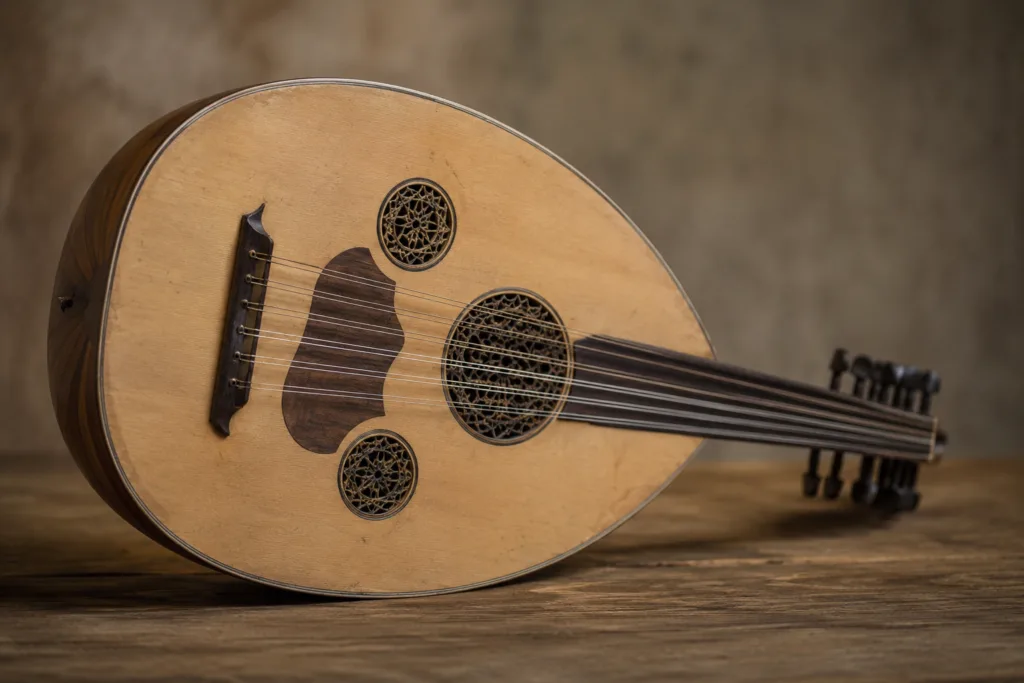
Oud Identity Card
- Instrument Family: short-necked bowl lute, played with a plectrum.
- Playing Surface: a fretless fingerboard, which lets the hand shape fine pitch shades.
- Usual String Layout: often 11 strings in 6 courses, though 10-string and 13-string ouds are also used.
- Sound Character: warm attack, fast decay, dry low register, and a vocal upper range.
- Core Materials: spruce or cedar soundboard, ribbed wooden bowl, hardwood pegs, and a light risha.
An oud does not hold notes the way a guitar does. It speaks quickly, blooms briefly, and decays. That short note envelope is part of its character. The player can lean into a phrase, pull back, bend the pitch a little, and leave space for the next note to breathe.
Its body looks generous, almost soft, but the build is not casual at all. The thin soundboard, the arched bowl, the bridge, the bracing, the strings, and even the risha all decide how the oud answers the hand.
Small details matter here. A little too much thickness in the top can make the voice stiff. A badly fitted peg can make the whole instrument feel unreliable. A heavy rosette may look fine yet slow the top. In oud making, beauty and sound live close together.
What Makes an Oud Different
| Feature | How It Works | What the Player Hears |
|---|---|---|
| Fretless Neck | The left hand stops the string directly on a smooth fingerboard. | Fluid slides, microtonal pitch, and a voice-like line. |
| Bowl Back | Curved wooden ribs form a deep resonating shell. | Rounded bass response and a wide air chamber. |
| Fast Note Decay | The oud gives a clear attack, then lets the note fade quickly. | Dry warmth, clean phrasing, and space between notes. |
| Risha Playing | A long flexible plectrum strikes the paired strings. | Soft snap at the start of the note, then a warm body behind it. |
| Paired Courses | Most strings are doubled in close unison. | A slight shimmer, especially when the two strings are not perfectly identical. |
The oud is often described as a pear-shaped lute, but that phrase only gets the outline right. The more useful idea is this: the oud is a fretless wooden voice with a body built to respond quickly rather than sustain for a long time.
Attack, left-hand position, risha angle, and playing force can make notes on the same string sound noticeably different. The left hand does not jump from fret to fret; it searches, listens, and corrects. That tiny correction is the instrument’s living edge.
Pro Tip: When judging an oud, do not listen only for volume. A better test is evenness across the courses. The bass should not swallow the middle, and the treble should not turn thin or glassy.
The Name Oud and the Idea of Wood
The word oud is commonly linked with Arabic meanings around wood, stick, or a wooden piece. That suits the instrument. Unlike skin-faced relatives in older lute families, the oud is known for its wooden soundboard. The face is the main vibrating surface that transfers string energy into the body.
Several names travel with the instrument. In Turkish writing, it is often seen as ud. The plectrum may be called risha in Arabic use and mizrap in Turkish. The carved soundhole ornament is often called shams, meaning “sun.” Good name, that one. The rosette does look like light held inside wood.
Older related instruments, including the barbat, sit near the oud in the long family story of short-necked lutes. The line is not always clean. Names moved, body shapes changed, and local workshops solved the same sound problem in slightly different ways.
A Short History Without the Fog
- Early short-necked lutes appear across West and Central Asian visual and written traditions long before the present concert oud settled into its familiar shape.
- Medieval scholars and musicians wrote about oud-like instruments, strings, tuning, and musical use in Arabic and Persian intellectual circles.
- The European lute developed through contact with oud-family instruments, though it later grew its own fretted neck, repertoire, and construction habits.
- Modern Arabic, Turkish, Iraqi, Iranian, Armenian, Greek, and Balkan settings keep different oud habits alive today.
- In 2022, crafting and playing the oud was added to UNESCO’s Representative List of the Intangible Cultural Heritage of Humanity for Iran and Syria.
The 2022 inscription covers both oud craftsmanship and performance practice. These skills are transmitted through workshops, homes, conservatories, ensembles, apprenticeships, and direct instruction.
The instrument remains part of active making and performance traditions.
2026 Multinational Oud Nomination
UNESCO’s 2026 cycle includes the multinational nomination “Oud instrument: practices, skills and performing arts”. The file was submitted by Iraq, Algeria, Bahrain, Egypt, Jordan, Kuwait, Mauritania, Morocco, Oman, the State of Palestine, Qatar, Saudi Arabia, Sudan, Tunisia, the United Arab Emirates, and Yemen.
The nomination covers oud-related practices, skills, and performing arts across the participating countries. UNESCO currently lists the file as not inscribed and under the 2026 nomination process, so it should not be described as a new Representative List inscription. The separate 2022 inscription for Iran and Syria remains the existing listed element.
Anatomy of the Oud
Soundboard: The Thin Wooden Voice
The soundboard is usually the most sensitive part of the oud. Spruce is common because it can be light, stiff, and responsive when cut well. Cedar appears in some modern instruments and can give a softer, warmer attack. The top must be thin enough to move, but not so weak that it collapses around the bridge.
Tap it gently and the best tops answer with a dry, woody ring. Not a thud. Not a papery click.
Bowl: The Ribbed Body or Tekne
The bowl is often made from narrow ribs of walnut, maple, rosewood, mahogany, apricot, poplar, or other seasoned woods. Turkish makers may call this rounded back the tekne. Its shape adds air volume, and its stiffness helps reflect energy back toward the top.
A bowl that is too heavy can make the oud feel slow. A bowl that is too light but poorly joined may lose stability. The best rib work feels tidy without looking machine-cold; the joins are clean, the curve is calm, and the back sits in the hands like it already knows where it belongs.
Bridge: The Pressure Point
The bridge carries string tension into the soundboard. Its footprint, weight, glue joint, and height affect attack, balance, and action. A bridge lifting from the top is not a small cosmetic problem. It changes the voice and can damage the soundboard if ignored.
Rosettes and Soundholes
Many ouds use one large soundhole with two smaller side holes; others use a single opening. The rosettes may be carved wood, bone-like composite, parchment, plastic, or inlaid material depending on age and workshop. They decorate, yes, but they also add mass around the opening.
Too much ornament can dull a lively top. A careful maker knows when to stop.
Collector’s Note:
On an older oud, original rosettes can tell a lot about the workshop. Replaced rosettes are not always bad, but they should make a buyer look more closely at the top, the brace repairs, and the bridge area.
Fingerboard and Pegbox
The fingerboard must be smooth, true, and tough enough to resist string wear. Ebony is valued here, though other dense hardwoods can work. The pegbox bends back from the neck and holds tapered friction pegs. When the pegs fit well, tuning feels quiet and controlled. When they do not, the player spends half the session negotiating with wood.
Wood Choices and How They Change the Sound
| Material | Where It Is Used | Typical Effect on Feel or Tone |
|---|---|---|
| Spruce | Soundboard, sometimes braces | Clear attack, strong response, good note separation. |
| Cedar | Soundboard on some modern ouds | Warmer start to the note, softer edge, often quick to open up. |
| Walnut | Bowl ribs, pegbox, neck parts | Balanced warmth, steady weight, rounded low-middle color. |
| Maple | Bowl ribs, decorative strips | Clean reflection, brighter outline, crisp visual figure. |
| Rosewood | Bowl ribs, decorative work | Dense feel, strong reflection, often a darker visual tone. |
| Ebony | Fingerboard, pegs, small fittings | Hard wearing surface, clean stopping feel, stable peg work when fitted well. |
| Apricot or Poplar | Bowl parts in some regional craft traditions | Lighter body feel and a less glassy response when well seasoned. |
No wood name saves a poor oud. A fine piece of spruce can still sound dull if it is too thick, braced clumsily, or forced under the wrong strings. A plain-looking walnut bowl can sound excellent if the geometry is right.
The useful question is not “Which wood is best?” It is which wood, in this build, under this tension, with this soundboard?
Spruce vs Cedar Soundboard
Spruce often suits players who want a clean edge, clear projection, and firm separation between fast notes. It can reward a strong right hand. It can also feel a little tight when new, depending on the top.
Cedar can feel more open early on. It may give a rounder attack and a gentler high register. That said, oud tone depends on the whole build, not the label on the timber. Bracing, thickness, string tension, and humidity can change the result more than a shop tag suggests.
Walnut vs Rosewood Bowl
A walnut bowl often gives a balanced, earthy response. It is a practical wood for ouds because it can be stable, workable, and musically honest.
Rosewood is denser and can look more dramatic. In some builds, it adds a strong reflected quality to the sound. In others, it can simply add weight. Pretty wood, but not a guarantee.
Pro Tip: For online oud shopping, ask for a plain recording of open strings, a slow scale, and a few notes high on the fingerboard. Studio reverb hides weak sustain, buzzing, and uneven courses.
Arabic Oud vs Turkish Oud
| Point of Comparison | Arabic Oud Tendency | Turkish Oud Tendency |
|---|---|---|
| Body Feel | Often larger and deeper, with a broad low register. | Often a little smaller, lighter, and more immediate. |
| Scale Length | Often around the longer side of the oud family. | Often shorter, commonly near 58.5 cm in many modern examples. |
| Pitch Habit | Often set up for lower, heavier-feeling tunings. | Often set up for higher pitch and lighter string tension. |
| Tone | Deep, dry, dark-leaning, with a generous bass. | Bright, nimble, clear, with fast response. |
| Best Fit | Players who want weight, low warmth, and broad phrasing. | Players who want agility, clarity, and a lively upper range. |
These are tendencies, not laws. A Turkish-made Arabic oud can sound deep. A smaller Arabic oud can be bright. The smarter way to judge is by scale length, soundboard response, string tension, and the player’s tuning.
One common mistake is to put a set of strings on an oud just because the package says “Arabic” or “Turkish.” The oud has to agree with the tension. If the scale is short and the tuning is low, the strings may feel floppy. If the scale is long and the pitch is high, the top may feel overworked.
Arabic Oud vs Turkish Oud for Beginners
A beginner does not need the loudest oud. A beginner needs an oud that stays in tune, has comfortable action, and makes clean notes without forcing the right hand. For many players, a slightly lower action and stable pegs help more than ornate decoration.
Comfort first. Ornament later.
Oud vs European Lute
| Instrument | Neck and Fingerboard | Tone and Use |
|---|---|---|
| Oud | Fretless, short neck, smooth pitch movement. | Direct, warm, rhythmically flexible, strongly tied to modal melody. |
| European Lute | Fretted neck, tied gut frets in many historical forms. | Clear polyphonic texture, chordal writing, and delicate sustain. |
The oud is often called the parent of the European lute, but the two instruments should not be treated as interchangeable. The lute’s frets make harmony and counterpoint easier to organize. The oud’s fretless surface keeps the melody open, especially in music that uses pitch shades smaller than the Western semitone.
Put simply: the lute often draws lines around pitch; the oud lets pitch move.
Oud vs Guitar
A guitar player who first touches an oud may expect familiar shapes. That expectation fades quickly. The oud has no frets, a shorter neck, double courses, a rounded back, and a right-hand method that depends on the long risha. Even the way the note dies is different.
- Guitar: longer sustain, fretted pitch, chord shapes, and a flat back.
- Oud: shorter sustain, fretless pitch, melodic slides, and a bowl body.
- Guitar pick: usually short and firm.
- Oud risha: longer, more flexible, and used with a different wrist motion.
Guitar habits can help with hand coordination, but they can also get in the way. Pressing too hard, holding the wrist stiff, or expecting chord shapes too early will make the oud feel more difficult than it is.
Oud vs Barbat
The barbat is often discussed beside the oud because both belong to the short-necked lute family. In today’s use, the barbat is closely linked with Iranian musical settings and may have a slightly different body profile, stringing, and tonal aim depending on the maker.
The oud usually has a larger public identity across Arabic, Turkish, Armenian, Greek, and other regional styles. The barbat feels more focused in its modern cultural setting. Both reward a sensitive hand, but they do not ask for the same touch.
Strings, Courses, and Tuning
Most modern ouds use doubled courses, with one lower course sometimes left single depending on the set. Nylon, plain synthetic, and wound strings are common today. Older gut strings belong to the historical story, but modern players usually choose stable synthetic sets for daily use.
| Setup Area | Common Choice | Practical Note |
|---|---|---|
| String Count | 11 strings in 6 courses | Very common, but 10 and 13 strings are also seen. |
| Arabic Tuning Family | C-F-A-D-G-C or D-G-A-D-G-C variants | Lower and heavier-feeling setups need matching gauges. |
| Turkish Tuning Family | E-A-B-E-A-D variants | Often higher in pitch; tension must suit the instrument. |
| Risha Material | Plastic, horn-like synthetic, or other flexible materials | Flex changes attack more than many new players expect. |
A tuning chart is only the start. The same oud can feel tight, loose, bright, or dull depending on string gauge. A good set brings the soundboard to life without pulling it into stress.
Why Double Courses Matter
Two strings struck together do not behave like one thicker string. They create a small shimmer and a fuller attack. If one string in a course is slightly off, the sound may beat or wobble. Some players use that tiny movement on purpose; too much of it sounds messy.
The oud forgives emotion. It does not forgive careless tuning for long.
Risha Choice and Right-Hand Color
The risha can make a warm oud sound sharper or a bright oud sound softer. A stiff risha gives more bite and volume. A flexible one can soften the start of the note and help fast passages feel smoother.
Players often trim, sand, or reshape a risha until it suits the hand. This is normal workshop behavior, not fussiness. A one-millimeter change at the tip can change the whole day.
Luthier’s Bench Note:
If an oud sounds harsh, do not blame the soundboard first. Try a different risha, check the action, confirm the string gauges, and listen again. The problem may be in the setup, not the wood.
The Fretless Fingerboard and Maqam Feel
The oud’s fretless neck helps it serve maqam-based music, where pitch can live between the fixed steps of a piano. A player can shade a note lower, lean into a phrase, or slide into a pitch with intention.
This does not mean the oud is vague. Quite the opposite. The player has to hear pitch with care. Frets do not correct the hand. The ear does.
For new players, this is the hard part and the good part. The instrument asks for listening from the first lesson.
Old Ouds, Workshop Ouds, and Factory Ouds
| Type | Strength | Risk to Check |
|---|---|---|
| Old Workshop Oud | Mature wood, hand-shaped voice, possible collector value. | Hidden cracks, loose braces, bridge lift, neck angle problems. |
| New Luthier Oud | Fresh setup, chosen materials, maker support. | Needs time to open; quality depends on the individual maker. |
| Factory Oud | Lower cost, easy availability, consistent appearance. | Uneven action, heavy tops, weak pegs, decorative weight. |
| Electric or Stage Oud | Useful for amplified settings and feedback control. | Less natural air movement; tone depends on pickup and sound system. |
Antique Oud vs Modern Oud
An antique oud can be moving to hold, but age alone does not make it better. Some old ouds have dry, open voices because the wood has settled and the top has learned to move. Others are tired, over-repaired, or built for a string tension no one should force on them now.
A modern oud can be cleaner, more stable, and easier to maintain. It may also lack the hand-worn charm of an older workshop instrument. The best choice depends on use: daily study, stage work, recording, collecting, or restoration.
Collector’s Note: On a vintage oud, check the neck angle, bridge glue line, soundboard cracks, brace noise, peg fit, and rosette originality. A beautiful label is not a health report.
How to Read an Oud Before Buying
- Check the top under light. Look for sinking around the bridge, open cracks, or uneven bulging.
- Turn every peg slowly. A peg should hold without sudden slipping or grinding.
- Play every course open and stopped. Listen for buzz, weak notes, and uneven volume.
- Check the action. If the strings sit too high, playing becomes tiring; if too low, the oud may buzz.
- Ask about tuning and string gauge. The set must match the scale length and build.
- Look inside if possible. Loose braces or messy repairs can change the sound more than outside scratches.
- Trust a plain sound sample. Reverb, heavy compression, and fast playing can hide problems.
Do not rush this step. A flawed oud can still look polished. A modest oud can still sing.
Care, Humidity, and Daily Handling
The oud is a wooden instrument with a thin top, many glue joints, and friction pegs. It likes stable conditions. Very dry rooms can shrink wood and open cracks; damp rooms can swell parts and weaken response.
- Keep the oud away from direct heat, strong sunlight, and car interiors.
- Use a case when moving between rooms with different humidity.
- Loosen strings only when advised for travel or repair; constant tension changes can also be unhelpful.
- Wipe strings and soundboard gently after playing.
- Do not oil the soundboard unless a qualified repairer tells you to do it.
The safest care habit is simple: keep the oud where a person would also feel comfortable. Not too dry, not damp, not hot. Plain advice, but it saves instruments.
Restoration and Repair: What Should Stay Original
Restoration is not the same as making an oud look new. For old instruments, too much cleaning, over-polishing, or replacing original parts can reduce both musical and historical value.
Useful repairs protect the voice. They close open seams, secure braces, correct peg fit, stabilize cracks, and reset action when needed. Cosmetic work should come after structural work, not before it.
When a Crack Is Serious
A small, stable surface line may not be urgent. A crack that runs from the bridge area, opens under tension, or comes with buzzing needs attention. The top carries the voice; it deserves respect.
When Buzzing Means Trouble
Buzzing can come from low action, loose braces, uneven fingerboard wear, rattling rosettes, old strings, or a poorly seated nut. A player may hear one buzz, but a repairer hears a list of suspects.
Pro Tip:
Record the buzz with the phone close to the soundboard, then record again from one meter away. Some buzzes are mechanical; others are only close-mic artifacts. The two recordings help separate them.
How the Oud Sits in an Ensemble
The oud can lead melody, answer a singer, outline rhythm, or fill the space between percussion and bowed strings. Its attack is clear enough to mark time, but its decay leaves room for other instruments.
In a small ensemble, it often behaves like a thoughtful speaker at a table. It does not need to shout; it needs timing.
Solo oud playing reveals more of the instrument’s inner mechanics. You hear the right hand, the slides, the open strings, the breath between phrases, and the wood under the note. A very loud oud is not always the most musical solo oud. Balance wins more often.
Common Myths About the Oud
Myth: More Decoration Means Better Quality
Decoration can show skill, but sound comes from structure. A plain oud with a responsive top and clean setup can beat an ornate oud with a heavy face.
Myth: A Beginner Should Buy the Cheapest Oud Possible
A poor oud teaches bad habits. If the action is high, the pegs slip, and the notes buzz, a beginner may think the instrument is too hard. Sometimes the oud is not hard. The setup is.
Myth: All Ouds Sound the Same Because They Look Similar
Two ouds with similar outlines can feel completely different. Scale length, top thickness, brace pattern, bowl mass, string tension, and risha choice all change the result.
What a Well-Made Oud Should Feel Like
- The first note starts easily. The player should not need to dig hard for sound.
- The courses respond evenly. No string group should feel sleepy or overly sharp.
- The pegs hold. Tuning should be a normal task, not a fight.
- The body feels alive but not fragile. Lightness is good; weakness is not.
- The tone changes with touch. A good oud gives more than one color to the same note.
That last point separates a useful instrument from a merely loud one. The oud should let the player whisper, speak, and press forward without losing its shape.
Questions People Ask Before Choosing an Oud
Is the oud hard to learn?
Answer
The oud is approachable at the beginning, but it asks for careful listening because it has no frets. The right hand also needs time to get used to the risha. A well-set-up oud makes the first months much easier.
How do I know if an oud is good quality?
Answer
Look for stable pegs, comfortable action, clean joins, a responsive soundboard, even volume across the courses, and no serious bridge lift or open cracks. Sound matters more than decoration.
What size oud should a beginner choose?
Answer
A beginner should choose an oud that feels comfortable to hold and has a scale length suited to the intended tuning. Many players start with a standard Arabic or Turkish-style oud, but setup quality is more important than size alone.
Is Arabic oud better than Turkish oud?
Answer
Neither is automatically better. Arabic ouds often lean deeper and warmer, while Turkish ouds often feel brighter and quicker. The better choice depends on the music, tuning, hand comfort, and the sound the player wants.
Can guitar players learn oud faster?
Answer
Guitar players may adapt faster to plucked strings and left-hand coordination, but they still need to learn fretless intonation, risha technique, and oud-specific tuning habits.