
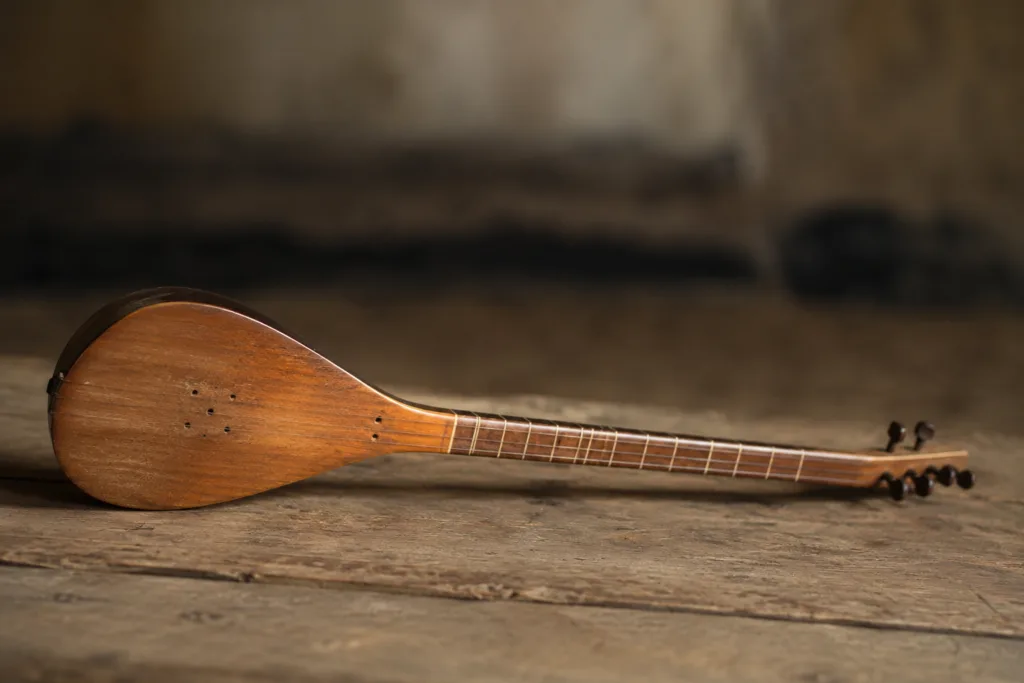
Tanbur: Long-Necked Lute Traditions of West and Central Asia
The tanbur is a member of an old and widely dispersed family of long-necked lutes found across Iran, Iraq, Türkiye, Afghanistan, and Central Asia. Its extended neck, fretted melodic range, wooden resonator, and use of melody strings beside drones connect it with many later regional lutes, although it should not be treated as the single proven ancestor of every modern string instrument.
What the Tanbur Is
Tanbur, also written as tanbūr, tambur, tanbour, tanboor, or tembûr, is a name applied to several related and sometimes structurally different long-necked lutes. Most forms have a pear-shaped or rounded wooden resonator, a thin wooden soundboard, a narrow neck, tied frets, and a small number of metal strings.
The instrument is usually plucked with the fingers or a plectrum. The player changes pitch by pressing a string against frets placed along the extended neck. Some strings carry the melody, while others may reinforce a tonal center, provide a drone, or add sympathetic resonance.
There is no single universal tanbur design. A Kurdish tanbur from western Iran is not simply a smaller version of an Ottoman tanbur, and an Afghan tanbur may have a different string arrangement, body structure, decorative language, and musical role. The shared name points to a broad historical family rather than one unchanged instrument.
About the “ancestor” label: Long-necked lutes associated with the tanbur family preserve several ideas found in later regional string instruments, including an extended fretted neck, a separate resonating body, melody-and-drone string roles, and adjustable fret placement. This makes the tanbur an important part of the ancestry of many Eurasian lute traditions, but not a documented single ancestor of guitars, violins, or all modern string instruments.
One Name, Several Instrument Traditions
The word tanbur moved between languages and musical cultures over a long period. Makers and musicians adapted the basic long-necked lute idea to local scales, repertoires, construction methods, and performance settings. As a result, the spelling alone does not identify the exact instrument.
Usually a compact pear-shaped lute with a long fretted neck and two or three sounding strings, often with a doubled melody course. It is commonly played with the fingers and has a close association with musical traditions in Kermanshah and nearby Kurdish regions.
A much larger instrument with a deep rounded bowl, an exceptionally long neck, numerous tied frets, and several strings arranged in courses. It belongs mainly to Turkish classical music and is normally played with a long plectrum.
Afghan instruments carrying the name may use multiple melody, drone, and sympathetic strings. Their construction can include mulberry wood, bone decoration, metal strings, and a body shape related to other Afghan and Central Asian lutes.
Dutar, dombra, setar, dambura, and several regional lutes share parts of the wider long-necked lineage. Their names, string counts, neck proportions, and playing methods differ, so they should not all be relabeled as tanburs.
Common Confusion: Tanbur is not another spelling of tambourine. It should also not be confused with the Indian tanpura, a fretless drone instrument used in Indian classical music. Similar names do not always indicate the same construction or musical purpose.
Anatomy and Build
Most tanburs follow the organological structure of a necked lute: strings run from tuning pegs along a neck, pass over a bridge, and transfer their vibration to a resonating body. The proportions and internal construction determine how quickly the instrument responds and how strongly each note projects.
The body may be carved from one piece of wood or assembled from narrow ribs. A carved bowl often produces a compact, direct response, while a ribbed bowl allows makers to create a larger and more rounded chamber.
A thin wooden face receives energy from the bridge and spreads it across the body. Its thickness, stiffness, grain, and attachment to the bowl affect projection, warmth, attack, and decay.
The long neck provides room for a broad series of fret positions. It also places considerable tension on the neck joint, making straight grain, stable wood, and accurate alignment important.
Many tanburs use frets tied around the neck with gut, synthetic cord, or similar material. A musician or maker can shift them to match a regional tuning system, temperament, or makam-based pitch requirement.
String count varies widely. Some tanburs use a doubled melody string with a separate drone, while Ottoman forms may carry several paired courses and an additional low string.
These small parts establish string height, spacing, speaking length, and transfer of vibration. Poorly cut grooves can cause buzzing, uneven response, tuning instability, or excessive string pressure.
Materials and Sound Character
Wood species alone do not determine the voice of a tanbur. Wall thickness, bowl volume, soundboard stiffness, bridge mass, neck rigidity, string gauge, and fret position work together. Two instruments built from the same woods can sound very different when their dimensions or setup differ.
| Part | Common Material | Effect on Structure and Tone |
|---|---|---|
| Bowl | Mulberry, walnut, maple, or other seasoned woods | Density and wall thickness affect reflection, weight, low-frequency support, and the speed of the response. |
| Soundboard | Thin mulberry, spruce, or another resonant wood depending on tradition | A lighter board can respond quickly, while a thicker or stiffer board may sound more focused but require greater string energy. |
| Neck | Walnut, beech, maple, or another stable hardwood | Rigidity helps maintain intonation and string height across an unusually long playing surface. |
| Frets | Gut, nylon, synthetic cord, or similar tied material | Movable frets permit regional pitch placement and can soften fret contact compared with fixed metal frets. |
| Strings | Steel, brass, bronze, or mixed metal sets | Gauge and alloy influence brightness, tension, sustain, finger resistance, and the strength of the drone. |
| Bridge | Light hardwood | Bridge height and mass affect action, attack, energy transfer, and balance between melody and drone strings. |
Traditional Kurdish and Iranian tanburs often have a dry, woody attack followed by a compact metallic ring. Rapid finger strokes can turn the instrument into both a melodic and rhythmic voice. Open strings reinforce modal centers and give sustained phrases a stable tonal background.
The Ottoman tanbur usually produces a more extended, ringing response. Its long strings, large resonator, thin soundboard, and detailed fret layout support delicate ornaments and fine pitch distinctions. Notes can sound clear and metallic at the attack, then open into a rounded resonance.
How the Tanbur Produces Sound
Plucking sets one or more strings into motion. The bridge passes that motion to the soundboard, which moves a larger volume of air than the strings could move alone. The bowl reflects and reshapes this vibration before sound radiates from the soundboard and any small sound openings.
The long speaking length of the strings contributes to the tanbur’s focused tone. Lower tension, string mass, and the distance between the bridge and nut can produce a flexible response with strong upper harmonics. Open drone strings may continue vibrating beneath stopped notes, adding a faint halo around the melody.
Fret material also changes the attack. Tied frets tend to create a softer contact point than tall metal frets. Their placement is musically important because many tanbur traditions use intervals that cannot be represented accurately by a standard twelve-fret guitar layout.
The String Is Plucked
A finger or plectrum displaces the string and releases it, creating the initial attack.
The Bridge Receives the Vibration
The bridge transfers part of the string’s energy into the thin wooden soundboard.
The Soundboard Moves Air
The larger surface area produces audible projection and shapes the balance between brightness and warmth.
The Bowl Reinforces Resonance
The internal cavity supports selected frequencies and adds body after the first sharp attack.
Open Strings Add a Tonal Center
Drone or unused strings may resonate with the played pitch, strengthening the mode and extending the decay.
Playing Feel and Technique
The tanbur’s long neck makes hand position and instrument balance different from those of a guitar, mandolin, or oud. The left hand must travel farther, and small errors in finger placement can become more noticeable when frets are low or closely spaced.
Finger-Plucked Iranian and Kurdish Styles
Many Iranian and Kurdish players use the fingernails and several fingers of the right hand rather than a separate pick. Downward and upward strokes may cross the melody and drone strings in rapid patterns. The result combines pitch, pulse, accent, and texture within one hand movement.
The left hand normally stops the main melody course while open strings reinforce the tonal center. Ornaments can include rapid grace notes, slides, repeated attacks, trills, and brief changes in pressure that alter the strength of the note.
Plectrum Technique on the Ottoman Tanbur
The Ottoman tanbur is generally played with a narrow plectrum. Controlled downstrokes and upstrokes give the player access to sustained melodic lines, repeated notes, delicate ornaments, and measured rhythmic articulation.
The instrument is often balanced with its bowl resting near the player’s lap while the long neck extends outward. Excess pressure from the fretting hand can pull notes sharp, so the hand needs to remain relaxed.
Tuning and Fret Placement
Tanbur tuning is not universal. It changes with instrument type, repertoire, regional practice, string arrangement, and the range required by a singer or ensemble. A tuning copied from an unrelated tanbur may place unsafe tension on the neck or soundboard.
Tied frets should not be moved casually without a pitch reference. Even a small shift can alter intonation across several modes. Players working with makam or regional modal systems usually learn fret placement together with repertoire rather than treating it as a separate mechanical setting.
Player Tip: Learn the open-string tuning, string roles, and regional name of the instrument before studying fingerings. A lesson written for an Ottoman tanbur will not automatically apply to a Kurdish tanbur or an Afghan instrument carrying the same name.
History and the Long-Necked Lute Lineage
Long-necked lutes appear in early visual and written records from the Near East and surrounding regions. Similarity of shape, however, does not prove an unbroken maker-to-maker line from every ancient image to a present instrument. Bodies, strings, tuning systems, and performance settings changed as the design moved between communities.
Ancient images show string instruments with small bodies and long necks. They establish the early presence of the general design, but individual instrument names and exact tunings are often uncertain.
Writers and theorists discussed different tanbur types, including forms associated with Baghdad and Khorasan. These accounts show that more than one regional model already existed.
Long-necked lutes developed alongside sung poetry, local modal repertoires, storytelling, community performance, and religious practice. Names such as tanbur, dutar, setar, and dambura came to identify related but distinct instruments.
The Ottoman tanbur acquired a large ribbed bowl, a very long neck, closely arranged tied frets, and a musical role suited to classical makam repertoire.
Players and makers altered string counts, dimensions, fret layouts, and right-hand technique. Bowed forms such as the yaylı tanbur and expanded modern instruments emerged from particular musical needs rather than replacing older designs.
Why It Matters to Later Instruments
The tanbur family demonstrates how a necked lute can support both melodic precision and drone-based resonance. The same broad design logic appears in the setar, dutar, bağlama, dombra, tambura, and other Eurasian lutes.
This relationship is better described as a network of shared construction ideas than a straight family tree. Instruments may borrow a name without retaining the same body, or preserve a body shape while adopting a new name. Migration, trade, court culture, religious practice, and local craftsmanship all affected the result.
Tanbur and Related Long-Necked Lutes
| Instrument | Typical Structure | Common Musical Role | Main Distinction |
|---|---|---|---|
| Kurdish or Iranian Tanbur | Small pear-shaped body, long neck, tied frets, few metal strings | Solo playing, song, regional repertoire, and some sacred traditions | Finger-strummed technique and close interaction between melody and drone strings |
| Ottoman Tanbur | Large rounded bowl, extremely long neck, numerous tied frets, several courses | Turkish classical makam music | Fine fret spacing, long sustain, and plectrum-based articulation |
| Setar | Smaller body, long neck, tied frets, normally four strings on present instruments | Persian classical solo music and intimate accompaniment | Lighter voice and a finger technique centered on the index fingernail |
| Dutar | Pear-shaped body, long neck, traditionally two strings | Sung poetry, narrative music, solo repertoire, and community performance | Two-string design and many distinct regional schools across Iran and Central Asia |
| Bağlama | Pear-shaped bowl, long fretted neck, strings commonly arranged in courses | Turkish folk music, âşık poetry, dance, and song accompaniment | Different body proportions, stringing patterns, repertories, and plectrum language |
| Oud | Large bowl, short fretless neck, several paired courses | Art, urban, folk, and ensemble traditions across the Middle East | Fretless fingerboard and short-necked construction allow continuous pitch movement |
Regional and Cultural Roles
Kurdish and Yarsan Contexts
In parts of western Iran, particularly around Kermanshah and the Guran region, the tanbur has a role that reaches beyond ordinary entertainment. It is associated with Yarsan religious gatherings and may be treated with respect as an instrument connected to sacred repertoire.
This ceremonial role should not be applied to every tanbur tradition. The name also belongs to instruments used in secular art music, regional song, teaching, recording, and concert performance.
Turkish Classical Music
The Ottoman tanbur became closely linked with the makam system. Its many movable frets allow musicians to place pitches used in particular melodic pathways, while the long string length supports clear ornaments and sustained phrases.
The tanbur can carry a composed melody, answer a singer, perform an improvised taksim, or join a classical ensemble. Its sound remains identifiable even in a mixed texture because of its bright attack and lingering resonance.
Afghanistan and Central Asia
Afghan and Central Asian instruments bearing tanbur-related names may include sympathetic strings, multiple drones, carved decoration, or construction shared with neighboring lute families. Their musical use may involve regional art music, song accompaniment, or ensemble performance.
Identification should rely on the instrument’s place of origin, string layout, fret system, and local terminology rather than the English label alone.
Modern Versions and Experimental Forms
Modern makers continue to build instruments based on local tanbur traditions, but they may adjust neck reinforcement, string gauges, fret materials, bridge shape, and body dimensions. Some changes improve stability under stage lighting, central heating, air conditioning, or frequent travel.
The yaylı tanbur is a bowed Turkish development. Instead of relying on a plectrum attack, it uses a bow to produce a sustained, nasal, and sometimes cello-like voice. Its technique and setup differ enough that it should be treated as a related instrument rather than a normal plucked tanbur played with another accessory.
Other modern instruments add strings, extend the range, or combine regional setups. Such experiments may be musically useful, but they do not automatically represent historical practice. A maker should state clearly which tradition supplied the body, frets, tuning, and playing method.
Buying and Collector Inspection
The first step in evaluating a tanbur is identifying what kind it is. A seller who describes an instrument only as an “ancient Persian lute” has not provided enough information. Ask for the regional name, maker, approximate date, tuning, string count, scale length, fret arrangement, and known repair history.
- The neck is straight or has only the relief intended by the maker.
- The soundboard is stable and free from active cracks or severe sinking.
- The bridge sits correctly and has not been replaced with an oversized part.
- The pegs turn smoothly and hold tuning without abrupt slipping.
- The frets are secure, correctly spaced, and suitable for the intended repertoire.
- Notes speak clearly without widespread buzzing or choking.
- A visibly twisted neck or rising fingerboard.
- Open seams between the ribs of a built bowl.
- A soundboard distorted by excessive string tension.
- Fresh decoration hiding cracks, repairs, or replaced wood.
- Mixed string gauges installed without regard to the instrument’s design.
- Claims of extreme age without provenance or construction evidence.
Collector’s Note: Age, decoration, and rarity do not guarantee good sound or historical value. An older tanbur may have altered frets, a replaced soundboard, an incorrect bridge, or repairs that make it unsuitable for playing. Documented origin and honest restoration records are more useful than romantic sales descriptions.
Care and Storage
Tanburs can be sensitive to changes in humidity and temperature. Long necks respond to string tension, while thin soundboards may move as the surrounding air becomes very dry or damp. Large Ottoman-style instruments are particularly vulnerable because of their neck length, ribbed bowl, and lightly built resonating surface.
- Store the instrument away from radiators, air-conditioning vents, direct sunlight, and damp exterior walls.
- Use a fitted case that supports both the bowl and the long neck.
- Wipe metal strings with a dry, soft cloth after playing.
- Do not apply furniture polish, alcohol, oil, or household cleaner to the soundboard.
- Check tied frets for looseness before attempting to shift their position.
- Use only the tuning and string gauges recommended for that particular tanbur type.
- Consult a maker before reducing tension for long storage, since sudden or uneven detuning can move the bridge or alter the setup.
- Have cracks, open seams, neck movement, and soundboard distortion examined before they spread.
Care Warning: A tanbur should not be restrung as though it were a guitar or bağlama. Strings that fit the nut and tuning pegs may still place excessive tension on the neck, bridge, and soundboard.
What to Listen For
A tanbur recording becomes easier to identify when attention shifts from melody alone to the relationship between attack, drone, and decay.
Listen for a clean metallic or woody edge at the start of the note. Finger-strummed forms may add a dry rhythmic flick, while plectrum playing can sound more pointed.
Open strings may continue beneath the melody, reinforcing one pitch and giving ornaments a stable background.
Closely placed or movable frets can produce intervals that sound unfamiliar beside equal-tempered piano or guitar tuning.
A small Iranian tanbur may sound compact and grainy, while a large Ottoman instrument can retain a longer metallic ring.
Rapid finger patterns create a rippling surface in Kurdish styles. Controlled alternating plectrum strokes shape the line in Ottoman playing.
The instrument often carries rhythmic information inside the melodic gesture rather than separating lead and accompaniment into different parts.
Mini FAQ
Is the tanbur the direct ancestor of the guitar?
No single direct line has been proven. The tanbur belongs to an old long-necked lute lineage that shares structural ideas with many later instruments, but the guitar developed through several historical branches and regional forms.
Is a tanbur the same as a saz or bağlama?
No. The terms sometimes overlap in regional speech, but the Ottoman tanbur, Kurdish tanbur, and bağlama have different proportions, string arrangements, fret layouts, repertoires, and right-hand techniques.
How many strings does a tanbur have?
There is no universal number. Some Iranian and Kurdish examples use two strings with one doubled course, while Ottoman and Afghan forms may carry several courses, drones, or sympathetic strings.
Is the tanbur always a sacred instrument?
No. The tanbur has a sacred role in certain Yarsan and related contexts, but other forms belong to classical, regional, secular, educational, and concert traditions.
Are tanbur frets fixed like guitar frets?
Many tanburs use tied frets that can be repositioned. This allows players and makers to match regional pitch systems, although the frets should be adjusted only with a reliable musical reference.
Is the tanbur suitable for beginners?
It can be, provided the student chooses one specific tradition and has access to suitable instruction. The long neck, unfamiliar tuning, tied frets, and specialized right-hand technique make mixed online lessons unreliable.