
Instrument Snapshot
The kora is a West African bridge harp associated with Mandé musical culture and the hereditary jali, or griot, tradition. Its sound is bright, ringing, and fluid, with the clarity of a harp, the interlocking patterns of a lute-like plucked instrument, and a storytelling role that reaches far beyond accompaniment.
What It Is
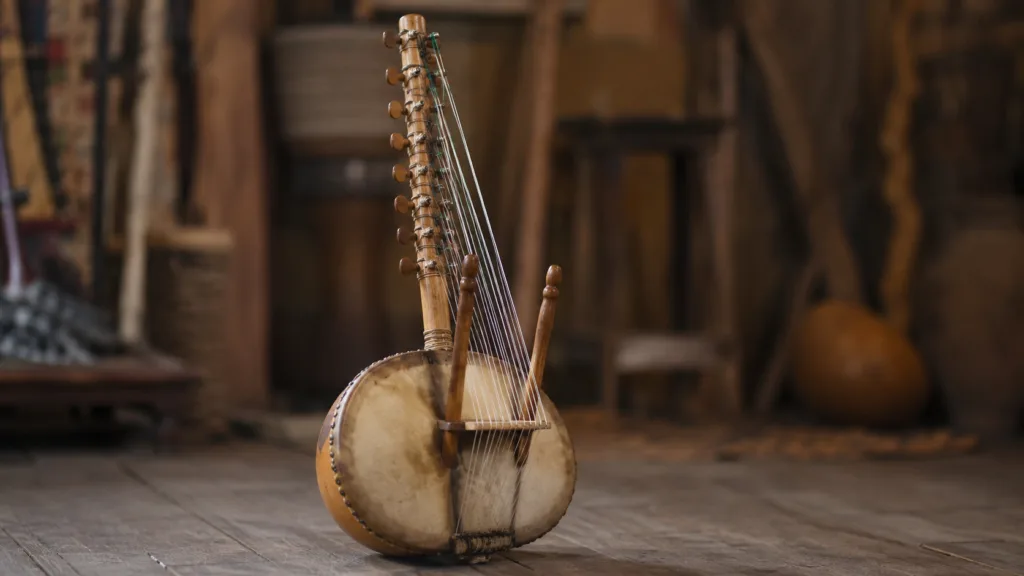
The kora is often described as a 21-string West African bridge harp. That description is useful, but it does not tell the whole story. The instrument has a large calabash resonator covered with hide, a long neck, a tall bridge, and two sets of strings arranged on either side of the bridge. The player plucks the strings with the thumbs and index fingers while holding two vertical hand posts.
Its music is built around repeating patterns, melodic decoration, bass movement, and sung or spoken narrative. A skilled kora player can make the instrument carry rhythm, harmony, melody, and ornament at the same time. This is why the kora can sound full even when played alone.
The kora is closely linked with jaliya, the Mandé professional tradition of musicians, historians, genealogists, praise singers, and verbal artists. In many settings, the instrument is not simply a musical object. It is part of a social role connected with memory, ceremony, diplomacy, family history, and public speech.
Anatomy and Build
The kora looks simple from a distance, yet its construction is carefully balanced. The sound depends on the tension of the strings, the angle of the bridge, the size and dryness of the gourd, the tightness of the hide, and the way vibrations travel through the neck and body.
| Part | Function | Effect on Sound |
|---|---|---|
| Calabash resonator | Forms the main body and air chamber | Adds rounded resonance and low-end support |
| Hide soundboard | Covers the gourd and receives string vibration through the bridge | Shapes attack, dryness, warmth, and projection |
| Hardwood neck | Holds string tension and passes through the body | Affects stability, tuning response, and sustain |
| Tall bridge | Separates the two ranks of strings and transfers vibration | Gives the kora its clear, harp-like articulation |
| Two hand posts | Allow the player to hold the instrument while plucking | Support the rapid thumb-and-finger technique |
| Strings | Traditionally skin or gut-like material; modern koras often use nylon or fishing line | Control brightness, tension feel, tuning stability, and note bloom |
| Tuning rings or machines | Adjust string pitch | Traditional rings give a historic setup feel; machine heads can make retuning faster |
How the Kora Produces Sound
The kora produces sound when the player plucks a string and that vibration travels through the bridge into the hide-covered gourd. The gourd acts as a resonator, while the hide gives the note a focused attack. The result is a tone that can feel bright and glassy, but still earthy because the body is organic and lightly percussive.
The bridge is central to the instrument’s voice. Since the strings rise on both sides, the player can create interlocking left-hand and right-hand patterns. Bass notes, inner figures, and high decorative runs can be layered into one continuous texture.
These tone bars describe a general listening profile, not laboratory measurement. Individual koras vary by maker, string choice, bridge setup, body size, and tuning.
Materials and Sound Character
A kora’s materials do more than create its shape. They influence how fast the note speaks, how dry the attack feels, how long the sound hangs in the air, and how stable the tuning remains under changing humidity.
| Material or Setup Choice | Common Use | Tone and Playing Effect |
|---|---|---|
| Large calabash gourd | Main resonating body | Can give a fuller low register and a broader bloom after the attack |
| Tightly fitted hide | Soundboard surface | Often gives a sharper attack, clearer projection, and drier decay |
| Nylon or fishing-line strings | Common in many modern instruments | Usually brighter, stable, and easier to source than older string materials |
| Traditional tuning rings | Historic tuning system on many koras | Preserves the traditional feel but takes patience to adjust accurately |
| Machine-head tuning | Modern adaptation | Makes pitch adjustment easier, especially for players using several tunings |
| Bridge height and notch spacing | String layout and tension path | Changes hand comfort, string separation, and the clarity of fast patterns |
Player Tip: A bright kora is not automatically better than a warmer one. Solo players may enjoy a ringing upper register, while singers often prefer an instrument that supports the voice without crowding it.
Playing Feel and Technique
The kora is played upright, with the resonator resting against the player’s body or between the knees depending on posture and setting. The player grips the two hand posts and plucks with the thumbs and index fingers. This hand position allows quick alternation between low, middle, and high strings without moving the whole arm.
Much of the kora’s beauty comes from interlocking motion. One hand may hold a repeating pattern while the other adds melody, variation, and response. A player can also split musical roles between the two hands so that the instrument seems to accompany itself.
Hold the Hand Posts
The hand posts stabilize the instrument while leaving the thumbs and index fingers free to pluck. A relaxed grip helps speed and tone.
Build the Pattern
Many pieces begin with a repeating figure that sets the pulse and harmonic ground. This pattern gives the music its flowing motion.
Add Melody and Variation
The player ornaments the pattern with high runs, bass movement, rhythmic shifts, and short answering phrases.
Support Voice or Story
In jali performance, the kora often supports singing, praise poetry, genealogy, or spoken narrative rather than standing alone as display.
History and Cultural Role
The kora is tied to Mandé-speaking regions and to the wider cultural memory of West Africa. Its roots sit within the jali tradition, where musicians preserve histories, praise names, social ties, and inherited repertoire. The instrument is especially associated with Mandinka, Malinke, and related Mandé communities, though its influence reaches far beyond one ethnic label.
In older courtly and community settings, the kora could accompany praise singing, mediation, ceremonies, and historical narration. In modern music, it also appears in concert halls, studio recordings, cross-cultural collaborations, jazz settings, classical projects, and solo instrumental albums.
The kora is linked with Mandé cultural regions and hereditary musician families whose work joins music, memory, and public speech.
Traditional performance connects the instrument with praise songs, family histories, moral commentary, and social ceremonies.
Twentieth-century recordings helped bring kora music to listeners outside West Africa while keeping many hereditary lineages visible.
Contemporary players use the kora in solo albums, chamber projects, collaborations with guitar and cello, and global festival settings.
Important Kora Players
The kora is strongly shaped by family lineages, regional schools, and individual voice. Some players are known for preserving older repertoire, while others are known for expanding the instrument into new musical settings.
A Malian kora master known for solo work, duet recordings, and collaborations that brought the instrument to a wide international audience. His style is often admired for clarity, speed, melodic control, and layered musical conversation.
A Malian kora player whose work moves between tradition, solo performance, and chamber-like collaborations. His recordings with cello, guitar, and other instruments show how flexible the kora can be without losing its identity.
A Gambian-British kora player, singer, and composer from a griot family. She is widely recognized for opening new space for women in a hereditary kora tradition long associated with male transmission.
A Gambian musician known for bringing kora into experimental, jazz, and cross-cultural projects. His work helped introduce the instrument to many listeners outside traditional West African contexts.
Kora Sound in Listening Terms
The kora has a clear upper register that can feel bell-like, but its body adds a woody and slightly dry attack. Fast patterns can create a sparkling surface, while lower strings provide a steady ground. The best listening approach is to hear the instrument as several musical layers at once.
Lower strings often mark the harmonic path and pulse. They may be subtle, but they hold the piece together.
The repeating figure is not background filler. It is the engine of the music and the place where many variations begin.
Fast upper-string phrases add shimmer, tension, release, and personal style.
When a singer is present, the kora often answers, supports, and comments rather than simply following chords.
How It Differs from Similar Instruments
The kora is sometimes compared with harps, lutes, and West African string instruments such as the ngoni. These comparisons help, but none of them is exact. The kora’s tall bridge, two string ranks, gourd resonator, and jali performance practice create a distinct identity.
Kora vs Harp, Ngoni, and Guitar
A bridge harp with two string ranks, gourd body, bright plucked tone, and a strong link to Mandé jali performance. It often layers pattern, melody, and accompaniment at the same time.
Usually has a larger frame, more strings, and a different tuning system. Its tone can be longer-sustaining and smoother, while the kora has a drier attack and more pattern-based drive.
A West African plucked lute with a different body shape, string layout, and playing feel. It often has a sharper, more lute-like attack compared with the kora’s cascading shimmer.
A fretted neck instrument built around stopped strings and chord shapes. The kora uses open strings, two ranks, and interlocking plucked patterns rather than fretboard fingering.
Modern Versions and Tuning Choices
Many modern koras keep the traditional body concept but use updated materials. Nylon strings are common, and some instruments use machine heads instead of leather tuning rings. These changes can make the instrument easier to tune and maintain, especially for players outside West Africa or in climates where humidity changes often.
Tuning is not one fixed universal system. Players may use tunings linked to regional practice, repertoire, vocal range, or collaboration with other instruments. A beginner should not assume that every kora lesson, recording, or instrument uses the same pitch layout.
Common Confusion: The kora is not simply an African harp with a different body shape. Its technique, tuning logic, social role, and two-sided bridge layout make it a separate instrument tradition.
Buying or Collector Notes
A good kora should be judged by stability, tone, comfort, and honest construction rather than decoration alone. Carved details or polished surfaces can look attractive, but the instrument must hold tuning, speak clearly across the strings, and feel balanced in the hands.
| Inspection Point | What to Check | Why It Matters |
|---|---|---|
| Gourd body | Look for cracks, weak repairs, and uneven deformation | The body affects resonance and long-term stability |
| Hide soundboard | Check tightness, dryness, tears, and loose edges | A damaged skin can reduce projection and cause buzzing |
| Bridge | Inspect alignment, string notches, and lean | Poor bridge position affects intonation, clarity, and string spacing |
| Neck | Check straightness and firmness through the body | The neck carries string tension and tuning load |
| Tuning system | Test whether rings or machine heads hold pitch | Unstable tuning makes practice and performance difficult |
| String response | Play low, middle, and high strings evenly | Weak zones may point to setup problems or uneven tension |
Collector’s Note: An older kora is not automatically more playable. Some older instruments are valuable as cultural objects, while a newer well-built kora may be better for daily practice, travel, recording, and stable tuning.
Care and Storage
The kora is sensitive to dryness, heat, impact, and humidity changes. The gourd can crack, the hide can loosen or become brittle, and the bridge can shift if the instrument is stored carelessly. Players should treat it as both a string instrument and a skin-covered resonator.
- Store the kora away from direct sun, heaters, damp walls, and car interiors.
- Keep pressure off the bridge when the instrument is not being played.
- Wipe strings and hand posts with a dry cloth after playing.
- Avoid chemical cleaners on hide, gourd, and unfinished wood.
- Loosen tension only when advised by a maker or experienced player; sudden changes can disturb setup.
- Use a padded case for travel, especially around the bridge and gourd rim.
Care Warning: Do not oil, soak, or polish the hide soundboard without expert advice. Treatments that seem harmless on furniture can change the skin tension and damage the tone.
Common Myths
The kora is just a type of harp.
It shares harp-like traits, but its bridge, gourd resonator, two string ranks, hand-post technique, and jali context make it a distinct West African instrument.
More sustain always means a better kora.
Too much sustain can blur fast patterns. Many players value a clear attack, balanced decay, and clean separation between strings.
Machine heads make a kora less authentic for every player.
Traditional rings remain important, but machine heads can be practical for learners, touring players, and musicians who change tunings often.
Mini FAQ
How many strings does a kora have?
A traditional kora commonly has 21 strings, arranged in two ranks on either side of a tall bridge. Some modern or experimental versions may differ.
Is the kora a harp or a lute?
It is often called a bridge harp or harp-lute because it shares traits with both categories. Its construction and technique are best understood as a West African instrument tradition of its own.
Where is the kora from?
The kora is associated with Mandé regions of West Africa, including musical cultures in Mali, The Gambia, Senegal, Guinea, and Guinea-Bissau.
Is the kora hard to learn?
The basic plucking motion can be learned gradually, but traditional repertoire, two-hand independence, tuning knowledge, and jali-style phrasing take long practice.
Can the kora play with Western instruments?
Yes. Modern kora players often work with guitar, cello, voice, percussion, jazz ensembles, and chamber settings. Tuning must be planned carefully when playing with fixed-pitch instruments.
What should a beginner look for in a first kora?
A beginner should look for stable tuning, even string response, comfortable hand-post spacing, a secure bridge, and a clear tone across the full range rather than choosing by ornament alone.