
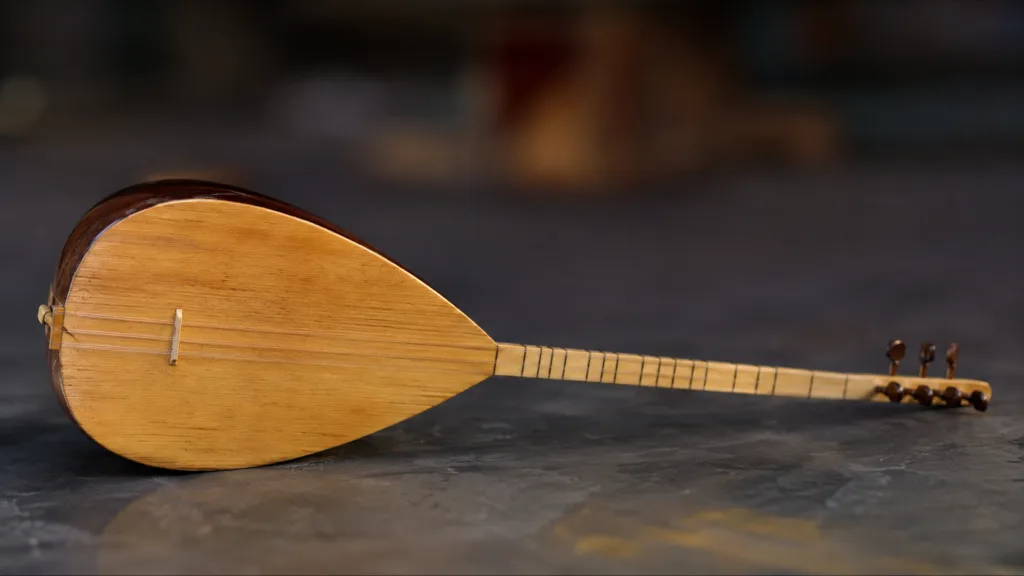
A well-made saz does not reveal itself only through volume. It reveals itself through the way the tekne breathes, the way the tied frets sit under the fingers, and the slight nasal shimmer that rises when the melody string meets the drone. The instrument is often called bağlama, and in Turkish musical life the two names can overlap, but the body in the player’s lap tells a more careful story.
The saz / bağlama is a long-necked, fretted, plucked lute used across Turkish folk music. It is also a craft object: wood, string tension, fret placement, bowl depth, and plectrum touch all decide whether the sound feels dry and direct, warm and woody, or bright enough to cut through a room.
Collector’s Note: On older instruments, decoration can distract the eye. Pearl inlay, bone trim, or carved details may be beautiful, but the real test is still the same: neck stability, clean fret work, responsive soundboard, and a balanced tekne.
Useful Details Before the First Note
| Feature | What It Means | Why It Changes the Sound |
|---|---|---|
| Long Neck | A long fretted neck with many tied frets | Allows more pitch detail, regional fingerings, and flexible melodic movement |
| Tekne | The bowl-shaped body, often made from mulberry or other tonewoods | Gives the instrument its woody depth, projection, and rounded resonance |
| Soundboard | The thin wooden top, commonly spruce or similar resonant softwood | Controls response, brightness, sustain, and attack |
| Tied Frets | Movable frets tied around the neck | Help the player reach microtonal colors used in Turkish folk modes |
| Three Courses | Strings grouped in paired or tripled sets | Creates melody, drone, and ringing support at the same time |
That last point matters. A bağlama does not behave like a single-line melody instrument only. Even a simple phrase can carry a faint inner hum from the open strings. The melody walks; the body answers.
What the Saz Actually Is
The saz belongs to the long-necked lute family. In Turkish usage, saz can also mean “instrument” in a broad sense, while bağlama often points more directly to the fretted folk lute most listeners picture today. In everyday speech, though, many players use the two words almost side by side.
Its shape is easy to recognize: a pear-like bowl, a long neck, a flat wooden soundboard, tied frets, side pegs, and metal strings arranged in courses. The player usually plucks it with a tezene, a small plectrum, although fingerstyle techniques are also part of the instrument’s living vocabulary.
Small body, long thought.
Saz vs Bağlama: Why the Names Overlap
For a newcomer, the names can feel untidy. That is normal. Saz is the broader word, while bağlama is more specific in many modern contexts. The word bağlama is often linked with the Turkish verb bağlamak, meaning “to tie” or “to bind,” a fitting idea for an instrument with tied frets and tied string courses.
In a workshop, the difference often becomes practical rather than theoretical. A maker may speak of kısa sap bağlama for a short-neck model, uzun sap bağlama for a long-neck model, cura for a small bright member of the family, or divan sazı for a large, deep-voiced instrument.
Pro Tip: When reading about the instrument, treat “saz” as the wider cultural word and “bağlama” as the more instrument-specific word. In actual Turkish use, people often blend them naturally.
That is not a mistake. It is how the language works around the instrument.
Anatomy of the Instrument
A saz / bağlama looks simple from a distance, but each part has a job. The tekne does not only hold air. The soundboard does not only close the body. The neck does not only carry frets. Together, they decide how the instrument speaks under the hand.
The Tekne: Bowl, Air, and Wood Memory
The tekne is the bowl-shaped back of the instrument. Traditional makers often favor mulberry wood, called dut in Turkish. Mulberry tends to give a warm, dry, slightly nasal voice that suits the bağlama’s folk color. It does not blur the note. It lets the string keep its edge.
Other woods also appear: walnut, juniper, maple, chestnut, beech, and several local choices. Each one changes the balance. Walnut can add a darker, rounder body. Juniper may feel lively and aromatic in both look and tone. Harder woods can tighten the response, though too much stiffness can make a small instrument feel less open.
The Soundboard: Where the Note Opens
The soundboard is usually a pale resonant softwood such as spruce or a similar top wood. This part must be thin enough to respond, but not so weak that it sinks under string tension. A good bağlama soundboard gives fast attack, clear treble, and a firm center to the note.
Here the maker’s hand matters. Too thick, and the sound can feel locked. Too thin, and the instrument may lose focus. The sweet area sits between strength and movement — not a formula, more a trained feel.
The Neck and Frets: The Quiet Precision Work
The long neck carries tied frets that allow intervals outside the fixed layout of a standard Western guitar. This is one reason the saz can shape Turkish folk melodies with such fine pitch shading. The frets are not just “more notes.” They are musical grammar under the fingers.
A clean neck should feel steady. It should not twist, dip, or fight the hand. The frets should be tied neatly and placed with care, because even a tiny shift can change the color of a phrase.
Carved Bowl vs Staved Bowl
Many short articles mention that the bağlama has a wooden bowl. The better question is: how was that bowl made?
| Construction | How It Is Made | Typical Feel | What to Check |
|---|---|---|---|
| Carved Tekne | Hollowed from a single block of wood | Often direct, woody, and focused | Even wall thickness, no dead spots, stable body shape |
| Staved Tekne | Built from thin ribs joined together | Can be lighter, more decorative, and open-sounding | Clean joints, no loose ribs, no glue gaps |
A carved mulberry tekne has a certain workshop honesty to it. It can feel compact, almost earthy. A staved bowl may carry more visual elegance, especially when different woods are alternated. Neither is automatically better. The maker’s control decides more than the method alone.
Collector’s Note: On antique or older saz instruments, small surface marks are not always a problem. Open seams, warped necks, sinking soundboards, loose pegs, and buzzing frets matter far more than light cosmetic wear.
The Sound: Bright Edge, Warm Body, and Drone
The saz has a voice that can be sharp without being thin. The metal strings give it a clean bite, while the wooden body rounds the note just enough to keep it human. A good instrument has a slightly nasal center — not unpleasant, not pinched, but clear in the way a reed-like color can be clear.
Because the strings are grouped in courses, a single plucked note often comes with a small shimmer. One course may carry the melody. Another may act like a drone. The result is not a thick chord in the guitar sense; it is more like a line with a shadow beside it.
This is where the bağlama earns its character.
What the Material Does to Timbre
- Mulberry body: Helps create a dry, warm, direct folk tone with a clear middle range.
- Walnut body: Can add a rounder and slightly darker color, useful for players who want depth.
- Juniper body: Often feels lively and bright, with a quick response when well made.
- Spruce-style soundboard: Helps the note open quickly and keeps the upper register present.
- Hardwood neck: Supports tuning stability and keeps the frets from feeling loose or uneven.
The same wood name does not guarantee the same sound. Drying, grain direction, carving depth, soundboard thickness, bridge fit, and string choice all matter. In a luthier’s hands, tonewood is only the beginning.
Strings, Courses, and Frets
Modern bağlama instruments commonly use seven strings arranged in three courses, often in a 2-2-3 grouping. Some instruments use different string numbers, especially historical, regional, experimental, or family-size models. The three-course idea remains central to the familiar sound.
The lower course often carries the melody. The other courses can support the pitch, add rhythmic bite, or create drone-like resonance. This is why a bağlama can feel full even when the player seems to be playing only a single line.
Why Tied Frets Matter
Tied frets are one of the instrument’s finest details. They allow small pitch placements that fit Turkish folk modes and regional melodic habits. On a guitar, frets are fixed into the fingerboard. On a saz, the tied fret system gives the instrument a more adaptable pitch map.
That adaptability is a gift, but also a responsibility. Poorly placed frets make the instrument feel strange even to a skilled player. Nicely tied frets, on the other hand, feel like a clean road under the hand.
Pro Tip: If a bağlama sounds dull, do not blame the wood first. Check the strings, bridge seating, fret ties, peg stability, and soundboard response.
A tired setup can hide a good instrument.
Tuning Systems That Shape the Instrument
The saz is not tied to one universal tuning. Turkish bağlama players use several düzen systems, and the choice affects both fingering and sound. This is where many simplified descriptions fall short: tuning is not only pitch. It is playing logic.
| Tuning Name | Often Linked With | Musical Effect |
|---|---|---|
| Bozuk Düzen / Kara Düzen | Long-neck bağlama and many traditional regional styles | Flexible fingering, open-string support, strong folk character |
| Bağlama Düzeni / Aşık Düzeni | Short-neck bağlama and vocal accompaniment | Comfortable chord-like shapes and flowing melodic support |
| Misket Düzeni | Certain regional melodies and tune families | Gives a distinct pitch center and phrase color |
| Müstezat Düzeni | Selected modal and regional pieces | Supports specific melodic turns and drone relationships |
Exact pitches vary by instrument size, string gauge, singer range, regional habit, and teacher. That is why a printed tuning chart should be treated as a starting point, not a law carved into the neck.
Long Neck vs Short Neck Bağlama
The difference between uzun sap and kısa sap is not only comfort. It changes the way the player thinks.
Long Neck Bağlama
The long-neck bağlama gives the player more fret positions and a wider map for traditional fingerings. It suits regional styles, older playing habits, and tunings where open strings and melodic movement need room. It can feel less immediate for a beginner, but it rewards careful study.
More road under the hand.
Short Neck Bağlama
The short-neck bağlama is often easier to handle because the frets sit closer together. It became widely used in modern performance settings, and many players like its directness, volume, and comfortable reach. Fast passages can feel more compact on a short neck.
It is not a “lesser” saz. It is a different working tool.
| Type | Best For | Feel Under the Hand | Common Player Choice |
|---|---|---|---|
| Uzun Sap | Regional repertoire, traditional tunings, broad fret access | More reach, more pitch positions | Players who want older-style flexibility |
| Kısa Sap | Compact technique, vocal backing, fast passages | Closer frets, easier stretches | Beginners and modern stage players often find it friendly |
Saz Family Members
The bağlama family is not one fixed size. It stretches from small, bright instruments to large, low-voiced forms. Names can vary by maker, region, and school, so the list below should be read as practical orientation rather than a rigid catalog.
- Cura: A small bağlama-family instrument with a bright, quick voice.
- Çöğür: A historical and regional name connected with bağlama-family forms.
- Tambura: A mid-to-large member with a fuller range and longer body feel.
- Divan Sazı: A large saz with a deeper and more commanding tone.
- Meydan Sazı: A very large family member, often discussed as part of older or specialist contexts.
A small cura can sound quick and sparkling, almost like a bright thread pulled tight. A divan sazı, by contrast, gives more air and weight. Same family, different room.
Bağlama vs Oud, Tambur, and Bouzouki
The saz is sometimes compared with other lutes because it has a pear-like body and plucked strings. Yet the playing feel is very different. The tied frets, long neck, three-course layout, and folk tuning systems give the bağlama its own place.
| Instrument | Neck and Frets | Sound Character | Main Difference From Saz |
|---|---|---|---|
| Oud | Short neck, fretless | Round, deep, smooth attack | The saz has tied frets and a long-neck folk-lute feel |
| Turkish Tambur | Very long neck, many frets | Refined, delicate, sustained | The saz has a more rustic plucked attack and folk rhythm role |
| Bouzouki | Fretted neck, metal strings | Bright, ringing, chord-friendly | The saz uses Turkish fret logic, tunings, and drone-based phrasing |
| Guitar | Fixed frets, six single strings | Wide chord range, even tempered layout | The bağlama centers on courses, tied frets, and modal folk melody |
Playing Techniques: Tezene, Şelpe, and Touch
The most familiar bağlama sound comes from the tezene, the plectrum. A light tezene stroke can sound crisp and speaking. A heavier one can bring out the percussive snap of the strings. Good players do not simply strike harder; they change angle, depth, and release.
Şelpe is a fingerstyle approach that uses plucking, tapping, and left-hand articulation. It can make the bağlama feel almost self-accompanying, with melody, rhythm, and drone living in the same hand pattern. When done well, it does not sound like a trick. It sounds like the instrument found another door.
Some players also tap or brush the soundboard for a dry rhythmic accent. This must be done with taste. Too much, and the music becomes busy. Just enough, and the wooden body joins the phrase.
Pro Tip: The saz rewards relaxed hands. Tension in the wrist can make the tone thin, even on a fine instrument. A clean attack usually comes from release, not force.
Historical Thread Without the Fog
The saz / bağlama sits within a broad family of long-necked lutes that spread through Anatolia and nearby musical cultures over many centuries. It is connected with the tanbur family, with older lute forms, and with the performance life of poet-singers known as âşık. In that setting, the saz is not background decoration. It carries the sung line, supports rhythm, and helps shape the story.
By the late Ottoman and early Republican periods, forms of the saz were already deeply tied to folk performance, teaching, and regional style. In the twentieth century, concert use, radio, conservatory study, and master players helped bring the bağlama into more formal teaching spaces while keeping its village, town, and family-room identity alive.
This double life is part of its charm: one foot in craft, one foot in repertory.
What Makes a Good Saz Feel Right
A good bağlama does not need to be loud in the first second. It needs to respond evenly. The low course should not boom while the upper course goes dry. The frets should not buzz. The pegs should turn with control. The bridge should sit cleanly on the soundboard without choking it.
- Check the neck line: Look from the pegbox toward the body. The neck should not twist to one side.
- Listen across all courses: Each course should speak clearly, without one area feeling weak or dull.
- Test the frets: Notes should sound cleanly up the neck, not only in first position.
- Feel the pegs: Slipping pegs make tuning frustrating, even when the tone is good.
- Inspect the soundboard: Small marks are normal; sinking, open cracks, or loose areas need care.
- Notice the weight: A heavy instrument is not always stronger. A very light one is not always better. Balance matters.
For a collector, originality can matter. For a player, function matters first. The best instrument is often the one that still wants to be played.
Care, Humidity, and Setup
The saz is wood under tension. It reacts to dry rooms, heat, cold, and sudden changes. A dry soundboard can become stiff or cracked. A damp body can feel sluggish. The tied frets may also shift with use, especially when the instrument travels often.
- Keep the instrument away from direct heat, radiators, and strong sunlight.
- Use a case when moving between very different indoor and outdoor conditions.
- Change strings when the tone becomes dull or tuning feels unstable.
- Have fret placement checked by a skilled repairer if intonation feels wrong.
- Do not force tight pegs; gentle fitting is better than pressure and hope.
A saz is not fragile in spirit, but it is still a wooden instrument. Treat it like one.
Buying a First Bağlama
For a first bağlama, the best choice depends on the player’s goal. A short-neck model can be friendly for beginners because the reaches are smaller and many teaching materials use it. A long-neck model may suit players who want a wider link to regional styles and older tuning habits.
Simple Buying Rule: Do not buy by decoration first. Buy by neck stability, clean sound, comfortable action, and reliable tuning.
Pretty inlay cannot fix a tired neck.
Students should also ask what tuning system their teacher uses. This small step prevents confusion. A bağlama bought for one learning path may still work for another, but the right neck length and setup make the early months much smoother.
Mini FAQ
Is the saz the same as the bağlama?
View Answer
In many Turkish contexts, saz and bağlama are used almost interchangeably. More carefully, saz can be a broader word for instruments or long-necked lutes, while bağlama usually points to the specific Turkish folk lute with tied frets and three courses.
Is it hard to learn the saz?
View Answer
The first melodies can be learned with steady practice, especially on a well-set-up short-neck bağlama. The harder part comes later: clean plectrum control, tuning awareness, regional style, and fret-sensitive pitch color.
Should I choose a long-neck or short-neck bağlama?
View Answer
Choose a short-neck bağlama if you want a compact feel and easier reach. Choose a long-neck bağlama if you want wider fret access, traditional tuning flexibility, and a closer link to many regional styles.
What wood is best for a saz?
View Answer
Mulberry is a classic choice for the bowl because it can give a warm, direct, woody tone. Spruce or similar resonant softwood is often used for the soundboard. Still, the maker’s skill, drying, carving, and setup matter as much as the wood name.
How do I know if an old saz is worth keeping?
View Answer
Check the neck, soundboard, seams, pegs, frets, and overall response. Light wear can add character, but a warped neck, sinking top, loose ribs, or unstable tuning can turn a beautiful old instrument into a difficult repair project.