Cuíca is one of those instruments that makes people turn their heads. It can sing, laugh, and slide between pitches like a voice, yet it’s still a drum. If you’re curious about Brazilian percussion, collecting vintage instruments, or simply want a new sound in your hands, the Brazilian friction drum is a deep rabbit hole in the best way.
🧭 What You’ll Get Here
- How a cuíca works (and why it feels more like bowing than drumming)
- Parts, materials, and what changes the pitch
- Techniques that sound musical fast, plus drills that stay fun
- Setup, tuning, and care—especially for vintage cuícas
| Part | What It Does | Common Materials | Care Hint |
|---|---|---|---|
| Shell | Holds the head and hardware; supports the feel more than the tone | Metal, wood, sometimes synthetic | Keep dry to avoid corrosion or warping |
| Head | The main vibrating surface; pressure here shapes pitch bends | Animal skin or synthetic | Avoid extreme heat; stable humidity helps tuning |
| Internal Rod | Transfers friction into vibration; the “voice box” inside | Bamboo or wood rod fixed to head center | Light rosin can improve grip; don’t overdo it |
| Hoop & Tension | Sets head tension; affects response and range | Lugs, screws, ring hardware | Tighten evenly to protect tone |
What Makes A Cuíca A Cuíca
- 🪘 A single-head drum that’s played by rubbing, not striking
- 🧵 Sound comes from friction on a rod attached to the head
- 🎛️ Pitch shifts with hand pressure on the head and how you grip the rod
The cuíca belongs to the family of friction drums. Instead of a stick hitting the head, a rod is fixed to the center of the membrane on the inside. You rub that rod with a damp cloth, and the head starts to vibrate. That vibration can squeal, moan, or chatter—then you steer it by pressing the head from the outside with your free hand.
It’s common to hear the cuíca described as “voice-like,” and that’s fair. The sound can glide, wobble, and snap into little syllables. With control, a cuíca line can feel like a playful singer inside the percussion section.
Name, Meaning, And Language Notes
- 🗣️ “Cuíca” is a Portuguese word linked to an opossum known for a sharp cry
- 🔎 You may also see names like puíta in older references
The word cuíca is often explained through Portuguese usage tied to a small opossum with a piercing call—an easy connection once you hear the drum’s high, bending squeaks. In some historical contexts, the instrument is also associated with the name puíta, a label that shows up in discussions of Afro-Brazilian percussion and related friction-drum traditions.
Roots, Family, And Cultural Pathways
- 🕰️ Strong links to Afro-Brazilian cultural lines, especially Bantu-speaking regions such as Angola
- 🌍 Part of a wider world of friction drums, with cousins in Iberian holiday traditions
- 🎭 A signature color in samba, especially in big percussion ensembles
The cuíca sits inside a large, worldwide family of friction drums—simple in concept, endlessly varied in voice. Many accounts connect the cuíca’s path into Brazil to Afro-Brazilian cultural routes from Bantu-speaking areas, with Angola mentioned often. At the same time, similar friction drums appear in parts of Europe, which is why discussions of “origins” can feel like a map with more than one arrow.
What matters for a player (or collector) is how the cuíca became a musical character in Brazil. In samba settings, it doesn’t just keep time; it adds a talking, teasing edge. That playful voice is exactly why the cuíca remains a favorite for carnival energy and modern recordings alike.
Anatomy Of The Instrument
Shell, Shape, And Feel
- 🏺 Shells are often metal; wood also appears, especially in artisan builds
- 🧩 Shape and depth influence comfort and response more than raw loudness
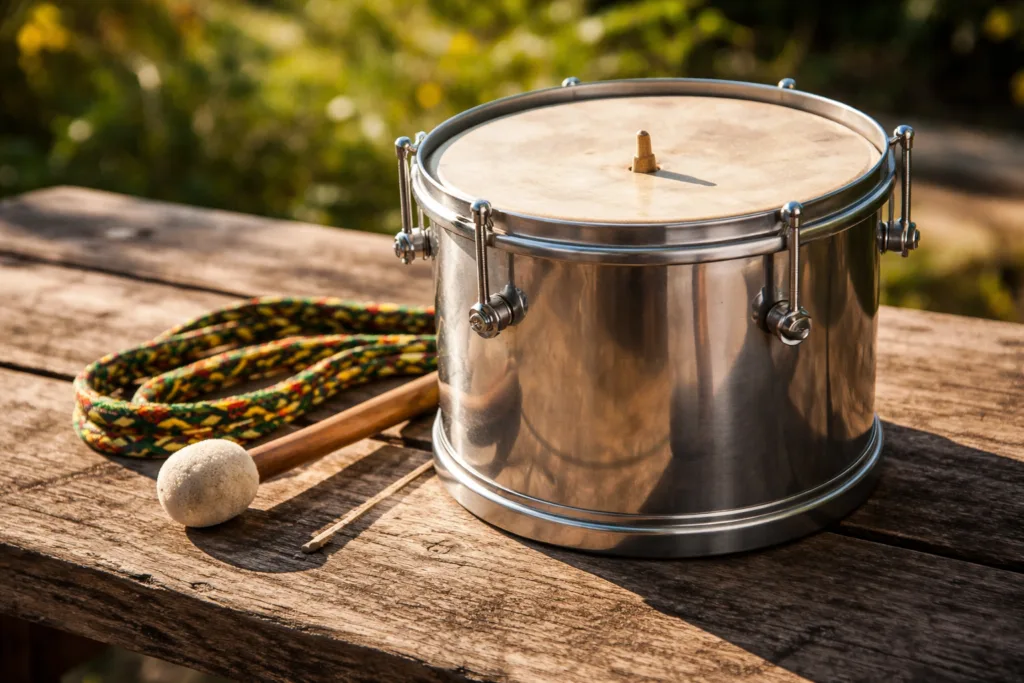
The shell is the body you hold under your arm. Many cuícas use metal shells for durability and projection, though wooden shells can feel warmer in the hands and look especially beautiful in vintage pieces. Sonically, the cuíca’s identity comes primarily from the vibrating head; the shell supports the experience, not the entire personality.
Head Material And Response
- 🥁 Natural skin heads can feel alive and flexible
- 🧪 Synthetic heads offer stability across weather changes
The head is where your outside hand does its magic. A skin head often gives a wide expressive range, but it asks for steadier humidity and gentle care. A synthetic head tends to be predictable day to day, which can be a relief if you’re practicing often or moving between rooms with different temperatures.
The Internal Rod
- 🪵 Usually bamboo or wood, fixed to the head center on the inside
- 🧵 Played by rubbing with a damp cloth for controlled friction
Inside the drum, a rod is attached to the center of the head. You rub it with a cloth—often slightly damp—so it grips and releases in micro-moments. That grip-release cycle makes the head vibrate continuously, closer to how a bow excites a string than how a stick strikes a drum.
🕰️ Collector’s Eye: Vintage Clues That Matter
- Hardware consistency: matching lugs and even wear usually signal careful ownership.
- Head condition: small marks are normal; deep cracking near the rod point is a red flag.
- Rod alignment: a straight, centered rod supports stable pitch bends.
- Patina vs. damage: gentle aging can be beautiful; sharp corrosion or warped shells can affect comfort.
How The Sound Is Born
- 💧 The cloth’s moisture controls friction—too dry slips, too wet can choke
- 🎛️ Pitch changes when you press the head and adjust rod grip
- 📏 Skilled players can reach a wide pitch range, sometimes approaching about two octaves
The cuíca’s sound starts with friction. When the rod is rubbed, it vibrates; because it’s fixed to the head, the membrane vibrates with it. Your outside hand then acts like a living pitch control. Press closer to the rod point, ease off, slide pressure around, and the voice shifts from tight squeaks to rounder groans.
The shell can change how it feels under your arm, yet the head and rod do most of the sonic work. That’s why tiny adjustments—cloth dampness, grip pressure, and where your fingers press—can completely change the timbre.
| Control | What You Change | Effect “Meter” |
|---|---|---|
| Outside Hand Pressure | Pitch bend depth, vocal “syllables” | |
| Rod Grip | Pitch height and stability | |
| Cloth Moisture | Smoothness, squeak vs. growl |
Holding Position And Hand Roles
- 🎒 Often supported with a strap; held under the arm at chest height
- 🧵 Inside hand rubs the rod with a damp cloth
- ✋ Outside hand presses the head for pitch control
Most players hold the cuíca under one arm so the head faces outward. The inside hand reaches into the shell and rubs the rod; the other hand stays on the head to shape pitch and tone. The division of labor is simple, yet it invites endless nuance—small changes in pressure turn noise into language.
Core Techniques That Sound Musical
Friction Stroke Basics
- 💧 Start with a slightly damp cloth, not dripping
- 🧵 Use steady up-down motion; keep the rod contact consistent
- 🎚️ Add pressure only after the sound is stable
Begin by chasing a clean, sustained tone. If the rod slips, increase friction with a touch more dampness or a gentler, firmer rub. If the sound grabs and stops, ease off moisture or lighten the grip. A steady voice comes first; pitch tricks come next.
Pitch Bends And “Talking” Shapes
- ✋ Press nearer the rod point for tighter, higher bends
- 🫧 Release slowly for glides; tap quickly for syllables
- 🎭 Think “vowels”: open pressure for round tones, firm pressure for sharper tones
The outside hand is your pitch wheel. Even a small push can lift the sound, and a tiny release can make it wobble. With practice, you can phrase bends like speech. That’s the moment a cuíca stops being a novelty and becomes a real musical voice.
Rhythm Control Without Losing The Tone
- ⏱️ Short strokes create rhythm; long strokes create phrases
- 🧩 Keep friction consistent; let the outside hand do accents
It’s easy to chase rhythm and accidentally lose the sound. A simple fix: keep the rubbing motion smooth and let the outside hand “speak” the beat with small presses. Your goal is clear tone first, then rhythm that rides on top of it.
A Practice Plan You’ll Actually Want To Repeat
- 🧠 Focus on one sound goal at a time
- 🎯 Use short drills that build control fast
- 🪘 End with playful phrasing so the instrument stays fun
- 2 minutes: Find a stable tone at one pitch. Keep it steady.
- 3 minutes: Do slow bends up and down using outside-hand pressure.
- 3 minutes: Make “syllables” by tapping pressure: soft-soft-hard, then hard-soft-soft.
- 2 minutes: Free play—make the cuíca “talk” in short phrases.
This routine works because it balances control and curiosity. If you only grind technique, the cuíca can feel stubborn. If you only play around, the tone stays messy. Two minutes of playful phrasing at the end keeps the instrument inviting, and that’s what builds real skill over time.
🎯 Mini Challenges
- Hold one steady tone for 10 seconds without squeaks.
- Do a bend that starts slow and ends fast, then reverse it.
- Make three distinct “voices”: round, nasal, and raspy.
Setup, Tuning, And Rod Prep
- 🔧 Tune evenly; avoid sudden, extreme tightening
- 🧵 Keep the cloth clean; grime reduces friction
- 🪵 A light touch of rosin on the rod can help, used sparingly
Tuning changes the instrument’s personality. A tighter head can feel brighter and more immediate; a slightly looser head can open a wider “talking” range. Tighten lugs in small, even steps so the tension stays balanced around the rim. That protects the head and keeps the response predictable.
For rod prep, many players rely on friction aids like a touch of rosin to help the cloth grip. Start small. If you overload the rod, the sound can become sticky and inconsistent. A clean, slightly damp cloth plus steady rubbing often does more than any extra product.
Care Tips For Modern And Vintage Cuícas
- 🌡️ Keep away from extreme heat or sudden humidity swings
- 🧰 Check hardware for gentle tightness; rattles steal clarity
- 🧽 Wipe the shell; keep the head clean and stable
If you’re caring for a vintage cuíca, the head is the sensitive point. Natural skin responds to the room. Aim for a consistent environment and avoid storing it near heaters or direct sunlight. For metal shells, a simple wipe-down keeps the instrument comfortable and helps preserve the finish without turning care into a big project.
- After playing: let the inside dry naturally; don’t seal it damp in a case.
- Weekly: inspect lugs and hoop for even tension; adjust gently if needed.
- Monthly: clean the cloth you use on the rod; replace if it sheds fibers.
Choosing A Cuíca For Your Hands And Your Ears
- 📏 Head sizes vary; comfort and response matter more than a “perfect” number
- 🧲 Metal shells often project; wood shells can feel organic
- 🕰️ Vintage value comes from condition: head, rod alignment, and hardware health
Cuícas come in different sizes and builds, and the “right” one depends on what you want. A smaller head often feels quicker and more nimble; a larger head can feel broader and more dramatic. Instead of chasing a label, look for an instrument that gives you a stable tone easily—then everything else becomes possible.
| Common Feel | Typical Use | What To Notice |
|---|---|---|
| Quick & Bright | Fast phrases, sharp “laughs,” tight bends | Rod grip consistency and clean starts |
| Wide & Vocal | Deep bends, expressive “talking,” broad tone | Even tension and smooth glides |
| Vintage Character | Collectors, studio color, distinctive texture | Head health, hardware wear, and alignment |
Cuíca In Ensembles And Samba Settings
- 🎶 Often used in samba and carnival percussion groups
- 🧩 Can play rhythmic figures, calls, or voice-like accents
- 🎭 Works best when it’s clear, not constant
In a big percussion group, the cuíca is rarely asked to be “background.” It pops out naturally, so the smartest approach is to treat it like a featured color. Short phrases, call-and-response moments, and well-placed accents can make the whole groove feel more alive without crowding other instruments.
In smaller ensembles, the cuíca can do surprising jobs: a quirky melodic hook, a comic wink, or a subtle texture under vocals. The key is intention—when the voice appears, it should feel like it meant to show up.
Common Problems And Fast Fixes
- 😬 Slipping (no sound): cloth too dry or not enough friction
- 🛑 Choking (sound stops): cloth too wet or grip too tight
- 🎯 Pitch won’t move: outside hand pressure too far from the rod point or head too tight
- 🔩 Buzz/rattle: loose lug or hoop contact point
- Slipping: add a tiny bit of moisture; try a cleaner cloth; consider a light touch of rosin.
- Choking: wring the cloth; lighten grip; let the inside dry for a minute.
- No pitch travel: change where you press; ease head tension slightly; keep the rubbing motion steady.
- Rattles: check each lug gently; keep tension even so the tone stays smooth.
FAQ
Is The Cuíca Hard To Learn
The first challenge is getting a steady tone. Once that clicks, pitch bends and “talking” effects come quickly. Short daily sessions beat long, rare practice because your hands learn the friction feel.
Why Does Moisture Matter So Much
Friction is the engine. A slightly damp cloth grips the rod in a controlled way, creating continuous vibration. Too dry and it slips; too wet and it can grab and stop the sound. Small adjustments are part of normal cuíca technique.
Do I Need A Skin Head For Authentic Sound
A skin head can feel especially expressive, but it’s more sensitive to the room. A good synthetic head can still sound convincing and may be easier for consistent practice. Authenticity comes more from control than materials alone.
Can The Cuíca Play Melodies
It can shape pitch in a wide range, and skilled players can produce melodic contours with bends and target tones. It won’t behave like a piano, yet it can absolutely suggest melody through vocal-like phrasing.
What Should I Check Before Buying A Vintage Cuíca
Check the head condition near the rod point, confirm the rod is straight and centered, and make sure the hardware tightens evenly without grinding. A stable tone is the best sign the instrument is healthy.