
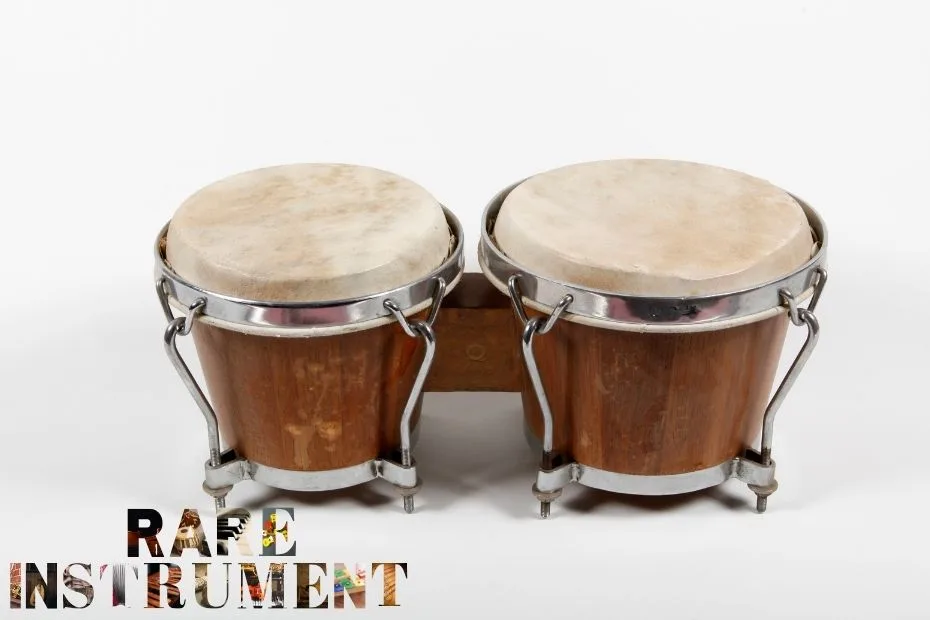
Small drums, short shells, fast decay—yet bongo drums can carry an entire groove line with almost no wasted motion. What looks simple on a stand or between the knees is not simple at all. A good pair answers with speed, bite, and vocal midrange; a weak pair only makes noise.
| Workshop Note | What Matters |
|---|---|
| Origin | Eastern Cuba, with early roots in changüí and later use in son cubano. |
| The Pair | Macho is the smaller, higher drum. Hembra is the larger, lower drum. |
| Common Modern Sizes | Entry-size pairs often sit around 6.75″ and 8″. Full-size pairs often sit around 7″ to 7.25″ and 8.5″ to 9″. |
| Common Shell Materials | Hardwood, layered wood, fiberglass, and sometimes acrylic. |
| Common Head Materials | Natural skin for organic response; synthetic heads for weather stability and repeatable tuning. |
| Usual Sound Goal | Quick attack, focused pitch, light sustain, and enough cut to speak inside an ensemble. |
- Short shell means fast response.
- Open bottom keeps the note dry and direct rather than boomy.
- A tight head sharpens speech-like articulation.
- A balanced pair matters more than raw volume.
🪘 What Makes a Bongo Sound Like a Bongo
The bongo drum is built around contrast. The macho gives the sharp edge, the click in the phrase, the little flash of pitch that can cut through brass and voice. The hembra adds body, but not in the way a conga does. Its job is not to bloom wide. Its job is to answer fast, hold shape, and leave space for the next stroke.
A well-made pair never sounds muddy. Even the lower drum should feel lean, almost carved. That is why shell depth, head tension, and rim geometry matter so much: the note has to appear quickly and leave cleanly.
Short, bright, exact.
In ensemble use, this is where the instrument earns its place. The bongo does not fill the room by lengthening the note; it fills the room by placing the note exactly where it belongs. When the attack is right, martillo feels almost woven rather than played.
How The Pair Works Together
- The smaller drum carries sharper partials and a tighter rebound.
- The larger drum gives a rounder center tone and more forgiving hand feel.
- The bridge between them shapes balance more than many players expect.
- The best sets feel like one instrument with two voices, not two separate drums bolted together.
If the hembra sounds woolly and the macho sounds brittle, the set is not only out of tune. It may also be mismatched in head thickness, rim pull, or shell stiffness.
🪵 Materials Under the Hand
Most players notice pitch first. Builders notice density, grain direction, head fit, and hardware mass. Fair enough—because those are the things that decide whether a bongo drum speaks with a dry crack, a woody bark, or a cleaner modern snap.
Wood Shells
Hardwood shells remain the reference point for many players because wood tends to soften the edge just enough to keep the tone human. Siam oak is common in modern production, especially in mid-range and upper-range models, because it is stable, fairly dense, and consistent. A denser shell usually gives quicker attack and firmer upper mids; a slightly softer shell can sound warmer and less glassy under the same hands.
Mahogany-style voicing, where the shell leans more toward warmth than bite, can feel friendlier in smaller rooms and under microphones. Oak-family shells tend to hold their outline more firmly at higher tension. Maple can sit somewhere between focus and sweetness when it is done well. Grain, ply count, and shell thickness still decide the final result. Wood species alone never tells the full story.
Fiberglass And Other Modern Shells
Fiberglass bongos often push the note forward with a cleaner front edge and a more reflective feel. The attack can be a touch brighter, the projection more direct, and the body less woody. In live work, that can be useful. In close-mic recording, it can also sound a bit less forgiving if the hands are heavy.
Acrylic and ABS-based shells move even farther from the old handmade profile. They are practical, stable, and less bothered by shifting climate. What they usually do not give, at least not in the same way, is that faintly fibrous texture a good wood shell leaves around the note.
- Wood: warmer edge, more tactile midrange, usually a more traditional feel.
- Fiberglass: cleaner attack, stronger projection, less seasonal moodiness.
- For studio work: wood often sits more naturally.
- For travel and outdoor use: fiberglass or synthetic-shell builds can be easier to live with.
Material choice is not about good versus bad. It is about what kind of answer the hand wants back.
🎵 Heads, Rims, and The Feel of the Strike
The drumhead decides more than tone. It decides trust. A natural skin head gives slight irregularities in surface and thickness, and those irregularities are part of the appeal. Under the fingers, natural skin can feel alive in a way synthetic film rarely copies perfectly. It flexes with tiny differences. It colors the slap. It can also shift with weather, room heat, and time.
Synthetic heads trade some of that organic variance for steadier tuning and a more predictable response. Some lean toward warm, skin-like mids. Others offer more projection and brighter overtones. On modern bongos, synthetic options are not just beginner gear anymore; they are serious working choices for players who need the drum to wake up in the same voice night after night.
Why Rim Shape Matters More Than Many Guides Admit
One of the most overlooked parts of any bongo drum setup is the space between the playing surface and the rim. If the counter hoop sits too high, the hand meets metal sooner than skin. If the hoop is shaped better and sits lower, the player gets cleaner access to edge strokes, less hand fatigue, and a more open slap sound. That difference shows up after ten minutes. Sometimes after one phrase.
Rounded rims are not only about comfort. They change confidence. Confidence changes sound.
Head Fit, Crown Size, And Real-World Frustration
Another detail often skipped in shallow guides: replacement head sizing does not always match the number printed on the shell in the way new buyers expect. Playing surface, shell edge, collar shape, and hoop style all affect fit. That is why two drums described casually as “7-inch bongos” can still take different replacement heads. It is a small detail—until it is not.
On older sets, an apparently harmless head swap can change the drum more than a new owner expects. A hoop that sits higher, a collar that pulls differently, or a head film that is too stiff can make a vintage pair feel less agile even when the tuning looks correct.
📏 Sizing, Balance, and Why Bigger Is Not Always Better
| Pair Size | Typical Feel | Who It Often Suits |
|---|---|---|
| 6.75″ + 8″ | Fast, compact, easy reach, slightly less low-end room. | Students, kit players, travel setups, small hands. |
| 7″ or 7.25″ + 8.5″ | Classic full-size balance, good cut, more air in the hembra. | Traditional son, salsa, Latin jazz, general-purpose use. |
| 7.25″ + 9″ | Bigger spread, more body, slightly slower physical travel. | Players who want more hembra weight and do not mind wider reach. |
Many buyers think the larger pair is automatically the “better” pair. Not quite. A wider spread changes how the arm travels, how fast the hands recover, and how relaxed the shoulders stay during repeating patterns. For some players, especially those focused on martillo and long sessions, a slightly smaller set feels faster and more precise.
That is the part many round-up articles miss: size is ergonomic before it is tonal. Tone follows the body more often than the other way around.
- 6.75/8: quicker travel, compact voice, often easier for mixed setups.
- 7/8.5: the safest all-around format for many players.
- 7.25/9: fuller hembra, more hand distance, more care needed in tuning balance.
🧭 From Changüí To Stage-Ready Bongos
- In eastern Cuba, early forms tied closely to changüí and the larger bongó del monte.
- As son cubano spread, the pair became smaller, tighter, and more suited to ensemble pulse.
- By the early 20th century, bongos had become part of urban popular performance.
- Later ensemble growth placed bongos beside congas, timbales, and brass, which pushed projection and hardware design forward.
- Modern use now spans salsa, Latin jazz, studio percussion, acoustic crossover, and drum-kit hybrid setups.
The old bongó del monte deserves more attention than it usually gets. Many general articles mention it only in passing, yet it explains a lot: lower tuning, tack-head construction, looser relationship to the polished modern shell, and a playing attitude that is less clipped and more open-ended. Without that older branch, the modern bongo looks tidier than its real history.
And yes, that older branch still matters when listening to vintage-style builds. The modern market often talks about finish and price; the older instrument reminds the ear to listen for shape, bark, and air.
🔧 Construction Details Many Buyers Never Get Told
- Bearing Edge Profile: a sharper edge can brighten attack; a rounder edge can soften it and reduce harshness.
- Shell Thickness: thicker shells can feel firmer and more focused; thinner shells may breathe more but can become less controlled if poorly built.
- Bridge Mass: the block joining macho and hembra changes how freely each shell vibrates.
- Drilled Vs. Suspension-Style Connection: some modern designs avoid drilling into the shell to preserve freer resonance.
- Rim Height And Shape: this affects comfort, edge access, and slap accuracy.
- Lug Quality: smooth, even lug pull helps tuning settle instead of fighting back.
This is one of the biggest gaps in most online bongo content. The conversation stops at shell material and head type, but the construction geometry often decides whether the drum feels refined or clumsy. Two oak bongos can share wood species and head type and still behave very differently because one has a cleaner bearing edge, better hoop clearance, and less drag in the hardware.
Little parts. Big effect.
- Traditional block joint: familiar look, direct build logic, solid mounting feel.
- Suspension-style systems: can allow shells to vibrate more freely and may slightly open the sound.
- What to watch: any extra metal between the shells adds weight and changes feel, even when resonance improves.
📚 Vintage Sets Vs. Modern Production
Vintage bongos are not automatically better. They are simply less uniform. That can be good news or a repair bill. Older sets often show more handwork in shell shaping, more variation in hardware, and more personality in the skin. They can sound wonderfully direct, almost dry-cheeked and conversational, but they may also come with warped hoops, tired threads, changed bridges, or heads that no longer sit cleanly.
Modern production bongos tend to be more predictable. The tuning action is usually smoother, replacement heads are easier to source, and shell pairs are more consistent from one unit to the next. What can be lost is a little unpredictability—the good kind, where a drum has a slightly odd but memorable bark that turns into a signature.
What Collectors Usually Check First
- Cracks near lug points and bridge joints.
- Warped counter hoops.
- Extra drilling or replaced mounting hardware.
- Over-sanded bearing edges.
- Mismatched heads that change balance between macho and hembra.
- Corrosion that suggests long-term damp storage.
The most interesting old pair is not always the cleanest one. The better sign is structural honesty: original shell shape, healthy edges, and hardware that still pulls evenly. Patina is fine. Distortion is not.
👂 How To Hear Quality In Ten Seconds
- Tap each lug area lightly and listen for even pitch around the head.
- Play a center tone on the hembra; it should stay focused, not collapse into a papery flap.
- Strike the edge of the macho; the slap should be clear without sharp metal intrusion from the rim.
- Move between drums quickly; the physical reach should feel natural.
- Listen for whether the pair sounds related. A good set sounds married, not merely joined.
Volume can fool the ear. Relationship rarely does. When the pitch gap is sensible, the response is even, and the hand does not flinch from the hardware, a better class of instrument usually announces itself right away.
🧰 Care That Protects Tone Rather Than Just Appearance
- Keep natural skin away from abrupt heat and damp swings.
- Tune in small steps across the lugs, not one full turn at a time on one side.
- Wipe hardware after use if hands sweat heavily.
- Do not leave the drum under strong sun or in a parked car.
- Check hoop level from the side once in a while; uneven pull can sneak in slowly.
- Store with enough cover to avoid dust, but let the instrument breathe.
Natural skin is not fragile in a dramatic way. It is simply honest. Treat it roughly, and it answers honestly. Synthetic heads are more tolerant, especially in travel and changing weather, but even then, lugs, rims, and shell joins still prefer steady conditions.
- Natural skin: nuanced feel, organic color, more climate-sensitive.
- Synthetic: steadier setup, easier travel life, more repeatable response.
- Best choice: the one that fits the room, the routine, and the player’s touch.
⚖️ Where Modern Bongos Really Changed
Modern production did more than add shiny lugs. It changed how the bongo drum lives in actual use. Better stands made kit integration easier. More reliable hardware made higher, more exact tuning less stressful. Refined synthetic heads made outdoor work, touring, and teaching far simpler. And newer shell-connection ideas gave builders more room to shape resonance instead of just holding two drums together.
Still, the instrument did not stop being intimate. It remains a hand-first percussion voice. That is why the best modern examples are not the ones that sound generic and polished; they are the ones that keep the old conversational quality while solving old practical headaches.
FAQ
Is it hard to learn bongo drums well?
Open Answer
The first sounds come quickly, but clean control takes time. Bongos ask for hand accuracy, steady timing, and smart touch rather than brute force. Many players can play basic patterns early, but making the macho and hembra speak clearly and evenly is the longer craft.
How do I know if a bongo pair is too big for me?
Open Answer
If the hands travel too far between the drums, the shoulders rise, or repeated patterns start to feel slow and tense, the pair may be too wide. A slightly smaller set can feel faster and more natural, even if it looks less imposing.
What should I choose first: natural skin or synthetic heads?
Open Answer
Choose natural skin for a more organic feel and tonal variation. Choose synthetic if steady tuning, travel, and climate resistance matter more. Neither option is automatically better; each serves a different working life.
How do I know if the heads or hardware are holding the sound back?
Open Answer
Listen for uneven pitch around the head, weak slap response, metal interference from high hoops, or tuning that drifts too quickly. If the shell seems healthy but the drum still feels stiff or choked, the heads, rims, or lug pull may be the real issue.
Are vintage bongos better than modern ones?
Open Answer
Not by default. Vintage sets can have beautiful personality and drier, more individual tone, but they may also bring repair needs and inconsistent hardware. Modern bongos usually offer easier tuning, better part availability, and more predictable setup.