
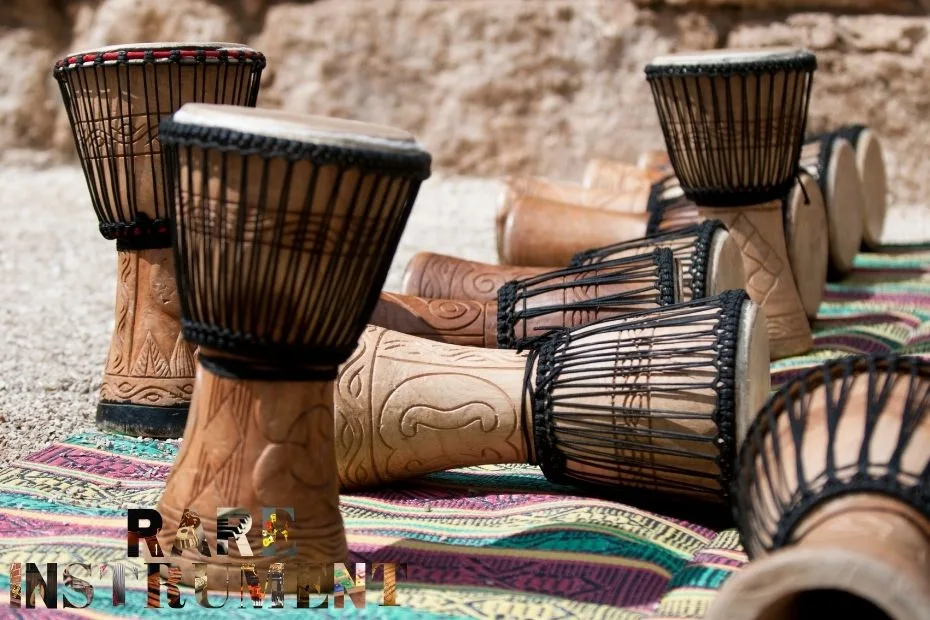
The throat does half the talking. A well-cut djembe does not earn its voice from head size alone; the shell, the bearing edge, the rope pull, and the hide thickness all have to agree. When they do, the djembe drum opens with a low bass, a clean open tone, and a slap that rises without turning brittle.
| Instrument Family | Hand-played goblet drum, membranophone |
| Historical Home | West Africa, especially the Mandé-speaking cultural zone tied to the old Mali Empire |
| Usual Build | Single-piece hardwood shell, rawhide head, metal rings, rope tension |
| Common Full Size | About 30–38 cm head diameter, 58–63 cm height, often 5–13 kg depending on shell and size |
| Main Voices | Bass, tone, slap — with finer players also shaping in-between colors such as tonpalo |
| Playing Range | Bass often sits around 65–80 Hz, tones roughly 300–420 Hz, slaps roughly 700–1000 Hz |
| Practical Role | Solo lead, accompaniment, dance support, teaching circles, ensemble dialogue with dunun |
A good traditional djembe drum feels carved for sound first, decoration second. That order matters.
🥁 What Is a Djembe, and Where Does Its Voice Come From?
- Djembe is the common modern spelling, though jembe also appears.
- The name is often linked to a Bambara phrase glossed as “everyone gather together in peace.”
- The djembe instrument is tied to a social role as much as a sonic one: dance, gathering, work, and shared time.
- Its body likely remembers the shape of the mortar, and that old profile still explains a lot of its sound.
Anyone asking what is a djembe usually gets the short answer: a West African hand drum. True enough, but thin. The fuller answer is that this djembe musical instrument is a carved air chamber with a living head material stretched across the top. The shell works like a bottle note: air in the bowl and throat shapes the bass, while skin tension shapes the upper voices. That is why two drums with the same diameter can behave very differently.
It is also a loud drum for its size. At solo tension, a strong djembe percussion voice can cut through a full ensemble and still stay articulate. Not every drum does that, though. The shell has to be right.
And when the shell is right, the drum does not just speak. It answers back.
🪵 Parts of a Djembe Drum That Change the Sound
- Head — usually goatskin, sometimes cowhide or synthetic material
- Bearing Edge — the top edge where the skin seats
- Crown Ring and Flesh Ring — the metal structure that holds the head
- Vertical Ropes and Tuning Diamonds — the tension system
- Bowl — the upper chamber that helps shape body and projection
- Throat — the narrow inner section that focuses the bass and the throw of the drum
- Foot — the lower opening that releases air and changes how the drum breathes
Many pages about the parts of a djembe drum stop at naming the ropes and the skin. That misses the part a maker notices first: the inside. A shell with the wrong throat width can leave the bass flat. A bearing edge with tiny chips can stop the head from seating evenly. A foot that is too closed can choke the air column. Small details, big result.
One detail is easy to miss and easy to hear. On older hand-carved shells, the inside is often not polished smooth; shallow tool marks or scalloped cuts are left behind. That is not sloppy work. Those light internal ridges can shorten excess sustain and help the djembe drum keep a quicker, drier response. A shell polished too smooth can ring longer than you want, especially in the upper voices.
Pro Tip
When checking a djembe, look inside with a small light. Clean carving matters more than shiny carving. A neat exterior can still hide a dull shell.
Djembe Shell Geometry Vs. Head Tension
Players often blame the head when a drum feels thin, but head tension is only half the story. Tightening the ropes will raise the tone and the slap. It will not fix a throat that was cut too wide, a foot that is too narrow, or a bearing edge that does not sit true. In plain terms: tension can brighten a drum; it cannot redesign it.
That is one reason a seasoned djembe instrument buyer taps the shell as much as the head.
🌿 The Materials: Wood, Hide, Metal, and Rope
| Material Choice | What It Usually Does to the Sound | What to Watch For |
|---|---|---|
| Lenke / Afzelia africana | Dense, steady projection, clear attack, firm bass core | Weight, dryness, honest carving |
| Iroko | A little lighter in feel, open and warm, often less hard-edged than denser shells | Can sound lovely, but cut quality matters even more |
| Djalla / Khaya and Other Medium-Dense Woods | Balanced tone with less mass than the hardest shells | Look for clean bearing edges and even ring fit |
| Goatskin Head | Classic djembe response, good balance of bass, tone, and slap | Moves with humidity and heat |
| Cowhide Head | Warmer, thicker upper voice, more overtone weight | Harder on the hands, less quick on sharp slaps |
| Synthetic Head and ABS/Fiberglass Shell | Drier, more controlled, often less weather-sensitive | Less of the natural head’s shifting color and feel |
The wood choice in a traditional djembe drum is never cosmetic. Dense hardwood helps projection and gives the shell enough resistance to throw the note forward instead of soaking it up. Traditional shells are commonly linked with woods such as lenke, djalla, dugura, gueni, gele, and iroko. Among them, lenke is often singled out with special respect.
The head matters just as much. A thin goatskin head tends to speak faster and louder, with a brighter slap and less overtone mass. Thicker skins move the drum the other way: warmer top end, more weight in the note, slower feel under the hand. That extra warmth can be lovely, but not every player wants it.
Lenke Vs. Iroko Vs. Softer Substitute Woods
Lenke is often favored when a player wants projection, definition, and a shell that stays firm under higher tension. Iroko can feel a touch lighter in voice and in physical weight, with a rounder edge when the cut is right. Softer substitute woods, often seen in export drums and later factory production, can still make usable instruments, but they tend to lean more on head tension to create brightness. That is not the same thing as depth.
Put plainly: a dense shell gives the maker more room to shape the sound before the first knot is ever tied.
Goatskin Vs. Cowhide Vs. Synthetic Head
- Goatskin keeps the classic feel under the hand and the familiar djembe response.
- Cowhide gives more body and more upper partials, but it is less forgiving for fast, sharp slaps.
- Synthetic heads hold pitch better across changing weather and suit travel, school, and outdoor use.
This is where modern djembe drums part ways from older ones. Natural rawhide loosens in humidity and tightens in dry heat. Synthetic heads do not drift as quickly, and modern ABS or molded shells are easier to live with outside controlled rooms. Recent classroom and outdoor models from major makers lean into that steadier behavior for good reason. Still, the trade is real: they sound cleaner and drier, but often with less of the skin’s tiny day-to-day color shifts.
Collector’s Note
On an older hand-carved djembe, small interior tool traces are not a flaw by default. They can be a sign that the shell was voiced by hand rather than sanded into a generic shape.
🖐️ How Is the Djembe Played When Tone Matters More Than Speed?
- Bass — struck near the center with a flat, relaxed hand
- Tone — struck closer to the edge with fingers together and quick rebound
- Slap — struck near the edge with a lighter contact area and faster release
- Tonpalo or Third Voice — an in-between color that stronger players pull from subtle hand angle and contact change
Anyone asking how is the djembe played will hear about bass, tone, and slap. That part is true, but it leaves out the thing that decides whether those sounds are clear or muddy: rebound. The hand has to leave the skin right away. Stay on the head too long and the note collapses. Sit the drum so the bottom opening can breathe, lean it slightly away from the body, and the shell will help instead of fight.
Many beginner pages stop at three sounds. Good players do not. On a strong djembe drum, hand position can shift the overtone mix enough to make the slap climb or soften, almost like a spoken vowel changing shape in the mouth. That nuance is where the instrument stops being a hand drum and starts being a voice.
Fast hands are useful. Clean sound comes first.
Traditional Rope-Tuned Djembe Vs. Modern Synthetic Models
Traditional Rope-Tuned Wood Djembe
- More organic response
- Wider day-to-day tonal shift
- Needs more care and more listening
- Often preferred for older repertoire and acoustic ensemble work
Modern Synthetic or Hardware-Tuned Djembe
- More stable across weather changes
- Lighter for travel and classroom use
- Often drier and more focused
- Easier for players who do not want frequent rope work
Neither side wins every time. A wood-shell djembe with natural skin feels alive in a way molded shells rarely copy exactly. A synthetic drum, though, can be the smarter working tool for outdoor sets, schools, and shifting climates. The right choice depends on where the instrument will actually live.
🌍 The Djembe in Ensemble Use, Not Just Solo Display
- In one common Mali setup, a djembe works in dialogue with a dunun or konkoni.
- In a common Guinean setup, several djembes and three dunun families may share the cycle.
- The higher-pitched djembe often takes the lead role while other drums anchor the pattern.
- The music is not only for listening; it is built for dancing, singing, clapping, and shared response.
This point gets skipped far too often. The djembe percussion tradition is not only about a soloist showing speed in a drum circle. In older practice, the drum often sits inside a web of repeating figures and dance cues. The lead part does not float above the group for its own sake; it marks movement, answers the supporting drums, and shapes the moment with the dancers. That is why a dry, articulate slap matters so much. It has a job to do.
A lone djembe drum is exciting. Inside an ensemble, it makes complete sense.
🔍 How to Choose a Djembe Without Guesswork
| Head Size | Typical Use | What It Usually Feels Like |
|---|---|---|
| 10–11 in | Younger players, travel, light practice | Easy reach, less bass depth |
| 12–13 in | Most adult players, classes, mixed use | Balanced range of bass, tone, and slap |
| 13–14+ in | High-output ensemble work, larger hands, deeper body in the note | More air, more weight, more setup care |
For most adults, a djembe drum around 12 to 13 inches across the head is the safe center. But diameter is only the start. A smaller, well-cut shell can beat a larger, badly proportioned one every day of the week. Shape, throat, head thickness, and ring fit still decide more than size alone.
- Check the bearing edge. It should feel even, smooth, and true.
- Inspect the shell for radial cracks. Fine surface marks are not the same thing as structural splits.
- Tap around the rim. Major pitch jumps suggest uneven seating or tension.
- Look at the rope. Frayed or stretched rope means future work.
- Look inside the throat. A lazy interior carve often sounds lazy too.
- Sit with it. The rim should rise comfortably above the thigh, not sink into it.
Older Hand-Carved Shells Vs. Later Export Drums
Older hand-carved djembes often show more individuality in the inner cut, foot opening, and wall thickness. Later export drums can look cleaner and more uniform, but uniformity is not always a gain. Some later drums use softer substitute woods, smoother interiors, or generic ring sets that make setup easier yet flatten the voice. That said, age alone proves nothing. A poor old drum is still a poor drum. The shell logic tells the truth faster than the calendar does.
Pro Tip
Do not judge a djembe instrument by carving density or decorative paint. A plain shell with a lively throat and a good head fit will outplay a flashy shell that was never voiced properly.
🧵 How to Tune and Care for a Djembe So It Keeps Its Voice
- Store it in moderate room conditions. Rawhide reacts to humidity and dry heat very quickly.
- Use a case for travel and storage. A fall can damage the shell long before the head shows it.
- Clean the shell lightly. A microfiber cloth is enough for sealed finishes.
- Treat unfinished wood sparingly. A little coconut oil or shea butter on the shell is plenty.
- Use shea butter lightly on natural heads only when needed. Synthetic heads do not need it.
For anyone searching how to clean djembe drum, the main rule is restraint. Do not soak the shell. Do not use harsh household cleaners. Do not rub random skin products into the head. Clean wood gently, keep the bearing edge smooth, and let the drum live in stable indoor conditions. That alone prevents a lot of trouble.
How to Tune a Djembe Without Killing the Bass
- Make sure the head is dry and the shell is at room condition.
- Check that the vertical ropes feel reasonably even before adding new diamonds.
- Pull tension in small steps, not in a rush.
- Test open tones around the rim after each round.
- Stop when the slap brightens but the bass still opens fully.
That last line matters. Anyone asking how to tune a djembe usually wants “higher.” But higher is not always better. A drum can be over-pulled into a sharp, narrow voice with no belly left in the bass. The best tuning point is where the three main voices separate clearly while the shell still breathes.
An over-tightened djembe drum gets loud, yes. It also stops talking.
FAQ
What Is a Djembe Drum Made Of?
Read The Answer
A traditional djembe drum is usually made from a single carved hardwood shell, a rawhide head that is often goatskin, metal rings, and a rope tension system. Modern versions may use fiberglass or ABS shells and synthetic heads for weather stability and easier upkeep.
How Do I Know if a Djembe Is Well Made?
Read The Answer
Check the bearing edge, the interior carve, the rope condition, and the evenness of the head tension. A good djembe has a clean seat for the skin, a shell that feels alive when tapped, and clear separation between bass, tone, and slap.
Is Goatskin Better Than a Synthetic Head?
Read The Answer
It depends on use. Goatskin gives the classic feel and a more organic response, but it reacts to humidity and heat. Synthetic heads stay steadier in changing weather and suit travel, school, and outdoor playing, though they often sound drier.
How Do I Tune a Djembe Without Making It Sound Thin?
Read The Answer
Tighten in small, even steps and listen for balance, not just pitch. The right tuning point gives a bright slap and a clean tone while the bass still opens. If the bass disappears, the djembe drum is likely too tight or the shell geometry is working against the setup.
Is It Hard to Learn How to Play Djembe?
Read The Answer
The basics come quickly: bass, tone, and slap. The harder part is making each sound clean and consistent, then placing it inside a cycle with good timing. A few months can build control, but a mature djembe instrument touch takes longer because rebound, hand angle, and listening all matter.