
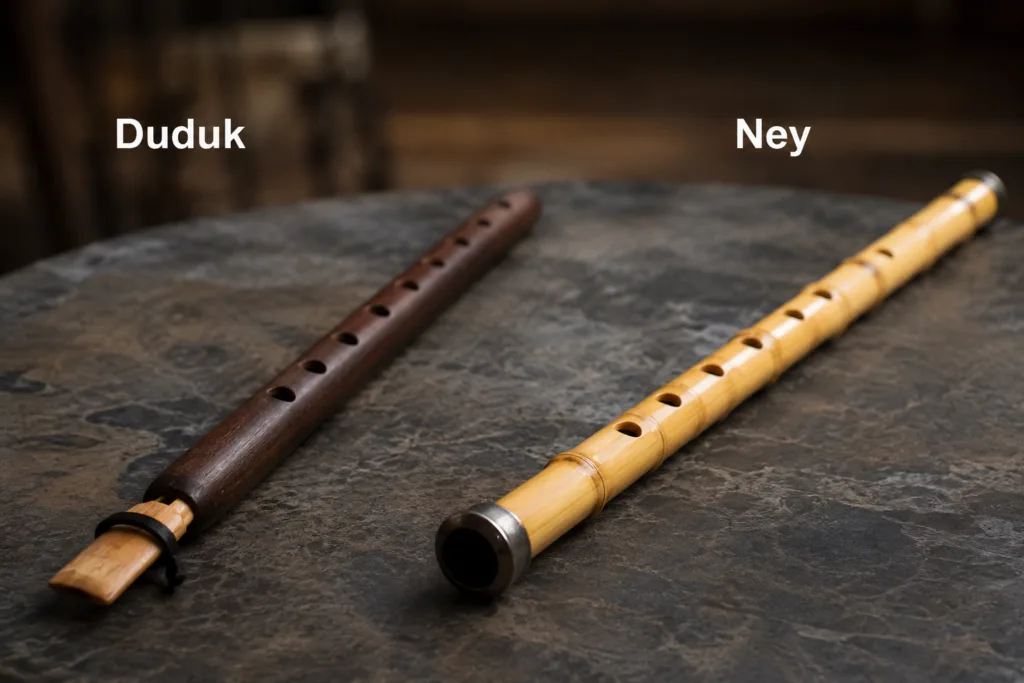
Instrument Comparison
The Armenian duduk and the ney are both breath-driven instruments with long musical traditions, but they create sound in fundamentally different ways. The duduk uses a large vibrating double reed, while the ney is an end-blown flute: air is directed across the edge of a cane or reed tube rather than through a vibrating reed.
The description “two ancient reed instruments” needs one technical distinction. Duduk is a true reed-vibrated instrument; ney is not. A ney may be made from natural reed or cane, but the tube itself does not act like the double reed of a duduk, oboe, or bassoon. Organologically, the ney belongs to the end-blown flute family.
That difference affects almost everything a player feels and a listener hears. Duduk tone begins with two reed blades responding to air pressure. Ney tone begins when a carefully directed air stream meets the blowing edge. As a result, the instruments differ in attack, breath resistance, pitch shaping, articulation, tone color, maintenance, and the way beginners learn to produce a stable note.
Duduk vs Ney: The Main Differences
| Feature | Duduk | Ney |
|---|---|---|
| Instrument family | Double-reed aerophone | End-blown flute |
| Sound generator | Two vibrating reed blades | Air directed across a blowing edge |
| Traditional body | Commonly apricot wood | Natural cane or reed |
| Physical form | Shorter, thicker wooden pipe with a large reed | Long, slender tube with visible natural nodes in many examples |
| Tone tendency | Warm, focused, soft, reedy and slightly nasal | Breathy, open, flexible and strongly shaped by embouchure |
| Main mouth interaction | Lips control a vibrating reed | Player controls the direction of air at the rim |
| Pitch shaping | Fingering, partial hole coverage, reed and lip control | Fingering, hole shading, air angle and embouchure |
| Traditional identity | Closely associated with Armenian music | Found in several West Asian, Middle Eastern and neighboring musical traditions |
| Distinctive ensemble practice | Traditional melody-and-drone pairing is especially characteristic | No equivalent standard two-ney drone pairing defines the instrument |
What Actually Produces the Sound?
The most useful comparison begins before melody, repertoire, or history. Duduk and ney use two different acoustic systems.
Duduk: Air Activates a Double Reed
The player blows into a broad double reed fitted to the wooden body. Air pressure causes the paired reed blades to open and close rapidly. Their vibration excites the air column inside the bore, producing the sustained tone associated with the instrument.
Ney: Air Meets an Edge
The ney has no vibrating reed tongue. The player forms and aims the air stream so that it interacts with the upper edge of the tube. This edge-tone mechanism sets the air column into vibration, placing the ney acoustically with flutes rather than double-reed instruments.
Common Confusion: “Reed” can describe the plant material from which a ney is made, while “reed instrument” can describe a sound-producing mechanism. A cane ney is made of reed material, but it does not use a vibrating reed in the way a duduk does.
Why the Duduk Sounds So Different from the Ney
The Duduk Starts with Reed Vibration
A duduk note carries the audible character of its large double reed. The attack is usually more defined than the airy onset of a ney, while the sustained tone can remain rounded, concentrated, and rich in reed texture. The result is often described as warm, soft, woody, and slightly nasal.
The reed is only one part of the result. Bore dimensions, finger-hole placement, reed opening, air pressure, embouchure, instrument size, and the player’s control all affect response and tone. Treating apricot wood alone as the explanation for the duduk sound oversimplifies the instrument.
The Ney Keeps More Breath in the Audible Tone
The ney does not isolate the air stream behind a reed mechanism. Airflow at the blowing edge remains part of the audible character, which is one reason many ney tones contain a noticeable breath texture. Small changes in lip position or blowing direction can move the sound from soft and diffuse to clearer and more penetrating.
This sensitivity makes the ney highly responsive to the player. Two notes with the same fingering can differ in color, stability, pitch shading, and register depending on how the air reaches the edge.
How the Instruments Feel to the Player
The player works against and with the resistance of a large double reed. Breath pressure, lip pressure, reed opening, fingering, and steady airflow must cooperate. Once the reed speaks reliably, the challenge shifts toward control: stable pitch, smooth sustained notes, expressive bends, ornamentation, and consistent tone.
The player must first create an efficient air-to-edge relationship. A poorly aimed stream may produce mostly air or no stable note at all. Once that basic embouchure develops, subtle changes in angle, lips, breath, and finger-hole coverage become part of everyday tone and pitch control.
Duduk Anatomy: Small Body, Large Reed
The visual proportions of the duduk are unusual among familiar woodwinds. Its wooden tube is relatively compact, while the double reed is broad and large in relation to the body.
Traditional Armenian duduks are closely associated with apricot wood. The body contains the cylindrical air passage and finger holes that establish the instrument’s basic acoustic dimensions.
The wide reed is the active sound generator. Its condition and opening have an immediate effect on response, resistance, pitch behavior, and tone.
The hole layout provides the main pitch positions, while partial coverage and embouchure adjustments allow finer pitch shaping than simple open-or-closed fingering suggests.
Traditional reed assemblies may include a regulator that helps control the opening of the reed. Setup therefore matters before the first note is played.
For a player or collector, the reed should never be treated as a minor accessory. A well-made body paired with an unsuitable, damaged, or poorly adjusted reed can feel and sound very different from the same instrument with a responsive reed.
Ney Anatomy: The Tube Is Simple, the Playing System Is Not
A ney can look almost minimal: a long hollow tube, finger holes, and an open blowing end. Its apparent simplicity hides a demanding relationship between tube length, internal diameter, nodes, blowing edge, finger holes, and the player’s embouchure.
Natural Cane and Nodes
Many traditional neys preserve the natural joints of the cane from which they are made. These visible nodes are part of the physical structure of the instrument rather than decorative rings added to imitate an old design.
The Blowing End
The upper edge is acoustically central because the player directs air against it. Some ney traditions use a fitted ring or mouthpiece at the blowing end, while others use a different rim arrangement and blowing technique. This is one reason a single description of “the ney mouthpiece” does not fit every regional type.
Finger Holes and Length
Neys are made in different sizes and pitch relationships. Finger-hole patterns also vary with regional tradition. Exact dimensions or a single hole count should not be presented as a universal specification for every instrument called ney, nay, or nai.
Ney Is Not One Completely Standardized Instrument
The word ney covers related flute traditions rather than one globally standardized model. Turkish, Persian, Arab, and neighboring forms share the basic idea of an end-blown pipe, but construction details and playing methods can differ enough to matter to both players and buyers.
The Turkish ney is closely connected with Ottoman-Turkish art music and Mevlevi musical practice. Traditional examples commonly use a fitted başpare at the upper end. Different ney sizes serve different pitch levels, so the instrument name alone does not identify one fixed length or tuning.
The Persian classical tradition uses its own characteristic construction and embouchure practice. Performance technique can differ noticeably from Turkish or Arab ney playing, especially in the way the player forms and directs the air stream.
Arab nay traditions use end-blown cane flutes in classical and regional music. Construction, tuning sets, dimensions, and blowing practice should be understood within the local musical system rather than copied directly from Turkish ney specifications.
This variation matters when comparing ney with duduk. The Armenian duduk is a more tightly defined subject, while “ney” can refer to a wider family of regional practices.
Embouchure: Reed Control vs Air-Angle Control
Duduk Embouchure
The lips interact directly with a flexible vibrating reed. Changes in lip pressure, jaw position, air support, and reed opening influence how quickly a note begins, whether it stays stable, and how far the pitch can be shaded.
Too much pressure can restrict the reed. Too little control may make the response unstable. The useful playing zone sits between those extremes and changes with the reed itself.
Ney Embouchure
The ney player is effectively part of the air-directing mechanism. Lip opening and air angle determine whether the stream reaches the blowing edge efficiently. Because there is no separate vibrating reed to initiate the note, the player’s control of the air jet is especially exposed.
Regional technique matters here. A Turkish ney, Persian ney, and Arab nay should not automatically be taught with identical mouth position simply because the instruments share a related name and form.
Pitch Control Goes Beyond the Finger Holes
Neither instrument behaves like a keyed woodwind in which each note is determined only by pressing a mechanical key. Fingering sets the basic acoustic condition, but the player continues shaping pitch after the holes are covered.
On Duduk
Partial hole coverage, changes in breath, and adjustments at the reed can shade notes between basic fingered positions. These techniques also support ornaments and pitch inflections that belong naturally to the instrument’s traditional phrasing.
On Ney
Finger-hole shading works together with the blowing angle and embouchure. The same tube therefore offers more tonal and pitch flexibility than a diagram of open and closed holes suggests. Register changes also depend heavily on how the air column is excited.
Player Note: A fingering chart can show where notes begin, but it cannot show the full pitch language of either instrument. Listening, embouchure control, and tradition-specific instruction remain part of accurate intonation.
The Duduk’s Melody-and-Drone Pairing
One of the most distinctive differences appears in ensemble practice. Traditional Armenian duduk music can use two players with sharply divided roles. One carries the melody, while the other sustains a continuous drone known as dam or a closely related spelling in transliteration.
The drone player maintains an unusually steady background pitch while the melodic duduk shapes ornaments and phrases above it. Circular breathing is especially useful in this role because breaks in the drone would interrupt the continuous acoustic bed.
The ney has many solo and ensemble functions, but it does not have a directly equivalent standard tradition in which a second ney is expected to sustain the defining continuous drone beneath the first. This makes the duduk pairing more than an accompaniment choice; it is part of a recognizable performance texture.
Cultural Roles Are Related by Geography, Not Interchangeable
Duduk in Armenian Musical Life
The duduk is strongly identified with Armenian music and is used across more than one social setting. Its repertoire includes song accompaniment, dance-related music, ceremonial contexts, and concert performance. Duduk and its music are also inscribed by UNESCO on the Representative List of the Intangible Cultural Heritage of Humanity.
That status refers to a living musical practice rather than simply to an old object design. The instrument, repertoire, makers, players, transmission of technique, and performance customs belong to the same cultural setting.
Ney Across Several Traditions
The ney cannot be assigned to one modern national tradition in the same way. Related end-blown flutes appear across Persian, Arab, Ottoman-Turkish, and neighboring musical cultures, with local forms developing their own repertories and techniques.
The Turkish ney has a particularly close connection with Ottoman classical music and the Mevlevi Sema tradition, where the ney player is known as a neyzen. That association should not reduce the instrument to “a Sufi flute.” Ney is also used in secular classical, regional, and other musical settings.
Duduk Is Not the Same Thing as Every Düdük
Instrument names can travel between languages more easily than instrument classifications. Armenian duduk should not automatically be equated with every instrument called düdük in Turkish.
The Turkish word can be applied to pipe or flute-related instruments that do not use the Armenian duduk’s broad double-reed mechanism. Similar names therefore do not guarantee identical construction, sound production, or repertoire.
If two traditional wind instruments share a similar regional name, they must be versions of the same instrument.
Names such as duduk and düdük can refer to different organological types. The sound-producing mechanism should be checked before assuming a direct relationship.
Can Duduk and Ney Play the Same Melody?
A melody can often be adapted for either instrument if its pitch range and tuning requirements are practical, but the result will not behave the same way. Transferring the sequence of notes does not transfer the instrument’s articulation, ornament vocabulary, tone production, or cultural phrasing.
On duduk, the melody passes through a flexible double reed. Attacks can carry a compact reed presence, while sustained notes respond to changes in pressure and embouchure. On ney, the audible air stream and edge interaction create a different beginning and decay, and pitch can be colored through subtle changes in blowing direction.
The instrument’s size also matters. Both duduks and neys exist in different pitch levels, so “Can it play this melody?” is partly a question of the particular instrument in hand rather than only the family name.
Which Is Harder to Get a Clean First Note From?
The two instruments challenge beginners at different stages.
A beginner may blow repeatedly without finding a stable note because the air stream misses the working angle at the edge. Developing that initial embouchure can take patience even before fingering becomes the main concern.
A responsive duduk reed can make initial sound production more direct, yet stable tone is another matter. Breath resistance, reed pressure, intonation, endurance, and smooth pitch control become demanding as soon as basic sound production is established.
There is therefore little value in declaring one universally harder. Ney often places more difficulty at the initial sound-production stage, while duduk presents its own demanding relationship with a sensitive double reed.
Why “Sad Duduk” and “Mystical Ney” Are Weak Descriptions
Duduk is frequently described only as melancholy, while ney is often reduced to spiritual or mystical associations. Neither label explains the instrument very well.
Perceived emotion comes from more than timbre. Register, mode, ornamentation, phrase shape, tempo, accompaniment, recording acoustics, repertoire, and cultural expectations all influence how a listener interprets the sound. A duduk can participate in dance and celebratory contexts, while a ney can function outside religious performance.
The useful tonal distinction is physical rather than emotional: duduk tends toward a concentrated reed-rich voice, while ney allows more audible air and edge tone to remain in the note.
Maintenance Differences Matter
The duduk contains a separate vibrating component whose condition directly affects playability. The ney does not.
The double reed must remain usable, clean, and properly adjusted. Dryness, deformation, damage, or an unsuitable opening can alter resistance and response even when the wooden body is unchanged.
The wooden pipe should be protected from uncontrolled moisture, strong heat, impact, and abrupt environmental changes. Hole edges and bore condition should also remain free of damage.
Natural cane should be protected from crushing, splitting, excessive moisture, and extreme dryness. The upper blowing edge deserves special care because damage there can change how the air stream speaks.
If a ney has a fitted başpare, reinforcing rings, or other regional fittings, their condition should be evaluated as part of the instrument rather than assuming every ney requires the same maintenance routine.
What to Check When Choosing Between Duduk and Ney
| If You Want… | Duduk May Fit Better | Ney May Fit Better |
|---|---|---|
| A double-reed playing experience | Yes | No |
| An end-blown flute technique | No | Yes |
| Armenian traditional repertoire | Direct cultural fit | Not the primary instrument |
| Turkish, Persian or Arab ney traditions | Not the primary instrument | Direct fit, with regional type chosen carefully |
| A dense, warm reed tone | Strong match | Different sound mechanism |
| Breathy edge-tone control | Less characteristic | Strong match |
| Minimal reed maintenance | No | Yes, because there is no vibrating reed |
| Traditional melody-and-drone duduk texture | Strong match | No direct equivalent |
For a new player, choosing the tradition first is usually more useful than choosing by appearance. Someone interested in Armenian duduk repertoire needs the duduk’s reed system and idiomatic technique. Someone interested in Ottoman-Turkish ney, Persian classical ney, or Arab nay should choose the regional instrument and instruction appropriate to that tradition.
What to Inspect Before Buying Either Instrument
- Confirm the exact instrument tradition rather than relying only on the word “ney,” “nay,” “duduk,” or a similar regional name.
- Check the stated pitch or size because both instrument families are produced in more than one pitch level.
- On a duduk, evaluate the reed as part of the playable instrument, not as a disposable detail.
- Check a wooden duduk body for cracks, damaged holes, irregular repairs, or obvious bore problems.
- Check a natural-cane ney for splitting, crushed sections, damaged nodes, and a compromised blowing edge.
- For Turkish-style ney, confirm that the başpare and other fittings suit the instrument rather than assuming replacement parts are universal.
- Avoid judging either instrument only by decorative finish. Playability depends on acoustic dimensions and setup.
- Do not assume that greater age automatically means better tone or better playing condition.
Similar Appearance, Different Acoustic Identity
Both instruments are vertical wind instruments operated by breath and finger holes, which makes a surface-level comparison tempting. Their internal logic separates them immediately.
The duduk asks the player to control a large double reed attached to a compact wooden resonating tube. The ney asks the player to create and steer the air jet that activates the rim of a longer flute tube. That distinction changes how resistance feels, how a note begins, how pitch is shaded, what must be maintained, and how the instrument responds to small movements of the mouth.
It also explains why switching from one to the other is not simply a matter of learning new fingerings. A skilled duduk player approaching ney must develop a new sound-production technique, while a ney player approaching duduk must learn how a flexible double reed responds to pressure and embouchure.
Mini FAQ
Is the duduk a flute?
No. The Armenian duduk is a double-reed wind instrument. Its tone begins with a vibrating pair of reed blades rather than an air stream striking a flute edge.
Is the ney really a reed instrument?
A traditional ney is commonly made from natural reed or cane, but its sound-production system is that of an end-blown flute. It has no vibrating reed comparable to a duduk reed.
Do duduk and ney use the same fingering system?
No. Hole layouts, pitch systems, instrument sizes, regional traditions, and embouchure techniques differ. Similar-looking finger holes do not make the fingering systems interchangeable.
Is every ney the same?
No. Turkish, Persian, Arab, and other regional ney or nay traditions differ in construction, dimensions, tuning relationships, fittings, and playing technique.
Why are duduks often played in pairs?
A traditional Armenian performance can pair a melodic duduk with a second player sustaining a continuous drone known as dam. This creates a characteristic two-part texture.
Which is easier for a beginner, duduk or ney?
They present different problems. Ney can make the first stable note difficult because the air angle must be precise. Duduk may speak sooner with a responsive reed, but reed control, resistance, intonation, and sustained tone require careful technique.