
Instrument Snapshot
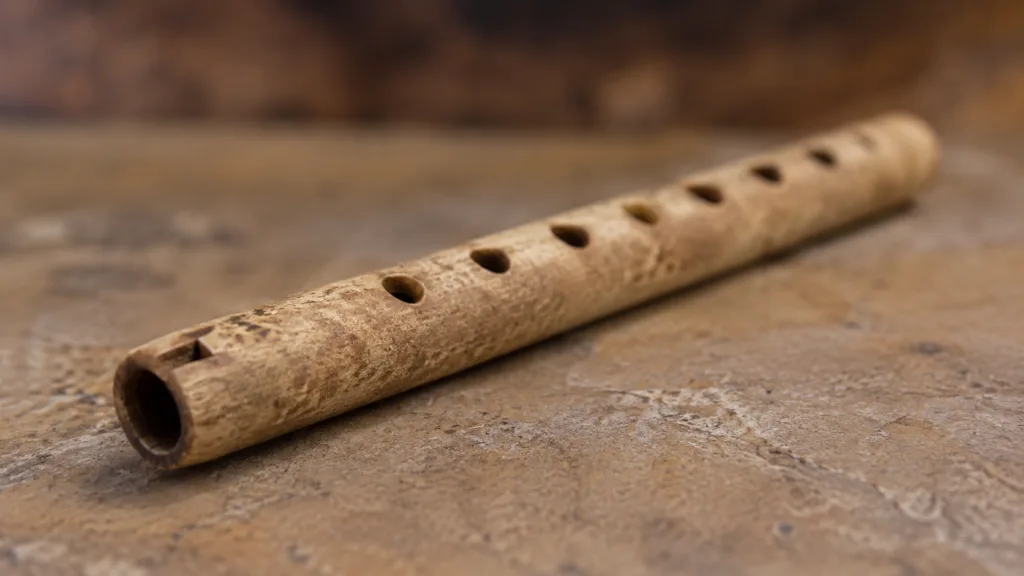
Sumerian flutes were wind instruments used in southern Mesopotamia during the third millennium BCE and later periods. The label covers more than one design: some pipes were probably edge-blown flutes, while the best-known surviving metal examples from Ur were more likely reed-driven double pipes.
What “Sumerian Flute” Means
Sumerian flute is a useful modern label, but it can hide several different instruments. Ancient texts, visual scenes, bone fragments, and metal tubes show that people in Mesopotamia used multiple kinds of pipes. Some were likely played by blowing across an open edge. Others probably used a vibrating reed fitted into or over the tube.
This distinction matters because an edge-blown flute and a reed pipe do not respond in the same way. A flute turns breath against a sharp edge, creating a soft, airy attack. A reed pipe begins with a vibrating tongue, producing a narrower, more penetrating tone. Ancient scribes did not organize their instrument names according to modern orchestral categories, so translations such as “flute,” “pipe,” and “oboe” often remain approximate.
Common Confusion: The Sumerian pipes are not the oldest flutes found anywhere in the world. Their importance lies in the early Mesopotamian record, where physical remains, images, and cuneiform texts can be studied together.
The Evidence That Survives
Wind instruments rarely survive as neatly as stone vessels or clay tablets. Reed and wood decay. Bone may break or be mistaken for an ordinary worked object. Metal lasts longer, but thin tubes can collapse, split, or lose the mouthpiece that once made them playable.
| Evidence Type | What It Shows | Main Limitation |
|---|---|---|
| Bone fragments | Prehistoric and early pipes with bored holes may preserve direct traces of wind instruments. | Fragmentary pieces can be hard to identify or date with precision. |
| Silver pipes from Ur | A paired metal instrument with measured tubes and finger holes. | The reeds or mouthpieces did not survive, so the original blowing system must be reconstructed. |
| Plaques, seals, and inlays | Players holding long pipes in ritual, banquet, or entertainment scenes. | Small-scale images may simplify finger holes, mouthpieces, and hand position. |
| Cuneiform texts | Instrument names, musicians, ceremonies, hymns, and materials associated with pipes. | One ancient term may cover several forms, and modern translations do not always agree. |
| Modern replicas | Possible fingering patterns, reed behavior, pitch range, and paired playing methods. | A replica demonstrates one plausible solution rather than the exact ancient sound. |
The Silver Pipes from Ur
The best-known surviving Sumerian wind instruments are a pair of thin silver pipes from the Royal Cemetery of Ur, dated to about 2450 BCE in the Early Dynastic III period. They were recovered in damaged and folded sections, which made their original arrangement difficult to read. Later study of early excavation photographs helped researchers join the surviving pieces more convincingly.
Each reconstructed tube is about 24 cm long. One has four finger holes and the other has three. When the tubes are aligned by the paired lines around their bodies, three holes correspond closely. This supports the view that they were designed to be held and played as a pair rather than as unrelated pipes.
The tubes were formed by rolling thin silver sheet. Their long seams were narrow but apparently not soldered. A sealant such as beeswax or bitumen may have made the bore airtight. The small outer diameter, roughly 4–5 mm, suggests a slender and highly focused instrument rather than a broad open flute.
What We Know: The silver tubes and finger holes survive. The original reeds, mouthpiece arrangement, bindings, sealant, and playing posture do not. Any playable reconstruction must therefore separate measured evidence from informed experiment.
Why the Ur Pipes Were Probably Reed Instruments
A plain tube with finger holes can belong to either the flute family or the reed-pipe family. The Ur tubes do not preserve a clear blowing notch, side embouchure hole, or duct window. Their narrow bore also leaves little room for a conventional flute-style mouthpiece. For these reasons, many reconstructions treat them as reed-driven pipes.
A small reed tongue may have been cut from wheat straw or another slender plant stem and fitted to each silver tube. The two pipes could then be sounded together, with one hand controlling each set of holes. One tube may have carried a steadier note while the other moved melodically, or both may have formed close intervals. The exact musical relationship cannot be recovered from the tubes alone.
Breath Activates the Reed
Air pressure causes a thin plant tongue to open and close rapidly. This creates a pulsing air stream inside the silver bore.
The Tube Shapes the Pitch
The vibrating air column reinforces certain frequencies. Tube length, bore width, reed stiffness, and sealing all affect the result.
Finger Holes Change the Effective Length
Opening a hole shortens the active air column and raises the pitch. The unequal hole counts may have given the paired pipes different melodic jobs.
Two Pipes Create a Layered Texture
Simultaneous pipes can produce a drone with melody, parallel motion, beating intervals, or alternating phrases, depending on fingering and breath control.
Materials and Their Effect on Sound
The surviving record includes reed, bone, wood, copper alloy, and silver. Material matters, but it does not determine tone by itself. Bore shape, wall thickness, hole placement, reed cut, airtightness, and the player’s breath can change the sound more than the outer material.
| Material | Construction Value | Likely Sound Tendency |
|---|---|---|
| Reed | Light, hollow, easy to cut, and well suited to replaceable pipes or vibrating tongues. | Direct response with a dry, grainy, or buzzing edge when used as a reed pipe. |
| Bone | Rigid natural tube that can hold clean finger holes. | Focused projection and a firm attack, though the bore shape varies with the bone. |
| Wood | Allows longer bodies and shaped bores but rarely survives in Mesopotamian soil. | Potentially warmer and less metallic, with tone strongly affected by bore finish and wall thickness. |
| Copper or bronze | Durable and workable for tubes, fittings, or ceremonial versions. | Stable bore geometry and clear projection; metal does not remove the reed’s buzzing character. |
| Silver | Prestige material that can be rolled into very thin tubing. | Fast response from a narrow bore, with a bright surface to a tone still governed mainly by the reed. |
The Archaeology of Breath
A wind instrument is more than the object that survives in a museum case. Its sound depends on perishable parts and bodily actions: a reed cut to the right thickness, a waxed seam, moisture in the mouthpiece, finger coverage, breath pressure, and the angle at which the pipes meet the lips.
This makes Sumerian wind instruments unusually difficult to reconstruct. A lyre can reveal its string length and soundbox outline even when its strings are gone. A pipe without its reed may conceal the feature that most strongly controls pitch, volume, and tone. Small changes to reed length can shift the register, while a weak seal can make the instrument unstable or silent.
Replica makers therefore work with ranges of possibility. They can match the surviving tube length and hole placement, test plant reeds that fit the bore, and compare how different setups behave. What they cannot do is prove that one reed cut, scale, or playing style was the only Sumerian method.
Musical Use in Sumerian Society
Music appears across many settings in the Mesopotamian record. Temple personnel performed hymns and laments. Courtly and funerary settings included singers, lyres, harps, percussion, and pipes. Plaques and small models also show musicians in less formal scenes, suggesting that pipe music was not limited to royal ceremony.
Reed pipes could support sung praise, ritual movement, lamentation, and offerings. Their sustained tone would contrast with plucked strings and struck percussion.
Later Mesopotamian texts connect pipes with grief, death, and the cult of Dumuzi. A narrow reed tone can carry a vocal, crying quality suited to lament performance.
Visual scenes place music beside feasting, movement, and social display. Pipes may have carried melody over clappers, rattles, or drums.
Reed and straw pipes are portable and closely tied to marsh, field, and herding environments. Mesopotamian stories also link pipes with shepherd figures.
Names in Sumerian and Akkadian Texts
Ancient instrument terminology does not map neatly onto modern labels. Sumerian words containing gi, a term associated with reed or tube, may refer to pipes of different lengths and functions. Later Akkadian vocabulary includes terms often translated as flute or pipe, including forms related to embūbu, but the exact body shape and mouthpiece cannot always be recovered from the word alone.
A Sumerian element connected with reed or tubular objects. Its presence in an instrument name does not prove a single fixed design.
A pipe sounded by a flexible tongue. It may use a single reed or double reed, though that distinction is often uncertain for ancient examples.
A pipe sounded by directing air against an edge. It does not require a vibrating reed.
Two sounding tubes played by one musician. The tubes may have matching or different finger-hole systems.
Edge-Blown Flute vs Reed-Driven Double Pipe
Air splits against an edge. The tone is usually breathier, and pitch can bend with blowing angle and pressure. The instrument needs a clear rim, notch, or embouchure arrangement.
A vibrating tongue starts the sound. The tone is more nasal, buzzing, and focused. Two pipes can support drone-and-melody textures or closely spaced intervals.
A Cautious Historical Timeline
Fragments of bone wind instruments show that bored pipes were used before the best-known urban Sumerian examples.
Art from southern Mesopotamia depicts pipe players, while the Royal Cemetery of Ur preserves the paired silver tubes dated to about 2450 BCE.
Sumerian liturgical texts mention reed pipes in praise and cult performance, linking wind instruments with formal song.
Lexical lists and literary texts preserve more instrument names, while Mesopotamian visual art continues to show pipes in ritual and processional settings.
Researchers and instrument makers test reeds, seals, fingerings, and paired playing methods while keeping the missing parts clearly marked as hypotheses.
How to Judge a Modern Reconstruction
A convincing replica should make its assumptions visible. Matching the silver tube length is not enough if the maker silently invents the reed, changes the hole spacing, or uses a modern tuning target that the artifact does not support.
- The tube dimensions and finger-hole positions are based on published measurements.
- The maker states whether the pipes use single reeds, double reeds, or an edge-blown setup.
- Modern sealants, bindings, and mouthpiece materials are identified.
- Pitch claims are presented as results from that replica rather than as a recovered Sumerian scale.
- The two pipes can be examined separately as well as played together.
- Decorative changes are not presented as archaeological features.
Replica Builder’s Note: The most informative replica is not necessarily the one with the prettiest finish. A documented model that allows reed, bore, and sealing experiments is more useful for understanding how the ancient pipes may have behaved.
Mini FAQ
Were Sumerian flutes made only from silver?
No. Silver survives well and draws attention, but texts and archaeological finds point to reed, bone, wood, copper alloy, and other materials. Everyday reed or wooden pipes were far less likely to survive.
Are the silver pipes from Ur true flutes?
Probably not in the narrow modern sense. Their lack of a surviving flute embouchure and their very small bore favor a reed-pipe reconstruction, although the missing mouthpieces prevent absolute certainty.
Could both Ur pipes be played at the same time?
The matching alignment marks and corresponding finger holes support paired use. How the player held them, whether both reeds sat inside the mouth, and what intervals they produced remain open questions.
Do we know the exact Sumerian flute scale?
No exact scale can be recovered from the pipes alone. Hole placement gives acoustic clues, but reed design, sealing, breath pressure, and fingering choices all affect pitch.
What did Sumerian pipe music sound like?
Edge-blown examples may have sounded soft and breathy. Reed-driven pipes were likely brighter, more nasal, and more forceful. Modern replicas offer possible sound models, not recordings of a fixed ancient practice.
Why are these instruments important?
They connect physical construction with visual art and written evidence. Together, those sources show that wind instruments had a place in ritual, courtly life, mourning, dance, and everyday music in Mesopotamia.