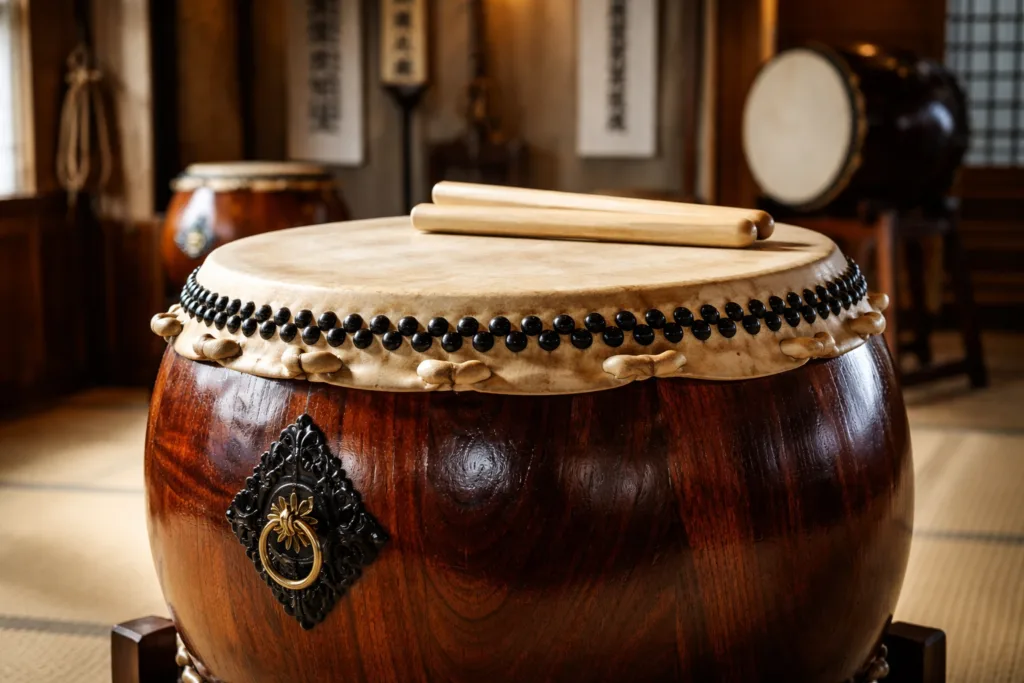
The Nagado Daiko is the classic Japanese taiko drum most people picture first: a barrel-shaped body, big presence, and a sound that can feel deep, clear, and alive.
- 🥁 Also known as Miya-daiko when used at shrines and ceremonies
- 🪵 Built in the byō-uchi style: tacked heads on a resonant body
- 📏 Sizes are often labeled in shaku (traditional units), so you can compare drums quickly
- 🎶 One drum, many voices: strike placement changes tone and color
- What it is: a long-bodied taiko with nailed heads
- What it does: anchors rhythm with weight and projection
- Where you see it: festivals, stage ensembles, and traditional settings
- Why it’s loved: power plus surprising nuance
Many modern groups gravitate toward 1 shaku 4 sun, 1 shaku 5 sun, and 1 shaku 6 sun Nagado sizes.
In measurements, 1 shaku is about 30.3 cm, and 1 sun is one-tenth of a shaku (about 3.03 cm).
🥁 Name, Shape, and Family
- Nagadō-daiko literally points to a long body, where the shell length is about the same as, or longer than, the head diameter.
- It sits in the byō-uchi (tacked-head) family, meaning the skins are fixed with rows of tacks rather than rope or bolts.
- The name Miya-daiko is often used when the drum is tied to shrine or ceremonial contexts.
The Nagado Daiko is a foundation drum in many taiko settings because its shape encourages a satisfying mix of boom and definition.
It can feel straightforward at first—hit the drum, get a big sound—then it quietly reveals a lot of control.
🪵 Materials, Build, and What They Change
- Body: traditionally carved from a single log (often described as kurinuki construction), shaped into a gentle barrel form.
- Wood: keyaki (Japanese zelkova) is widely prized; other hardwoods are also used, sometimes grouped under the term meari.
- Heads: thick cowhide is commonly used, fixed with heavy tacks in neat rows.
- Tuning reality: a byō-uchi drum is not tuned by tightening hardware after assembly.
Wood choice affects the character more than people expect. Dense, stiff hardwoods tend to support a strong core tone and a confident “throw” into the room.
The hide adds its own personality: thicker heads can feel solid under the stick, while slightly lighter heads can speak faster.
- Look down the shell: you want a clean curve and a stable feel, not a wobbly stance.
- Check tack rows: consistent spacing suggests careful work.
- Tap the shell lightly: a lively ring often hints at a responsive body.
🎧 Sound, Strike Points, and the “One Drum, Many Voices” Trick
- Center hits: focus on depth and roundness.
- Near the edge: bring out brightness and a tighter snap.
- Different stick angles: change how much of the bachi contacts the head, which shifts attack.
- Room size matters: Nagado tone blooms differently in a small studio versus a large hall.
Bold
Deep
Clear
Moderate
This isn’t a strict measurement. It’s a friendly way to describe what many players feel when a Nagado Daiko is sitting in a room and doing its job: carrying the groove while still giving you details to play with.
- Play 8 steady hits near the center. Listen for roundness.
- Move your target one palm-width outward and repeat. Notice the brightness.
- Now alternate center/edge every hit. Keep the same volume, change only the placement.
- Finish with 4 big center hits. Let the room respond. It’s oddly satisfying.
🧍 Playing Positions, Stands, and Comfortable Power
- Flat style: the drum sits on its end; you strike the top head for a grounded, direct feel.
- Horizontal style: mounted sideways; common for ensemble settings and long rehearsals.
- Diagonal style: angled toward you; encourages fluid motion and dynamic accents.
A stand changes your relationship with the instrument. With a horizontal setup, your shoulders can stay relaxed and your strokes can stay efficient.
With a diagonal setup, you often get a more natural arc in the arms, which can help keep speed and control together.
- Your wrists should stay neutral at impact, not bent sharply.
- The head should sit at a height where you don’t shrug your shoulders to reach it.
- You should be able to step around the drum without bumping it; stability supports confidence.
- If the drum creeps or slides, fix that first. A steady drum invites clean timing.
🥢 Bachi Choices That Change the Whole Conversation
- Materials you’ll see often: oak, maple, hinoki (cypress), hō (magnolia), and other hardwoods.
- Length hint: around 40 cm is a common adult length for Nagado playing, then you adjust for style and comfort.
- Weight feel: heavier bachi can produce a thicker sound, while lighter bachi can help with speed and long sessions.
If you’re chasing a warmer voice, try a slightly thicker stick and aim closer to the center. If you want crisp articulation, a lighter stick and a slightly outward target can give you clarity.
It’s a small change that can make your drum feel new.
- Play 6 identical strokes with bachi A. Focus on the attack.
- Switch to bachi B without changing your grip. Notice the body of the note.
- Repeat softly. Some sticks stay clear at low volume; that’s a useful detail.
🌿 Care, Climate, and Long-Term Health
- Keep the drum away from direct heat sources and harsh sun to protect the hide and the shell.
- Avoid sudden humidity swings; gradual changes are kinder to wood and skin.
- Use a soft cloth for dust; skip aggressive cleaners that can dull finishes.
- For transport, steady padding matters more than fancy cases. Preventing impact is everything.
A Nagado Daiko is a relationship with two natural materials: wood and hide. When the room gets very dry, heads can feel tighter and brighter. When it’s humid, they can feel a touch softer.
Instead of fighting it, treat it like a built-in seasonal personality.
- Wipe shell and rims lightly. Keep it dry and gentle.
- Inspect tack rows for any looseness. A stable head supports consistent response.
- Listen for new rattles or buzzes from hardware on the stand, not the drum.
- Let the drum “breathe” in its storage spot. Crowding it can trap moisture around the hide.
Taiko can get loud fast. If you rehearse often, consider comfortable hearing protection so your ears stay fresh and your timing stays sharp.
🔎 Antique and Vintage Nagado Daiko: What to Look For
- Shell condition: small surface marks can be normal; structural cracks deserve careful attention.
- Roundness: the head opening should feel true and even; an uneven rim can affect response.
- Hide health: look for dryness, deep splits, or areas that feel “dead” when tapped.
- Patina: older finishes may mellow beautifully; that gentle aging can be part of the story.
- Stand it up and check stability. A confident stance hints at a healthy shell.
- Tap-test around the head: center, mid, edge. Listen for a smooth transition, not sudden dead spots.
- Inspect tack lines closely. Even spacing and firm seating often reflect careful maintenance.
- Look inside if possible. Clean interior shaping can support resonance.
- Ask about storage: stable temperature and humidity help a drum age gracefully.
Antique instruments reward patience. If you find a vintage Nagado that feels solid, speaks evenly, and shows thoughtful care, you’re not just buying a drum—you’re picking up a voice that has already lived a little.
🎭 Tradition, Festival Life, and Modern Stage Energy
- Festival and dance: Nagado is a familiar heartbeat in community settings.
- Ceremony: the “Miya-daiko” identity connects it to ritual and formal occasions.
- Theater color: taiko can support dramatic moments with clean accents and rolling textures.
- Ensemble era: modern kumi-daiko took a major step in 1951, when Daihachi Oguchi formed Osuwa Daiko and shaped a concert-style approach.
That mix—old roots and modern imagination—keeps the Nagado Daiko in constant motion. One day it’s providing a steady pulse for a group. Next day it’s the dramatic spotlight, filling the room with thunder and silence on demand.
Keep it simple. Aim for even sound, then start shaping contrast.
- 8 hits at medium volume (center)
- 8 hits at soft volume (center)
- 8 hits at medium volume (edge)
- 8 hits alternating center/edge, same volume throughout
🏠 Bringing Nagado Daiko Into Your Space
- Floor care: use a stable mat under the stand to protect both drum and room.
- Stick control: smaller motions can still produce big sound when your timing is clean.
- Session planning: short, focused practice often beats long, unfocused sessions for growth.
If you practice at home, you can still explore depth without forcing volume. Work on precision, clean stick rebound, and consistent tone. Those skills translate directly to stage power.
The drum stays expressive even when you play quietly.
❓ Nagado Daiko FAQ
What makes a Nagado Daiko different from rope-tension taiko?
A Nagado Daiko is typically a byō-uchi drum, meaning the heads are fixed with tacks. Rope-tension drums use lacing or hardware to adjust tension. With Nagado, you shape tone through placement, stick choice, and the room.
Is “Miya-daiko” the same thing as Nagado Daiko?
You’ll often hear Miya-daiko used as an alternate name for the Nagado Daiko, especially in shrine or ceremonial contexts. In daily use, many players treat the terms as closely linked.
What size feels “most versatile” for a first Nagado?
Sizes around 1.4–1.6 shaku are commonly used in groups and feel versatile. They balance depth, portability, and a satisfying strike response. Your arm comfort and stand height matter as much as the number.
Do Nagado Daiko heads need regular retightening?
Because the heads are tacked, you don’t retighten them like tunable drums. You mainly manage environment and care: stable humidity, gentle cleaning, and safe storage help the hide stay healthy over time.
How do I choose bachi for a deeper sound?
Try a slightly thicker, heavier bachi and play closer to the center. Harder woods can also feel more defined. Then adjust your grip so the stick rebounds cleanly instead of forcing the stroke.
What are common red flags when buying a vintage Nagado?
Watch for structural shell cracks, severe head splitting, loose tacks, and an uneven rim. A well-kept vintage drum can have beautiful patina, but it should still feel stable, responsive, and safe to play.