
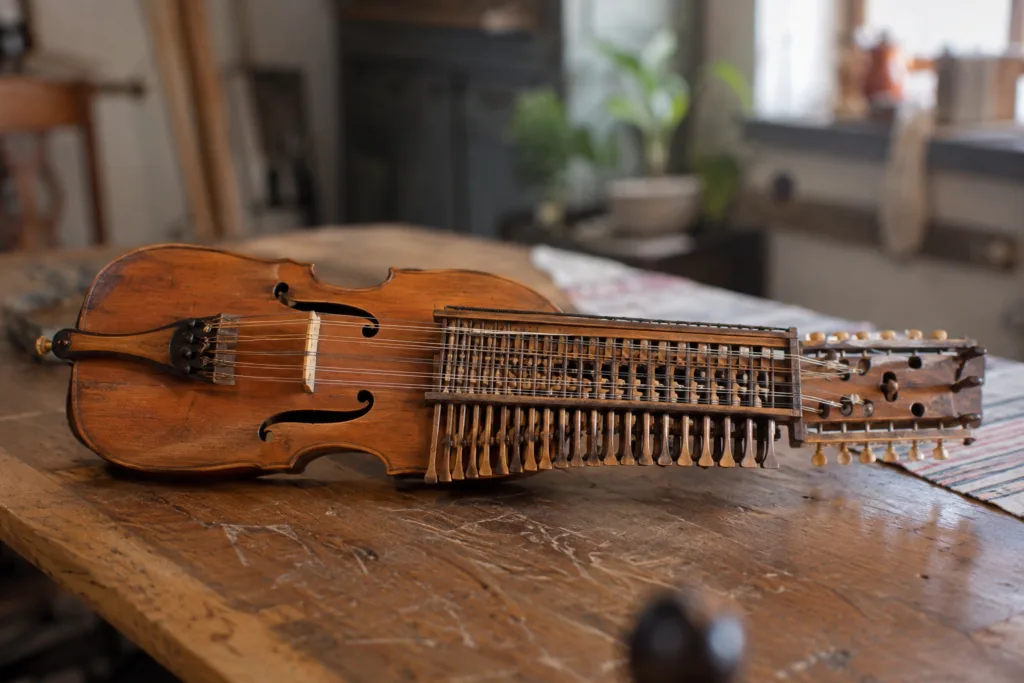
The nyckelharpa is a Swedish bowed string instrument in which the player changes pitch with rows of wooden keys rather than placing the fingers directly on the strings. Each key carries a small tangent that reaches a playing string and shortens its vibrating length. Beneath the bowed strings, a separate set of sympathetic strings responds to matching frequencies and overtones, giving the instrument its unusually resonant sustain.
The familiar modern chromatic nyckelharpa combines three systems in one body: a hand-held bow starts the vibration, keys and tangents determine pitch, and unbowed resonance strings add a second layer of vibration. That combination makes it more than a fiddle fitted with keys. Its mechanism shapes the attack of each note, while its sympathetic strings shape what happens after the note begins.
Keyed bowed chordophone
Northern Uppland, Sweden
16 strings
4 bowed strings and 12 sympathetic strings
Wooden keys fitted with tangents
Short hand-held bow
Usually three rows for three melody strings
Focused bowed attack followed by resonant sympathetic bloom
How the Keys Change Pitch Without Touching the Strings by Hand
The word keyed can create the wrong mental picture. A nyckelharpa does not use its keys to strike or pluck strings as a piano mechanism would. The bow remains responsible for starting the sound.
The left hand operates wooden keys that slide through the keybox. Attached to each key is a tangent, a small upright contact point positioned to meet a particular playing string. Pressing a key moves its tangent against the string and creates a new endpoint for the vibrating section of that string.
The Bow Starts the Vibration
The right hand draws the bow across one or more playing strings. At this stage the instrument behaves like a bowed chordophone: friction between bow hair and string repeatedly pulls and releases the string.
A Key Moves Its Tangent
The player presses the required wooden key. Its tangent moves toward the corresponding melody string.
The Tangent Stops the String
Contact with the tangent shortens the part of the string that can vibrate freely. A shorter effective string length produces a higher pitch, assuming the same basic string tension and mass.
The Body and Understrings Respond
String energy passes through the bridge into the wooden structure. Frequencies that correspond closely with the tuning of the sympathetic strings can then set those strings into motion.
The tangent therefore performs a job comparable to a fiddler’s fingertip, but by a very different mechanical route. The player selects a fixed tangent position instead of continuously choosing a contact point along an open fingerboard.
Tangent placement affects intonation. Moving or adjusting a tangent changes where the string is stopped. On a well-set-up instrument, the relationship between key position, tangent position and string height must allow clean contact without excessive pressure or buzzing.
What the 16 Strings Actually Do
A common modern three-row chromatic nyckelharpa has 16 strings, but they do not perform the same task. Only four belong to the directly bowed group. The other twelve form the resonance system.
| String Group | Typical Number | How It Is Used | Function |
|---|---|---|---|
| Keyed melody strings | 3 | Bowed and stopped by tangents | Carry most of the fingered melodic range |
| Low playing or drone string | 1 | Bowed, normally open on the standard three-row form | Adds a low open pitch and expands the bowed register |
| Sympathetic strings | 12 | Normally neither bowed nor stopped by the keys | Respond acoustically to related frequencies |
A Common Tuning for the Four Playing Strings
A traditional tuning for the four playing strings of the modern three-row instrument, from low to high, is C3–G3–C4–A4. The G, C and A strings are the three principal keyed melody strings. The low C is the open fourth playing string on the standard three-row arrangement.
That layout is not immutable. Some players raise the C4 string to D4, and other modern variants use different systems. Four-row instruments can also extend the key mechanism to a fourth playing string.
The Twelve-Note Resonance Set
One widespread arrangement tunes the twelve sympathetic strings chromatically from G♯ through G:
A
B♭
B
C
C♯
D
E♭
E
F
F♯
G
This gives the instrument a sympathetic string for every pitch class of the chromatic scale. Alternative placement schemes exist, so two well-made nyckelharpas do not necessarily arrange their understrings in exactly the same order.
Common Confusion: “A nyckelharpa has 16 strings” describes a widespread modern chromatic configuration, not every instrument that has carried the nyckelharpa name. Historical forms used different combinations of melody strings, drones, keys and resonance strings, and some early forms had no sympathetic-string system at all.
Why the Sympathetic Strings Vibrate Without Being Bowed
The sympathetic strings sit where the bow does not normally contact them. Their purpose is not to create a second manually played melody. They respond to energy already moving through the instrument.
Resonance Begins with a Frequency Match
Suppose a bowed string produces an A. That vibrating string drives the bridge, which transfers motion into the soundboard and the rest of the body. A sympathetic string tuned to A receives energy near its own natural frequency and can begin vibrating even though the bow never touched it.
The response is not limited to an exact match between two fundamentals. A bowed note contains a series of overtones. When one of those frequency components corresponds closely with a natural frequency of an understring, that string can also respond. Chords, open strings and strongly resonant intervals can therefore activate a broader set of vibrations than a simple “one played note, one understring” model suggests.
Sympathetic Resonance Is Not the Same as Echo
An echo is delayed sound returning to the listener after reflecting from a surface. Sympathetic resonance is a new physical vibration inside the instrument. The understring itself moves because it has received energy through acoustic coupling.
This distinction explains why the effect remains part of the instrument’s tone rather than sounding like a separate repetition. The directly bowed string establishes the note; the sympathetic system enlarges its resonant envelope.
Why Understring Tuning Changes the Character of the Instrument
A resonance string reacts most readily when its tuning aligns with frequencies present in the played note. If several understrings drift noticeably out of tune, the nyckelharpa can still be played, but the familiar sympathetic response becomes less coherent.
Retuning twelve understrings can also alter the total load on the bridge. For that reason, tuning may require more than one pass through the strings: adjustments to one group can slightly affect tensions elsewhere in the instrument.
The Sound Comes from More Than the Extra Strings
Sympathetic strings are responsible for much of the nyckelharpa’s lingering shimmer, but the complete sound also depends on the bowed strings, tangent contact, bridge, soundboard, internal support and body construction. A poorly responding bowed string cannot be turned into a good one simply by adding resonance underneath it.
The bow gives the note a clear bowed onset. Tangent contact can make articulation feel more mechanically defined than the continuous finger placement of an unfretted fiddle.
After the principal string speaks, matching sympathetic strings can continue contributing vibration. The perceived decay can therefore feel fuller than the decay of the directly played string alone.
Open playing strings, body modes and the twelve understrings interact. Some pitches stimulate the instrument more strongly than others because more resonant elements align with them.
Bridge geometry, soundboard stiffness, body construction and setup affect how efficiently string vibration becomes audible sound. Modern makers can adjust these variables without changing the basic keyed-fiddle principle.
Wood, Arching and Internal Setup
The wooden body is an active acoustic structure. Soundboard thickness and stiffness influence how easily energy moves away from the bridge, while bridge mass affects response and transmission. Wood choice also matters, but species name alone does not predict the result; density, cut, dimensions and maker decisions work together.
Modern chromatic construction was also influenced by violin-family ideas. Eric Sahlström experimented with features that included a bass bar, a less strongly arched top and violin-like f-holes. Such changes were part of the transition toward the responsive modern form rather than universal characteristics of every historical nyckelharpa.
Playing It Requires Two Different Kinds of Coordination
The right hand works in familiar bowed-string territory: bow speed, pressure, contact point and string choice affect the attack and tone. The left hand faces a different problem. Instead of locating pitches directly on a fingerboard, it must navigate rows of projecting keys.
The Left Hand Reads a Mechanical Layout
Each row of a standard three-row instrument controls one of the three keyed melody strings. Fingering therefore combines note selection with awareness of which string and key row is active. Double stops and open-string combinations add another layer because not every sounding pitch has to come through the same row.
The Short Bow Fits the Instrument’s Geometry
A nyckelharpa is normally supported with a strap and held across the front of the body. The keybox occupies the left side of the instrument, while the bow works within a relatively compact playing space. A shorter bow suits that geometry and allows controlled changes between strings without requiring the stroke length associated with a standard violin bow.
Instrument position can even affect setup behavior. On some nyckelharpas, gravity helps the keys and tangents fall clear of the strings when they are released. This is one reason tuning and checking an instrument in a realistic playing orientation can matter.
Why a Nyckelharpa Is Not Simply a Hurdy-Gurdy with a Bow
The nyckelharpa and hurdy-gurdy can both use keys and tangents to stop strings, which makes the resemblance more than visual. Their string-excitation systems, however, are fundamentally different.
| Feature | Nyckelharpa | Fiddle | Hurdy-Gurdy |
|---|---|---|---|
| What starts the string vibration? | Hand-held bow | Hand-held bow | Rosined rotating wheel |
| How is melodic pitch stopped? | Keys and tangents | Player’s fingers | Keys and tangents |
| Are drones structurally important? | Important in several historical forms; still available through open strings | Not normally part of the instrument’s structure | Common and often central to the design |
| Are sympathetic strings characteristic? | Yes on the dominant modern form | Not on a standard fiddle | Not a defining requirement |
The nyckelharpa therefore combines the hand-bowed excitation of a fiddle with a mechanical stopping system. The hurdy-gurdy shares the keyed stopping idea but replaces the player’s bow stroke with a continuously rotating wheel.
The Modern Instrument Is One Stage in a Much Older Keyed-Fiddle Tradition
The history of the nyckelharpa is easier to understand as a sequence of changing mechanisms than as one unchanged instrument surviving for centuries. Key arrangements, drone systems, sympathetic strings and chromatic capability all changed.
Late-medieval imagery is often discussed in connection with early keyed bowed instruments, including a relief at Källunge church on Gotland. Such evidence should not be treated as proof that the depicted instruments were mechanically identical to a modern three-row nyckelharpa. The securely documented Swedish playing and building tradition associated with northern Uppland becomes much clearer in later centuries.
Historical images and surviving objects show that bowed instruments with mechanical pitch control existed long before the standardized modern chromatic nyckelharpa. Their exact relationship to later regional forms is not always simple.
The nyckelharpa became closely associated with northern Uppland, where farmers and craftspeople built and played it for dancing, ceremonies and community events.
Forms with sympathetic strings, drones and different tangent arrangements developed alongside one another. The kontrabasharpa and silverbasharpa represent different solutions rather than a simple straight-line sequence in which every later form replaced the one before it.
August Bohlin built one of the early three-row chromatic nyckelharpas. The extra chromatic flexibility helped the instrument work more readily with fiddle repertory outside the restricted tonal layouts of older forms.
Eric Sahlström refined construction, built instruments, composed and performed, and taught both playing and making. His work became closely associated with the spread of the modern chromatic form.
The international safeguarding work surrounding the Swedish nyckelharpa tradition was selected for UNESCO’s Register of Good Safeguarding Practices.
Historical Types Explain Why String Counts and Key Layouts Vary
Older nyckelharpas should not be judged as incomplete versions of the current instrument. Their mechanics were built around different musical functions, especially drones, restricted tonalities and regional repertory.
| Form | Mechanical Character | Musical Consequence |
|---|---|---|
| Moraharpa | Early-style single-row keyed layout associated with a surviving historical instrument and later reconstructions | Represents a very different keyed-fiddle design from the modern chromatic form and should not be treated as a 16-string model |
| Kontrabasharpa | One key row with multiple tangents on many keys, playing strings, drone and resonance strings | Allows characteristic combinations of melody and drone rather than the fully chromatic three-row logic of the modern instrument |
| Silverbasharpa | Two-row development with a different arrangement of playing strings and tangents | Expands interval and double-stop possibilities but remains less chromatically flexible than the later three-row type |
| Three-row chromatic nyckelharpa | Three keyed melody strings, low open playing string and typically twelve resonance strings | Provides broad chromatic access while retaining open-string and sympathetic resonance |
| Four-row modern variants | Extend tangent control to another playing string and may use alternative tuning systems | Expand the keyed range and can make layouts more familiar to players coming from other bowed strings |
The Moraharpa Needs Particular Care in Historical Claims
The famous instrument associated with Mora bears the date 1526, but the date carved or associated with an object is not automatically the same as the date when its complete instrument was built. Research into its wood and construction has complicated older interpretations of the object. It is safer to treat the Moraharpa as an unusual historical specimen with a debated construction history rather than a perfectly documented direct ancestor of every later Swedish nyckelharpa.
Why the Silverbasharpa Has “Silver” in Its Name
The name does not mean that its body was made from silver. It is associated with the use of a silver-wrapped gut bass string, a way of obtaining a stronger low response without relying on an impractically thick plain gut string.
Uppland Preserved More Than a Musical Repertory
Northern Uppland became the strongest regional home of the nyckelharpa tradition. The instrument was historically both played and built within communities, so musical knowledge and practical construction knowledge remained closely connected.
This matters because the nyckelharpa is unusually dependent on mechanical setup. A player encounters not only strings and bow hair but dozens of moving keys and tangents. Builders must consider how those parts slide, how cleanly they return, where each tangent meets its string, how the bridge separates the playing strings from the resonance set, and how the body responds to the total tension.
The instrument served dances and other community occasions in Uppland. Interest weakened during the early twentieth century, yet builders and players maintained enough of the tradition for a later revival. The result was not merely the reproduction of old instruments. Makers continued modifying the instrument while older forms remained playable alongside the modern chromatic type.
Eric Sahlström and the Shape of the Modern Chromatic Nyckelharpa
Eric Sahlström was a player, composer, builder and teacher whose work helped move the chromatic nyckelharpa from a regional instrument with a fragile player base into a form that could be built and taught more widely. His influence belongs as much to construction practice as to performance.
Sahlström experimented with the body and internal acoustic system rather than simply adding more notes. Bass-bar construction, changes to the top arching and the use of f-shaped sound holes are associated with efforts to obtain a responsive, more focused bowed tone while retaining the resonance strings that distinguish the instrument.
He also taught instrument building. That connection between making and playing remains characteristic of the nyckelharpa community: understanding tangent adjustment, key movement, bridge behavior and string setup is unusually useful even for musicians who do not consider themselves instrument makers.
The 2023 UNESCO Recognition Is About Safeguarding the Tradition
In 2023, the Nyckelharpa network was selected for UNESCO’s Register of Good Safeguarding Practices. The recognition concerns the way a living music and instrument-building tradition has been maintained and transmitted, not a declaration that the physical nyckelharpa itself is a “World Heritage instrument.”
What the UNESCO decision covers: the network of builders, musicians, dancers, researchers, educators, institutions and other participants who support playing, construction, documentation, teaching, meetings and knowledge exchange around the nyckelharpa tradition.
The distinction fits the history of the instrument. Nyckelharpa culture has survived through both preservation and change. Older instruments remain part of the tradition, while chromatic instruments, new construction approaches and repertory outside Swedish folk dance music continue to develop.
The instrument can now be heard in folk, classical, experimental and popular-music settings, yet the mechanism that identifies it remains recognizable: a hand-held bow excites the playing strings, wooden keys move tangents against the melody strings, and sympathetic understrings respond without being directly played.