
Instrument Snapshot
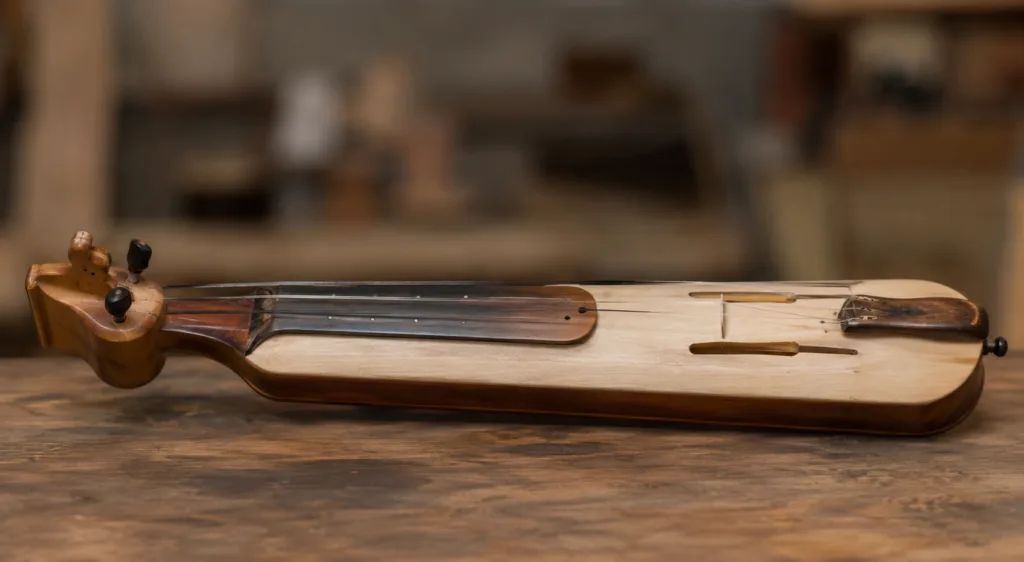
The Karadeniz kemenche, or Karadeniz kemençesi, is a compact three-stringed bowed lute associated most closely with the Eastern Black Sea region of Türkiye. Its narrow carved body, responsive soundboard, fourth-based tuning traditions, open-string textures, and fast bow articulation give it a focused voice suited to horon dancing, sung repertory, solo playing, and several distinct regional performance styles.
The Karadeniz kemenche is small enough to be held in one hand while standing, yet its construction supports a surprisingly dense musical texture. A player may bow two strings together, leave one string open beneath a melody, shift the bow rapidly between adjacent strings, and use short ornaments that make a single melodic line sound rhythmically full. Its characteristic voice therefore comes from more than the pitch of three strings. Body geometry, soundboard thickness, wood choice, bridge response, tuning, bow tension, open-string use, and the habits of a local playing tradition all affect what reaches the listener.
There is also no single physical or musical specification that defines every Karadeniz kemenche. Instruments associated with different parts of the Black Sea region can differ in length, body width, tonal center, tuning preference, and playing feel. Görele traditions are often associated with a more treble-oriented sound and highly developed horon playing, while Sürmene instruments have been documented with longer, wider bodies and a lower tonal tendency. Ağasar places more emphasis on the relationship between kemenche and sung performance, while the inland Kelkit tradition adapts the instrument to a musical environment that differs markedly from the coastal horon belt.
Why the Body Shape Matters to the Sound
A Karadeniz kemenche is typically built around a narrow resonating body carved from a solid piece of hardwood. A separate soundboard closes the cavity, while the bridge transfers string vibration into that soundboard and the body beneath it. The result is a lightweight structure that can respond quickly to rapid bow changes.
Traditional descriptions record body woods including mulberry, walnut, plum, maple, ivy, lemon wood, and other locally or commercially available timbers. Pine or fir has been used for the soundboard, while maple is documented for bridges. These choices should be understood as maker traditions rather than a fixed recipe. Two instruments made from the same named wood can still behave differently because density, grain, moisture history, wall thickness, soundboard thickness, and internal dimensions are not identical.
| Part | What It Does | Why It Matters |
|---|---|---|
| Carved Body | Forms the resonating cavity and supports the neck and soundboard | Body dimensions and wall stiffness affect vibrational behavior and tonal balance |
| Soundboard | Receives energy from the bridge and vibrates over the cavity | Wood, thickness, stiffness, and mass can alter responsiveness and frequency balance |
| Bridge | Transfers string motion to the soundboard | Its fit, mass, position, and material influence attack and energy transfer |
| Soundpost | Provides a structural and vibrational connection beneath the soundboard | Its position and fit affect how different areas of the body respond |
| Sound Holes | Connect the enclosed air cavity with the surrounding air | Geometry and opening area influence acoustic response |
| Neck and Peg Area | Supports string length and tuning hardware | Mass and geometry contribute to the vibration of the instrument as a whole |
The soundpost deserves attention because the instrument can look extremely simple from the outside. Traditional construction places a small post beneath the soundboard near the treble side, much as bowed instruments in other traditions use an internal post to connect vibrating surfaces. Its job is not decorative. A poorly fitted or displaced post can change response even when the strings, bridge, and tuning remain unchanged.
From a Wood Blank to a Playing Kemenche
Carving the Resonating Body
The maker establishes the outer profile and hollows the body to create the internal air space. The remaining wall thickness affects weight, stiffness, and vibration.
Shaping the Neck and Head
The narrow neck, peg area, and body are balanced as one structure. Small dimensional changes can alter both handling and vibrational behavior.
Preparing the Soundboard
A separate plate is shaped and fitted over the carved cavity. Thickness is especially important because a lighter plate can respond differently from a thicker, stiffer one.
Cutting the Sound Holes
The openings are positioned and shaped before final setup. Their size and geometry influence the interaction between the moving soundboard and the internal air cavity.
Fitting Bridge, Soundpost, Pegs, and Tailpiece
These small parts determine how string tension is supported and how bow energy reaches the body. Precise fit matters more than decorative complexity.
Stringing and Final Setup
The maker or player adjusts string choice, bridge position, tuning, and bow response. The finished instrument is therefore a combination of woodworking and setup rather than a body shape alone.
What Makes One Kemenche Brighter and Another Lower in Tone?
Descriptions such as bright, treble-oriented, lower, or woody should not be assigned to a single species of wood as though timber alone determines the instrument. The kemenche behaves as a coupled structure. Soundboard thickness, body dimensions, material density, neck geometry, bridge behavior, strings, tuning, and bow input all interact.
This helps explain why apparently similar instruments can feel different under the bow. A lightly responsive soundboard may speak quickly, while another instrument may require more bow pressure before the body responds fully. A larger or stiffer structure may distribute energy differently across the spectrum. The player then modifies that response further through bow speed, pressure, angle, and the choice to engage one or two strings.
What Acoustic Testing Found: A 2026 Acta Acustica study examined 18 regionally representative Karadeniz kemenches from Rize, Trabzon, and Giresun and recorded 20 geometric parameters alongside acoustic measurements. Eleven instruments formed a bass-oriented group that predominantly used ivy or plum bodies with soundboards averaging about 3.1 mm thick, while seven treble-oriented examples used dense mulberry and averaged about 2.5 mm. The study also found relationships between higher-frequency content and structural measurements, with fingerboard and nut thickness emerging as a strong individual predictor in its statistical models. These findings describe the tested instruments; they are not universal construction rules for every kemenche.
Soundboard Thickness Is More Than a Craft Detail
The difference between roughly 2.5 and 3.1 mm may look minor on a ruler, but a few tenths of a millimeter can alter the mass and stiffness of a small soundboard. Earlier acoustic work on Karadeniz kemenche models has likewise shown that changing soundboard thickness can shift the response at particular frequencies. This does not mean that thinner is automatically better or brighter in every instrument. The rest of the body still matters.
Body Wood Works Together with Geometry
Mulberry has a long association with regional instrument making, but the 2026 sample also shows why a species label cannot serve as a tone guarantee. Dense mulberry appeared mainly in the treble-oriented group, while ivy and plum appeared more often among the bass-oriented instruments. Wood choice and geometry had developed together in those examples, making it misleading to separate one variable from the rest of the build.
Sound Holes Also Change Acoustic Behavior
The openings in the soundboard regulate more than the appearance of the instrument. Their shape and size affect how the air cavity interacts with structural vibration. For a maker, changing a sound hole is therefore an acoustic decision as well as a visual one.
Three Strings and the Logic of Kemenche Tuning
Traditional Karadeniz kemenche descriptions commonly place the three strings in relationships of fourths, while absolute pitch may move to suit the instrument or the singer. Recorded examples of tuning practice range from G–C–F to E–A–D. The useful point is the interval relationship, not the idea that every performer must tune to one fixed pitch standard.
This flexibility fits a tradition in which a kemenche player may also sing. The upper string can be placed where it suits the voice, with the lower strings adjusted in relation to it. Historical descriptions also record a thin steel upper string and gut for lower strings, although string materials and modern setups can vary.
Why an Open String Is Musically Active
A melody does not always occupy the sound by itself. Players often bow two neighboring strings together while leaving the lower of the pair open. That open tone forms a persistent harmonic reference beneath the moving line. Because fourth-based relationships are common, parallel fourths and other intervals naturally appear in the texture.
The effect is closer to a melody surrounded by a constantly changing drone and interval field than to a violin line played strictly one note at a time. Thirds, fifths, sixths, and sevenths can also appear according to fingering and which pair of strings receives the bow.
| Playing Choice | Resulting Texture |
|---|---|
| Single-String Melody | A clearer linear phrase with less continuous harmonic weight |
| Melody + Open String | A sustained drone or interval beneath the moving melody |
| Two Fingered Strings | Parallel intervals and a thicker harmonic texture |
| Rapid String Changes | Rhythmic articulation becomes part of the melodic character |
The Bow Shapes the Regional Accent
A Karadeniz kemenche performance cannot be understood by looking only at fingering. Bow behavior determines attack, pulse, string pairing, and much of the rhythmic character. Small changes in angle decide whether one string speaks alone or a neighboring string joins it.
Traditional bows can be simpler than a modern violin bow. Historical descriptions record hair tied to the stick without the screw-operated frog used on a violin, allowing the player’s hand to influence hair tension while playing. Bow construction is not identical across every regional or modern example, and some Pontic-style bows use a self-tensioned design closer to the mechanical idea of a violin bow.
Short Strokes and Continuous Motion
The instrument is well suited to repeated short bow movements and fast changes of direction. In dance repertory, the bow can maintain an almost uninterrupted stream of subdivisions while the left hand changes only part of the pitch material. The rhythmic engine is therefore distributed between both hands.
One String or Two Is a Constant Choice
A small rotation of the instrument or bow can bring a second string into contact. The player can move between a narrow single-line sound and a rougher, denser two-string texture without interrupting the phrase. That control is one reason recordings by different regional players can sound unlike each other even when the melody itself is related.
Standing and Seated Playing
The instrument may be played seated, supported near the knees, or held freely in the left hand while standing. The standing position is especially compatible with mobile social performance because the instrument does not require a shoulder rest or floor support. Balance becomes part of technique: the left hand must control the instrument without gripping so tightly that fingering loses freedom.
Why Horon and Kemenche Technique Fit Each Other
The close association between the kemenche and horon is heard in continuous bow motion, repeated rhythmic figures, sharp attacks, and the ability to intensify a phrase without changing instruments. The player can reinforce dancers by repeating a compact motif, tightening the bow stroke, increasing rhythmic density, or moving into a higher-energy register.
Horon should not be treated as one meter or one fixed tempo. Coastal examples include asymmetrical patterns such as 7/8 and 7/16 as well as other regional meters, while the Kelkit area has traditions in which 5/8 becomes more prominent. Tempo behavior also changes by place.
The Görele Tempo Arc
Descriptions of Görele performance document horons such as Hamzabaş, Tuzcuoğlu, and Sıksara in a progression that may begin at a slower pulse, accelerate as the dancers develop their figures, and relax again toward the end. In this setting, the kemenche does not merely provide a tune. Its bowing helps shape the physical arc of the dance.
The same fast and nearly continuous bowing language can also appear in solo playing. Horon has influenced technique strongly, but it does not define every piece in the instrument’s repertory.
There Is No Single Black Sea Kemenche Playing Style
Regional classification is useful only when treated as a map of tendencies rather than a set of rigid borders. One influential study of Eastern Black Sea kemenche practice identifies Görele, Ağasar, Sürmene, Kelkit, and a Pontic/Rum style as recognizable performance schools. Players, makers, repertories, and neighboring communities have continued to influence each other, so individual instruments do not always fit neatly into one category.
| Tradition | Core Area | Documented Tendencies | Musical Context |
|---|---|---|---|
| Görele | Görele, Tirebolu, Eynesil, Çanakçı | Treble-oriented kemenches, developed instrumental lineages, energetic horon bowing | Horon repertory including Hamzabaş, Tuzcuoğlu, and Sıksara |
| Ağasar | Şalpazarı, Tonya, Beşikdüzü, Vakfıkebir | Small, higher-tuned examples documented; stronger emphasis on the sung dimension | Atma türkü, social singing, oturak gatherings, regional horon |
| Sürmene | Sürmene, Araklı, Of, Çaykara | Lower tonal tendency, longer and wider bodies, historical interaction with kaval technique | Local horon and song traditions with a distinct eastern Trabzon character |
| Kelkit | Şebinkarahisar, Alucra, Çamoluk, Suşehri, Koyulhisar, Mesudiye | Inland rhythmic character, slower dance tempos, frequent 5/8 use in documented repertory | Long airs, horon with inland traits, coexistence with davul and zurna |
| Pontic / Rum | Black Sea-derived tradition continued largely in Greece | Generally lower tonal tendency in the documented style, more detached bow articulation, different bow setups | Pontic dance, song, stage performance, and newer amplified settings |
Görele: Instrumental Lineage and Treble Energy
The Görele area has one of the most clearly documented master-to-student kemenche lineages. Historical performers such as Picoğlu Osman helped establish recordings and techniques that later players studied and imitated. The regional sound is commonly described as relatively high and penetrating, matching a playing tradition in which instrumental detail and horon articulation receive strong attention.
That treble tendency does not mean every Görele instrument follows one template. It describes a regional preference visible across maker and performer traditions rather than a mandatory measurement.
Ağasar: Kemenche Inside a Singing Tradition
Ağasar centers strongly on Şalpazarı and extends into Tonya, Beşikdüzü, and Vakfıkebir. Its documented distinction is not merely an alternative bow pattern. Sung performance has a larger role, especially in social settings associated with atma türkü, improvised or exchanged verse, and oturak gatherings.
Descriptions of the area record small, high-tuned kemenches and a vocal culture in which the singer may attract as much attention as the instrumentalist. Görele and Ağasar are geographically close and have shared highland environments, so the boundary between their sounds can be less obvious than the difference between either of them and Sürmene.
Sürmene: Lower Tone, Wider Bodies, and Kaval Interaction
Sürmene tradition extends through nearby Araklı, Of, Çaykara, and smaller settlements east of central Trabzon. Researchers have documented kemenches here with lower tonal tendencies, longer bodies, and wider carved cavities than examples associated with Görele and Ağasar.
Kaval once occupied a strong place in the same musical environment, and its phrasing is described as having influenced local kemenche technique. This is a useful example of why regional sound cannot be reduced to construction alone. Makers can favor a body suited to a lower voice while players carry melodic habits learned from another local instrument.
Kelkit: A Kemenche Tradition Away from the Coast
The Kelkit school changes the usual image of the kemenche as a purely coastal dance instrument. Its area follows an inland corridor through Şebinkarahisar, Alucra, Çamoluk, Suşehri, Koyulhisar, and Mesudiye. This zone sits between Black Sea and Central Anatolian cultural environments.
Local horons have been documented with slower tempos and a stronger presence of 5/8 than many coastal examples. Davul and zurna also hold an important place, while the kemenche can accompany long airs. The result is a playing language in which the same three-stringed instrument serves a different rhythmic and melodic environment from the fast coastal horon stereotype.
The Pontic / Rum Continuation
Black Sea Greek communities carried their kemenche tradition into Greece during the population movements of the early twentieth century. The tradition continued there and developed its own performance habits. Research comparing regional schools describes more detached bow articulation, generally lower tonal orientation, and self-tensioned bow designs among recognizable Pontic-style practices.
Later contact through recordings, travel, digital media, makers, and performers has allowed techniques to circulate again between Türkiye and Greece. This makes the Pontic tradition relevant to Karadeniz kemenche study without treating it as a frozen copy of an earlier Black Sea style.
Construction and Regional Style Reinforce Each Other
A regional playing style can create practical preferences for an instrument, and those instrument choices can in turn make certain techniques easier to produce. A treble-oriented kemenche with a quick response may suit a performer seeking crisp articulation in dense dance textures. A longer, lower-voiced instrument may support another repertory and bowing approach.
This relationship is best understood as a feedback loop between maker and player. A luthier hears what local performers want, adjusts body proportions or soundboard behavior, and passes those decisions into later instruments. Players then develop technique around the instruments available to them. Over time, a recognizable local sound can emerge without a written manufacturing standard.
The 2026 acoustic study adds measurable evidence to this relationship. Its 18 instruments did not form one uniform design population; they separated into bass-oriented and treble-oriented clusters with differences in materials and geometry. Two transitional instruments also showed mixed properties, which fits the idea of a continuum rather than two sealed instrument types.
Karadeniz Kemenche and Classical Kemençe Are Different Instruments
Common Confusion: The word kemençe can refer to more than one bowed instrument in Turkish musical life. The narrow-bodied Karadeniz kemenche belongs to Black Sea folk traditions, while the pear-shaped classical kemençe, also associated with names such as armudî kemençe, belongs to a different construction and performance tradition connected with Ottoman and Turkish classical music.
The shared name does not make the instruments interchangeable. Their body shapes, repertories, tuning practices, bow handling, sound ideals, and performance settings differ. A collector searching for a Black Sea instrument should therefore confirm the body form and regional setup rather than relying on the word kemençe alone.
What to Inspect in a Playable or Collectible Kemenche
An older instrument is not automatically a better-sounding one. Condition, setup, structural stability, and the original maker’s choices matter more than age by itself. Regional differences also mean that an unusual width, low voice, or nonstandard-looking bow should be investigated before being treated as a defect.
- Check the soundboard around the bridge for cracks, excessive sinking, lifting, or poorly matched repairs.
- Inspect the carved body for splits along the grain, especially around thin wall areas and the neck-to-body transition.
- Make sure the bridge sits correctly and has not twisted under long-term string tension.
- Confirm that the tuning pegs turn smoothly but hold tension without slipping.
- Listen across all three strings rather than judging the instrument only from the highest string.
- Check whether the open-string drone and two-string response are balanced; weak response on one string may point to setup rather than poor wood.
- Do not reposition the soundpost casually. A small change can alter response and may damage the soundboard if the fit is wrong.
- Ask about regional setup, intended tuning, and maker tradition before comparing dimensions with another kemenche.
For a player, response under the bow is often more informative than raw loudness. A good match should let the intended tuning speak cleanly, allow controlled single- and double-string contact, and remain stable when the bow moves rapidly. For a collector, originality and provenance may matter as well, but those concerns should be kept separate from playability.
Mini FAQ
Is the Karadeniz kemenche the same as the classical Turkish kemençe?
No. They share a name and both are bowed instruments, but the Karadeniz kemenche has a narrow carved body and belongs mainly to Black Sea folk traditions. Classical kemençe has a pear-shaped body and a separate playing tradition associated with Ottoman and Turkish classical repertory.
How many strings does a Karadeniz kemenche have?
It normally has three strings. Traditional practice often uses one string as an open tone while a neighboring string carries the melody, and two strings may be bowed together to create a thicker texture.
Does every Karadeniz kemenche use the same tuning?
No. Fourth-based relationships are common in traditional descriptions, but the absolute pitches can vary. Tunings documented in older practice include arrangements ranging between G–C–F and E–A–D, and singing players may adjust pitch to fit their voice.
Why are some regional kemenches larger or lower in pitch?
Maker practice and local sound preferences vary. Research has documented longer, wider and generally lower-toned instruments in the Sürmene tradition, while Görele is associated more often with a treble-oriented sound. Acoustic testing also shows that wood, soundboard thickness, and other dimensions can correlate with tonal orientation.
Is the kemenche used only for horon?
No. Horon is one of its best-known settings, but the instrument also accompanies songs, solo repertory, improvised verse, long airs, and other regional forms. Its musical function changes across Görele, Ağasar, Sürmene, Kelkit, Rize, Artvin, and Pontic performance traditions.