- 🌊 Core Sound: a continuous, granular “wash” that can move from silky surf to crashing pebbles
- 🪵 Core Feel: gentle resistance from the moving beads, plus the instrument’s own inertia as the frame “wants” to keep rolling
- 🧭 Core Skill: control of angle, speed, and stopping—more like steering than striking
- 🏺 Curator’s Lens: modern in name, but rooted in older membrane-and-frame ideas found across frame drum families
What An Ocean Drum Really Is
| Part | What You See | What It Does To Sound And Feel |
|---|---|---|
| Frame | Shallow hoop, often wood or composite | Sets resonance, weight, and how the drum “rolls” in the hands |
| Heads | One or two membranes (natural skin or synthetic film) | Defines brightness, sustain, and the grain of the timbre |
| Fill | Beads or pellets inside the frame | Creates the moving “shoreline” texture; changes perceived sand vs stone character |
| Depth | Usually shallow compared to many drums | Controls bead travel distance; deeper frames can feel slower and more “swirly” |
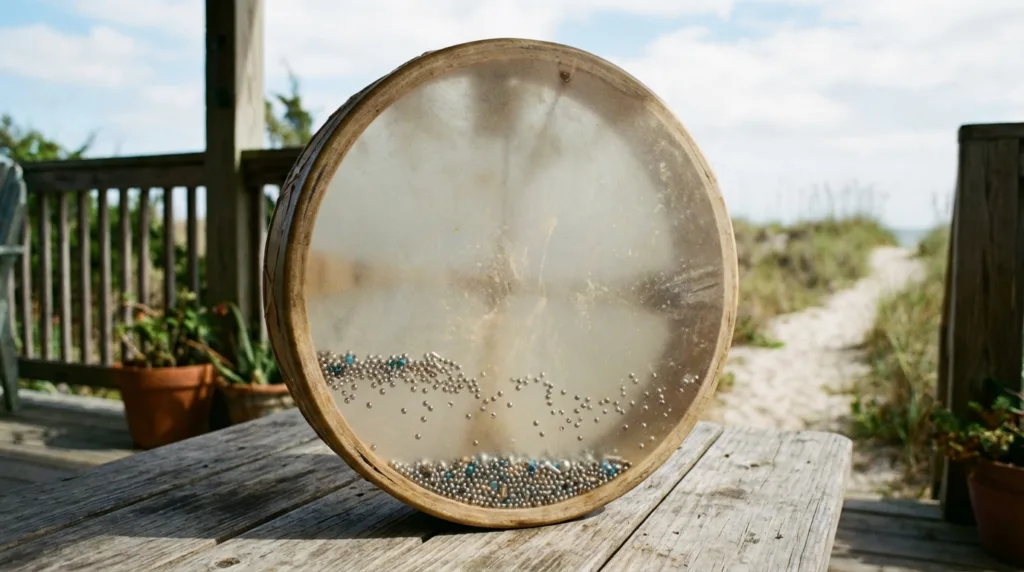
An ocean drum is a frame drum that produces sound mainly through controlled motion, not impact. Inside the frame, small beads or pellets move across a drumhead like countless tiny fingers. The result is not one note but a shifting noise-spectrum—rich in detail, sensitive to angle, and surprisingly expressive once you stop treating it like a “special effect” and start treating it like an instrument with breath.
Many players also know it as a wave drum. In orchestral contexts, a closely related design is often associated with the geophone concept—an instrument built to imitate granular natural textures. The name “ocean drum” stuck because the ear quickly maps those rolling grains onto surf, foam, and stones.
Sound Character: Timbre, Texture, And The “Grain” Of Waves
- 🎧 Low-Speed Tilt: soft “sand” hiss with long, even tails
- 🪨 Medium Roll: distinct bead chatter; the beach gets rockier
- 🌪️ Fast Swirl: dense white-noise wash; less detail, more energy
- ✋ Stop-And-Catch: sudden crest-and-break, like a wave collapsing
The timbre of an ocean drum is built from micro-impacts: each bead taps, slides, and rebounds against the membrane. Your ear blends thousands of tiny events into one moving picture. That is why the instrument feels “real.” It has randomness with direction—like nature itself.
Listen for the “grain size.” Fine grain sounds like wet sand retreating. Coarser grain sounds like pebbles pulled back by undertow. The grain is not only about bead size; it also comes from head material, head tension, and the internal surface’s friction.
One sentence worth keeping in mind: On an ocean drum, your hands conduct gravity.
If the wash feels “flat,” slow down and reduce the tilt angle. A smaller angle often brings back detail because the beads travel in thinner layers instead of piling up.
Materials That Matter: Frame, Head, And Fill
Frame Woods And What They Do
- 🪵 Maple: balanced resonance, smooth response, often a “studio-friendly” choice
- 🪵 Birch: a bit more focus and snap; can make the wash feel clearer
- 🪵 Beech: warm and solid, with a steady midrange presence
- 🪵 Ash: lively attack and slightly brighter edge to the texture
In a luthier’s workshop, the frame is not just a ring—it is the instrument’s acoustic boundary. Stiffer woods can project the wash with more definition, while softer or more damped constructions can make the sound feel closer and gentler. The joinery matters too: a clean, stable seam helps the drum stay round, and “round” is a big deal when you want an even roll with no dead zones.
Drumheads: Natural Skin Vs. Synthetic Film
| Head Type | Sound | Feel | Practical Notes |
|---|---|---|---|
| Natural Skin | Complex, earthy, slightly irregular “shoreline” | More tactile drag; grains feel more organic | Sensitive to humidity; can shift tension over seasons |
| Synthetic Film | Clear, bright, consistent wash; easy “ocean” illusion | Slicker surface; beads glide with less friction | Stable tuning; often preferred for travel and stage |
If your ear loves detail, natural skin can be deeply rewarding—its microscopic texture adds tiny variations to each bead’s contact. Synthetic film tends to deliver a cleaner, more predictable wave, which helps in ensemble settings where you need the same effect every time.
Fill: Beads, Pellets, And The Secret Of “Sand Vs. Stone”
- Smaller beads often read as sand: smoother, more continuous noise.
- Larger beads read as pebbles: more clicks, more separation, more drama.
- Heavier material increases impact energy: louder wash, stronger “break.”
- Fill quantity controls density: too little feels thin; too much can choke motion.
The fill is your palette. It decides whether the ocean drum sounds like foam sliding over sand or stones tumbling under a stronger pull. The best builds avoid a harsh “metallic rain” unless that is the goal. A well-voiced instrument keeps brightness, but it stays round on the ear.
Some documented orchestral-style designs historically used dense pellets. If you ever evaluate an older, unusual specimen, favor instruments with sealed interiors and clean head seating. Condition and safety of materials should always come before rarity.
Size, Depth, And Why The Same Motion Can Sound Different
| Common Diameter Range | What You Tend To Hear | What You Tend To Feel | Where It Fits Best |
|---|---|---|---|
| 10–12 in | Bright, quick ripples; very articulate grains | Fast response; low inertia | Close miking, small rooms, tight arrangements |
| 14–16 in | Balanced surf; easy to shape from calm to crash | Comfortable control; moderate weight | General purpose: education, stage, therapy, studio |
| 18–22 in | Big, enveloping wash; deeper “swell” illusion | More inertia; slower turns feel powerful | Soundscapes, ensembles, large rooms, cinematic work |
Bigger ocean drums do not just get louder. They change time. The beads have farther to travel, and your wrists feel that extra momentum. That momentum is your friend when you want a slow swell, but it demands cleaner technique when you want sharp stops. In smaller sizes, the instrument reacts quickly and can sound more “sparkly,” especially with smoother synthetic heads.
Depth is the quiet influencer. A slightly deeper frame gives beads more space to “pile,” which can turn a tidy surf into a thicker, cloudier roar. A shallow frame can keep the layer thin and transparent.
How It Plays: Resistance, Control, And The Real Technique
- ✋ Grip: hold the frame, not the head; let the drum float, not clamp
- 🧠 Motion: use wrists for micro-tilts; use forearms for bigger swells
- 🧊 Stops: stop the frame cleanly; let beads catch up for a natural “break”
- 🎯 Angle: small angles reveal detail; big angles create dramatic cascades
A good ocean drum feels like it pushes back, gently. That pushback is the bead mass shifting. With practice, you stop fighting it and start steering it. The most expressive players think in layers: a slow undercurrent controlled by the arms, and a fine foam texture controlled by the wrists.
Try this simple exercise: tilt left to right in a narrow arc and keep the sound continuous. Then repeat, but add one clean stop at the end of each arc. You will hear the “wave” form, travel, and finally break. That break is not loudness. It is timing.
For a more realistic surf, avoid perfect circles at first. Use imperfect figure-eights. Nature rarely repeats the same path twice.
Vs. Comparisons That Actually Help You Choose
Ocean Drum Vs. Rainstick
- Sound Shape: rainstick falls in one direction; ocean drum can ebb and return
- Control: rainstick timing is set by gravity; ocean drum timing is set by your hands
- Texture: rainstick often has more “drip” articulation; ocean drum has more continuous “wash”
If you want a one-pass cascade, a rainstick is direct and beautiful. If you want loops, breath, and the ability to “hold” the shoreline in place, the ocean drum gives you more steering.
Ocean Drum Vs. Frame Drum (Bodhrán-Style)
- Primary Voice: frame drum speaks by strike; ocean drum speaks by motion
- Pitch: frame drum can center around a pitch; ocean drum centers around texture
- Role: frame drum drives rhythm; ocean drum paints space
Players coming from frame drums often overplay the hands at first. With an ocean drum, less striking usually helps. Let the beads do the talking, and use touch to shape the edges.
Ocean Drum Vs. Water Drum
- Mechanism: water drum uses moving water under a membrane; ocean drum uses moving beads over a membrane
- Tone: water can introduce pitch bends and gurgle; ocean drum emphasizes granular surf
- Setup: water drum may require careful handling; ocean drum is typically grab-and-play
If you want liquid wobble and pitch-like motion, a water drum has its own magic. If you want the sound of shore materials—sand, stones, foam—an ocean drum speaks that language more directly.
Ocean Drum Vs. Digital Ocean Samples
- Realism: samples can be pristine; a live ocean drum can be alive
- Dynamics: samples often jump between layers; ocean drum can morph continuously
- Performance: samples are triggered; ocean drum is performed like breath
Digital can sound polished. The ocean drum sounds human. The difference is in the tiny, unrepeatable variations that happen under your fingertips.
Build Quality Checklist: What A Maker Looks For
- Roundness: the frame should feel even; unevenness can cause dead zones in the roll.
- Head Seating: edges should sit cleanly with no loose areas that buzz.
- Interior Cleanliness: no sharp staples, splinters, or rough seams that snag beads.
- Fill Consistency: beads should move smoothly; listen for harsh scraping that sounds like grit.
- Balance In Hand: a comfortable weight distribution helps control more than raw lightness.
A strong ocean drum is quiet when it should be quiet. That may sound odd, but it matters: when you barely tilt it, the instrument should whisper, not rattle. Rattles often come from poor seating, stray hardware, or beads catching on a rough interior. The best instruments keep the noise musical.
If two ocean drums sound similar, choose the one with the smoother bead travel. Smooth travel usually means less wear over time and more control in soft dynamics.
Technique Palette: Five “Sea States” You Can Play
- 🌫️ Mist: micro-tilts, minimal angle, constant whisper
- 🏖️ Shoreline: slow left-right arcs; let beads arrive and retreat
- 🌊 Swell: large, slow circles; keep motion continuous for long waves
- ⚡ Break: accelerate, then stop cleanly; allow the beads to crash forward
- 🌀 Undertow: roll forward then subtly pull back; a “grab” sensation in the sound
These are not presets. They are hand behaviors. Once you can switch between them on purpose, the ocean drum stops being an effect and becomes a storytelling tool. The listener does not just hear waves; they hear distance, wind, and space.
If you want a more percussive edge, you can also strike the head lightly with fingertips or a soft mallet. Keep it gentle. The drum’s charm is in its continuous motion, and heavy strikes can flatten that illusion.
Recording And Amplification Without Losing Detail
- Start Close: place a mic closer than you would for a loud drum; the magic is in the fine grains.
- Avoid Harsh Rooms: reflective rooms can exaggerate high clicks; add soft absorption if needed.
- Control Handling Noise: grip the frame gently; clutching can add unwanted creaks.
- Let The Low End Breathe: larger drums can create a soft air movement that reads as “swell.”
The biggest mistake is chasing volume. A well-recorded ocean drum feels immersive even when it is not loud, because the ear locks onto the moving detail. Keep the capture honest and the instrument will sound bigger than it looks.
Care, Storage, And Long-Term Health
- 🧴 Cleaning: wipe the frame; avoid introducing moisture inside the drum
- 🌡️ Climate: steady temperature and humidity protect natural skins and frame stability
- 🧳 Transport: carry flat or in a snug case; avoid pressure on the heads
- 🔧 Inspection: listen for new rattles; check head seating and interior integrity
If your ocean drum uses natural skin, expect seasonal shifts. That is not a flaw. It is part of what makes skin sound alive. Synthetic heads are generally more stable, which is why many stage players prefer them for consistent shows and frequent travel.
Never store the drum where something can press into the head. A subtle dent can change how beads spread and can create a permanent “hot spot” that dominates the wash.
Choosing The Right Ocean Drum For Your Use
- For quiet, close listening: choose a size you can control at very low dynamics; mid sizes often feel easiest.
- For stage soundscapes: consider larger diameters for a more enveloping wash and a deeper swell illusion.
- For education and group settings: durable frames and stable heads help; consistency matters.
- For collectors: prioritize craftsmanship, structural health, and smooth bead travel over novelty features.
The best ocean drum is the one that matches your hands. If it is too heavy, you will over-tilt. If it is too light, you may shake instead of steer. The sweet spot is where the instrument’s inertia helps you create waves, and the resistance feels like a guide rather than a fight.
Before buying, do one slow roll and one sudden stop. A strong instrument keeps clarity in both. If the stop turns into an ugly rattle, the interior or head seating may be rough.
FAQ
Is it hard to learn the ocean drum?
It is easy to start and deep to master. Basic surf sounds come quickly, but consistent control of angle, speed, and clean stops takes focused practice—more like learning bow pressure than learning a drum rudiment.
How do I know if an ocean drum is good quality?
Listen for smooth bead travel at low volume and check for unwanted rattles. A quality ocean drum stays musical when it whispers, and it keeps control when you stop sharply. Also check the frame’s roundness and the head’s clean seating.
What size should I get for home use?
Many players find mid sizes easiest to manage because they balance control and richness. Larger sizes can sound bigger but may need more space and stronger wrist endurance. Choose the size that lets you play quietly with detail.
Do natural skin heads sound better than synthetic?
They sound different, not universally better. Natural skin often adds earthy complexity and subtle irregularities. Synthetic film often offers a clearer, more consistent wash. If you want stable performance across changing climates, synthetic is usually easier.
Can I play rhythms on an ocean drum?
Yes, but the rhythm is usually textural rather than pitched. You can shape patterns by timing swells and stops, or by adding gentle taps with fingers or a soft mallet. Think in waves: pulse, crest, release.
How do I keep my ocean drum from sounding too clicky?
Reduce tilt angle, slow the motion, and avoid shaking. A softer approach lets beads spread in thinner layers, which smooths the wash. If the clickiness is extreme, the instrument may have a very slick head or coarse beads; try playing at lower speeds to keep it natural.