
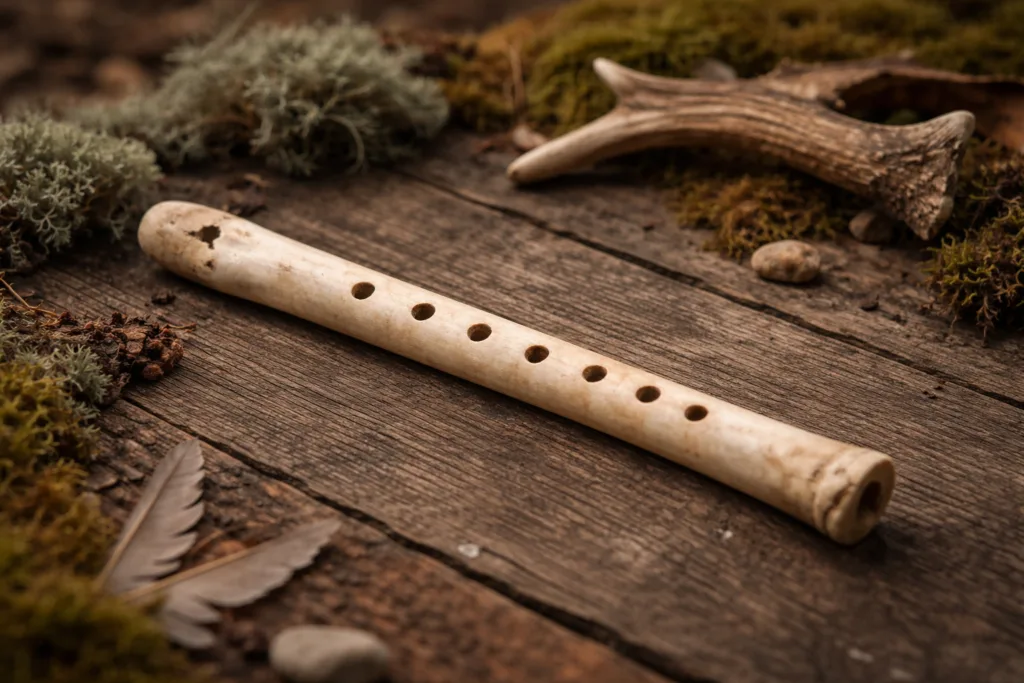
Bone Flute Evidence Profile
A bone flute is an edge-blown aerophone made from a hollow animal bone or from bone worked into a tube. Prehistoric examples show that early makers understood air-column length, finger-hole placement, blowing edges, and surface preparation. Claims about the first bone flute require care because some perforated bones are accepted as musical instruments while others remain disputed.
What Makes a Bone Object a Flute?
A flute produces sound when an airstream meets a sharp edge and begins to alternate above and below it. The resulting pressure changes excite the air column inside the tube. Opening a finger hole shortens the effective air column and raises the pitch, while closing it lengthens the column and lowers the pitch.
Bone is well suited to flute making when it already contains a long internal cavity. Bird wing bones are especially useful because they can be thin-walled, relatively straight, and naturally hollow. Mammal bones are usually thicker and may require more work to remove internal tissue, open the ends, regularize the bore, and create playable holes.
A perforated bone is not automatically a musical instrument. Archaeologists examine the placement and shape of the openings, marks left by tools, opposing tooth punctures, fracture patterns, wear, archaeological context, and comparison with naturally damaged bones. A reconstruction that produces notes can demonstrate acoustic possibility, but playability alone does not prove who made the original holes.
Common Confusion: “Bone flute” describes a material and a sound-producing principle, not one fixed design. Some examples are simple rim-blown tubes. Others have a carved notch, a shaped mouth end, a duct, or several finger holes. Archaeological fragments may preserve only part of the original instrument.
How Bone Flute Construction Controls the Air Column
| Feature | Structural Role | Playing Consequence |
|---|---|---|
| Blowing Edge | Splits the airstream and starts the edge tone. | Its sharpness, angle, and position influence response, breath noise, and tonal stability. |
| Bore | Contains the vibrating air column. | Length, diameter, taper, and internal irregularities shape pitch and harmonic behavior. |
| Finger Holes | Change the effective sounding length of the tube. | Diameter and spacing determine available pitches, hand position, and cross-fingering options. |
| Tube Wall | Holds the air column and protects the bore. | Wall thickness affects durability and hole-making, while bore geometry has the stronger direct effect on pitch. |
| Distal End | Acts as the main terminal opening of the air column. | An open, narrowed, damaged, or reconstructed end changes the effective length and tuning. |
| Surface Marks | Record cutting, scraping, drilling, polishing, wear, or animal damage. | They help researchers decide whether the object was deliberately manufactured. |
The material can influence weight, durability, moisture response, and the practical limits of manufacture. It should not be treated as the sole source of the instrument’s tone. The blowing edge, bore, tube length, hole layout, and player’s air control usually have a stronger acoustic effect than the fact that the tube is bone rather than wood or metal.
Divje Babe and Hohle Fels: What “Oldest Flute” Means
Two finds dominate discussions about the earliest flutes, but they do not carry the same level of archaeological agreement. The Divje Babe object from Slovenia is older and is presented by the National Museum of Slovenia as a Neanderthal musical instrument. Its status remains disputed among researchers who interpret the openings as possible carnivore damage.
The Hohle Fels flute from southwestern Germany is younger but preserves clearer evidence of deliberate manufacture. It was found in an early Aurignacian layer associated with anatomically modern humans and belongs to a regional group of bone and ivory flutes. Its finger holes, carved blowing end, surface markings, and archaeological setting support a musical-instrument interpretation that is far more widely accepted.
For that reason, oldest claimed flute and oldest widely accepted flute are not interchangeable labels. Divje Babe may represent musical behavior tens of thousands of years earlier than the Aurignacian instruments, but that conclusion depends on accepting that Neanderthals deliberately altered the bone. Hohle Fels belongs to the earliest secure body of evidence for manufactured musical instruments.
| Feature | Divje Babe | Hohle Fels |
|---|---|---|
| Location | Divje Babe I cave near Cerkno, Slovenia | Hohle Fels cave in the Ach Valley, southwestern Germany |
| Approximate Age | About 60,000–50,000 years, based on the archaeological layer | More than 35,000 calendar years old and probably close to 40,000 years |
| Human Association | Found in a Middle Palaeolithic layer associated with Neanderthals | Found in a basal Aurignacian layer associated with early modern humans |
| Bone Species | Left femur of a young cave bear | Radius from the wing of a griffon vulture |
| Preserved Openings | Two complete perforations and two partly preserved openings | Five finger holes and two deep V-shaped notches at the blowing end |
| Proposed Manufacture | Supporters propose that a stone point formed a hollow and a bone punch pierced the cortex. | Cutting, scraping, notching, and finger-hole placement left visible manufacturing traces. |
| Main Dispute | Whether the openings were made deliberately or punctured by carnivore teeth | The instrument interpretation is broadly accepted; discussion centers more on dating, reconstruction, and playing method. |
| Careful Label | Oldest claimed flute or proposed Neanderthal flute | One of the oldest widely accepted manufactured musical instruments |
The Divje Babe Bone and the Carnivore Debate
The Divje Babe object was discovered in 1995 in a cave that had served as a den for cave bears and had also been visited by Neanderthals. The surviving fragment is 11.4 centimetres long and comes from the femur of a young cave bear. Its archaeological layer also contained Middle Palaeolithic stone tools.
The National Museum of Slovenia interprets the four preserved or partly preserved openings as deliberately made finger holes. Experimental work supporting this view proposes a two-stage method: a pointed stone tool first cut a small depression, then a bone punch opened the hole. Reconstructions based on the surviving fragment can function as flutes and produce several pitches.
Other researchers argue that the bone was gnawed and punctured by a carnivore. Cave bear remains from carnivore accumulations can contain rounded perforations, opposing punctures, broken ends, and tooth damage that resemble parts of the Divje Babe object. Under this interpretation, the apparent alignment of the holes is coincidental rather than evidence of instrument design.
The debate is not simply about whether the reconstructed tube can make music. It concerns the sequence of physical events that altered the original bone. Researchers must decide whether humans cut and pierced it before later animal damage occurred, whether carnivores created all of the openings, or whether human and animal modifications were combined.
Why the Claim Remains Qualified: The museum presents Divje Babe as a deliberately made Neanderthal flute, and experimental replicas support a playable reconstruction. Other archaeological studies continue to identify carnivore puncturing and gnawing as a plausible explanation. The object should therefore be described with both interpretations rather than assigned an uncontested title.
Why Hohle Fels Is More Widely Accepted
The Hohle Fels bone flute was recovered in 2008 from an early Aurignacian layer. Twelve fragments were joined to form the surviving instrument. The preserved section is about 21.8 centimetres long, while comparison with modern griffon vulture bones suggests an original length of roughly 34 centimetres.
The maker selected the radius of a griffon vulture, a large bird whose wing bones provide long, hollow tubes. Five finger holes were cut into the shaft. Fine incisions near several holes appear to have marked their intended positions before cutting. Two deep V-shaped notches were carved into one end, forming the area into which the player probably blew.
The object preserves striations, cut marks, notches, and polish connected with manufacture and use. It was also found within a regional archaeological record that includes several other bone and mammoth-ivory flutes from Hohle Fels, Geissenklösterle, and Vogelherd. The repeated presence of deliberately worked instruments reduces the likelihood that the Hohle Fels flute is an accidental natural form.
The original instrument is incomplete, so its exact embouchure and full pitch set cannot be recovered with certainty. It may have been blown directly into the notched end, held obliquely, or used with a technique that has no exact modern equivalent. These uncertainties concern how the accepted instrument was played, not whether its holes were intentionally manufactured.
Why Bird Bone, Cave Bear Bone, and Ivory Require Different Work
A large bird radius provides a long, naturally hollow tube. The maker can clean the interior, shape the ends, mark the hole positions, and cut the finger holes without building the tube from separate halves.
A mammal femur has thicker cortical bone and a more complex internal cavity. Turning it into a flute would require opening or cleaning the marrow space and creating holes without splitting the shaft.
Ivory is not naturally hollow. Aurignacian makers split a shaped ivory blank, hollowed both halves, carved holes and joining marks, then sealed the halves together to form an airtight tube.
The ivory instruments from the Swabian Jura show that early modern humans used more than convenient hollow bird bones. Making an ivory flute required planning the tube before it existed, controlling two matching internal channels, and joining the halves without serious air leakage.
Bird bone offered a different solution. Its natural bore reduced the number of manufacturing stages, but the thin wall required careful cutting. The small incisions beside the Hohle Fels holes indicate that their positions were planned rather than casually punctured.
Jiahu Bone Flutes: What the 2026 Data Analysis Adds
The Jiahu bone flutes come from the Neolithic site of Jiahu in Henan, China. They belong to a different archaeological setting from the European Palaeolithic examples above, so their value here is not a claim to replace Divje Babe or Hohle Fels in an “oldest flute” ranking. They provide evidence for how bone-flute construction and pitch organization may have changed within a long-lived Neolithic tradition.
A 2026 analysis brought previously dispersed Jiahu measurements, acoustic samples, excavation records, and material data into a semantic knowledge graph with data-governance controls. This allowed physical attributes and recorded pitches to be compared across the archaeological phases rather than treating each flute as an isolated object.
The acoustic comparison found that samples assigned to Phase III tended toward higher pitches than those from Phases I and II, with the difference meeting the study’s statistical threshold of p < 0.05. The later material also showed reduced variation in finger-hole spacing. Taken together, those patterns support the possibility that Jiahu makers changed aspects of flute design and pitch organization over time.
The same linked dataset was used to identify cultural and knowledge connections among major Neolithic sites. This does not establish a single route by which musical ideas travelled, but it shows how relationships among instrument structure, acoustic measurements, archaeological context, and site connections can be examined together rather than through separate records.
What the Finding Means: The Jiahu analysis did not announce a newly discovered oldest flute. Its contribution was quantitative: later Jiahu samples showed a measurable shift toward higher pitch, while linked archaeological data offered a way to examine changes in flute design and connections between Neolithic communities.
Lv (2026), Jiahu bone-flute analysis, International Journal of Knowledge Management
How Archaeologists Test a Possible Flute
Identify the Bone
Species, skeletal element, age of the animal, wall thickness, and natural internal structure determine what modifications were physically possible.
Examine the Openings
Researchers inspect hole shape, internal fracture cones, edge damage, repeated dimensions, opposing marks, and microscopic traces of cutting or pressure.
Separate Tools from Teeth
Experimental punctures made with stone tools, bone punches, and carnivore teeth are compared with the archaeological specimen.
Study the Entire Surface
Gnawing at the ends, scrape marks, polish, marrow removal, weathering, sediment pressure, and later breakage can clarify the order of events.
Read the Excavation Context
Associated tools, occupation debris, animal remains, dating evidence, nearby instruments, and the quality of excavation records affect interpretation.
Test Acoustic Possibility
A replica can show whether the proposed form supports controlled tones. It cannot by itself establish that the original openings were deliberately made.
Sound, Scale, and Playing Possibilities
Bone flutes can produce a clear central pitch surrounded by audible breath noise. Their tonal character depends on how the player directs the air, how sharply the stream meets the edge, and how evenly the finger holes seal. A small change in blowing angle can move the sound from weak and diffuse to focused and stable.
Finger-hole spacing does not automatically reveal a familiar modern scale. The original instrument may have used variable breath pressure, half-holing, cross-fingering, altered embouchure, or pitch relationships that do not match equal temperament. Missing ends make acoustic reconstruction even less certain because a small change in tube length shifts every note.
The five holes of the Hohle Fels flute would have allowed several fingered pitches, while overblowing could extend the range. The exact scale remains dependent on the reconstruction of the missing length and the chosen blowing method. Divje Babe replicas can also produce broad ranges, but this demonstrates what a proposed reconstruction can do rather than settling the manufacture debate.
If a perforated bone can play a scale, it must have been made as a flute.
Playability establishes acoustic potential. Tool marks, damage patterns, archaeological context, and the sequence of modification are needed to support deliberate manufacture.
Playing a Modern Bone Flute
Modern replicas vary from close archaeological reconstructions to freely designed instruments using bone as the tube material. A reconstruction may preserve irregular hole spacing, an incomplete scale, or a demanding blowing edge because the maker is reproducing archaeological behavior rather than building a standardized concert instrument.
Begin with a Narrow Airstream
Use moderate breath and direct a thin stream toward the edge. Blowing harder before finding the correct angle usually adds noise rather than a stable note.
Rotate the Instrument Slowly
Small changes in angle can reveal the point where the edge tone becomes focused. Hold that position before increasing volume.
Seal Every Hole
Irregular or small holes may require the soft pads of the fingers rather than the fingertips. A slight leak can weaken the lowest notes and disturb tuning.
Map the Fingerings by Ear
Open one hole at a time and record the resulting pitch. Test half-holing and cross-fingering only after the basic notes remain stable.
Control Pitch with Air
Breath speed and angle can raise or lower a note. Historical reconstructions should not be expected to hold modern reference pitch under every dynamic level.
Player Tip: A weak first note usually calls for a change in air direction rather than more pressure. Find the speaking edge quietly, then build volume while preserving the same angle.
How Tube Material Changes What a Maker Can Build
The original anatomy places limits on length, bore shape, wall thickness, and comfortable hole positions. Archaeological replicas may preserve those irregularities, and the blowing edge can demand close control from the player.
A maker can choose the bore, wall thickness, hole positions, and outer shape with fewer anatomical constraints. Longer tubes and more standardized hand spacing are easier to design deliberately.
Precisely manufactured headjoint geometry, tone holes, and keywork support a broad chromatic range and repeatable tuning. Its construction and fingering system differ greatly from most prehistoric-style bone flutes.
These differences are mainly consequences of manufacturing freedom and bore design, not a simple rule that one material has a fixed tone. Bone begins with an existing biological form. Wood can be drilled and shaped around the maker’s intended geometry, while a modern metal flute is engineered around a standardized acoustic and mechanical system.
Choosing an Archaeological Replica
A useful replica should state which find it follows and which missing details were reconstructed. “Prehistoric bone flute” is too broad to explain whether the instrument copies Hohle Fels, Geissenklösterle, Divje Babe, a later archaeological tradition, or a modern design inspired by old materials.
- The archaeological reference and bone species are identified.
- Reconstructed sections are distinguished from preserved features.
- The maker explains whether the instrument is rim-blown, notched, obliquely blown, or ducted.
- The intended scale and reference pitch are described without presenting them as proven prehistoric tuning.
- Finger-hole spacing is comfortable enough for the intended player.
- The bore is clean and free from loose tissue, sharp fragments, or unstable repairs.
- The bone was obtained legally and through documented, ethical sourcing.
- The instrument is a modern replica rather than an archaeological or protected cultural object.
Collector’s Note: A Divje Babe replica represents one side of an unresolved archaeological interpretation. It should be labeled as a reconstruction of the proposed Neanderthal flute, not as physical proof that the original object was deliberately manufactured.
Care and Storage
Prepared bone is durable under careful use but remains vulnerable to cracks, impact, prolonged moisture, and rapid environmental change. Thin bird-bone replicas require extra protection around finger holes and cut ends.
- Remove moisture after playing with a soft, dry swab that fits without pressure.
- Do not soak the flute or leave liquid inside the bore.
- Avoid bleach, acids, abrasive polish, and household disinfectants unless the maker approves a specific product.
- Store the instrument in a padded sleeve or rigid case so it cannot roll or bend.
- Keep it away from radiators, direct sunlight, hot vehicles, and abrupt temperature changes.
- Inspect the edges of finger holes and repaired joints before playing.
- Ask the maker before applying oil, wax, resin, or another surface treatment.
Questions About Bone Flute Archaeology and Replicas
What is the oldest bone flute?
Divje Babe is presented by the National Museum of Slovenia as a 60,000–50,000-year-old Neanderthal flute, which would make it the oldest known musical instrument. Its human manufacture remains disputed. The Aurignacian flutes from the Swabian Jura, including Hohle Fels and Geissenklösterle, form the earliest widely accepted evidence for deliberately manufactured flutes.
How old is the Hohle Fels flute?
The original study established that it is more than 35,000 calendar years old and linked its layer with the first Upper Palaeolithic settlement of the region around 40,000 years ago. It is safer to describe it as roughly 40,000 years old than to assign a more exact date.
Why is Divje Babe disputed?
The main question is whether its openings were deliberately pierced by Neanderthals or created by carnivore teeth and gnawing. Supporters point to hole placement, experimental tool production, and playable reconstructions. Critics compare the damage with naturally perforated cave-bear bones from carnivore accumulations.
What bone was used for the Hohle Fels flute?
It was made from the radius of a griffon vulture. The long, naturally hollow wing bone provided a suitable tube for five finger holes and a carved blowing end.
Does a playable reconstruction prove that an archaeological bone was a flute?
No. It proves that the proposed form can function acoustically. Deliberate manufacture must also be supported by tool traces, hole formation, wear, archaeological context, and evidence that natural or animal damage is less likely.
Did prehistoric bone flutes use the modern musical scale?
The surviving instruments show controlled pitch production, but their complete tuning systems are not known. Missing sections, variable blowing pressure, half-holing, and reconstruction choices prevent a secure match with a modern standardized scale.