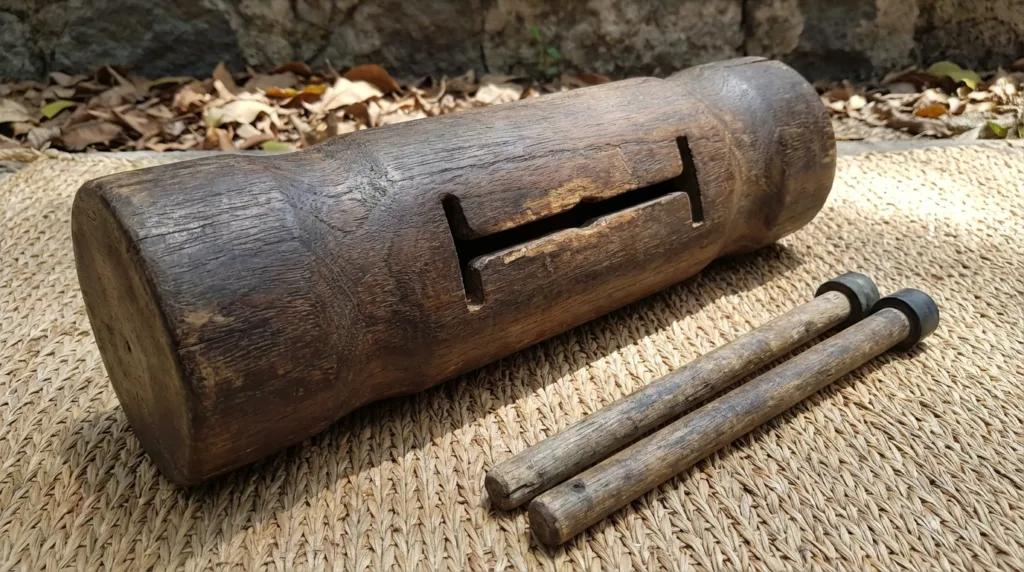
- Teponaztli is a slit drum made from a single hollowed log 🪵.
- Its top is cut with an H-shaped slit, creating two vibrating tongues.
- Struck with padded mallets 🥢, it speaks in two distinct pitches.
If you like instruments that feel engineered and alive, the teponaztli is hard to forget.
It’s wood, air, and careful carving—nothing extra—yet the sound can feel surprisingly bold.
| What You’re Looking At | Why It Matters For Sound And Value |
|---|---|
| 🪵 One-piece hardwood body | Hard, dense wood supports cleaner attack and better projection. |
| 🔪 H-shaped slit forming two “tongues” | The tongue sizes drive two pitches; subtle carving changes tuning and sustain. |
| 🥢 Struck with padded mallets (often rubber-tipped) | Padded tips bring out tone while reducing harsh clicks; they protect the tongue edges. |
| 📏 Common museum sizes around 50–60 cm long | Size affects resonance; bigger bodies can feel rounder and more room-filling. |
| 🪚 Carved exterior designs (animals, figures, patterns) | Carving can signal workshop style and history; it also changes mass and can shift response. |
| 🧰 Played on a stand or support ring | Lifting it off the ground helps the body resonate; contact points can mute a good instrument. |
- Tap each tongue softly with the same padded mallet.
- Listen for a stable pitch and a clean decay.
- Move your ear around the body—good resonance feels even, not “choked.”
What Makes A Teponaztli Different 🥁
- It’s an idiophone: the wood itself vibrates to make sound, not a stretched skin.
- Two tongues act like “wooden keys,” each with its own pitch.
- The body is a resonator: hollow space shapes volume and tone color.
Many drums rely on tension and tuning hardware. A teponaztli relies on carving.
That’s the magic. The instrument is basically a sound sculpture—and every millimeter counts.
Because the sound comes from wood tongues, it has a crisp start and a woody ring.
It can sit inside a rhythm section, yet it also works as a lead voice when you let those two tones “talk” back and forth.
Name, Language, and Spellings 📜
- The term teponaztli comes from Nahuatl, the language associated with the Mexica.
- In Spanish usage you may also see teponaxtle or teponaxtli.
- A common pronunciation guide is “tay-po-nawtz-lee”.
Spelling shifts are normal when a word moves between languages. If you’re searching catalogs, try both teponaxtle and teponaztli.
You’ll often uncover extra listings, museum notes, or maker descriptions that would stay hidden otherwise.
One more thing: some sources use “slit drum,” others say “log drum.”
They’re pointing at the same family, but the teponaztli is especially known for its H-shaped cut and two-pitch layout.
Deep Roots and Cultural Setting 🗿
- The teponaztli is associated with Central Mexico and the Mexica (often called Aztec in modern writing).
- Its exact origin is not pinned to a single date, and it likely reaches back many centuries.
- Historical depictions show it paired with other percussion, supporting song and dance.
The easiest way to understand the teponaztli is to see it as a community instrument.
It helped mark time for movement, for poetry, for gathering.
Even today, its design still feels purpose-built—strong, direct, and uncomplicated.
You’ll often hear it mentioned alongside the huehuetl, a vertical hand drum.
That pairing makes sense: one brings a resonant body voice, the other brings two clear pitches that can outline patterns.
Together, they create a tight rhythmic frame without needing many instruments.
How It Is Built 🪵
- A single hardwood log is hollowed, leaving walls that balance strength and resonance.
- The top slit is carved into an H shape, forming two tongues.
- Carvers adjust tongue thickness and length to shape pitch and timbre.
Think of the tongues as two wooden “springs.” When struck, they flex and vibrate.
The hollow body boosts what they produce, like a speaker cabinet built into a log drum.
Small changes in carving can shift the feel from dry to ringing.
Many examples are visually stunning: relief carving, animal figures, or stylized motifs.
That decoration isn’t just surface beauty.
It can hint at regional style, workshop practice, and the maker’s hand—details collectors love because they add context to a rare instrument.
How It Sounds and Tunes 🎶
- It produces two pitches, one from each tongue.
- Many descriptions place the interval around a third or fourth, though carving choices vary.
- Striking position matters: near the tongue’s end can feel brighter; closer in can feel rounder.
A strong teponaztli can sound focused and surprisingly loud.
If the tongues are carved with care, you’ll hear two tones that are distinct but related—like a tiny call-and-response built into wood.
That’s why players often describe it as melodic percussion, not just a beat-maker.
Mallet choice is huge.
Many historical descriptions mention rubber-padded tips, and some references use the term olmaitl for that kind of stick.
Padded contact helps you get tone without punishing the tongue edges, which matters a lot for a fragile antique surface.
Playing Techniques That Make It Sing 🥢
- Alternate tongues to create a natural two-note phrase.
- Use consistent height for even tone; let the wood do the work.
- Try “near-edge” hits for clarity and “near-center” hits for warmth.
- Keep mallets relaxed—tight grip can turn a resonant instrument into a clicky block.
This instrument rewards patience. Small changes in touch create big differences in sound.
If you’re used to modern drums, your first instinct might be to hit harder.
Go the other way: light strikes often bring out a fuller ring and keep the two pitches clearly separated.
Want a practical pattern? Try an 8-beat loop: low, high, low, high, low, low, high, rest.
It’s simple, but it teaches control fast.
On a responsive teponaztli, that little loop can feel almost like a melody—clean, woody, and oddly hypnotic.
Stands, Supports, and Placement 🧱
- Placing it directly on a hard surface can dampen resonance.
- Many depictions show a stand or ring support under the body.
- Small support points help the log vibrate more freely, boosting projection.
The body is part of the sound, so treat placement like tuning.
A soft cradle or minimal-contact stand can make the same instrument feel louder and more open.
If you’re displaying an antique piece, a stable mount also protects edges and carvings—good for sound, good for long-term care.
Carving Styles and What They Can Tell You 🪚
- Many surviving examples show carved figures or animals in relief.
- Look for tool marks that match the piece’s age story and wear pattern.
- Decoration can change how the body vibrates, subtly shaping attack and sustain.
Carving is where a teponaztli often becomes personal.
Some pieces feel like pure engineering; others feel like sculpture you can play.
For collectors, that artistry is part of the value—especially when the carving, wear, and wood aging look like they belong together in a coherent timeline.
A gentle reminder: don’t judge authenticity on decoration alone.
Plain instruments exist, and ornate ones can be later creations.
The real tells often come from how the slit is cut, how the tongues are finished, and how the interior hollowing looks—details that affect sound as much as appearance.
How To Evaluate An Antique Teponaztli 🔍
- Check the tongues: look for hairline cracks radiating from slit corners.
- Inspect the interior if possible: uneven gouges are normal; fresh bright wood can signal later work.
- Listen for buzzes: a clean strike should not rattle like loose debris.
- Review provenance: museum notes, collection history, or expert documentation helps.
- Look at repairs: old stabilizing bands or patches may exist; clarity about when and why matters.
An antique teponaztli is wood, and wood moves with time.
Small age lines can be normal.
What you want to avoid are active splits through a tongue or severe deformation around the slit—those can change sound and raise the risk of damage when played.
When in doubt, enjoy it as a display piece and choose a modern build for frequent performance.
If you’re buying, ask for clear photos of the slit corners, the underside, and any repaired zones.
A seller who can describe the piece calmly—without hype—often provides the most useful info.
That tone of clarity is a quiet green flag for a responsible and careful listing.
Care, Storage, and Display 🧰
- Keep it in a stable indoor environment; rapid swings in temperature and humidity stress old wood.
- Avoid direct sunlight; UV can fade surfaces and dry the wood.
- Use padded support points; protect carved edges and keep pressure off tongues.
- Clean gently with a soft brush; skip oils unless a conservator recommends a specific treatment.
Antique percussion can look tough, yet the most delicate area is the slit and tongue corners.
Treat those corners like the bridge of a violin: they’re small, but they carry a lot of the instrument’s function.
A simple stand that supports the body while leaving tongues untouched can preserve tone and structure.
If the piece is playable, keep sessions short and gentle.
Padded mallets and light strokes go a long way.
It’s not about volume; it’s about letting the wood speak in its own voice—clear, warm, and authentically percussive.
Modern Builds and Respectful Ownership 🏺
- Modern makers can build a teponaztli-style slit drum for regular playing.
- Antique examples often suit careful display and occasional gentle demonstration.
- Clear documentation and lawful sourcing protect both the instrument and the collector.
If you want to explore rhythms daily, a modern build is often the stress-free route.
You still get the two-tongue feel and that woody ring, without worrying about harming a historic surface.
Then the antique piece can remain what it already is: a rare artifact that carries craft and time in every line of its grain.
Mini FAQ ❓
Is A Teponaztli A Drum Or A Wooden Xylophone?
Is A Teponaztli A Drum Or A Wooden Xylophone?
It sits closer to a slit drum in the idiophone family.
Like a xylophone, it uses vibrating wood for pitch, but the “keys” are carved as tongues on a hollow log body, which gives it a drum-like presence.
Why Does It Have An H-Shaped Cut?
Why Does It Have An H-Shaped Cut?
The H-shaped slit creates two tongues.
Those tongues vibrate separately, producing two pitches from one piece of wood, while the hollow body supports resonance.
Are The Two Notes Always The Same Interval?
Are The Two Notes Always The Same Interval?
No. Many descriptions mention intervals around a third or fourth, yet each instrument depends on carving.
Tongue length and thickness shape pitch, so two antique pieces can feel quite different.
What Kind Of Mallets Work Well?
What Kind Of Mallets Work Well?
Padded mallets are a safe starting point.
They help reveal tone while protecting tongue edges.
If you’re handling an antique surface, choose a soft tip and play with light strokes for a cleaner ring.
Should It Sit On The Floor While Played?
Should It Sit On The Floor While Played?
Direct contact can mute resonance.
A stand or minimal-contact support can help the body vibrate more freely.
For antiques, a stable padded mount also protects carvings and reduces stress on the tongues.
How Do I Care For An Antique Teponaztli Without Risk?
How Do I Care For An Antique Teponaztli Without Risk?
Keep conditions stable, avoid direct sunlight, and handle the instrument with calm support under the body.
Clean with a soft brush and skip home “treatments.”
If there’s cracking near the slit corners, consult a qualified conservator before any repair or frequent playing.