
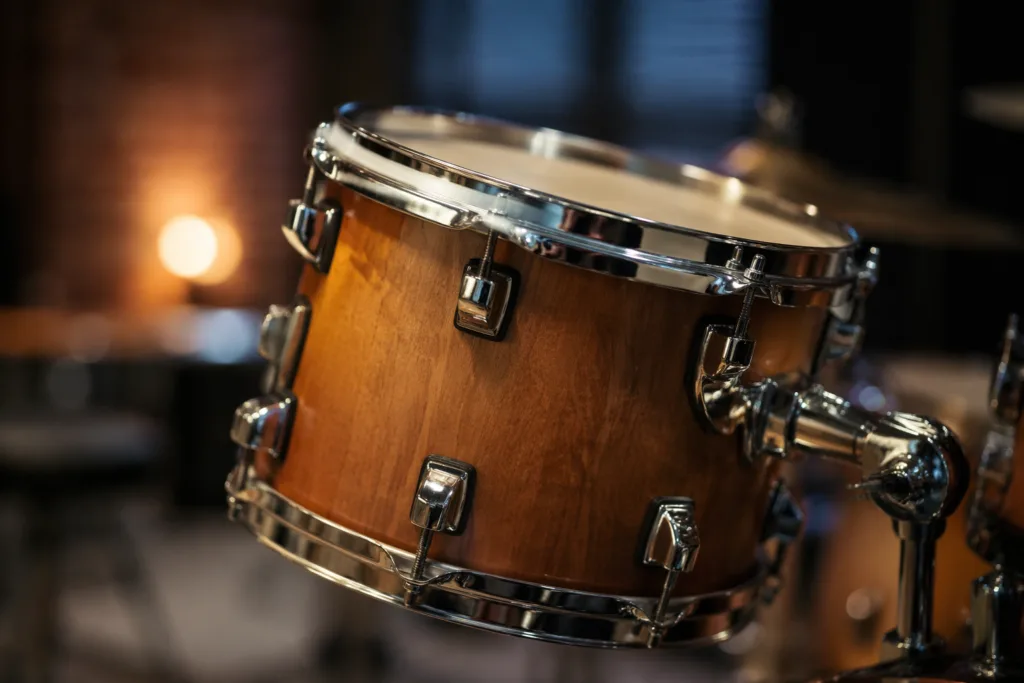
A tom-tom drum earns its place in a kit because it speaks in a note, not just in a hit. The shell has no snares underneath, so the stroke blooms as a rounded tone rather than a crack. That single design choice changes everything. The tom is where a drum set starts to sing in pitches instead of only marking time.
Look closely and the differences are tactile as much as audible: the shell depth under the hand, the rebound from a tighter batter head, the softer shoulder of a rounder bearing edge, the way maple gives back a smooth low end while birch answers with a faster, cleaner front. Small choices. Big shift.
🥁 Pro Tip: When two toms feel too close in pitch, diameter spacing usually fixes the problem faster than extra shell depth. That is one reason a 10-inch tom beside a 12-inch tom tends to read more clearly than a 12-inch beside a 13-inch.
How the Tom-Tom Entered the Drum Set
The early tom that fed into Western drum kits was a simpler object than the modern shell most players know. Late-19th-century Asian tom-toms used shallow wooden shells with heads tacked in place, which meant the drum had color and character but not much practical tuning range. When early trap-set builders in the first decades of the 20th century absorbed that shape into the growing drum kit, the tom arrived first as an effect voice—decorative, direct, and a little wild around the edges.
Then the hardware changed, and the instrument changed with it. Tunable heads, tension rods, and proper hoops turned the tom from a fixed accent drum into a repeatable pitched shell. By the 1930s, drummers and builders were pushing for fully tunable top and bottom heads, and once that happened the tom stopped being a novelty item and became part of the grammar of the kit. The note could now be placed, matched, and returned to.
Plastic heads in the late 1950s sealed the next leap. Calfskin could sound lovely, but it moved with weather. Mylar made the tom steadier, more practical, and much easier to trust under stage light, studio air, or a cold load-in. That stability is easy to take for granted now. It was not minor. It let the tom keep its voice day after day.
Why That History Still Matters
- Early tacked-head toms explain why old photos show shells that look shallower and more decorative.
- The shift to fully tunable double-head toms explains why modern drummers think in intervals and shell relationships.
- The move from skin to plastic heads explains why the tom became dependable enough for modern studio and touring use.
🛠️ Collector’s Note: On an older tom, badge year is not the first thing to inspect. Bearing edge condition, shell roundness, and clean hardware travel matter more to the actual playing result. A less famous shell that tunes easily will usually outplay a rarer one with a tired edge.
Sizes That Change the Voice
For toms, diameter shapes pitch first. A larger drum usually speaks lower because the head spans a wider circle. Depth matters too, but in a different way: it changes how the note develops. Shallower shells tend to answer faster and stay tidier. Deeper shells usually hold more air and give the stroke a longer, heavier tail. Put plainly, diameter decides where the note sits; depth helps decide how it moves.
Rack Tom Vs. Floor Tom
Floor toms do more than finish a fill. A good one acts almost like a second bass register, especially when tuned low enough to leave room under the snare without turning to mush. That low note is part of why a 16-inch floor tom remains such a dependable choice. It is not flashy. It just works.
Why the 13-Inch Tom Feels Different
The old 12/13/16 layout still has a rightful place, especially for players who want a smoother, more rolling descent across the kit. But many modern shell packs now lean toward 10/12/16 or 10/12/14/16 groupings. There is a practical reason: the pitch gap between 12 and 13 can feel narrow unless the heads, edges, and shell depth are working in perfect sympathy. A 10 into 12 usually separates faster, reads clearer under microphones, and leaves more room for the floor tom to sound like a true arrival point.
That does not make a 13-inch tom outdated. Not at all. It simply places more pressure on tuning judgment, because it lives in a middle register that can either sound beautifully connected or slightly crowded. Lovely when right. A bit stubborn when wrong.
Shell, Edge, and Head: Where the Real Character Comes From
Catalogs love to sell toms by finish and size. Builders know better. The real personality sits in the relationship between shell material, bearing edge, head choice, and even mounting hardware. Change one of those, and a familiar diameter can stop sounding familiar.
Wood Vs. Wood
- Maple usually gives a rounded low end, balanced mids and highs, and a broad tuning window. It is easy to understand why so many all-purpose kits still start here.
- Birch tends to answer with quicker attack, shorter decay, and firmer separation between notes. In dense mixes, that tidy front edge helps.
- Mahogany leans toward softer highs and fuller low-mid body. The note feels older in shape—rounder, thicker, and less eager to snap.
- Poplar often sits in warmer, value-friendly shells, with a pleasant middle attack that does not fight the player.
- Oak can produce a low fundamental with bright cut on top, which makes the tom speak with weight and a firm edge.
- Acrylic and other synthetic shells shift the feel again: more immediate impact, more focused attack, and a cleaner, harder outer line around the note.
The point is not that one shell wood is “best.” The point is that material changes the shape of the note. Maple often gives the tom a broader cushion. Birch tends to pull the front edge into focus. Mahogany relaxes the top end and fattens the middle. Those are not marketing fantasies when the shell, heads, and edge are well matched. You can hear it. More importantly, you can feel it under the stick.
Bearing Edge Vs. Rounder Edge
A sharper bearing edge gives the head less contact with the shell. Less contact usually means a more open response, easier tuning, and more apparent resonance. A rounder or flatter edge increases that contact area, which softens the front, warms the tone, and trims some openness. This is one of those details players often hear before they can name. The drum either feels like it opens quickly—or it feels like the note sits down into the shell before coming back out.
That is why two toms with the same size and the same wood can still behave very differently. Edge profile decides how much of the shell joins the conversation. And yes, it matters a lot.
Single-Head Tom Vs. Double-Head Tom
Concert toms still make sense when the player wants a very clean strike with obvious front-end definition. Double-head toms remain the default because they simply give more body back. That bottom head is not decoration. It is part of the instrument’s breathing system.
🎼 Pro Tip: If a tom sounds thin, do not blame the shell first. Check the resonant head, then the edge, then the mount. A shell can be good and still feel choked by a poor bottom head or a mount that clamps too much of its natural movement.
Head Choice Matters More Than Many Players Expect
A single-ply tom head usually lets the shell breathe more freely, which means more overtone detail and a longer, livelier note. Two-ply heads pull the sound inward: more control, less splash in the overtones, and a firmer hit under the stick. Neither is “correct.” They simply move the tom toward different jobs. Open and singing, or trimmed and disciplined.
So when people say a tom is naturally warm, bright, dry, or boomy, they are often hearing more than the shell wood alone. They are hearing the whole recipe.
What the Tom-Tom Does in the Modern Kit
Many short articles reduce toms to “the drums used for fills.” That sells the instrument short. In a modern kit, the tom is often the bridge voice between timekeeping and shape. It can answer a vocal phrase, thicken a chorus entry, replace a crash for a darker accent, or carry a whole melodic descent that changes how a section lands.
- In rock and pop, toms often turn transitions into architecture—verse to chorus, breakdown to lift, fill to stop.
- In jazz and fusion, smaller toms can act like spoken intervals, not just loud punctuation.
- In studio work, the right tom tuning creates note separation so microphones hear distinct pitches instead of a wash.
- In live playing, a slightly broader, lower tuning often helps the tom read clearly in the room without becoming papery or brittle.
There is also a physical role to the tom in the modern kit. Layout changes phrasing. A single rack tom over the bass drum and one floor tom to the right encourages cleaner movement and fewer crowded decisions. Add a second rack tom, and the kit invites longer descending shapes. Add a second floor tom, and suddenly the low end of the kit starts to behave like a second territory rather than an ending point.
Classic Layout Vs. Current Shell-Pack Thinking
A classic setup might lean on 12/13/16 or even a single 13/16 pairing. Many current shell packs, though, are built around 10/12/16, 10/12/14/16, or compact 12/14 arrangements. That says something about how the tom’s job has shifted: players now want cleaner pitch spacing, faster setup logic, and shells that drop into microphones or smaller stages without forcing awkward angles. It is a practical evolution, not just a trend.
And mounting plays into that too. Modern suspension or isolation-style mounts help many toms ring more freely than older systems that drilled deeper into the shell interior and interrupted resonance. Hardware, then, is not separate from tone. It is part of tone.
🪵 Collector’s Note: A wrapped shell, a lacquer shell, and a rawer satin shell can feel very different in the hands, but the shell edge, ply recipe, and head pairing still decide far more of the actual tom voice than the finish alone.
How to Read a Tom Before You Buy
- Read the size correctly. Diameter and depth are both important, but diameter tells you more about pitch placement.
- Check the edge profile. Sharper edges usually open faster; rounder edges often feel softer and warmer.
- Ask what wood or shell recipe is really there. Pure maple, birch, mahogany blend, poplar, oak, acrylic—each changes the note shape.
- Look at the mount. A tom that is easy to position but over-clamped can lose life.
- Listen for interval space, not only for isolated tone. A tom may sound lovely alone and still sit badly between the tom above it and the tom below it.
That last point gets missed all the time. A tom-tom drum is rarely judged alone in real playing. It is judged as part of a line: snare into high tom, high tom into mid tom, mid tom into floor tom. The shell must carry its own voice, yes—but it also has to belong to a sentence.
FAQ
Is a Tom-Tom the Same as a Tom?
Open Answer
Yes. In modern drum language, tom is simply the shorter everyday form of tom-tom. Both refer to the unsnared drum used in a kit for pitched movement, fills, and tonal color. The shorter form is now more common in casual use, but the older full name still appears in catalogs, history writing, and formal descriptions.
Why Do So Many Kits Use 10, 12, and 16-Inch Toms?
Open Answer
Because that spread gives clear pitch separation without forcing awkward tuning. A 10-inch tom reads high and focused, a 12-inch sits comfortably in the middle, and a 16-inch floor tom gives a proper low landing point. It is a practical layout for modern kits, microphones, and tighter stage footprints.
Is a Deeper Tom Always Lower in Pitch?
Open Answer
Not always. Diameter usually has the bigger say in pitch. Depth changes the way the note develops—more air, more body, often a longer tail—but it does not override diameter. A shallower large tom will still speak lower than a deeper small tom in most normal setups.
How Do I Know if I Want Single-Head or Double-Head Toms?
Open Answer
Choose single-head concert toms if you want a more direct strike and stronger attack. Choose double-head toms if you want more warmth, more volume, and a fuller sustaining note. Most drum-set players stay with double-head toms because they offer a broader and more familiar range of sounds.
Which Wood Usually Gives a Warmer Tom Sound?
Open Answer
Many players hear maple and mahogany as warmer choices, though they do not warm the note in the same way. Maple often stays balanced and smooth, while mahogany usually leans fuller in the low-mid area with softer highs. Head choice, edge shape, and shell thickness still affect the result a great deal.