
Instrument Snapshot
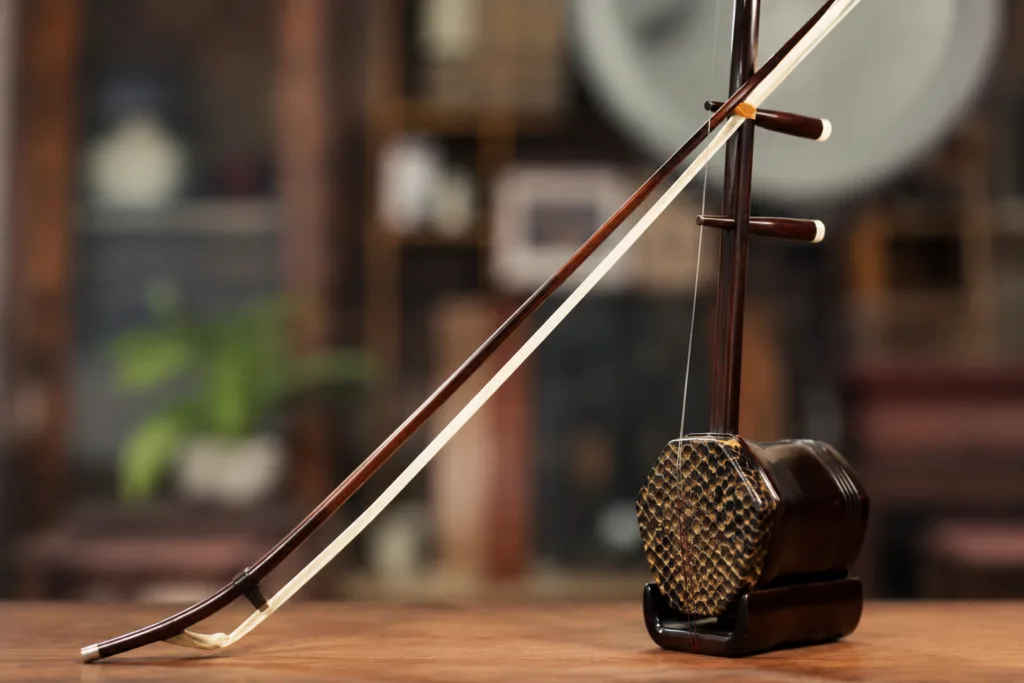
The erhu is a Chinese two-string bowed spike fiddle with a small resonator, a skin-covered soundboard, and a bow that sits between the two strings. It belongs to the huqin family and is valued for its focused, vocal sound, quick response, and ability to shape sliding ornaments, vibrato, and long lyrical phrases.
What the Erhu Is
The erhu is often called the Chinese two-string fiddle, but it does not work like a violin with fewer strings. It has no fingerboard, the player stops the strings in midair with the fingertips, and the bow hair runs permanently between the inner and outer string. These details give the instrument a sound that can feel close to the human voice: narrow, flexible, direct, and able to bend pitch with fine control.
The instrument is played upright, usually resting on the player’s thigh. Its small soundbox is covered on the front by a stretched membrane, traditionally snakeskin, which acts as the vibrating soundboard. A small bridge transfers string vibration into the membrane, while the wooden resonator shapes projection and tone color.
In Chinese music, the erhu can carry a main melody, answer a singer, imitate speech-like inflection, or sit inside a larger bowed-string section. It is heard in solo recital music, regional opera, folk genres, modern Chinese orchestras, film scores, and cross-cultural arrangements.
Anatomy and Build
The erhu’s design looks simple, yet every part affects sound and playing feel. The long neck does not have frets, the two strings run from large tuning pegs down to the base, and the resonator is small enough to keep the attack fast. The result is an instrument that rewards touch more than force.
| Part | Function | Effect on Sound or Playing |
|---|---|---|
| Neck | Holds the strings vertically without a fingerboard. | Allows sliding, pitch bending, and subtle left-hand control. |
| Tuning Pegs | Adjust string tension. | Set the main tuning; peg fit affects tuning stability. |
| Two Strings | Provide the full melodic range of the instrument. | The inner string is lower; the outer string is higher and brighter. |
| Bow | Horsehair bow placed between the strings. | Controls attack, volume, articulation, and string change. |
| Bridge | Transfers string vibration into the membrane. | Bridge height and fit affect response, clarity, and buzz control. |
| Membrane | Acts as the soundboard on the front of the resonator. | Shapes the erhu’s bright, reedy, penetrating voice. |
| Soundbox | Small wooden resonating chamber. | Influences warmth, projection, dryness, and tonal focus. |
Player Tip: A good erhu does not need heavy bow pressure to speak. If the tone sounds crushed or scratchy, bow angle, rosin balance, bridge placement, and left-hand tension are usually better places to check before blaming the instrument.
How the Erhu Produces Sound
The erhu produces sound when the horsehair bow grips and releases the string in fast cycles. That vibration travels through the bridge into the stretched membrane, then into the wooden soundbox. Because the resonator is small and the membrane is highly responsive, the note begins quickly and has a focused edge.
The bow cannot be removed from between the strings during normal playing. Pushing or pulling the bow hair toward one side activates one string, while moving it toward the other side activates the second string. This makes bow control central to clean tone. The right hand decides how the sound starts; the left hand decides how the pitch lives after it starts.
Unlike a violin, the erhu has no fingerboard stopping the string from behind. The fingertip touches and controls the string directly. Small changes in pressure and position can change pitch, color, and stability, which is why beginner notes often wobble before the hand learns exact spacing.
Materials and Sound Character
Erhu tone comes from the relationship between string tension, membrane response, bridge contact, and resonator wood. The body material does more than hold the shape. Density, wall thickness, inner air space, and surface finish all affect how quickly the tone speaks and how much warmth remains after the attack.
| Material or Setup Area | Common Use | Likely Tonal Effect |
|---|---|---|
| Hardwood Body | Many instruments use dense hardwoods; quality varies by maker. | Can add focus, projection, and a firmer attack. |
| Skin Membrane | Traditionally used on the front of the soundbox. | Gives the erhu its bright, nasal, reedy edge. |
| Metal Strings | Common on modern erhus. | Offer stronger pitch stability and a cleaner upper register than older silk strings. |
| Bridge | Small wooden bridge fitted between strings and membrane. | Affects clarity, volume, and the amount of surface buzz. |
| Qianjin Loop | String loop near the neck that sets playing geometry. | Changes string spacing, feel, and left-hand comfort. |
| Mute or Damper | Sometimes used near the bridge or membrane area. | Can reduce harshness, control ringing, and soften attack. |
Sound Profile
The erhu is known for a clear melodic line rather than a large chordal texture. Its tone can be bright and piercing in the upper register, warmer and more speech-like on the lower string, and highly flexible under slides and vibrato. The profile below is a listening guide, not a laboratory measurement.
Good erhu tone is not only about volume. A strong player can make a note start sharply, bloom softly, bend upward, lean downward, or fade with a narrow vibrato. This is why the instrument often carries melodies that need vocal phrasing rather than percussive drive.
History and Cultural Role
The erhu is part of the broader huqin family of Chinese bowed fiddles. Earlier bowed instruments with Central and northern Asian links are often discussed as part of the erhu’s background, while later Chinese regional traditions shaped the instrument into the form known today. Its name is commonly understood in relation to two strings and the huqin family.
For much of its history, the erhu was tied to folk music, theater, narrative singing, and local ensemble practice. In the twentieth century, new solo works, conservatory training, and Chinese orchestral writing helped move it into formal concert settings. This shift did not erase its folk character; it gave players a wider stage and a more demanding technical language.
Chinese bowed-string instruments developed through contact, adaptation, and regional use rather than from a single fixed invention story.
Huqin-type fiddles became linked with local theater, accompaniment, dance music, and melody-led ensemble practice.
Teachers, performers, and composers expanded erhu technique for recital pieces, conservatory study, and staged performance.
The erhu now appears in Chinese orchestras, film music, crossover projects, and amplified stage settings, while still remaining close to traditional melody styles.
Basic Playing Guide
The erhu looks compact, but it is not a shortcut instrument. Its two strings, lack of frets, and exposed pitch control make the first stage demanding. The beginner’s goal is not speed. The first goal is a stable note with a clean bow change and accurate pitch center.
Set the Sitting Position
The erhu usually rests on the left thigh with the neck vertical. The body should feel stable without being squeezed. A shifting instrument makes pitch and bow control harder.
Balance the Bow Hand
The bow hair must contact one string cleanly. Too much pressure gives a rough edge; too little pressure makes the sound thin or broken.
Find the Two Open Strings
Modern beginners commonly tune the inner string to D4 and the outer string to A4. The strings sit a fifth apart, giving the erhu a compact but useful melodic range.
Place the Left Hand Lightly
The fingertips stop the string without pressing it against a fingerboard. Pitch comes from exact placement and controlled pressure, not from squeezing.
Add Slides and Vibrato Slowly
Slides and vibrato are part of the erhu’s voice, but they should not hide poor pitch. Clean notes first, ornaments later.
Core Techniques to Listen For
The player draws the bow across a string without left-hand stopping. This reveals the basic setup, bow control, and membrane response.
The finger travels along the string while the note sounds. This gives erhu melodies a vocal, speech-like curve.
The left hand gently varies pitch around the note center. Erhu vibrato can be narrow, wide, slow, fast, or used only at the end of a phrase.
The hand moves to a new area of the neck to reach higher notes. Smooth position shifts are essential for lyrical playing.
The bow changes contact from inner to outer string. Because the bow sits between the strings, clean crossing depends on right-hand angle and pressure.
Short notes, turns, and passing tones help connect erhu playing to regional melody styles and opera-influenced phrasing.
Erhu Compared with Similar Instruments
The erhu is sometimes described as a Chinese violin, but that label can mislead beginners. Both are bowed string instruments, yet their construction, posture, bowing system, and pitch control are different. It is more accurate to compare the erhu with other spike fiddles and huqin relatives.
Erhu vs Violin vs Other Huqin Instruments
Two strings, vertical playing posture, no fingerboard, skin-covered resonator, and a bow placed between the strings. Best for flexible melodic expression and Chinese bowed-string phrasing.
Four strings, shoulder-held posture, wooden soundboard, separable bow, and a wider standard classical repertoire. Best for chordal options, orchestral section writing, and Western violin technique.
A higher-pitched huqin relative with a brighter, more penetrating sound. Often associated with southern Chinese styles and high melodic lines.
A lower-pitched huqin instrument with a deeper register. Often used to fill alto-like lines in Chinese orchestral settings.
Common Confusion: “Two strings” does not mean the erhu is limited to simple music. Its challenge comes from pitch accuracy, bow control, ornamentation, tone shaping, and the absence of frets or a fingerboard.
Buying or Collector Notes
A beginner erhu should be easy to tune, stable in the hands, and properly set up. Decorative carving or dark polished wood does not guarantee good sound. A plain instrument with a clean bridge fit, stable pegs, and balanced response is often a better learning partner than an ornate but poorly adjusted one.
| Inspection Area | What to Check | Why It Matters |
|---|---|---|
| Pegs | They should turn smoothly and hold tension. | Slipping pegs make tuning frustrating and slow practice. |
| Membrane | Look for tears, loose areas, extreme dryness, or uneven tension. | The membrane is central to volume, brightness, and response. |
| Bridge Fit | The bridge should sit cleanly and not lean heavily. | Poor bridge contact can cause buzzing, harshness, or weak tone. |
| Neck Alignment | The neck should feel straight and stable. | Alignment affects string position and left-hand comfort. |
| Bow Hair | Check hair condition, tension control, and rosin response. | The bow is part of the instrument’s playing system, not an accessory. |
| Sound Balance | Test both strings for even response. | A strong outer string with a weak inner string can limit expressive range. |
Collector’s Note: Historical value and playing value are not always the same. An older erhu may be culturally interesting but still need careful setup, membrane evaluation, peg work, or string replacement before it becomes a reliable musical instrument.
Care and Storage
The erhu is sensitive to heat, dryness, sudden humidity shifts, and rough handling around the membrane. The skin head should not be cleaned with harsh liquid products. Light surface care, controlled storage, and careful handling are safer than aggressive restoration.
- Store the erhu away from direct sun, heaters, damp rooms, and car interiors.
- Wipe rosin dust from strings and nearby surfaces with a soft dry cloth after playing.
- Do not press fingers, tools, or cleaning cloths hard into the membrane.
- Loosen or protect the bow according to the maker’s setup and local climate needs.
- Check bridge position after transport before tuning and playing.
- Use a case when moving the instrument, especially in dry or cold weather.
Care Warning: A damaged membrane is not a small cosmetic issue. It can change the entire response of the instrument. Repairs involving the skin head, bridge fitting, peg shaping, or structural cracks should be handled by an experienced repairer.
Good Match and Not Ideal If
The erhu suits players who enjoy melody, pitch nuance, slow tone work, and expressive ornamentation. It is a strong choice for students interested in Chinese music, bowed instruments, film scoring colors, and voice-like phrasing.
It may frustrate players who want quick chord playing, fixed frets, low-maintenance tuning, or instant clean pitch. The erhu rewards patience, careful listening, and steady control more than force.
Mini FAQ
Is the erhu hard to learn?
The first stage can be difficult because there are no frets or fingerboard, and the bow sits between the strings. Beginners usually need time to develop stable pitch, clean bow pressure, and relaxed left-hand placement.
How many strings does an erhu have?
The erhu has two strings. Modern instruments are commonly tuned a fifth apart, often with the inner string at D4 and the outer string at A4.
Why does the erhu sound so vocal?
The erhu’s fretless strings, flexible left-hand technique, small resonator, and responsive membrane allow slides, vibrato, bends, and narrow pitch shading that can resemble sung phrasing.
Is an erhu the same as a Chinese violin?
No. “Chinese violin” is only a loose nickname. The erhu has two strings, a vertical posture, no fingerboard, a skin-covered resonator, and a bow that stays between the strings.
What music uses the erhu?
The erhu appears in Chinese folk music, regional opera, solo repertoire, Chinese orchestras, chamber ensembles, film music, and modern crossover projects.
What should a beginner check before buying an erhu?
Check tuning stability, bridge fit, membrane condition, bow response, string balance, and whether the instrument has been properly set up. A reliable setup matters more than decorative appearance.