
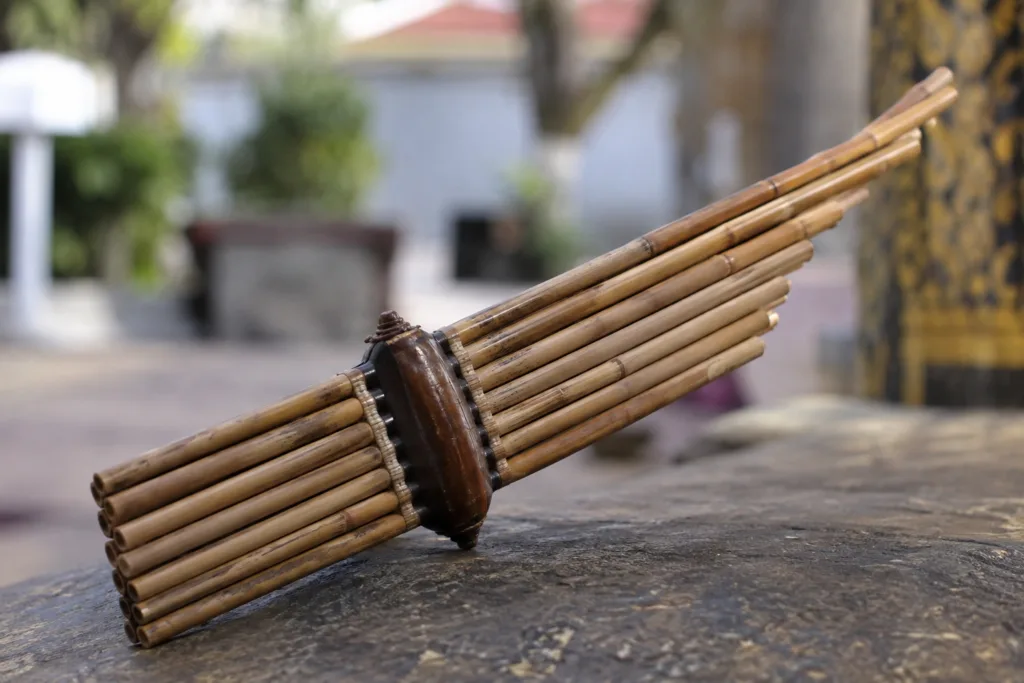
The khaen is a Lao free-reed mouth organ built from parallel bamboo pipes passing through a compact wooden windchest. Its tall, raft-like silhouette can resemble a set of panpipes, but the resemblance ends at the surface. Each sounding pipe contains a small metal free reed hidden inside the windchest, and the instrument can produce notes while the player both exhales and inhales.
That two-way airflow changes almost everything about the instrument. Melodies can run across long breath cycles, selected pipes can remain as drones, and several notes can sound together. In Lao music and the closely related traditions of northeastern Thailand, the khaen is therefore not simply a bamboo flute substitute. It is a polyphonic reed instrument with its own fingering logic, tuning system, modal practice, and relationship to sung lam traditions.
Free-reed mouth organ
Bamboo pipes, wooden windchest, metal reeds, sealing wax or related material
Sounds on both exhalation and inhalation
Melody, intervals, drones, and simultaneous tones
Laos, with closely connected traditions in Isan, northeastern Thailand
Khaen paet, with two rows of eight pipes
Why the Khaen Is Not a Set of Panpipes
A panpipe produces sound when the player directs air across the open edge of a tube. The khaen uses a different acoustic principle. Its bamboo tubes act mainly as resonators for free reeds mounted in their walls where the pipes pass through the central windchest.
The player places the mouth against an opening in that windchest rather than blowing separately across individual pipe ends. Air pressure reaches the concealed reeds, while the fingers determine which pipes are able to resonate.
| Part | Mechanical role | Effect on the sound |
|---|---|---|
| Bamboo pipe | Forms the resonating air column around a reed | Reinforces a particular pitch and shapes its spectrum |
| Metal free reed | Vibrates through a close-fitting opening without striking a frame | Creates the reedy, lightly buzzing core of the note |
| Wooden windchest | Distributes inhaled or exhaled air to the reeds | Allows many pipes to share one controlled air supply |
| Finger hole | Changes whether a pipe can establish the resonance needed to speak | Acts as the player’s note-selection mechanism |
| Tuning slot | Adjusts the effective resonating length of a bamboo pipe | Helps match pipe resonance to the reed’s operating pitch |
Common Confusion: The visible length of a khaen pipe does not by itself tell you its note. Hidden tuning openings can shorten the effective acoustic length, so two pipes of similar or identical physical length may produce different pitches.
The Free Reed Hidden Inside the Windchest
The sound generator is easy to miss because the most important part of the khaen is concealed. A small metal reed is fitted into the wall of each sounding bamboo pipe at the point where it passes through the windchest. The reed consists of a flexible tongue that moves through an opening with very little clearance.
This differs from a clarinet-type reed, which beats against a mouthpiece surface. A free reed passes back and forth through its slot. Airflow sets it into motion, while the attached bamboo tube provides the resonance needed for the khaen’s characteristic stable tone.
Historical instruments do not all use identical reed alloys or construction details. Museum examples document thin metal reeds together with bamboo, hardwood, wax, and other locally available materials. Maker practice, region, instrument age, and intended tuning can all affect the exact construction.
Why the Bamboo Still Matters
The metal tongue initiates the vibration, but the bamboo pipe is not a passive holder. Pipe diameter, wall thickness, acoustic length, vent placement, and coupling with the reed influence how readily a note starts and which harmonics are reinforced.
This is why describing the khaen simply as a set of metal reeds misses half of its acoustic design. The reed and resonating pipe operate as a coupled system.
Covering a Hole Makes the Pipe Speak
The khaen reverses an expectation many flute players bring to the instrument. In the commonly documented Lao and Isan design, a pipe normally stays silent while its finger hole is open. Covering the hole allows the pipe resonance to build strongly enough for its free reed to operate as intended.
The finger hole therefore behaves more like an acoustic on/off control than a sequence of tone holes on a recorder. The player does not obtain a scale by progressively shortening one bore. Instead, individual fingers activate separate reed-and-pipe units.
Air Enters the Windchest
The player either blows into the central chamber or draws air back through it.
An Open Pipe Hole Prevents Full Resonance
With the finger hole uncovered, the acoustic condition needed to couple that pipe strongly to its reed is disrupted.
The Player Covers the Hole
Closing the opening changes the resonating air column and allows pressure and pipe resonance to interact with the reed.
The Reed and Pipe Lock into a Stable Tone
The metal tongue vibrates while the bamboo tube reinforces the sounding frequency.
Because each pipe can be selected independently, several holes may remain covered at the same time. That makes sustained intervals, drones, and polyphonic textures a normal part of khaen technique rather than an unusual extended effect.
Why the Khaen Sounds on Both Inhale and Exhale
A defining property of the khaen is its ability to speak with airflow moving in either direction. The free reeds are arranged so that the player can activate them while breathing out through the windchest and while drawing air back in.
This gives the performer a form of continuity that a conventional flute does not provide. A flute player normally needs to interrupt the outward air stream to inhale unless circular breathing is used. A khaen player can change breath direction and continue sounding selected reeds.
The transition is still a musical skill. Air pressure, phrasing, articulation, and the timing of the reversal affect how smooth the line feels. Skilled playing does not simply alternate breaths mechanically; the breath cycle becomes part of articulation and rhythmic control.
Why Long Drones Are Practical
A player can keep one or more pipes activated while other fingers articulate a melody. Since the drone can continue across changing breath directions, the tonal center remains audible beneath moving notes for long stretches.
This helps explain the khaen’s dense sound. A single performer can create a sustained background tone, melodic motion, and simultaneous intervals without needing separate accompanying instruments.
Khaen Paet: Sixteen Pipes Without a Simple Low-to-High Layout
One widely encountered form is the khaen paet. The word paet refers to eight, and this type carries two rows of eight bamboo pipes for a total of sixteen.
The pipes may look as though their graduated lengths form a visual scale, but the pitch layout is not necessarily arranged from lowest to highest across the instrument. Notes are distributed between the two sides in a way that supports traditional fingering patterns, drones, and modal playing.
A documented sixteen-pipe museum instrument, for example, has four of its longest pipes at the same physical length even though they produce different pitches. Internal rectangular tuning openings change the pipes’ effective resonating lengths. The neat exterior profile is therefore partly visual design rather than a literal chart of pitch.
Not Every Khaen Has Sixteen Pipes
Pipe count is not fixed across every instrument carrying the khaen name. Regional practices and instrument forms vary, and UNESCO documentation itself notes variation in shape and number of tubes among communities. Fourteen-, sixteen-, and other pipe configurations are encountered in documented instruments and modern practice.
The sixteen-pipe khaen paet is useful for explaining the instrument’s architecture, but it should not be treated as the only authentic configuration.
Tuning Depends on Acoustic Length, Not Just Bamboo Length
Cutting each bamboo pipe to a visibly different length would be an incomplete way to tune a khaen. Makers also control the effective acoustic length of the tube through openings cut into the pipe wall, commonly on the inward-facing side where they are less visible during normal playing.
A tuning slot placed closer to the reed can make a physically long pipe behave acoustically like a shorter resonator. Its position must work with the frequency of the free reed. The reed and tube are adjusted as a pair rather than treated as unrelated parts.
Reed Pitch and Pipe Resonance Pull Toward Each Other
Free reeds have their own preferred vibration frequency, but a khaen reed is strongly coupled to its pipe. When pipe resonance lies within a suitable range, the reed can be pulled toward that resonant frequency and operate efficiently. Fine adjustment therefore involves both the metal tongue and the acoustic geometry of the bamboo.
This coupling also explains why damage that seems minor can change the response. A cracked tube, altered vent, leaking seal, or distorted reed may affect more than volume. It can change whether a pipe starts cleanly, how stable its pitch feels, and how strongly it blends with neighboring notes.
Measured Acoustic Example: A 2025 study examined one sixteen-pipe khene from the Isan region of Thailand and measured fundamental frequencies from about 221 Hz at the low end to 887 Hz at the high end. Several measured pitches lay close to equal-tempered reference notes, while others showed measurable deviation. The instrument also included a duplicated G4 that could support drone-and-melody textures. These measurements describe the tested instrument, not a universal tuning standard for every khaen.
The Khaen Is Built for More Than One Note at a Time
The independent pipes make the khaen naturally polyphonic. Several reeds can sound together as long as their holes are activated and the performer maintains sufficient airflow.
This can produce a texture that combines a melody with one or more sustained tones. Chord-like sonorities and intervals are possible as well, although traditional musical organization should not be reduced to Western chord progressions. The instrument’s musical grammar is closely tied to regional modal patterns, phrasing, ornament, and rhythmic behavior.
Lai Organizes More Than a Scale
Traditional khaen playing uses modal and melodic systems referred to as lai. A lai is better understood through its tonal center, favored pitches, drone relationships, melodic contours, and idiomatic phrases than by assigning it a Western scale name alone.
Names and classifications vary across repertories and regional traditions. Documented practice includes modes such as lai soi and lai yai, while other systems divide repertory into broader modal families. Fingering, articulation, breath, and rhythm remain as important as the pitch collection itself.
Why the Sound Feels Denser Than a Single-Reed Melody Instrument
The khaen’s tone starts with the metallic vibration of a free reed, giving individual notes a focused, reedy buzz. The bamboo resonator reinforces that vibration and changes its harmonic balance. When several pipes sound together, overlapping partials create a fuller texture than the visual simplicity of the instrument suggests.
Its sustained sound can be bright in the upper pipes and more rounded or grainy in the lower register. Exact tone varies with reeds, bamboo dimensions, breath pressure, tuning, and the condition of the instrument.
The Windchest Has to Be Airtight
The central wooden chamber does more than hold the pipe bundle together. It must deliver controlled airflow to multiple reeds without wasting pressure through gaps around the bamboo.
Traditional instruments may use beeswax or another wax-like sealing material where the pipes pass through the chamber. If these seals shrink, crack, or loosen, air can escape before it reaches the reeds. The result may be weak response, unstable notes, or a need for noticeably more breath pressure.
Why Old Khaens Are Not Automatically Better Players
Age can make an instrument culturally or historically interesting while reducing its practical playability. Bamboo can split, sealing compounds can dry out, reeds can corrode or deform, and previous repairs can alter tuning vents or airflow.
A museum-worthy khaen and a reliable performance khaen are therefore different evaluations. Original materials, maker evidence, provenance, and age matter to a collection. Reed response, airtightness, stable tuning, and structural integrity matter when the goal is to play it.
Khaen and Lam: A Reed Instrument Built Around the Voice
The khaen has a close relationship with lam, the broad family of sung and poetic traditions associated with Lao culture and with mor lam in northeastern Thailand. In these settings, the instrument can establish the tonal environment, support the singer, sustain drones, answer vocal phrases, and supply rhythmic momentum.
The relationship is more active than simple chordal accompaniment. Khaen patterns can track the contour and pacing of sung lines while maintaining modal anchors underneath them. Fast articulations and irregular melodic jumps are also found in documented Isan khaen repertories.
Because the player can sound the instrument on both breath directions, long vocal passages do not force the khaen into the same breathing gaps expected from many other wind instruments. The reed texture can remain present while the singer shapes extended lines above it.
Traditional Technique Also Depends on Articulation
Finger movement alone does not define khaen playing. Tonguing, breath-pressure changes, rhythmic accents, ornaments, and rapid changes between active pipes affect the character of a performance.
Two players using the same nominal set of pitches can therefore sound very different. Modal identity is heard through phrasing and articulation as well as tuning.
Laos and Isan Share a Connected Khaen Tradition
The khaen is especially associated with Lao people and Lao musical identity. Its cultural geography, however, does not end at the modern border of the Lao People’s Democratic Republic.
Across the Mekong, northeastern Thailand has a large Isan population with deep linguistic and cultural connections to Laos. Khaen playing is deeply established there as well, especially in mor lam and regional folk repertories. Research comparing ceremonial khaen music in Laos and Thailand has documented related playing methods and modal practices on both sides of the border.
Modern Isan performance has also adapted the instrument to new settings. Khaen can now appear beside phin, drums, electric bass, guitar, keyboards, or other instruments in contemporary mor lam and fusion ensembles. Some performers use instruments tuned or adjusted for easier interaction with Western equal-tempered instruments.
These newer contexts do not erase the older reed-mouth-organ technique. The paired bamboo pipes, windchest, hidden reeds, breath reversal, drones, and modal patterns remain recognizable features even when the ensemble around the khaen changes.
Khaen, Sheng, and Shō Share a Reed Principle but Not a Single Tradition
The khaen belongs to a wider Asian family of free-reed mouth organs. The Chinese sheng and Japanese shō also use pipes fitted with free reeds and supplied from a shared air chamber.
That common acoustic idea does not make the instruments interchangeable. Their pipe arrangements, windchests, repertories, tuning practices, playing techniques, musical functions, and cultural histories differ. The khaen’s long paired bamboo pipes and strong melody-and-drone practice give it a form and performance identity distinct from the compact pipe clusters associated with the sheng and shō.
The comparison is most useful at the mechanical level: all demonstrate how a small free reed can be coupled to a resonating pipe and selected by the player’s fingers. Beyond that shared principle, each developed within a different musical system.
Recognizing a Playable Khaen Rather Than a Decorative Pipe Bundle
The silhouette alone is not enough to confirm that a bamboo mouth organ is fully functional. A playable khaen needs a working acoustic system hidden inside its visible pipe structure.
- Each active pipe should contain a properly fitted free reed where it passes through the windchest.
- The windchest should seal closely around the bamboo rather than leaking freely around the pipe joints.
- Finger holes should control individual pipes consistently.
- Tuning vents should remain intact and should not be blocked or enlarged by careless repair.
- Bamboo pipes should be checked for lengthwise cracks, loose joints, and damaged ends.
- Notes should respond on both inward and outward airflow without a large difference in pitch or stability.
- Drone pipes and melodic pipes should remain usable together without one reed demanding excessive pressure.
Decorative instruments may reproduce the familiar two-row profile while using crude reeds, incomplete drilling, poor seals, or no functional voicing at all. For collectors who also want to play the instrument, external appearance and musical condition should be judged separately.
What UNESCO Recognized in 2017
In 2017, UNESCO inscribed Khaen music of the Lao people on the Representative List of the Intangible Cultural Heritage of Humanity. The wording matters: the inscription covers the living musical practice rather than declaring the physical bamboo instrument itself a standalone heritage object.
The recognized practice includes performance, community participation, knowledge transmission, songs and dances, teaching, and the social settings in which khaen music continues to function. UNESCO documentation describes the music as widespread across Laos and notes its use during village festivals, traditional song and dance, community occasions, and religious ceremonies.
Transmission takes place through families, experienced players, local associations, schools, cultural centers, and other formal and informal settings. UNESCO also records community efforts to keep the practice active as social conditions and urban lifestyles change.
The same documentation recognizes regional variation in instrument shape, tube count, associated events, and melodies. That variation is important when identifying historical or modern examples: there is no single set of dimensions, pipe lengths, or tuning details that can represent every authentic khaen.
A Living Instrument Rather Than a Fixed Museum Type
Historical collections preserve nineteenth- and twentieth-century mouth organs that reveal older materials, construction details, pipe layouts, and regional forms. Contemporary players continue to use the same free-reed principle in traditional lam, ceremonial repertories, staged mor lam, new ensembles, and cross-genre music.
The continuity comes from the mechanism as much as the silhouette: bamboo resonators, concealed metal reeds, a shared windchest, notes activated through the fingers, and uninterrupted musical possibilities created by breathing both out and in.