
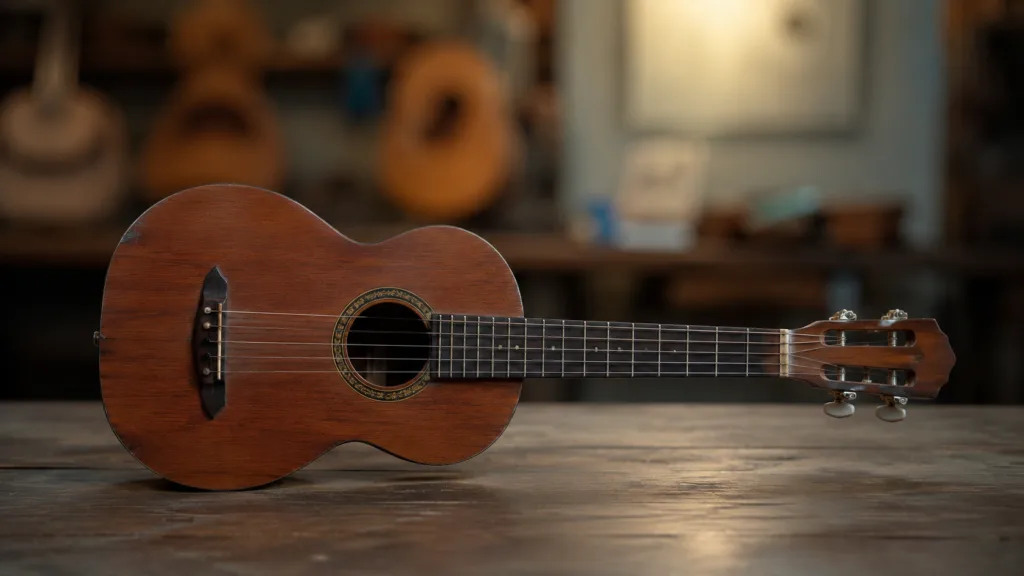
Instrument Snapshot
The Cuban tres is a plucked, fretted chordophone with six strings arranged in three double courses. Its bright wire-string attack and repeating guajeo patterns give son cubano a rhythmic, melodic, and harmonic voice that an ordinary strummed guitar does not reproduce in the same way.
What the Cuban Tres Is
The name tres refers to three string courses, not three individual strings. A course is a group of strings treated as one playing unit. On a Cuban tres, each of the three courses normally contains two strings, giving the instrument six strings in total.
The body resembles a compact guitar, but the stringing and musical function are different. A tresero usually plays with a pick and combines short strums, picked notes, chord fragments, passing tones, and repeated figures. The result sits between rhythm guitar, melodic counterline, and harmonic punctuation.
The tres is closely linked to son cubano and related eastern Cuban traditions. It can support singing, define a repeating pattern, answer a vocal phrase, mark a transition, or become more active during a montuno. Its part often remains recognizable even when trumpet, bass, percussion, and several voices fill the same texture.
A Cuban tres is a three-string guitar.
It normally has three double courses: six strings grouped into three playable pairs.
The tres simply strums the same chords as a guitar.
Its characteristic language uses syncopated guajeos, chord fragments, melodic links, and responses shaped around the ensemble.
Three Double Courses and Their Tuning Logic
The course system explains much of the tres sound. Two strings struck together produce a denser attack than a single string. When both strings share the same pitch, the course has a firm unison voice. When they are separated by an octave, one pick stroke combines a lower body with a brighter upper edge.
A widely documented C-family tuning uses the course centers G, C, and E. Those three notes form a C major triad, but the exact octave placement may change. For that reason, a chart that says only “G–C–E” does not fully describe the setup.
| Tuning Layout | Course Pairing | Resulting Character | Setup Note |
|---|---|---|---|
| C-family, octave G | G4–G3 / C4–C4 / E4–E4 | Low-and-high spread on the G course; compact unisons on C and E | A well-documented baseline layout |
| C-family, octave outer courses | G4–G3 / C4–C4 / E4–E3 | Wider register spread and a more pronounced octave texture | String gauges must suit the octave arrangement |
| D-family transposition | A4–A3 / D4–D4 / F♯4–F♯4 or an octave-paired F♯ course | Similar interval logic one whole step higher | Higher tension is not safe with every string set |
Common Confusion: Tuning lists may run from the player’s bass-side course to the treble-side course, or in the opposite direction. A writer may also place the high string before the low string within an octave pair. Compare the actual pitches and octave numbers rather than relying on printed order alone.
Unison Courses
Two strings tuned to the same pitch reinforce the note and create a concentrated center. Tiny differences in tuning, pick contact, and string age can add a light beating effect. The pair should still sound intentional rather than unstable.
Octave Courses
An octave pair places two registers inside one course. The lower string adds weight while the upper string helps the note cut through percussion and voices. This octave spread is one reason open strings and partial chords can sound larger than the instrument’s body suggests.
Why the Printed Order Can Be Misleading
Course order is not the same as pitch order. An octave course may contain a thin high string beside a thicker low string, and the physical placement of those two strings can differ by maker or player choice. A useful tuning description therefore identifies the course, both octave numbers, the intended string gauges, and the viewing direction.
Construction: From Guitar Form to Tres Response
The Cuban tres developed from the guitar family, yet its construction is organized around double courses, wire-string tension, and a playing style that needs fast response. A wooden soundboard, hollow box resonator, fretted neck, bridge, saddle, nut, and geared tuners form the basic structure. Dimensions are not fixed across all makers.
One documented museum instrument has a 21-inch vibrating string length, a mahogany back and sides, a western red cedar soundboard, internal wooden struts, a rosewood fingerboard, wire strings, and bone contact points. Those measurements and woods describe one instrument, not a universal Cuban specification. Handmade, workshop-built, converted, and factory-produced treses may use different outlines, scale lengths, bracing patterns, and timber combinations.
| Part | Construction Role | Effect on the Instrument |
|---|---|---|
| Soundboard | Receives vibration from the bridge and moves air through the body | Influences response speed, projection, warmth, and upper-frequency detail |
| Back and Sides | Form the resonator and reflect energy inside the body | Affect resonance, note shape, and how focused or open the sound feels |
| Internal Bracing | Supports thin wooden plates under string tension | Balances structural stiffness with the soundboard’s ability to move |
| Bridge and Saddle | Transfer string vibration to the soundboard and set action geometry | Influence attack, clarity, intonation, sustain, and playing comfort |
| Nut | Spaces each pair and defines open-string contact | Controls course spacing, clean open notes, and paired-string feel |
| Fingerboard and Frets | Provide chromatic stopping positions | Determine playability, pitch accuracy, and freedom to move through chord shapes |
| Wire Strings | Create the primary vibration under relatively firm tension | Produce a quick, bright attack with enough projection for a dense ensemble |
Body Shape and Resonator Volume
Many Cuban treses keep a guitar-like waist and flat soundboard, though body proportions vary. A larger air cavity may add low-mid fullness, while a smaller or stiffer body may feel quicker and more focused. Wood species alone cannot predict the final voice; plate thickness, bracing, bridge mass, finish, scale length, and setup work together.
Course Spacing Is a Functional Choice
The two strings inside each course must be close enough to sound as a pair, yet the three courses need enough separation for clean picking and chord work. Poor nut or saddle spacing can make one string dominate, push the pick between paired strings, or cause adjacent courses to interfere with the left hand.
String Tension and Scale Length
Tension changes with pitch, scale length, string diameter, and string construction. Raising a C-family setup to a D-family setup without changing gauges can make the instrument feel stiff and may place avoidable load on the neck, bridge, and soundboard. A compatible tres string set or a luthier-calculated gauge plan is safer than guessing from ordinary guitar strings.
Sound Character and Double-Course Texture
The tres usually speaks with a quick attack and clear upper frequencies. Wire strings add a metallic edge, while the wooden body rounds the note after the pick strike. Double courses create extra density, and octave pairing can make a short figure occupy more register without adding more notes.
The profile below describes a common listening impression, not a laboratory measurement. Instrument design, pick material, string age, player touch, room acoustics, and amplification can move each trait in either direction.
A firm pick produces a defined front edge that makes syncopated figures easy to locate inside the groove.
Two strings never behave as one perfectly rigid oscillator. Their minute differences add motion and thickness to held notes.
An octave course joins a lower pitch body to an upper glint, helping a small voicing feel wide without becoming harmonically crowded.
The note can release quickly enough for repeated patterns to remain clear rather than blurring into the next rhythmic cell.
Playing Position and Right-Hand Control
The tres may be played seated or standing with a strap. The neck can remain nearly horizontal or rise at a moderate angle. The soundboard faces outward, while the left hand stops paired strings against the frets and the right hand uses a pick for strumming, single-note work, and mixed articulation.
Strike Both Strings as One Course
The pick should contact the pair cleanly. Catching only one string weakens the course and changes the octave or unison balance.
Keep the Motion Economical
Small wrist movement helps repeated figures stay even. Wide guitar-style strums can add excess volume and blur the gaps that give a guajeo its shape.
Release Notes Deliberately
Left-hand pressure controls more than pitch. Timed release creates space between attacks and keeps the pattern from becoming a continuous wash.
Use Chord Fragments
Two-note and three-note shapes often leave more room for bass, vocals, trumpet, and percussion than full six-string guitar voicings.
Player Tip: Practice a figure first on muted courses. When the rhythm stays steady without pitch, add the fretted notes and listen for equal contact across both strings of each course.
Guajeo: The Tres Language of Son Cubano
A guajeo is a repeating melodic-rhythmic figure that outlines harmony while participating in the groove. It is not merely a riff pasted over percussion. The figure is shaped by chord movement, clave direction, bass placement, vocal phrasing, and the amount of space available in the arrangement.
A tres guajeo may repeat for several cycles, but good playing is rarely mechanical. A tresero can alter the final note, shift register, add an approach tone, thin the voicing, answer a singer, or change the route into the next chord. The recognizable contour remains while small details keep the part responsive.
Short attacks reinforce forward motion and place accents around, rather than simply on top of, the percussion pattern.
Selected chord tones reveal the progression without filling every register with a block chord.
Passing notes and contour give the accompaniment a line-like quality, even when the pattern repeats.
Brief responses can connect a lead vocal, coro, instrumental break, and the next entrance.
Repetition Without Rigidity
The guajeo establishes identity through return. Variation works best when it does not erase that identity. A player may change one rhythmic cell or cadence note while preserving the pattern’s relationship to the song and clave.
Guajeo, Montuno, and Tumbao
A repeating instrumental figure with melodic, rhythmic, and harmonic content. Tres and piano parts may both use guajeo logic.
A section or pattern area where repetition, coro responses, improvisation, and stronger cyclical motion often become more prominent.
A term used for recurring syncopated patterns in several Afro-Cuban instrumental roles. Its exact meaning depends on the instrument and context.
The coro supplies a repeated group response, while the lead singer may deliver improvised or semi-improvised calls between those responses.
How the Tres Relates to Son Clave
Clave is both a sounded pattern and an organizing guide for phrasing. In son, musicians may think in a 2–3 or 3–2 direction depending on which half of the two-measure cycle comes first. The tres does not need to duplicate every clave stroke. Its part must make musical sense across the same directional cycle.
A well-placed guajeo may attack on some clave points, answer between them, or lead into the next measure. What matters is the pattern’s arrival, release, and harmonic movement across the full cycle. A figure can contain the correct notes and still feel misplaced if its accents imply the opposite direction.
| Listening Question | What to Notice | Common Problem |
|---|---|---|
| Where does the figure begin? | Whether the opening feels like an answer, pickup, or downbeat statement | Starting from a memorized shape without checking the song’s direction |
| Where does it resolve? | The note and rhythm that lead into the next two-measure cycle | Ending too heavily and blocking the vocal or bass entrance |
| Which spaces remain open? | Gaps that allow percussion, bass, and voices to remain distinct | Filling every subdivision with strumming |
| How does harmony change? | Whether chord movement and rhythmic direction arrive together | Moving the shape at the right chord but the wrong rhythmic point |
Rhythmic Note: A written 2–3 or 3–2 label is useful only when the bar line and starting point are clear. In rehearsal, listening to the complete bass, percussion, vocal, and tres cycle is more reliable than counting isolated strokes without context.
The Tres Through a Son Performance
The instrument’s role changes as the arrangement moves. A restrained part under a verse may become more repetitive and active during a montuno. A melodic introduction may later be reduced to a two- or three-note cell that supports coro and pregón exchanges.
| Section | Likely Tres Behavior | What the Listener Can Follow |
|---|---|---|
| Instrumental Opening | Introduces a motif, tonal center, or compact guajeo | The first bright double-course attack and melodic contour |
| Lead Vocal Verse | Uses lighter figures and short responses around the singer | How the tres leaves room at the center of the vocal line |
| Transition | Redirects harmony, register, or rhythmic density | A changed ending that prepares the next section |
| Montuno | Strengthens a repeating guajeo and adds controlled variation | The lock between tres, bass, percussion, and coro |
| Pregón–Coro Exchange | Supports call and response with gaps, fills, and altered cadences | How the part reacts without covering the lead singer |
| Instrumental Break or Solo | Moves toward longer lines while retaining rhythmic clarity | The balance between melodic freedom and the established cycle |
How the Tres Fits the Son Ensemble
Son cubano joins Hispanic-derived string practices with Afro-Cuban rhythmic organization and percussion. Historical ensembles varied in size before the sexteto became a leading format during the 1920s. Trumpet or cornet entered some groups during the 1930s, extending the upper melodic register while the tres retained its rhythmic-harmonic identity.
The bass establishes low-register movement and anticipations. The tres outlines harmony above it without duplicating every bass attack.
The tres adds pitched attacks to a field of drums, maracas, güiro, and other rhythmic colors. Clean gaps prevent the texture from becoming crowded.
The tres phrase follows the same directional cycle even when its notes fall between the audible clave strokes.
The trumpet can carry sustained or projecting melodic lines while the tres supplies a shorter, more articulated pattern beneath or around them.
The tres may answer phrase endings, leave space for text, and tighten its repetition as the call-and-response section develops.
When both are present, the guitar may provide broader chordal support while the tres takes the more pointed guajeo role, though arrangements differ.
Eastern Cuban Roots and the Development of Son
The early history of the tres is tied to rural eastern Cuba in the late nineteenth and early twentieth centuries. No single maker or performer is securely credited with transforming the Spanish guitar model into the three-double-course Cuban instrument. Its form appears to have developed through local making, performance needs, and shared musical practice.
Changüí, associated closely with Guantánamo, belongs to the eastern Cuban lineage that preceded and fed into son cubano. The tres in these traditions developed as a rhythmically active instrument rather than a passive chord holder.
Local song, dance, guitar-family instruments, and Afro-Cuban rhythmic practices provide the setting in which early tres and son-related forms develop.
Son takes recognizable form in eastern Cuba, while the tres becomes closely tied to its repeating accompaniment language.
Early commercial son recordings help the genre circulate beyond its earlier regional settings.
The sexteto becomes a central ensemble format, placing the tres among voices, guitar-family strings, bass, and percussion.
Trumpet or cornet joins some groups, creating a broader ensemble sound without displacing the tres guajeo.
Larger groups, amplified stages, recordings, and teaching programs adapt the tres while retaining its double-course voice and son vocabulary.
The practice of Cuban Son is inscribed on UNESCO’s Representative List of the Intangible Cultural Heritage of Humanity.
Cuban Tres, Standard Guitar, and Puerto Rican Tres
The Cuban and Puerto Rican instruments share the name tres, but they should not be treated as one standardized design. Their course counts, string arrangements, body traditions, tunings, and repertories differ. A standard six-string guitar is also a separate setup even when its body is used as the basis for a conversion.
| Feature | Cuban Tres | Standard Guitar | Puerto Rican Tres |
|---|---|---|---|
| String Organization | Three double courses, usually six strings | Six single strings in the common modern form | Common modern forms often use three triple courses |
| Characteristic Tuning Logic | G–C–E or transposed course centers with unison and octave pairing | E–A–D–G–B–E is the common standard | Uses a different regional course and octave system |
| Primary Traditional Context | Son cubano, changüí-related practice, and other Cuban forms | Broad international repertories | Puerto Rican traditional and popular repertories |
| Typical Musical Task | Guajeo, syncopated harmonic outline, and vocal response | Chordal, melodic, bass, fingerstyle, or mixed roles | Regional melodic and accompaniment roles shaped by Puerto Rican practice |
| Conversion Compatibility | Needs paired-string spacing, suitable gauges, and tres setup | Designed for six separately spaced strings | Requires its own multi-string course layout |
Modern Tres Instruments, Pickups, and Guitar Conversions
Modern treses range from traditional acoustic instruments to cutaway, pickup-equipped, and stage-oriented models. Electronics can improve control in a loud ensemble, but amplification also reveals fret noise, uneven courses, poor intonation, and harsh pick attack. A balanced acoustic setup remains important even when a pickup carries most of the room sound.
Some players convert a six-string guitar into a tres. A workable conversion changes more than tuning. The nut must space three pairs, the bridge or saddle area must guide those pairs correctly, string gauges must match the pitches and scale length, and intonation must remain usable across the fingerboard.
Setup Warning: Do not raise ordinary guitar strings to a tres tuning by note name alone. Scale length, gauge, construction, octave placement, and total tension must be checked together. Excess tension can damage strings, tuning hardware, the bridge, the neck, or the soundboard.
Pickup Choices
Under-saddle piezo systems can provide strong feedback resistance but may emphasize a hard upper-mid attack. Soundboard transducers can capture more body movement, though stage volume may become harder to control. Internal microphones offer air and detail but require careful placement and feedback management. Blended systems can combine these traits.
Action and Intonation
Low action helps quick guajeos, yet paired strings must clear the frets under a firm pick stroke. A setup that works for gentle guitar fingerstyle may buzz when used for tres rhythm. Intonation should be tested on both strings of every course; one correct string cannot hide a poorly compensated partner.
Tuning and Setup Readiness Checklist
Before Changing Tuning
- Identify the scale length rather than assuming it matches a classical or steel-string guitar.
- Write all six target pitches with octave numbers.
- Mark which courses are unison pairs and which are octave pairs.
- Use string gauges intended for the chosen tuning or calculated for comparable tension.
- Check that each pair sits cleanly in the nut and saddle spacing.
- Bring strings to pitch gradually while watching the bridge and listening for strain.
- Test open notes, fifth- and twelfth-fret intonation, course balance, and fret clearance.
- Recheck neck relief and action after the new strings settle.
Signs the Setup Needs Attention
- One string of a course consistently sounds louder or sharper than its partner.
- The pick falls between paired strings during normal playing.
- Open courses sound clean but fretted pairs beat severely against each other.
- The octave string feels dangerously tight or the wound string feels slack.
- The bridge lifts, the top distorts, or tuning becomes unstable after a pitch change.
- Buzzing appears only when both strings of a course are struck together.
Choosing and Inspecting a Cuban Tres
A good tres should be judged as a playable musical tool before age, decoration, or rarity. Course balance, neck condition, bridge security, fret accuracy, and tuning stability matter more than an elaborate finish. Older instruments can be valuable, but age does not guarantee better tone or safe string tension.
The neck is comfortable, the pairs speak evenly, fretted notes remain usable, and the instrument responds clearly to both short strums and picked lines.
Construction, maker details, repairs, originality, provenance, and regional context can be documented without ignoring structural condition.
Collector’s Note: A replaced nut, saddle, bridge, tuner set, or fingerboard may reduce originality but improve playability. Record what was changed, why it was changed, and whether the work can be reversed before assigning value.
Inspection Points
- Look along the neck for twist, excessive relief, or a raised fingerboard extension.
- Check the bridge perimeter for lifting, gaps, cracks, or a distorted soundboard.
- Inspect each nut slot for clean spacing and a suitable depth for paired strings.
- Test every tuner under normal tension and listen for slipping gears or binding posts.
- Play both strings of every course open and fretted to compare volume and pitch stability.
- Check repaired cracks inside and outside the body rather than judging only the finish.
- Confirm the instrument’s intended tuning before fitting or tightening strings.
The Tres as Living Heritage
UNESCO inscribed The practice of Cuban Son on the Representative List of the Intangible Cultural Heritage of Humanity in 2025. The inscription applies to the musical and social practice as a whole, not to the tres as an isolated object.
Son joins singing, instrumental performance, rhythm, dance, improvisation, repeated structures, instrument making, and community transmission. Within that practice, the tres carries a recognizable musical role. Its heritage value depends not only on preserving old instruments, but also on maintaining the knowledge needed to build, tune, play, teach, repair, and adapt them.
A pickup-equipped stage tres, a handmade acoustic instrument, and an older regional example can all belong to a living tradition when musicians retain the course logic, rhythmic language, and social use that make the instrument meaningful. Change alone does not erase tradition; change without musical understanding can.
Heritage Clarification: The 2025 inscription recognizes the practice of Cuban Son. It should not be described as a separate UNESCO listing for the Cuban tres.
Practical Listening Notes
Listen for a bright paired-string strike that is shorter and more pointed than a sustained trumpet or vocal note.
Follow the shape of the figure rather than trying to identify every pitch. The contour often returns with small changes.
Notice where the tres stops. Those spaces allow bongó, bass, clave, maracas, and text to remain audible.
The verse part may be lighter and more responsive; the montuno often brings a firmer repeating cycle and more variation at phrase endings.
A short tres phrase may complete, echo, or redirect the singer’s line without copying the melody exactly.
When both instruments are present, the broader chord bed may belong to guitar while the sharper cyclical line belongs to tres.
Mini FAQ
How many strings does a Cuban tres have?
A Cuban tres normally has six strings arranged as three double courses. The name refers to the three courses rather than three individual strings.
What is the common Cuban tres tuning?
A widely documented C-family layout is G4–G3, C4–C4, and E4–E4. Other setups place the E course in octaves, and some players use a D-family transposition centered on A, D, and F♯.
Is the Cuban tres played like a standard guitar?
Some left-hand shapes and pick movements are transferable, but the musical role differs. Tres playing centers on paired courses, guajeos, syncopated chord fragments, melodic connections, and interaction with clave, bass, percussion, and voice.
What is a guajeo on tres?
A guajeo is a repeating melodic-rhythmic figure that outlines harmony and works inside the ensemble’s groove. It may stay recognizable while the player alters register, cadence, passing notes, or responses.
Can a six-string guitar be converted into a Cuban tres?
Yes, but a reliable conversion needs paired-string nut spacing, suitable bridge guidance, compatible gauges, correct octave placement, usable intonation, and a tension plan for the guitar’s scale length and structure.
Is the Cuban tres the same as the Puerto Rican tres?
No. They are related guitar-family instruments with different regional histories, string-course arrangements, tunings, body traditions, and repertories.