
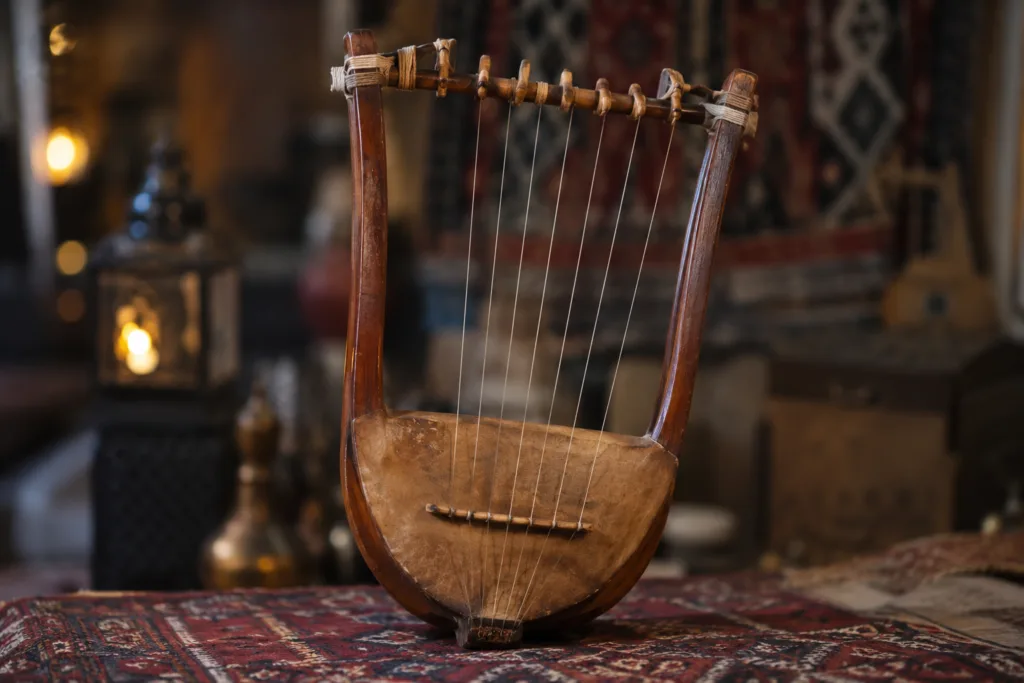
The semsemiah, also widely written as simsimiyya, is a plucked lyre associated with Red Sea maritime culture and, in Egypt, especially with the cities of the Suez Canal. Its open triangular frame, compact resonator, crossbar and individually tuned strings place it in the lyre family rather than among lutes or true harps. Traditional forms commonly carried five strings, while Egyptian makers and players have developed instruments with larger string sets for broader melodic use.
Its identity is closely tied to people as well as construction. Fishermen, sailors, port workers, singers, craftspeople and neighborhood ensembles have used the semsemiah for songs, dances and social gatherings. In Egypt the instrument became strongly identified with Port Said, Ismailia and Suez; in Saudi Arabia it has a documented place in Red Sea coastal traditions, particularly around Yanbu, with performance also recorded on Farasan Island.
Semsemiah, Simsimiyya and Semsemia Are Names for the Same Instrument Tradition
There is no single English spelling of the instrument’s Arabic name. Semsemiah is the spelling used for the UNESCO inscription, while simsimiyya appears frequently in ethnomusicology and instrument collections. Semsemia, simsimiyah and related forms also occur.
These spellings should not be treated as separate instrument types. They mainly reflect different ways of representing Arabic pronunciation in the Latin alphabet, along with regional variation. The physical instrument itself also varies, which can make the naming issue look more complicated than it is.
Common Confusion: A five-string semsemiah and a ten- or twelve-string simsimiyya can look quite different, yet both may belong to the same living instrument tradition. String count alone does not define the name.
Why the Semsemiah Is a Lyre Rather Than a Small Harp
The quickest structural clue is the upper crossbar. Two arms rise from the resonating body and meet a transverse wooden bar, or yoke. The strings run between the lower part of the instrument and that yoke. This is the basic geometry of a lyre.
A harp uses a different string arrangement. Its strings connect the soundbox to a neck at changing lengths without the two parallel arms and crossbar that define the lyre frame. The semsemiah may look harp-like to a casual viewer, especially when its strings fan across an open frame, but its construction belongs to the lyre family.
The lower body receives vibration from the strings through the bridge. It may be wooden, metal, bowl-like, box-like or built from a reused container.
Wooden uprights rise from or through the body and support the upper yoke under string tension.
The crossbar carries the upper string attachments. Many modern examples use individual wooden or mechanical tuning pegs.
A bridge lifts the strings above the soundboard and transfers their vibration into the resonator.
There Is No Single Standard Semsemiah Body
The recognizable lyre frame stays fairly consistent, but the lower body can change dramatically. Documented Egyptian instruments include small rectangular metal containers, wooden boxes, bowl-shaped wooden bodies and deeper metal forms covered by a membrane. Traditional Saudi descriptions also record hollowed wooden bodies covered with a thin skin.
Reused materials are part of this construction history. Metal cans, oil containers, fishing-related materials and readily available wire have all been adapted into playable instruments. This does not make the semsemiah merely an improvised substitute for a more formal instrument. The practice reflects a craft tradition in which makers shape available materials around a familiar acoustic structure.
Wood, Skin and Metal Change the Response
A skin-covered resonator tends to respond quickly when the bridge drives vibration into the stretched membrane. The note can have a dry, immediate front edge with less lingering resonance than a large wooden soundboard. A rigid wooden box can give the pitch a rounder body, depending on its depth, wall thickness and bridge position.
Metal containers introduce another set of resonances. Their thin walls can emphasize a harder edge and mechanical overtones, while the compact cavity keeps the response focused. The result also depends heavily on the string material and tension, so body material cannot predict the entire sound on its own.
| Part | Documented Variations | What Changes Acoustically |
|---|---|---|
| Resonator | Wooden box, wooden bowl, metal container, deep metal plate | Body resonance, projection, weight and decay |
| Sounding surface | Wood or stretched animal skin in some forms | Attack speed, dryness and transfer from the bridge |
| Strings | Gut in older descriptions; fishing line, wire and metal strings in later examples | Tension, brightness, tactile resistance and upper overtones |
| Tuning hardware | Wooden pegs and later mechanical pegs on some instruments | Ease and precision of tuning rather than basic instrument classification |
Five Strings Were the Traditional Starting Point
Older descriptions repeatedly identify the semsemiah as a five-string lyre. Each string produces an open pitch rather than being stopped against a fingerboard as on a guitar or oud. This makes tuning part of the instrument’s playing logic: the available open pitches must suit the melody or scale being performed.
Historical recordings of Red Sea and Sinai fishing communities describe five open strings tuned for the song being played. When the required tonal material changed, the player could alter the tuning rather than create every new pitch by shortening strings with the left hand.
More Strings Expanded the Egyptian Instrument
The Suez Canal tradition did not remain fixed at five strings. Seven- and nine-string forms became documented as musicians adapted the instrument to Egyptian urban repertories and maqam-based melodic practice. Later makers pushed the idea further.
Field research carried out in Port Said and Ismailia in 2024 and 2025 recorded contemporary instruments with ten or twelve strings, while a 16-string example was also documented. These larger instruments should not be treated as a new family. They show how makers have expanded the same open-string concept to give players more pitches without constant retuning.
What the String Count Tells Us: Five strings describe an older and still important form, not a permanent specification. A semsemiah may retain its characteristic frame and playing logic while carrying a much larger set of individually tuned strings.
Plucking and Muting Work Together
The semsemiah is commonly played with a plectrum in the right hand. In Egyptian descriptions the plectrum may be called a risha or mizwag. The right hand supplies the attack, repeated strokes and melodic rhythm.
The other hand has a less obvious job. Rather than moving along a neck to stop strings at different lengths, it can touch or block strings that should remain silent. The plectrum may move across several strings while the muting hand determines which pitches are allowed to ring.
When the string is struck and left free, its full tuned pitch sounds.
Contact from the other hand prevents an unwanted string from ringing during a stroke.
Fast alternating or repeated movement can create tremolo-like ornament and sustained rhythmic energy.
This technique helps explain why a small set of open strings can support animated melody and rhythm. The player is not simply plucking one isolated string after another. Strumming motion, selective damping, repeated attack and tuned open resonance operate together.
The Sound Comes from Fast Attack and Exposed Open Strings
The semsemiah usually speaks quickly. A plectrum gives the note a clear front edge, while open strings allow the tuned pitch to ring without the damping that comes from pressing a string against a fingerboard. Metal strings can add brightness and a sharper overtone edge; fishing line or other synthetic materials can soften that response.
Compact resonators keep the sound relatively focused. Skin-topped forms can be especially immediate, with a short, dry decay, while some wooden or metal-bodied examples sustain more strongly. There is no single semsemiah timbre because makers do not follow one fixed material specification.
The instrument often works beside singing, clapping and percussion, so separation matters. A fast attack can mark the pulse and trace the melodic contour without covering the voices around it.
Egypt’s Semsemiah Became Closely Tied to the Suez Canal Cities
In Egypt, the strongest modern association is with Port Said, Ismailia and Suez. These were not isolated musical environments. Canal construction, port labor, shipping, migration and fishing brought together communities from the Nile Valley, Nubia, Sudan, Sinai and wider Red Sea routes.
Research into the Canal tradition describes the semsemiah as arriving through more than one movement of people. One documented interpretation places an important stage of its spread in the nineteenth century, when Nubian, Sudanese and Upper Egyptian laborers came to the canal region. Other scholarship has proposed different routes through the Red Sea and Arabian Peninsula. A single uncontested point of origin for the modern instrument has not been established.
From Harbor Cafés to a Public Stage Instrument
During the twentieth century the instrument became deeply embedded in Canal-city life. It was heard among workers and fishermen and in harbor cafés, then moved into larger public settings. Its repertory changed as the instrument entered urban Egyptian musical life.
The wars and political upheavals affecting the Canal region during the 1950s and 1960s also changed the social role of local semsemiah ensembles. Songs connected with Port Said and the Canal became associated with local memory, resistance and collective identity. The instrument later moved more visibly onto formal stages without losing its neighborhood and celebratory uses.
Population movement connected with construction and maritime work helped bring Red Sea and Nile Valley musical practices into the developing Canal cities.
The semsemiah became closely associated with workers, fishermen, cafés and communal music in Port Said, Ismailia and Suez.
Canal-city repertories absorbed songs connected with conflict, displacement, local solidarity and public memory.
Expanded string counts and changing tuning systems supported a wider urban Egyptian repertory and stage performance.
Egypt and Saudi Arabia jointly secured UNESCO inscription for semsemiah crafting and playing.
Saudi Arabia Preserves a Distinct Red Sea Maritime Context
On the Saudi side of the Red Sea, the semsemiah is especially associated with Yanbu and coastal seafaring culture. Traditional accounts describe sailors using it with songs and dances aboard vessels known as sanabeek and sawa’i. The instrument also moved ashore into weddings, festivals and other group celebrations.
Saudi construction descriptions preserve a recognizable five-string form: a hollow wooden body, a thin skin covering, three wooden members arranged into the lyre structure, five tuning keys and taut metal strings. Other documented instruments use reused containers such as jerrycans or oil tins, showing the same flexibility in material choice found elsewhere around the Red Sea.
Yanbu Is Important, but the Tradition Is Not Limited to One City
Yanbu is one of the clearest Saudi centers associated with the instrument, yet UNESCO documentation also records semsemiah practice on Farasan Island, including its use by sailors during fishing. The wider picture is therefore coastal rather than city-bound.
Maritime repertory is central to this setting. Songs can carry stories of sea travel, fishing, work and local social life, while the instrument provides the tuned string voice within a larger communal performance.
Egyptian and Saudi Traditions Share the Instrument Without Being Identical
| Aspect | Egypt | Saudi Arabia |
|---|---|---|
| Strongly documented places | Port Said, Ismailia and Suez | Yanbu, with practice also documented on Farasan Island |
| Maritime association | Fishermen, ship traders, port workers and Canal communities | Sailors, fishermen and Red Sea coastal communities |
| Construction pattern | Highly variable bodies, strings and tuning hardware | Traditional five-string wooden and skin-covered forms alongside reused-material construction |
| Performance setting | Communal singing, cafés, weddings, festivals, public stages and local cultural events | Maritime songs, social celebrations, weddings, festivals and group performance |
| Modern development | Expanded string counts are well documented | Strong continuity of coastal and maritime performance practice |
The table describes documented tendencies rather than fixed national specifications. Instruments, repertories and performance habits vary between communities and individual makers.
The Semsemiah Is a Group Instrument as Much as a Solo Voice
Its musical role becomes clearer when the surrounding ensemble is considered. Semsemiah repertories often involve a lead singer, answering voices, hand clapping, percussion and dance. Call-and-response structure can matter as much as the instrumental melody.
Historical recordings from Red Sea fishing communities show rhythmically active semsemiah accompaniment beside group singing and clapping. The instrument outlines pitch while repeated plectrum strokes help reinforce the pulse. This combination suits communal performance in which the boundaries between musician, singer and participant are less rigid than in a formal concert setting.
That also explains why sheer volume is not the best way to judge the instrument. Its role is often to remain rhythmically clear and melodically recognizable inside a social texture rather than dominate every other sound.
Ancient Lyres Do Not Prove an Unbroken Pharaonic Semsemiah Lineage
Lyres have a very old history in Egypt, northeastern Africa and the wider Near East. Ancient images and surviving archaeological evidence make that broader history clear. The modern semsemiah also shares the defining yoke-and-arms structure of the lyre family.
What remains uncertain is a direct, uninterrupted line from one particular ancient Egyptian lyre to the instrument now called semsemiah. Similar construction can survive, disappear, return or travel between neighboring regions over long periods. Instrument names also change far more quickly than basic musical technologies.
The modern semsemiah is simply the same instrument played unchanged since Pharaonic Egypt.
The semsemiah belongs to an old regional lyre tradition, but the documented modern instrument developed through later Red Sea movement, local craftsmanship and changing musical practice.
Its modern history is therefore more useful when treated as a Red Sea story with several connected routes rather than as a straight line from a single ancient prototype.
Semsemiah and Tanbura Are Related Red Sea Lyres, Not Interchangeable Names
The semsemiah is sometimes confused with the tanbura because both belong to Red Sea and northeastern African lyre traditions. Their frames can look related, and historical movement around ports makes neat boundaries difficult.
The semsemiah is generally more compact and is strongly associated with individually tuned pegs in many modern examples. The tanbura is commonly larger and belongs to its own performance histories, including traditions that do not match Canal-city semsemiah repertory. Older tuning methods can blur the visual distinction, so a crossbar with pegs should be treated as a useful clue rather than an absolute test.
The safest identification comes from several features together: body size and shape, number and arrangement of strings, tuning method, local name, repertory and the community in which the instrument is used.
How to Recognize a Semsemiah
- Look for two arms rising from a compact resonating body.
- Check for a crossbar joining the arms at the top of the frame.
- Follow the strings from the lower body or bridge toward that crossbar.
- Expect individually tuned open strings rather than a fretted neck.
- Do not reject an example because its body is metal rather than wood; reused containers are documented.
- Do not assume that every genuine instrument must have five strings; expanded modern forms exist.
- Use regional and performance context alongside shape when distinguishing it from related Red Sea lyres.
UNESCO Recognized the Crafting and Playing Practice in 2024
Egypt and Saudi Arabia jointly nominated Semsemiah: instrument crafting and playing for UNESCO’s Representative List of the Intangible Cultural Heritage of Humanity. The inscription was approved in 2024.
The wording matters. UNESCO did not designate one museum specimen, one standard body shape or one national version as the definitive semsemiah. The recognized element includes the knowledge used to build the instrument, the skills used to play it and the community practices through which those skills continue.
That definition fits an instrument with no fixed factory specification. A maker can change the resonator, use recycled material, fit a different number of strings or alter the tuning hardware while remaining inside a recognizable local craft tradition.
Transmission Still Happens Through People, Not Specifications
Crafting and playing skills continue to pass through families, ensembles, experienced players and local craftspeople. In Egypt, workshops and educational training also contribute to transmission. In Saudi Arabia, digital media has become another route through which younger players encounter songs, playing methods and instrument making.
Children can begin learning the practice at a young age, and UNESCO documentation includes craftspeople teaching instrument making as well as musicians passing on performance knowledge. This matters because semsemiah tradition depends on more than preserving old objects. The instrument survives when people still know how to build one, tune it, mute its strings, fit it into a song and use it within the social settings that gave the lyre its Red Sea identity.