
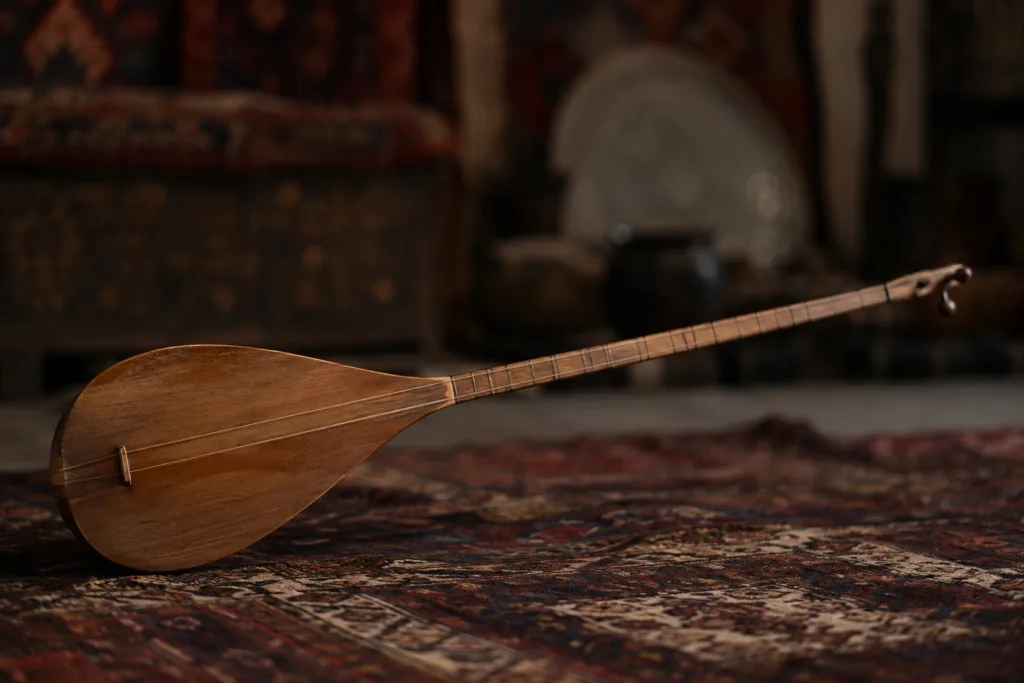
Central Asian Long-Necked Lute
The dutar is a long-necked plucked lute whose traditional identity is built around just two strings. That apparent simplicity is deceptive. Across Uzbekistan, Turkmenistan, Tajikistan, Khorasan, Afghanistan, and Uyghur musical traditions, makers have changed the body construction, string material, fret system, tuning, and right-hand technique while preserving a recognizable long-necked lute concept.
The name appears in several spellings, including dutar, dutār, dotar, dotār, and dutor. The name itself is commonly understood through Persian do tār, meaning “two strings.” Two strings remain the defining historical idea, but the term does not describe one instrument built to a single specification. A Central Asian rib-built dutar, a carved Khorasani dotār, a Turkmen dutar, and a modern Herati dutar can differ enough that treating them as identical instruments hides much of what makes the family interesting.
Long-necked plucked lute
Two strings
Central Asia, Khorasan, Afghanistan, Xinjiang
Wood
Rib-built or carved, depending on tradition
Silk and gut in several traditions
Nylon or metal on many instruments
Often fourths, fifths, or unison; not standardized
Why Two Strings Define the Dutar
Two strings are not simply a reduced version of a many-string lute. Traditional dutar technique was shaped around the interaction of those two strings. Open resonance, fretted melody, repeated strokes, ornaments, and rhythmic hand movement can create a texture much denser than the string count suggests.
One string can carry much of the moving melodic line, especially when the other is allowed to remain open or return repeatedly to a stable pitch.
The second string may reinforce the tonal center, add resonance, or participate directly in the phrase. Its role changes with tuning, repertoire, and local technique.
In many older dutar traditions, the right hand does not treat the strings as two isolated lines. A single finger movement can activate both, combining rhythm and pitch in the same gesture.
The common description of one “melody string” and one “drone string” is useful only as a starting point. Some repertories use the second string far more actively, and different tunings change the relationship between them.
One Name Covers Several Regional Designs
The most useful way to understand the dutar is as a group of related regional lutes. Body size alone does not define the instrument. Construction method, neck proportions, stringing, frets, and playing technique can all change across the regions where the name is used.
| Tradition | Typical Construction | String Character | Playing Context |
|---|---|---|---|
| Uzbek and Central Asian dutar | Long neck with a relatively large pear-shaped body, often assembled from wooden ribs | Historically associated with silk; modern materials also occur | Solo music, song accompaniment, maqom-related repertories |
| Turkmen dutar | Carved wooden resonator with a thin wooden table; mulberry and apricot are closely associated with the craft | Two-string layout remains central | Solo dutar performance and sung bagshy traditions |
| Khorasani dotār | Usually shorter and narrower than large Central Asian forms; carved body is common | Older silk or gut traditions; steel is common on later instruments | Bakhshi performance, narrative song, solo music |
| Uyghur dutar | Long-necked regional form associated with Uyghur musical practice | Two-string concept with local setup and technique | Song, instrumental music, and muqam-related performance |
| Herati dutar | Afghan form that underwent major twentieth-century redesign | Older forms were closer to the two-string model; later versions added extra strings | Regional Afghan music and expanded urban instrumental practice |
Even within a single country, the name can cover instruments with different proportions and setups. Regional identification is therefore more useful than asking for one universal dutar measurement or one universal tuning.
The Central Asian Dutar: Long Scale, Rib-Built Body
Large Uzbek and related Central Asian dutars are among the longest members of the family. Museum examples from Uzbekistan measure well over one meter in total length, while traditional descriptions of the large Central Asian type place some instruments around 125 cm.
The resonator can be assembled from narrow wooden ribs joined edge to edge. This construction produces a rounded pear-shaped bowl without carving the entire back from one block. A thin wooden soundboard closes the body, while the neck extends far beyond the length of the resonator.
The long scale gives the instrument a broad physical reach and allows fine melodic placement along the neck. Historical silk stringing also contributes to a softer attack than the steel-strung sound associated with some Khorasani instruments. The result is not weak or indistinct; the tone can be focused, woody, and rounded, with open-string resonance filling the space between articulated notes.
Uzbek and Tajik Traditions Are Not Identical
Uzbek and Tajik musical traditions share repertories and historical connections, but not every instrument called dutar or dotār follows the same construction. Some Tajik popular forms described under related names are much shorter and may even be fretless, with body and neck carved from one piece of wood.
This variation is a useful warning against identifying every two-string Central Asian long-necked lute by silhouette alone.
The Turkmen Dutar Is Built Around Carved Wood
Traditional Turkmen construction differs sharply from the rib-built Central Asian bowl. The resonating body is hollowed from wood rather than assembled as a shell of separate ribs. Mulberry is closely associated with the body and soundboard, while dried apricot wood is traditionally used for the neck.
The relationship between those parts affects more than appearance. The carved resonator produces a continuous wooden cavity, while the thin soundboard must remain responsive enough to transmit the energy of two strings. Wall thickness, soundboard thickness, bridge mass, and neck stiffness all affect how quickly the note speaks and how much resonance remains after the initial stroke.
A hollowed body has a different structural behavior from a bowl assembled from ribs. The maker controls the cavity and wall thickness directly while shaping a single piece.
The wooden table converts limited string energy into usable acoustic projection. If it is excessively heavy, response can become slower and less open.
The neck must remain stable over a long span while carrying the fret system and maintaining a playable string height.
Turkmen practice also preserves distinct names for musical roles. Dutarchy refers to instrumental dutar performance, while bagshy practice combines the instrument with singing. Epic performance may move between spoken narration, poetry, sung passages, and instrumental transitions rather than treating the dutar as simple background accompaniment.
Khorasani Dotār: Shorter Body, Brighter Response
The Khorasani dotār generally has a narrower, shorter profile than the largest Uzbek forms. A carved mulberry body is common, and metal frets may be used on the long neck. Historical examples were strung with silk or gut, while steel became widely used during the twentieth century.
That string change matters acoustically. Steel can produce a quicker, brighter attack and stronger upper partials than low-tension silk or gut. It also supports the rapid ornamental playing associated with many Khorasani styles. Fast tremolo, repeated strokes, and sharply articulated decorations can keep a melodic line active even when only two strings are present.
The dotār is strongly associated with bakhshi musicians in Khorasan. Their repertories can combine instrumental playing with epic, historical, lyrical, moral, and spiritual narratives. The instrument therefore functions as part of an oral performance system rather than only as a device for producing standalone melodies.
Silk, Gut, Nylon, and Steel Change the Same Instrument in Different Ways
String material is one of the clearest reasons two dutars of similar size can behave differently under the hand.
| Material | Historical or Modern Use | Typical Playing Effect |
|---|---|---|
| Silk | Historically important in Central Asian traditions | Softer attack, lower-tension feel, rounded response |
| Gut | Found in older Iranian and Afghan traditions | Warm, organic attack with less metallic edge |
| Nylon | Common modern substitute on some instruments | Stable, practical, smoother response than steel |
| Steel | Strongly associated with later Khorasani and Afghan developments | Brighter attack, clearer projection, longer metallic sustain |
Changing string material also changes tension. A dutar built for silk, gut, or nylon should not automatically be treated as suitable for heavier steel. Neck stiffness, bridge design, soundboard strength, scale length, and intended setup must be considered together.
The Long Neck Controls More Than the Instrument’s Appearance
The dutar is visually dominated by its neck. In many forms, the neck is longer than the resonating body, producing the elongated silhouette shared with several tanbur- and dombra-related lutes.
A long vibrating length allows small changes in left-hand position to produce carefully spaced pitches. The player can move through melodic figures without the visual density of a short-necked instrument covered with many strings. That makes fret placement especially important.
There Is No Universal Dutar Fret Count
Fret systems differ across regions and historical periods. Some instruments use metal frets, while other traditions use different materials or layouts. Related regional forms may even be fretless.
The number of frets should therefore never be used as a stand-alone test of authenticity. The tuning system, regional repertory, scale length, and intended pitch organization all matter.
The Bridge Couples Two Light Strings to a Large Wooden Surface
The bridge may look modest, but its mass and contact with the soundboard affect attack and projection. Too much mass can absorb energy that would otherwise move the table. A light bridge can respond quickly, though it still has to withstand downward string pressure and remain stable under repeated playing.
Dutar Tuning Is Better Described by Intervals Than Fixed Notes
There is no single pitch pair that defines every dutar. Traditional tunings include relationships of a fourth, a fifth, and, in some Central Asian practice, unison. Exact pitches are adjusted to the performer, repertory, regional school, string material, and instrument.
The two strings are separated by a perfect fourth, giving the player a stable interval that supports melody and open-string resonance.
A wider interval gives the two strings clearer registral separation and can strengthen the sense of an open tonal foundation.
Some traditions bring both strings to the same pitch, shifting the musical interest toward fingering, articulation, rhythm, and the contrast between open and stopped notes.
Common Confusion: A tuning listed for one Uzbek, Turkmen, Iranian, or Afghan dutar should not be treated as the standard tuning for every instrument carrying the name.
The Right Hand Is the Dutar’s Rhythmic Engine
Traditional dutar playing often differs from guitar-style single-string picking. In many forms, the fingers sweep across both strings in coordinated strokes. The accented attack may travel across the string pair in one motion, followed by return strokes, lighter articulations, tremolo, or repeated rhythmic cells.
This gives the right hand two jobs at once. It activates pitch, but it also creates pulse, accent, texture, and continuity. Rapid motion can keep a two-string instrument sounding active without needing sustained chords.
Ornament Replaces Harmonic Density
The dutar is not normally treated as a chord-heavy instrument in the manner of a modern guitar. Melodic decoration, repeated notes, open-string resonance, rhythmic articulation, and rapid alternation create complexity instead.
Khorasani technique may emphasize fast tremolo and brilliant ornament. Uzbek and Tajik traditions can use highly developed finger patterns that combine accented and unaccented strokes. Turkmen playing places its own demands on timing when the musician must support sung poetry or extended narrative performance.
Playing Position Shapes the Stroke
The instrument is typically supported across the player’s body with the long neck projecting outward and upward. Because the resonator is relatively narrow compared with a guitar, the right arm does not need to wrap around a wide body. This leaves the hand free to work near the strings with compact, fast movements.
Why a Two-String Dutar Can Sound Full
Low string count does not necessarily produce a thin musical texture. Several acoustic and technical features work together.
A string that repeatedly returns to an open pitch creates a persistent tonal center under moving notes.
The extended scale gives the strings room to develop a clear fundamental while preserving strong pitch definition along the neck.
A thin soundboard spreads the energy of two strings across a much larger radiating surface.
Repeated strokes and ornaments fill the gaps between individual attacks, producing movement rather than relying on long chordal sustain.
Regional setups can still produce very different tone. Large silk-strung Central Asian instruments may sound rounded and restrained, while steel-strung Khorasani examples can be lighter, sharper, and more brilliant. A modern Afghan form with extra metal strings creates yet another sound profile.
The Herati Dutar Broke the Two-String Rule
The dutar of Herat is one of the clearest examples of a traditional instrument changing while retaining an older name. Earlier Herati instruments followed the two-string idea more closely. During the twentieth century, gut strings were replaced by metal strings on many instruments, a third string appeared, and further redesign followed.
By the 1960s, makers and musicians in Herat were adding drone and sympathetic strings under influence from neighboring instrumental traditions. Some developed forms reached roughly fourteen strings. The playing method also changed: the older finger-driven approach gave way on these expanded instruments to a metal pick.
Why can a dutar have more than two strings? The name preserves the older two-string identity of the instrument. Modern Herati development added functional string groups for melody, drone, and sympathetic resonance without replacing the established name.
This is why string count alone must be interpreted historically. A fourteen-string Herati dutar is not proof that “dutar” never meant a two-string lute; it documents how one regional branch was redesigned for a different musical environment.
Maqom, Muqam, Bakhshi, and Bagshy: The Dutar’s Musical Roles
The dutar is used in several musical systems that should not be collapsed into one generic Central Asian folk style.
Uzbek and Tajik Repertories
Large Central Asian dutars can accompany songs, perform solo pieces, and participate in art-music traditions connected with maqom. The instrument’s low string count does not limit it to simple repertory. Refined right-hand patterns and carefully organized melodic movement support technically demanding performance.
Uyghur Muqam and Song
The Uyghur dutar belongs to a musical culture in which instrumental music, sung poetry, and large muqam traditions intersect. Here again, the instrument should be understood through its local repertory rather than treated as an Uzbek dutar with a different regional label.
Khorasan Bakhshi
In Khorasan, the dotār is closely associated with bakhshi performers. Music can carry narrative material, poetry, local history, moral themes, and spiritual texts. Rapid ornament allows one musician to maintain forward motion while supporting the voice.
Turkmen Bagshy
Turkmen bagshy performance joins dutar playing with singing. Epic specialists can alternate spoken narration, poetry, vocal improvisation, and instrumental passages. The dutar becomes part of the pacing and structure of the story rather than merely accompanying its melody.
Dutar, Dotar, and Dutor Are Not Separate Instrument Families
Different spellings often reflect language and transliteration rather than separate organological categories. Dotār is common when writing about Iranian traditions, while dutar is widely used in English for Central Asian forms. Dutor is often encountered in Uzbek contexts.
Spelling alone does not reveal construction. A better identification combines the name with location: Uzbek dutar, Turkmen dutar, Khorasani dotār, Uyghur dutar, or Herati dutar.
Dutar, Dombra, and Tanbur Share a Silhouette but Not One Identity
Long necks and narrow wooden bodies make several Eurasian lutes look related at first glance. They may share historical connections, terminology, or playing ideas, but their names are not interchangeable.
| Instrument | Useful Identifying Clue | What Not to Assume |
|---|---|---|
| Dutar | Traditionally built around a two-string system, with regional rib-built or carved forms | That every dutar has exactly the same body, frets, tuning, or modern string count |
| Dombra | Distinct regional construction and right-hand traditions, especially in Kazakh and neighboring musical cultures | That every two-string long-necked lute is a dutar |
| Tanbur | A broad historical name applied to several long-necked lute traditions with different string and body systems | That tanbur describes one fixed instrument model |
Historical terminology adds another layer. Earlier writings describe two-string tanbur forms before the name dutar became firmly established. This makes a simple family tree difficult to defend. Similar construction ideas existed before today’s regional names settled into their present usage.
The Dutar Name Appeared After Older Two-String Tanbur Traditions
Two-string long-necked lutes existed in written musical thought before the term dutar became common. Fourteenth-century descriptions of tanbur-type instruments already discuss two-string examples and interval tuning.
The term dotār appears later in the historical record. By the early modern period, names based on string count such as two-string, three-string, and four-string forms helped distinguish related long-necked lutes. This history makes it safer to describe the dutar as part of a changing lute continuum rather than assign it one precise invention date.
Written descriptions already record two-string tanbur-type lutes, showing that the musical concept predates widespread use of the dutar name.
The dotār name becomes established for two-string long-necked forms in Persian and Central Asian musical terminology.
Regional forms remain visibly different in body construction, decoration, string material, and performance practice.
Silk and gut are replaced by nylon or steel on many instruments, while the Herati branch gains extra drone and sympathetic strings.
Two UNESCO Listings Protect Different Dutar Traditions
The dutar does not have one global UNESCO inscription covering every regional instrument. Iran and Turkmenistan have separate entries centered on their own living practices.
Traditional skills of crafting and playing Dotār was inscribed on the Representative List of the Intangible Cultural Heritage of Humanity. The practice includes instrument making, playing, oral transmission, and narrative performance among communities in Iranian dotār regions.
Dutar making craftsmanship and traditional music performing art combined with singing was inscribed separately. The entry joins instrument making with instrumental dutar performance and bagshy singing traditions.
The distinction matters because UNESCO recognition concerns living skills and community practices, not a declaration that every instrument called dutar is constructed or played in the same way.
How to Recognize a Dutar Without Relying on the Name
A long neck is not enough. Tanburs, dombras, and other regional lutes can produce a similar outline. Identification becomes more reliable when several traits appear together.
- A neck noticeably longer than the resonating body
- A pear-shaped or elongated wooden resonator
- A fully wooden soundboard rather than a skin-covered belly
- A traditional two-string layout, unless the instrument belongs to a later expanded Afghan type
- A fret arrangement compatible with the regional playing tradition, though some related local forms can be fretless
- Finger-driven right-hand technique on many traditional two-string forms
- Construction details that match the claimed region, such as rib-built Central Asian bowls or carved Khorasani and Turkmen bodies
Decoration is much less reliable than construction. Bone, mother-of-pearl, horn, metal, and other inlay materials can appear on elaborate examples, but plain working instruments may carry little ornament at all.
What to Listen for in a Dutar Performance
Listen for a pitch that repeatedly returns beneath or beside the melody. It may behave like a drone without remaining completely static.
The right hand often creates its own pulse through alternating strokes, accents, and repeated patterns instead of simply triggering isolated notes.
Rapid tremolo, grace notes, repeated attacks, and shifting finger patterns supply movement that a listener might otherwise expect from a larger string group.
A silk- or nylon-strung Central Asian dutar can sound rounded and woody, while a steel-strung Khorasani or expanded Afghan instrument may have a brighter, more metallic edge.
The most recognizable feature is not simply the number of strings. It is the way a long-necked lute, a narrow resonating body, open-string resonance, and highly active right-hand technique turn a very small string system into a complete melodic and rhythmic instrument.