
The Ghatam is one of the most iconic percussion instruments in Carnatic music. At first glance it looks like a simple clay pot, but in the right hands it becomes a remarkably expressive drum with a punchy attack, melodic contours, and a kaleidoscope of textures. Whether you’re a percussionist exploring world rhythms or a music lover curious about Indian traditions, this guide will walk you through the ghatam’s sound, construction, techniques, sizes, buying tips, and care.
Ghatam Specifications
| Feature | Details |
|---|---|
| Material | High-fired clay (often mixed with brass/copper/iron filings) for strength and tone |
| Typical Sizes | 8″ (high), 10″, 12″, 14″ (low); size affects pitch and projection |
| Tonal Range | From crisp, high “ting” tones to deep, woody thumps and resonant bass |
| Playing Positions | Held horizontally with the mouth against the abdomen; strokes on body, neck, and rim |
| Primary Genres | Carnatic concerts, fusion, film, world percussion ensembles |
| Weight | Approx. 2–5 kg depending on size and wall thickness |
| Price Range | Student: ~$80–$200; Performance: ~$200–$500+ (excl. shipping/insurance) |
What Is a Ghatam?
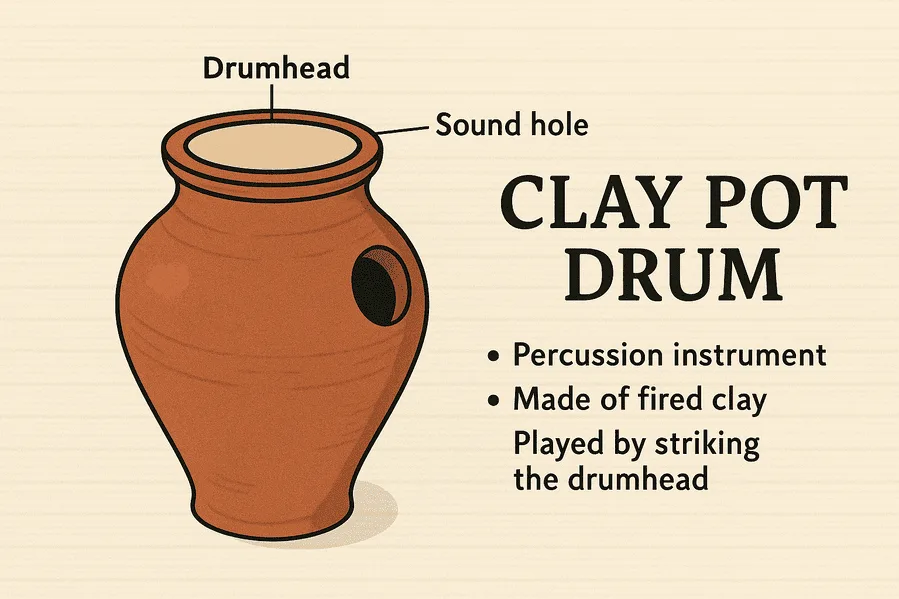
The ghatam is a high-fired terracotta pot designed specifically for musical use. Unlike many drums that use skins, its “membrane” is the clay body itself. The instrument’s pitch and timbre are shaped by the mouth diameter, wall thickness, and the specific clay mix. While the ghatam looks deceptively minimal, its sound palette spans brilliant clicks, woody knocks, gliding bends, and chesty bass—making it a rhythmic powerhouse in South Indian ensembles.
History and Construction
From Water Pot to Concert Stage
Historically, vessels similar to the ghatam were used domestically across India. In South India, artisans began creating purpose-built musical pots with carefully controlled clay mixes and firing techniques. Over time, regional styles emerged—most famously from Manamadurai and Chennai—each with distinct tonal signatures and durability.
Materials and Craft
- Clay composition: Fine clay is combined with metal filings (copper, brass, or iron) to increase hardness, density, and ring.
- Firing: High-temperature firing yields a tough, resonant shell with a complex “ceramic chime.”
- Geometry: A balanced shoulder, neck, and mouth ensure ergonomic grip and consistent resonance.
Because each pot is hand-made, no two ghatams sound exactly alike—part of their charm and the reason advanced players often own multiple instruments in different sizes and tonalities.
How the Ghatam Is Played
Basic Setup and Grip
Sit cross-legged, tilt the pot slightly, and rest the mouth against your abdomen. This contact acts like a movable acoustic valve: by opening or pressing the pot against the body, you subtly shape the resonance and perceived pitch.
Core Strokes
- Body hits: Using fingers and palms on the pot’s belly for full, bassy tones (“dhin/dhum”).
- Neck and shoulder taps: For articulate, crisp sounds (“ta/ti”).
- Rim clicks: Bright, cutting accents with fingertips or nails.
- Muted strokes: Press the pot to the abdomen for short, dry attacks.
- Glides and bends: Slightly opening/closing the mouth against the body creates subtle pitch inflections.
Rhythmic Language
In Carnatic music, ghatam patterns often mirror vocal konnakol syllables. This tight link between syllables and strokes produces dazzling rhythmic variations, especially in solos and thanis (percussion features).
Sound, Role, and Ensemble Use
The ghatam delivers a unique blend of attack and tone: it can cut through dense textures while still sounding warm and earthy. In traditional settings, it complements the mridangam with off-beat accents, call-and-response phrases, and coloristic fills. In fusion or world contexts, its organic timbre pairs beautifully with guitar, bass, frame drum, and handpan.
Ghatam vs. Udu: What’s the Difference?
- Ghatam: Solid clay body; played externally on body, neck, rim; bright attack with woody bass.
- Udu (Nigeria): Has side holes and emphasizes air resonance; more “whooshy” bass and sustained tones.
Sizes, Pitch, and Choosing Your Ghatam
What Size Is Right for You?
- 8″–10″: Higher pitch, fast response; great for cutting through live mixes.
- 12″: Versatile “middle” choice for many concert settings.
- 14″: Lower pitch and stronger bass; ideal for warm, rounded grooves.
Key Buying Considerations
- Tone and sustain: Check for an even response across body, neck, and rim. Listen for a clear bass without rattle and a crisp high-end.
- Build quality: Look for uniform wall thickness, a smooth mouth rim, and no visible hairline cracks.
- Comfort: Ensure the shoulder/neck contour suits your hand size; test long-practice comfort.
- Maker and region: Renowned makers from Manamadurai and Chennai have consistent professional builds.
- Use case: For studio, favor balanced sustain; for live, prioritize projection and articulation.
Can You Tune a Ghatam?
The ghatam’s pitch is largely fixed by its size and thickness. Players may apply a small amount of beeswax or similar material around the mouth to fine-adjust the perceived tonic (sruti), but the adjustment range is limited. Many professionals keep multiple ghatams to cover different keys and tonal colors.
Microphones and Amplification
- Live close-mic: Dynamic mics like an SM57 aimed at the body/neck area for attack; add a small clip-on condenser for detail.
- Studio: A large-diaphragm condenser (e.g., C414 style) ~30–60 cm off-axis captures warmth and transient detail; consider a secondary mic angled toward the rim for clicks.
- Placement tip: Avoid pointing directly into the mouth—too much boom and air turbulence.
Care, Maintenance, and Transport
- Keep it dry: Moisture weakens clay. Never add water inside (that’s an udu technique, not ghatam).
- Temperature control: Avoid rapid changes; extreme cold/heat can cause cracking.
- Cleaning: Wipe with a soft dry cloth. Do not use harsh cleaners or soak.
- Storage: Padded case with firm neck and base support; keep off hard floors.
- Repairs: Hairline cracks can worsen—consult a specialist; DIY glue may deaden tone.
Technique Deep Dive: Getting Expressive
Dynamics and Texture
- Finger rolls: Rapid alternating fingers on the body for shimmering tremolos.
- Palm “ghosts”: Feather-light taps for internal pulse without crowding the groove.
- Rim triggers: Staccato clicks that cut through amplified bands.
- Bass shaping: Slight torso pressure for controlled thuds vs. open bloom.
Practice Tips
- Map konnakol syllables to strokes to internalize phrasing.
- Alternate body and neck accents to create question–answer motifs.
- Record yourself to balance lows, mids, and highs in fast phrases.
Notable Artists to Explore
- Vikku Vinayakram (The “Ghatam Maestro”) — explosive virtuosity and lyrical phrasing.
- V. Selvaganesh — fusion-forward ideas with traditional depth.
- U. Shrinivas collaborations — hear ghatam in modern Carnatic-fusion contexts.
Quick FAQ
Is the ghatam suitable for beginners?
Yes. A mid-sized 12″ model is comfortable, versatile, and forgiving.
Do I need nails or rings to play rim sounds?
No. Fingertips work well. Some players use the edge of nails sparingly; avoid anything that chips the rim.
How fragile is a ghatam?
It’s sturdy for a clay instrument thanks to metal filings and high firing, but a hard drop can crack it. Use a padded case.
Final Thoughts: Why the Ghatam Belongs in Your Setup
The ghatam offers a rare blend of percussive clarity, earthy resonance, and nuanced expressivity. From traditional Carnatic concerts to global fusion, it adds a distinctive voice that’s both ancient and strikingly modern. If you’re building a world percussion palette—or searching for a fresh, organic color—the ghatam is a compact, affordable, and endlessly inspiring choice.
Pro tip: Start with a balanced 12″ ghatam, practice with konnakol phrases, and experiment with mic placement. You’ll discover why this terracotta marvel continues to captivate audiences around the world.