
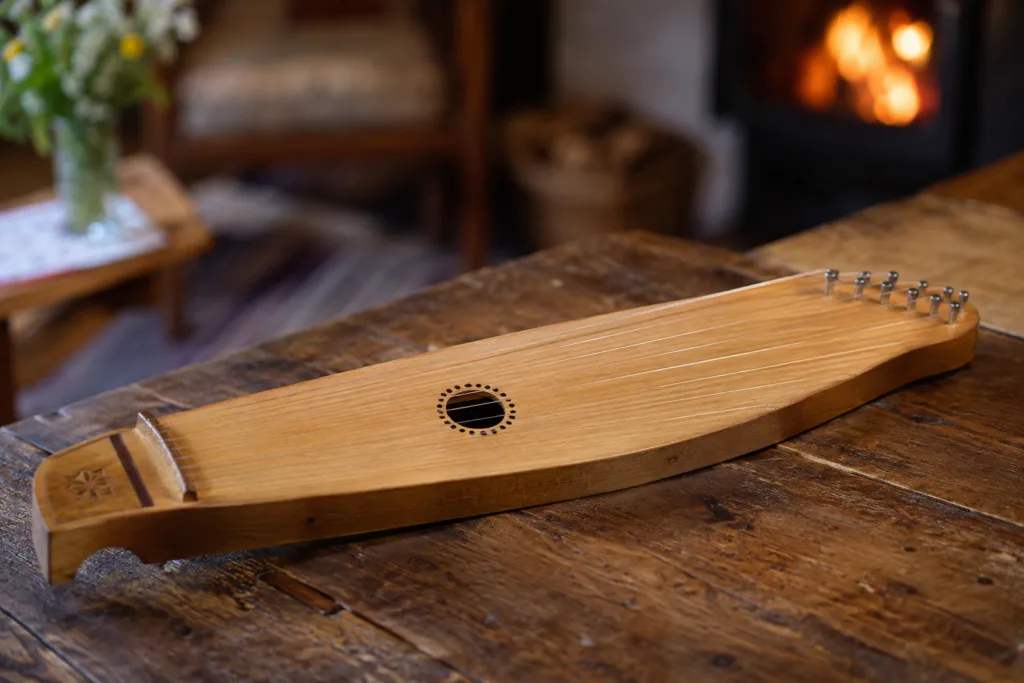
The kantele is Finland’s best-known traditional plucked zither and the Finnish-Karelian member of the wider Baltic psaltery family. The name does not describe one fixed design. It can mean a compact five-string instrument, a larger traditional kantele with a broader range, a 39-string concert instrument with pitch-changing levers, or an electric model built for amplified performance.
Plucked zither / Baltic psaltery
Finland and Karelia
Small carved or built wooden body with diatonic strings
39 strings with hand-operated pitch-changing levers
Steel on many small, concert, and electric instruments
Clear attack, bright overtones, overlapping resonance, and long decay
Kantele Is a Family, Not One Fixed Instrument
A small five-string kantele and a modern concert kantele can look almost like different instrument types. Their connection lies in a shared zither principle: the strings run across the resonating body without a separate fretted neck, and each open string normally supplies a particular pitch.
The family expanded as builders added strings, altered body construction, and developed mechanisms that let performers change pitch without retuning every string by hand. As a result, the modern word kantele covers instruments with very different ranges and musical roles.
Often built with five to fifteen strings. These instruments retain the closest visual and technical relationship to older carved and small traditional forms. Five-string models are also widely used for teaching.
Additional strings extend the diatonic range and allow denser melody, accompaniment, drones, chords, and bass movement. Construction may use separate wooden components rather than one hollowed block.
A modern professional instrument commonly has 39 strings. A lever mechanism changes selected pitches so a basically diatonic string layout can handle chromatic concert music.
Electric models preserve kantele string technique while adding amplification, effects processing, and the projection needed for contemporary ensembles, pop, rock, jazz, and experimental performance.
Why the Kantele Is a Baltic Psaltery Rather Than a Harp
The kantele belongs to the zither family because its strings are stretched across the instrument’s body rather than along a separate neck. A harp uses a different geometry: its strings extend between the soundbox and another structural member at an angle to the soundboard. A kantele instead presents a relatively flat field of strings above its resonating body.
More specifically, the kantele belongs to the Baltic psaltery group. Closely related regional traditions extend around the eastern Baltic and into northwestern Russia. Their instruments can share wing-like or trapezoidal bodies, fan-shaped string layouts, carved construction, metal strings, and related playing techniques, yet each tradition developed its own forms and repertories.
| Name | Main Tradition | Relationship to Kantele |
|---|---|---|
| Kantele | Finland and Karelia | Finnish-Karelian branch of the Baltic psaltery family |
| Kannel | Estonia | Closely related regional psaltery with its own traditional and modern forms |
| Kokle / Kokles | Latvia | Related Latvian tradition, including small traditional and larger concert forms |
| Kanklės | Lithuania | Lithuanian member of the same broader instrument group |
| Wing-Shaped Gusli | Northwestern Russia | Closely related forms share structural and historical connections with Baltic psalteries |
Common Confusion: Kantele, kannel, kokles, and kanklės are related instruments, not interchangeable spellings for exactly the same object. Shape alone may not identify an old instrument reliably; geographic provenance, construction, tuning layout, and local playing tradition also matter.
The Old Carved Kantele Was Hollowed from a Block of Wood
One of the defining early construction methods is the carved kantele, known in Finnish as a koverokantele. Instead of assembling a deep box from several boards, a maker hollows the resonating cavity from a solid piece of wood. Historical Baltic psalteries were carved in several ways: from the top, bottom, or side, depending on local practice and the intended design.
The result can be remarkably light. Body shape is usually asymmetrical, with one end narrower than the other and the strings spreading in a shallow fan. The longest string occupies the longer part of the body, while shorter strings step toward the treble end.
Historical wood choice was not completely standardized. Alder, birch, maple, spruce, and other locally available woods appear in Baltic psaltery construction. Wood density, wall thickness, cavity size, soundboard stiffness, and the way the string anchoring system couples vibration into the body all affect how quickly a note speaks and how strongly the body supports it.
A Five-String Kantele Used Before 1836
A surviving five-string Finnish kantele in the National Museum of Finland shows how different an older instrument can be from many modern teaching models. Its wooden body was hollowed from below, and the five strings were made from gut rather than modern steel. At the opposite end from the tuning pegs, the strings were attached to an iron rod.
The instrument measures about 66.6 cm long but weighs only 384 grams. Its construction demonstrates that the familiar combination of a wooden kantele body and steel strings should not be projected unchanged onto every historical example.
Modern small kanteles are often built from separate wooden pieces and fitted with steel strings. That makes them descendants of the same tradition, but not exact replicas of every older carved instrument.
Five Strings and Thirty-Nine Strings Create Different Musical Possibilities
Adding strings changes more than pitch range. It changes what the player can do with melody, bass movement, chord voicing, damping, modulation, and the division of work between the two hands.
| Feature | Small Kantele | Large Traditional Kantele | Concert Kantele |
|---|---|---|---|
| Typical String Count | Often 5–15 | Varies widely | Commonly 39 |
| Basic Pitch Layout | Usually diatonic or modal | Often diatonic | Basically diatonic with pitch-changing mechanism |
| Chromatic Changes | Usually require retuning | Depend on design | Handled with hand-operated levers |
| Musical Texture | Melody, drones, simple chords, rhythmic blocking | Expanded melody, harmony, and accompaniment | Multi-octave melody, bass, harmony, and concert writing |
| Portability | High | Depends on size | Low compared with small kanteles |
A five-string instrument can create surprisingly dense music because open strings continue ringing while new notes enter. A concert kantele offers far more pitches, but the larger string field also demands a different spatial technique, wider hand movement, and coordination with its pitch-changing levers.
Paul Salminen Changed What a Concert Kantele Could Do
The expansion of the kantele into a modern concert instrument was not simply a matter of adding more strings. The harder problem was changing key efficiently. A large diatonic instrument can carry many notes, yet music that moves through chromatic pitches would still require awkward retuning unless the string length or tension could be altered mechanically.
Finnish musician and instrument developer Paul Salminen devoted much of his work in the early twentieth century to this problem. His experiments included several mechanisms, body designs, and string layouts rather than one immediate final solution.
Salminen applied for a tuning mechanism for the kantele and related instruments. The patented system used rotating components and alternative strings to make pitch changes available without conventional full retuning.
A later patented mechanism changed pitch by altering the tension and effective behavior of the same string. This approach moved closer to the operating principle associated with later lever-equipped concert kanteles.
Salminen continued refining large kanteles, lever placement, playing orientation, and body design. Some experiments were mechanically elaborate and should not be mistaken for a single standardized concert model.
The modern 39-string concert instrument combines a broad diatonic string field with hand-operated levers that provide chromatic and enharmonic pitch changes during performance.
Salminen also experimented with unusually high string counts in some early mechanized designs. Those instruments show that the path toward the modern concert kantele involved trial, mechanical complexity, and several competing ways of solving the same musical problem.
Five-String Tuning Is Simple, but It Is Not Universal
A widely used modern setup for a five-string kantele is D–E–F♯–G–A, the first five notes of a D major scale. Lowering the third string from F♯ to F changes the same five-string set to D–E–F–G–A, producing a minor pentachord without changing the other four strings.
Longest / lowest
Second degree
Lower to F for a common minor setup
Fourth degree
Shortest / highest
This tuning is useful for explaining the instrument, but it should not be treated as a rule for every historical or regional kantele. Pitch level, modal practice, string number, repertory, and performer preference can all change the tuning.
Concert Kantele Uses a Different Pitch System
A modern concert kantele is basically diatonic and is commonly organized around C major. A standard 39-string concert instrument covers roughly G1 to C6. Hand-operated levers change selected pitches so the performer can reach notes outside the open-string diatonic layout.
This is different from a piano, where all twelve chromatic notes are permanently present as separate keys within each octave. On the concert kantele, the player works with a diatonic field and changes the state of selected strings when chromatic notes are needed.
Playing Without Frets Depends on Plucking, Blocking, and Damping
A kantele does not require the player to press a string against a fret to determine its normal pitch. The string is already tuned to a note. Technique therefore revolves around choosing which strings vibrate, how they are attacked, and which ones are prevented from ringing.
Individual Plucking
One or more fingers pluck selected strings directly. This is the clearest route to melody and broken chord patterns, especially when the player wants individual attacks to remain distinct.
Block and Strum
The player lightly touches strings that should remain silent and strums across the group. Because the blocked strings cannot ring freely, the unblocked strings form the audible chord or pattern.
Selective Damping
Stopping a ringing string is part of phrasing. On an instrument with long decay, silence must often be created deliberately rather than waiting for every vibration to disappear on its own.
Extended Concert Techniques
Contemporary repertoire may add harmonics, mallets, scratching or rubbing effects, altered plucking positions, bass-string effects, and electromagnetic excitation such as an E-Bow.
Playing posture also varies. Small kanteles may rest on the lap or a table, and different traditions orient the short and long sides differently. Large concert instruments require a dedicated playing position that gives both hands access to the wide string field and leaves the pitch-changing controls within reach.
Why Kantele Notes Continue Ringing into Each Other
The kantele is known for a relatively long decay. A plucked note often remains audible while later notes are added, creating a layered field of resonance rather than a sequence of fully separated attacks.
Several physical elements contribute. A string transfers vibration into the wooden body, whose panels and enclosed or partly enclosed air space respond at their own resonant frequencies. Nearby strings can also react sympathetically when they share related frequencies. On a well-matched instrument, these interactions help the sound remain active after the finger has left the string.
Research on carved Baltic psalteries has shown that body resonances and the coupling between strings and the soundbox influence both volume and tonal behavior. Sound-hole area and placement can also affect the acoustic response. Two instruments with the same number of strings can therefore differ noticeably because their body geometry, wall thickness, soundboard properties, string material, and internal cavity are not identical.
Steel and Gut Do Not Produce the Same Attack
Many modern kanteles use steel strings, which support a clear, bright, sometimes shimmering attack with strong upper partials. Historical examples show that gut strings were also used. Gut changes mass, flexibility, tension behavior, and the way the attack develops, so an older gut-strung instrument should not be expected to reproduce the exact tonal profile of a modern steel-strung kantele.
The body does more than hold the tuning pins. It is an active part of the sound-producing system.
Runosong Kantele Playing Was Built Around Variation and Improvisation
The older Finnish-Karelian kantele tradition belongs closely to runosong culture, an oral musical and poetic tradition in which repetition, variation, and improvisation played major roles. The musical language did not depend on a large chromatic range. A small number of pitches could support long performances through rhythmic change, repeated figures, melodic alteration, drones, and shifting emphasis.
This helps explain why judging a five-string kantele only by the number of available notes is misleading. Its older musical environment did not demand the same harmonic movement expected from a piano or modern concert harp. Limited pitch material could instead become the basis for continuous variation.
Research into Finnish and Karelian older music describes kantele performance alongside runosong and other oral traditions as music shaped by repeated melodic and rhythmic patterns rather than only by fixed compositions. Improvisation remains part of contemporary Finnish folk-music practice, where older concepts can be used without simply recreating a historical performance note for note.
Väinämöinen’s Pike-Jaw Kantele Belongs to Myth, Not Instrument Archaeology
The kantele has an unusually strong place in Finnish mythology because of its association with Väinämöinen in the Kalevala. In the famous pike episode, he constructs a kantele from the jawbone of a giant pike, with teeth used in the instrument and horsehair providing the strings.
The earliest real Finnish kanteles were made from pike jaws because the Kalevala describes one that way.
The pike-jaw kantele is part of a mythic creation narrative. It documents the cultural meaning attached to the instrument, not the literal construction of the first archaeological kantele.
The distinction matters because epic poetry preserves symbolism, memory, and oral tradition in a different way from a museum object or excavated instrument fragment. The story shows how deeply the kantele became linked with music-making, creation, and Väinämöinen; it does not provide a dated construction record.
How Old Is the Kantele?
There is no secure date for the invention of the kantele as a distinct Finnish instrument. Statements that give it a precise age of one, two, or three thousand years make the evidence appear more exact than it is.
The broader Baltic psaltery tradition is old, and related archaeological instruments have been found east and south of Finland. One historical hypothesis proposes that Baltic psalteries developed through changes to earlier lyre-like instruments around the end of the first millennium. That model helps explain structural relationships, but it does not establish an exact birthday for the Finnish kantele.
Wood also survives poorly in many archaeological environments. This creates a large gap between the possible early history of the instrument family and the much better documented kanteles preserved from later centuries.
What the Evidence Supports: Surviving nineteenth-century and earlier-used museum instruments allow direct study of materials and construction. Historical descriptions and ethnographic records document later playing traditions. Earlier origin dates depend more heavily on related archaeological psalteries, linguistic evidence, structural comparison, and competing theories of development.
It is therefore safer to describe the kantele as part of an old Baltic psaltery tradition than to assign the instrument a single unqualified age.
The Concert Kantele Did Not Replace the Small Traditional Instrument
Concert development created a new branch rather than a replacement. Five-, ten-, and fifteen-string instruments continue to be used for folk music, teaching, composition, and improvisation while the 39-string concert kantele serves music that requires wider range and rapid pitch changes.
The two approaches can even appear in the same contemporary musical environment. A composer may choose a five-string instrument because its restricted pitch set and open resonance are part of the desired sound, then use a concert kantele elsewhere for bass register, dense harmony, or chromatic writing.
The same distinction applies to construction. A small modern instrument can use a traditional-looking outline while being assembled from separate parts, fitted with modern tuning pins, and strung in steel. Historical appearance, historical construction, and historical sound are related but not identical concepts.
Electric Kantele Changes Projection More Than Identity
The electric kantele extends the instrument into settings where an acoustic soundbox alone may not provide enough volume or tonal control. Purpose-built electric models can be amplified, processed through effects, and balanced against drums, electric guitars, keyboards, and other amplified instruments.
This does not turn the instrument into an electric guitar or keyboard. The player still works with a kantele string field, direct finger contact, open-string resonance, damping, lever changes on suitable models, and techniques developed around the geometry of the instrument.
Electric kanteles have been used in contemporary folk music as well as pop, rock, jazz, experimental music, and composed concert works. The 39-string electric form also shows how far the family can move in materials and amplification while retaining the playing logic that identifies it as a kantele.
Why the Kantele Became So Closely Associated with Finland
The instrument’s Finnish identity comes from several layers that reinforce one another. It belongs to old Finnish-Karelian musical traditions, appears prominently in the Kalevala, became a cultural symbol during the growth of Finnish national arts, and later developed its own concert and teaching traditions.
Its role is not limited to preservation. Kantele is still taught within Finnish music education, including professional folk-music study, while performers use small traditional, concert, and electric instruments in living repertoire. Contemporary use includes improvised music, children’s music, folk practice, new composition, amplified performance, and concert works.
Calling the kantele Finnish does not mean the instrument developed in isolation. Its close relatives around the Baltic show that local identity and shared regional instrument history can exist at the same time.
What Identifies a Kantele Across Very Different Forms?
No single string count, body size, material, or tuning defines every kantele. The family is better recognized through a cluster of related traits: a zither layout without a fretted neck, strings arranged across a resonating body, direct plucking and damping techniques, strong open-string resonance, and a historical connection to Finnish-Karelian Baltic psaltery traditions.
A five-string carved instrument emphasizes the oldest surviving structural logic. A large concert kantele adds range and mechanical pitch control. An electric kantele adds amplification and processing. Their appearances differ, but each preserves enough of the same string geometry and playing concept to remain part of the kantele family.