
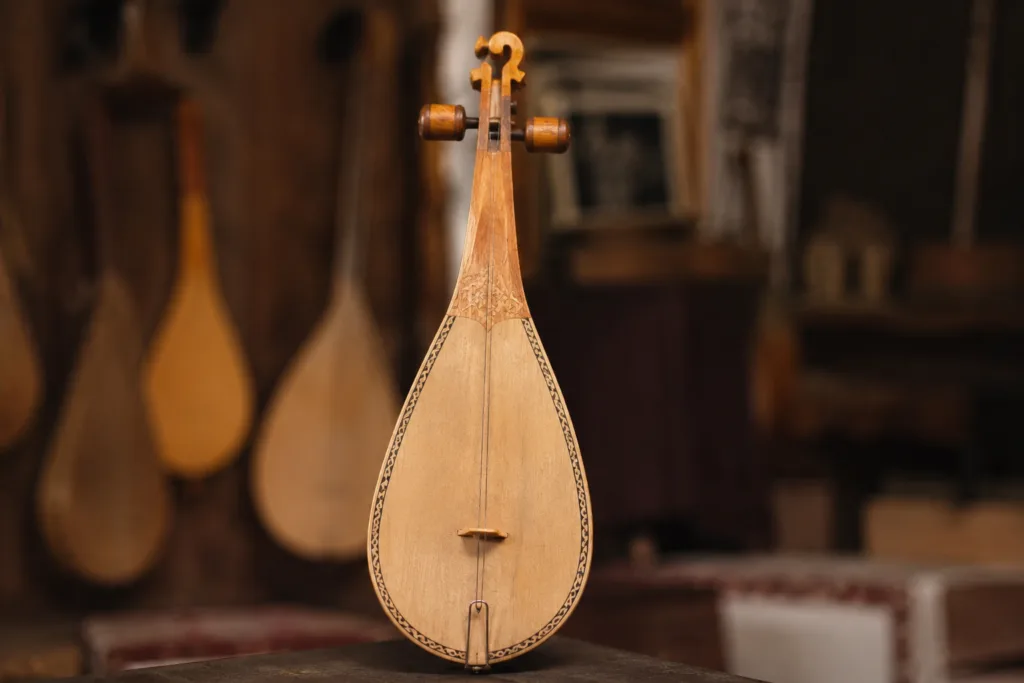
Instrument Snapshot
The lahuta is a bowed, single-string instrument tied to epic singing in northern and northwestern Albania. Its leather-covered wooden body and narrow tonal range support a singer’s pacing, vocal contour, and narrative tension rather than functioning as a melody instrument in the orchestral sense.
The Albanian name appears as lahutë in its indefinite form and lahuta in the definite form commonly used in English-language discussion. The performer is called a lahutar. In traditional practice, the same person bows the instrument and sings, joining instrumental pulse, verbal memory, and vocal delivery in one performance.
The lahuta is not designed to provide chords, a broad solo register, or polished sustained notes. Its single string creates a concentrated field of pitch and texture beneath the voice. Repeated bow strokes keep the account moving, reinforce phrase endings, and mark changes in dramatic pressure.
What Makes the Lahuta a Distinct Instrument
The lahuta belongs to the family of bowed string instruments, yet its construction differs sharply from a violin, fiddle, or bowed lute with several strings. A hollowed wooden body forms the resonator. Animal skin stretches across the open face, creating a membrane that receives vibration through a small bridge. A long neck rises from the body and often ends in a carved animal, bird, or human-like form.
One string runs from the lower body across the bridge to a tuning peg. Historical practice used horsehair for the string in many examples. Nylon is now common in newer instruments because it is easier to obtain, more consistent, and less sensitive to some forms of wear. Makers may use woods such as maple or walnut, although species, dimensions, wall thickness, decoration, and setup vary.
What the 2025 UNESCO Record Covers: The recognized element is not a museum object or one fixed instrument pattern. It includes making the lahuta, playing it, singing with it, teaching the practice, and maintaining its role in community life.
Anatomy and the Job of Each Part
| Part | Construction Role | Effect on Performance |
|---|---|---|
| Hollowed wooden body | Creates the air cavity and supports the membrane. | Body volume and wall thickness affect projection, dryness, and response speed. |
| Skin membrane | Covers the sound box and carries bridge pressure. | Tension and humidity influence attack, pitch stability, and resonance. |
| Single string | Provides the instrument’s only bowed vibration. | Material and tension alter surface noise, focus, and resistance under the bow. |
| Bridge | Transfers string movement into the skin. | Height, mass, and position shape response and can change how freely the membrane moves. |
| Neck | Supports the string path and left-hand pitch control. | There is normally no violin-like fingerboard for pressing the string down. |
| Tuning peg | Sets and holds string tension. | Peg fit matters more than decorative appearance when the instrument must remain playable. |
| Bow | Sets the string into continuous vibration. | Hair condition, tension, rosin, pressure, and speed control attack and grain. |
| Carved head | Extends the neck into a decorative terminal. | Usually has more visual and cultural value than acoustic function. |
How One String Supports a Full Epic Performance
The lahuta is usually held upright, supported against the lap, knee, or lower body according to the player’s posture and the instrument’s proportions. The right hand draws the bow across the string. The left hand changes pitch by touching the string from the side rather than pressing it onto a fingerboard.
This contact can be made with the fingertips or nails, depending on local practice and the player’s training. Because the string remains free from a hard fingerboard, the result includes controlled friction, audible bow texture, and small pitch movements that blend closely with the singer’s voice.
Bow Stroke Starts the Pulse
The bow creates a quick attack and a continuous, textured vibration. Pressure and speed determine whether the tone speaks firmly, scrapes, or weakens.
Left-Hand Contact Shapes Pitch
The player shortens the vibrating length of the single string without forming violin-style stopped notes against a board.
The Membrane Projects the Vibration
The bridge carries motion into the stretched skin, which produces a direct, dry response with limited lingering sustain.
The Voice Carries the Narrative
The instrument holds tonal tension beneath spoken-sung lines, supports cadences, and connects one verbal phrase to the next.
Sound Character and Listening Focus
A lahuta can sound narrow, nasal, woody, and grainy. Those words describe its function better than judging it by the smoothness expected from a violin. Bow noise remains part of the texture, and the skin soundboard gives the attack a dry edge. Sustain is often short to moderate, while repeated bowing creates continuity.
The singer and instrument should be heard as a combined unit. The lahuta may hold a pitch area, answer the end of a line, increase activity during conflict, or thin out during a quieter passage. Its role can shift inside one performance without becoming harmonically complex.
- Listen for changes in bow pressure when the narrative becomes tense.
- Notice how instrumental motion continues through pauses in the text.
- Follow phrase endings rather than searching for a separate instrumental melody.
- Compare repeated formulas; small changes in accent and pacing often carry meaning.
- Pay attention to the singer’s language, breath, and vocal register alongside the string.
The Lahutar as Musician, Singer, and Story Carrier
A lahutar does not simply play accompaniment under a memorized poem. The performance joins remembered lines, inherited verbal formulas, personal phrasing, vocal stamina, bow control, and awareness of the listeners. Even when the narrative is well known, no two performances need to unfold with identical timing or emphasis.
Transmission has traditionally taken place through observation and participation in families and communities. A learner hears the repertory, watches hand position, imitates the bow pulse, and absorbs the relationship between text and sound. Individual lessons, seasonal courses, festivals, and online recordings now add other routes into the tradition.
The practice was historically associated mainly with men, but women also perform today. That change belongs to the living history of the instrument rather than being treated as an exception that weakens the tradition.
The Epic Cycle Behind the Instrument
The lahuta is closely associated with the northern Albanian heroic song tradition known as Eposi i Kreshnikëve, Cikli i Kreshnikëve, or Kângë Kreshnikësh. English translations often use “Epic of the Frontier Warriors” or “Songs of the Frontier Warriors.” These names refer to an oral cycle with many variants, not to one book with a fixed author and final wording.
Mujo and Halili
Mujo and Halili stand among the best-known figures in the cycle. Their stories involve kinship, frontier conflict, reputation, obligation, supernatural help, and tests of endurance. A lahutar may draw on familiar episodes while shaping pace and emphasis for the occasion and audience.
Gjergj Elez Alia
The song of Gjergj Elez Alia offers a different emotional pattern. Its wounded hero, long period of incapacity, family duty, and return to confrontation allow a performer to move between restraint and force. The tale is valuable for hearing how a sparse instrumental texture can sustain a long dramatic arc.
These songs should not be read as direct records of events. Historical memory, legend, inherited formulas, regional language, and performance choice are mixed within the tradition.
Making a Lahuta by Hand
A playable lahuta depends on the relationship between wood, cavity, skin, bridge, string, and bow. Decoration may attract first attention, but acoustic setup determines whether the instrument responds evenly and remains stable under tension.
Selecting and Drying the Wood
The maker chooses a sound piece of wood with enough stability for hollowing and carving. Maple and walnut are documented choices, though other locally available woods may appear.
Hollowing the Resonator
The body is carved into a bowl-like cavity. Thick walls can make the response restrained, while excessive thinning raises the risk of cracking and deformation.
Preparing the Skin
The membrane must be cleaned, cut, stretched, and fixed with even tension. Uneven drying can produce wrinkles, weak areas, or an unstable bridge surface.
Carving the Neck and Head
The neck must remain structurally aligned with the body and string path. The terminal carving may carry regional, family, maker, or personal preferences.
Fitting Peg, String, and Bridge
Peg friction must hold tension without binding. Bridge position and height set the working relationship between string clearance and membrane pressure.
Adjusting the Bowed Response
The maker and player test string tension, bridge behavior, bow grip, and response. Small setup changes can alter attack more than a dramatic decorative change.
Why the Neck Is Often Carved
Lahuta necks may end in carved forms such as goats, rams, horses, birds, human heads, or geometric designs. The carving can identify a maker’s hand, reflect local taste, or connect the instrument with stories and symbols familiar to its community.
No single meaning should be assigned to every example. A goat head on one instrument does not prove that all goat carvings carry the same message. Older forms, recent nationalist imagery, souvenir decoration, and individual workshop styles can appear beside one another.
Collector’s Note: Elaborate carving does not establish age, regional authenticity, or musical quality by itself. Tool marks, wood oxidation, repairs, membrane condition, peg wear, ownership history, and evidence of actual playing deserve equal attention.
The 2025 UNESCO Inscription
On 9 December 2025, UNESCO inscribed “Art of playing, singing and making the lahuta” on the List of Intangible Cultural Heritage in Need of Urgent Safeguarding. The exact list name matters. The decision recognizes a living practice that requires stronger transmission measures; it is not an entry on the Representative List.
The element entered Albania’s national cultural heritage inventory.
The national inventory entry was updated as the nomination and safeguarding work developed.
The UNESCO committee approved inscription on the Urgent Safeguarding List during its twentieth session in New Delhi.
A US$154,846 international assistance project was approved for documentation, inventory work, cultural mapping, training, education, and public awareness in northern and northwestern Albania.
Urgent safeguarding does not mean that the lahuta has disappeared. It means that the practice faces pressures serious enough to require organized support. Youth migration, fewer active makers, shrinking performance settings, and interrupted teacher-student contact can damage the chain even when instruments remain visible at festivals or in private collections.
What Can Disappear Even When Instruments Survive
Wood selection, hollowing depth, skin preparation, bridge fitting, peg adjustment, bow preparation, and final response testing are learned through practice rather than through measurements alone.
Bow pressure, left-hand contact, posture, vocal coordination, and fatigue control must work together during long performances.
Regional vocabulary, Gheg forms, recurring phrases, names, and verbal patterns may lose meaning when separated from the singers who use them.
Family gatherings, local celebrations, weddings, festivals, and teaching relationships give the repertory social purpose beyond staged display.
Lahuta, Gusle, and Çifteli
The lahuta shares structural and performance traits with the gusle traditions of neighboring South Slavic communities. Both can use one bowed string, an upright playing position, a skin-covered resonator, and epic singing. Similarity does not erase differences in language, repertory, naming, community history, or modern identity.
The çifteli belongs to a different playing system. It is a two-string plucked instrument used in Albanian music for songs, dance repertories, and other settings. Confusing the two removes the central role of the bow and epic vocal delivery from the lahuta.
| Feature | Lahuta | Gusle | Çifteli |
|---|---|---|---|
| String Action | Bowed | Bowed | Plucked |
| Common String Count | One | Usually one | Two |
| Playing Position | Upright | Upright | Across the body |
| Main Traditional Association | Albanian epic singing | South Slavic epic singing | Albanian song and dance repertories |
| Sound Production | Continuous bow friction over a membrane resonator | Continuous bow friction over a membrane resonator | Alternating plucked strings over a wooden body |
| Main Distinction | Defined by Albanian terminology, repertory, practice, and maker traditions | Defined by its own languages, repertories, and community practices | Different construction, technique, and musical function |
Common Confusion: UNESCO inscription of Albania’s lahuta practice does not serve as a legal ruling that every similar Balkan instrument belongs to one national tradition. It records the named practice submitted by Albania and the communities involved in that file.
Lahuta and Lahuta e Malcís Are Not the Same Thing
A physical instrument and living performance practice involving making, bowing, singing, teaching, and oral repertory.
Gjergj Fishta’s written epic poem, published in parts from the early twentieth century and completed in book form in 1937. Its English title is The Highland Lute.
Fishta’s poem draws on northern Albanian language, heroic verse, oral style, historical conflict, and literary composition. It is not a transcript of one anonymous lahutar performance, nor is it identical to the full Cycle of the Frontier Warriors.
Claims That Need Careful Wording
The lahuta has remained unchanged since Illyrian antiquity.
The instrument belongs to a long regional history of bowed instruments and epic performance. A direct, unchanged line from antiquity requires stronger evidence than visual similarity or later tradition.
A single string makes the lahuta musically limited.
The design suits its task. Pitch movement, bow rhythm, texture, phrase support, and coordination with the voice provide the needed range of expression.
An old-looking carved instrument must be an old performance instrument.
Dark finish, distressed carving, and traditional motifs can be recent. Age and use require inspection of materials, wear patterns, repairs, provenance, and setup.
Collector and Care Checks
A lahuta may be collected as a playable instrument, a workshop object, a family heirloom, or a decorative carving. Those categories should not be treated as equal. A visually striking piece can be difficult to tune, while a plain instrument may show thoughtful acoustic work and heavy use.
- Inspect the skin for splits, lifting edges, deep wrinkles, brittle areas, and old adhesive repairs.
- Check the wooden body for cracks, insect channels, warped edges, and excessive refinishing.
- Confirm that the neck, string path, bridge, and lower anchor align under tension.
- Turn the peg carefully and test whether it holds without sudden slipping or severe binding.
- Examine bow hair and stick condition rather than assuming the original bow remains usable.
- Record bridge position and string setup before replacing parts or reducing tension.
- Keep the instrument away from radiators, damp walls, direct sun, and rapid humidity changes.
- Do not wet-clean the membrane, oil the skin, or apply household polish to unknown finishes.
Mini FAQ
Is the lahuta a lute?
It can be placed within the broad lute family because its string runs along a neck attached to a resonating body. In everyday English, however, “lute” often suggests a plucked, multi-string instrument. Calling the lahuta a single-string bowed chordophone is more precise.
How many strings does a lahuta have?
Traditional lahuta construction uses one bowed string. Historical strings were often made from horsehair, while many newer instruments use nylon.
Does the lahuta play a melody?
It can shape pitch and repeated melodic contours, but its main traditional task is to support the sung account. The bow pulse, tonal center, phrase endings, and changes of intensity matter more than a separate tune.
Who plays the lahuta?
A performer is called a lahutar. The same performer commonly bows and sings. The practice was traditionally associated mainly with men, although women also perform today.
Why is the lahuta on UNESCO’s Urgent Safeguarding List?
The practice still exists, but the chain of makers, singers, teachers, learners, repertory, and community settings is under pressure. UNESCO approved inscription in December 2025 together with a multi-year safeguarding project.
Is the lahuta the same as the gusle?
They are closely related bowed epic instruments with strong structural similarities. They are not interchangeable labels for every community. Language, repertory, naming, craft practice, and cultural setting distinguish the Albanian lahuta tradition from neighboring gusle traditions.