
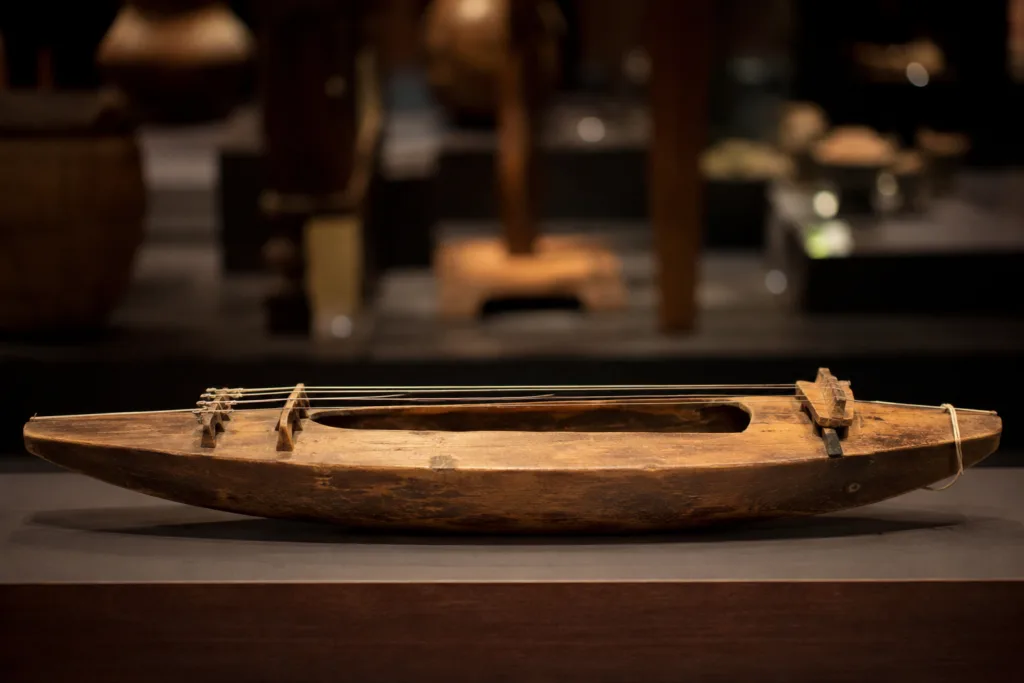
Instrument Snapshot
Mvet Oyeng is both a Central African plucked string instrument and the Ekang performance tradition built around epic narration, song, movement, and audience participation. The instrument supplies a repeating tonal and rhythmic ground while a specialist performer carries stories concerned with memory, conflict, mortality, lineage, conduct, and the legendary domain of Engong.
Mvet Oyeng cannot be described accurately as a rare African guitar or a decorative harp with gourds. Its physical form matters, but the name reaches beyond the object. Depending on context, Mvet Oyeng may refer to the instrument, the body of epic stories, the musician-storyteller, or the entire practice in which voice, strings, gesture, dance, and collective response work together.
The instrument is usually held horizontally near the chest. Strings run along a long plant stalk and pass over a raised, notched bridge, which divides the playable length into two areas. Calabash resonators attached beneath the stalk strengthen the vibration. A performer plucks on both sides of the bridge while speaking, chanting, or singing, so the instrumental pattern and the verbal line develop as one performance rather than as separate layers.
The practice belongs to Ekang communities and related Fang-Beti-Bulu cultural settings across parts of Cameroon, Gabon, the Republic of the Congo, and Equatorial Guinea. In 2025, UNESCO inscribed “Mvet Oyeng, musical art, practices and skills associated with the Ekang community” on the Representative List of the Intangible Cultural Heritage of Humanity through a joint nomination by Cameroon, the Republic of the Congo, and Gabon.
Why Mvet Oyeng Names More Than an Instrument
The word mvet, also written mvett in some publications, has long been used for both a chordophone and forms of oral literature delivered with its accompaniment. UNESCO’s wording for Mvet Oyeng extends the term to the stories, the storyteller, the instrument, and the musician. That overlap is not a naming error. It shows that the object and the art cannot be separated without losing part of their meaning.
| Use of the Term | What It Describes | Why the Distinction Matters |
|---|---|---|
| Instrument | The long plucked zither with a bridge and attached calabash resonators. | Explains the physical source of the accompaniment. |
| Epic repertoire | Story cycles, episodes, songs, characters, genealogies, and recurring themes. | Shows that the practice is also a form of oral literature. |
| Performer | The specialist who combines narration, singing, playing, memory, and dramatic delivery. | Places expertise in a trained person rather than in the object alone. |
| Performance tradition | The event created by musician, story, movement, listeners, and social setting. | Explains why preservation must include practice, language, and teaching. |
Common Confusion: Calling Mvet Oyeng a “Central African guitar” may help a new listener imagine plucked strings, but it gives the wrong structural picture. A mvet has no guitar-shaped sound box, fretted neck, or single bridge-to-soundboard layout. Its long stave, divided string courses, raised notched bridge, and external calabash resonators place it closer to the stick-zither family.
Anatomy and Construction
No single museum specimen should be treated as the universal Mvet design. Historical examples differ in length, string count, resonator number, fastening method, repair history, and material. Even so, several structural ideas recur often enough to define the instrument.
The main body is a narrow stalk or rod, often associated with raffia palm in older descriptions. It acts as the structural spine and as a vibrating support for the strings.
A raised bridge stands across the stave and separates the strings into playable sections. Its height, notch spacing, mass, and stability affect response and string clearance.
One or more gourds are fixed beneath the stave. Their cavities reinforce the otherwise quiet string vibration and add a rounded, hollow resonance around the quick attack.
Older idioglot examples may use narrow string strips lifted from the outer layer of the same palm stalk. Movable fiber or wire loops alter tension and help set pitch relationships.
A late nineteenth- to early twentieth-century Fang example held by the Metropolitan Museum of Art measures about 165 centimeters in length and uses gourd, strings, and fiber. Another Fang example in the same collection is about 183 centimeters long. By contrast, two study-collection instruments documented at the University of Würzburg have staves a little over one meter long. These figures describe particular objects, not a fixed specification.
| Part or Material | Mechanical Role | Likely Audible Effect |
|---|---|---|
| Palm or plant-fiber stave | Supports string tension and carries vibration between bridge and resonators. | A firm, dry response with a woody grain; stiffness and condition affect clarity. |
| Raised notched bridge | Divides the strings and transfers energy into the stave. | Helps produce a focused attack and distinct pitch areas on either side. |
| Calabash cavities | Increase acoustic output by coupling string vibration to enclosed air. | Add resonance, low-mid body, and a hollow bloom after the pluck. |
| Idioglot palm strings | Form strings from the same material as the stave rather than from separate wire or gut. | Can favor a dry, light, intimate response with limited sustain. |
| Modern replacement strings | Restore playability when original organic strings are absent or unsuitable. | May add brightness, tension, projection, or sustain, while changing the older response. |
How the Mvet Produces Sound
The basic action is plucking, but the full acoustic system includes the performer’s hands, the bridge, the stave, the gourds, and the body position. The instrument does not project like a large arched harp or a modern amplified guitar. Its voice is close, patterned, and closely tied to the spoken line.
The Strings Are Plucked on Both Sides
The bridge creates separate speaking lengths. Both hands can articulate alternating tones, repeating figures, accents, and short responses to the vocal line.
The Bridge Transfers the Pulse
Each pluck sends energy through the notched bridge into the stave. A stable bridge gives cleaner attacks; looseness, wear, or poor seating can reduce clarity and introduce unwanted movement.
The Gourds Reinforce the Vibration
The attached calabashes act as resonating chambers. Differences in cavity size, wall thickness, opening, and attachment can change fullness, projection, and decay.
The Chest Can Shape Resonance
Historical descriptions show the central gourd held against the chest. Changing the contact or opening around that resonator can alter the color and apparent volume, making posture part of the acoustic design.
Voice and Strings Form One Texture
The instrumental figure supports pacing, marks turns in the story, reinforces sung passages, and gives the narrator a recurring sonic ground during extended delivery.
Listening Profile
The bars describe a typical listening impression from traditional stick-zither construction. They are not laboratory measurements, and individual instruments can differ sharply.
What to Listen For
- The alternation between short plucked tones and longer spoken or sung phrases.
- Repeated instrumental cells that stabilize the pace without functioning as a fixed pop-song loop.
- Changes in resonance when the instrument shifts against the performer’s chest.
- Moments when the audience answers through clapping, singing, rhythmic sticks, or spoken response.
- Transitions between narration, chant, character voice, song, and instrumental punctuation.
The Mbom-Mvet as Musician and Storyteller
The specialist performer is often described as a mbom-mvet. Instrumental skill is only one part of the role. A performance may require command of narrative episodes, names, relationships, praise formulas, songs, changes of voice, pacing, gesture, movement, and the social limits of what may be told in a given setting.
Both hands maintain a stable pattern while making room for speech, song, pauses, and dramatic accents.
The performer carries characters, conflicts, genealogical links, repeated formulas, and multiple routes through a large narrative store.
Speech, chant, song, character portrayal, gesture, and movement allow listeners to follow shifts in scene and viewpoint.
The performer responds to attention, participation, mood, occasion, and the knowledge already shared by the people present.
Older ethnographic and museum descriptions connect specialist status with long apprenticeship and, in some settings, initiation. That evidence should not be turned into one universal training rule. Mvet practice has regional, historical, sacred, public, and personal variations, and not every modern performer follows an identical path.
A Performance Made with the Audience
Mvet Oyeng is not simply a solo recital observed in silence. UNESCO’s description emphasizes active participation: listeners may clap, sing, play rhythmic sticks, and engage directly with the storyteller. The resulting event is shaped by exchange rather than by a one-way delivery from stage to seats.
The Storyteller Establishes a Pattern
A plucked figure, vocal opening, or recognizable narrative signal prepares the group for an episode. Characters, journeys, conflicts, speeches, songs, and descriptions then unfold through changes in tempo and delivery.
Participants Respond and the Performance Adjusts
Clapping, sung answers, rhythmic accompaniment, laughter, comments, or other reactions feed energy back into the event. An episode may be expanded, shortened, repeated, redirected, or emphasized according to the occasion and the response in the room.
Shared Memory Is Renewed
The performance does not merely repeat stored material. It allows a community to hear, test, remember, and reinterpret inherited narrative knowledge.
The Epic Tradition Behind the Strings
Mvet narratives are not one fixed book recited word for word. They form a large oral repertoire that can include mythic episodes, heroic conflict, social memory, genealogy, cosmological thought, historical recollection, satire, ethical argument, and reflections on death. The content changes with genre, performer, community, and occasion.
Engong, Oku, and the Problem of Mortality
One widely documented epic strand concerns the legendary Ekang people of Engong, often associated with immortality, extraordinary strength, and formidable warriors. Narratives may place them in conflict with mortal people linked to Oku. This opposition does more than arrange heroes and enemies. It allows the performance to consider the attraction of immortality, the limits of human strength, the use of knowledge, loyalty, rivalry, courage, and the cost of power.
Engong and Oku should not be presented as a complete plot summary for every form of Mvet. The wider tradition contains several genres and bodies of material. Some performances emphasize heroic epic, while others can address ancestry, migration, community behavior, social criticism, local memory, or daily life. The familiar Engong cycle is an important route into Mvet literature, not a template imposed on every performance.
Why Repetition Is Functional
Repeated names, formulas, instrumental patterns, praise lines, and scene-setting phrases help an oral performer organize long material in real time. Repetition also helps listeners identify characters, anticipate transitions, join sung portions, and retain relationships. What appears redundant on a printed page may be structurally useful in a live event.
Variation Is Part of the Form
A recorded or transcribed Mvet performance preserves one realization. It does not freeze the whole tradition. Another performer may select a different episode, adjust the order, alter the pace, expand a speech, respond to a local concern, or use a different balance of narration and song. Memory and invention work together within recognized conventions.
Sacred and Popular Forms
UNESCO distinguishes two broad forms of Mvet Oyeng: sacred and popular. The distinction concerns context, access, transmission, and flexibility rather than a simple division between “authentic” and “modern.” Both belong to a living practice, but they are not interchangeable.
Associated with important events and stricter processes of initiation and transmission. Knowledge may be limited by role, preparation, or occasion, and not every detail is intended for unrestricted public explanation or recording.
More flexible in public celebrations, cultural events, educational programs, and modern shows. It can reach wider audiences while retaining the core relation among story, instrument, performer, and participation.
Public presentation can support teaching and visibility, yet a short festival set cannot represent every layer of an extended narrative practice. Sacred restrictions, community authority, language, performer training, and the length of epic development remain part of the cultural setting even when the instrument appears on a modern stage.
The Ekang Cultural Geography
Mvet traditions are associated with Ekang communities and with Fang, Beti, and Bulu cultural and linguistic settings in western Central Africa. These identities and names do not map neatly onto one modern national border. Communities connected with the practice live across southern Cameroon, Gabon, Equatorial Guinea, the Republic of the Congo, and nearby areas.
The 2025 UNESCO inscription was submitted by Cameroon, the Republic of the Congo, and Gabon. This list identifies the nominating states, not the full cultural reach of every Mvet-related tradition. Equatorial Guinea is part of the broader documented Fang and Mvet geography even though it was not one of the three states named in that nomination.
Regional Variation: Spellings, repertoire labels, construction choices, training customs, and performance contexts may differ. “Ekang,” “Fang,” “Beti,” and “Bulu” should not be flattened into a single interchangeable identity, even where related languages and shared practices connect them.
Making a Mvet as Acoustic Craft
Construction begins with the relationship among stave stiffness, string tension, bridge position, and resonator volume. A maker cannot treat the gourds as decoration added after the instrument is finished. Their position and opening affect how efficiently vibration becomes audible sound.
Selecting and Preparing the Stave
Traditional descriptions often identify raffia palm or a related plant stalk. The material must be long enough to carry the playing layout and sound enough to hold tension without splitting. Density, straightness, dryness, wall condition, and previous insect damage all affect stability.
Forming the String System
In an idioglot construction, narrow strips are raised from the stave’s own outer surface while remaining attached at their ends. This creates a close material relationship between string and body. Other examples may use separate strings or later replacements. A new string material can restore function, but it can also alter tension, brightness, sustain, and stress on an older stave.
Setting the Bridge
The notched bridge determines string spacing and creates playable lengths on both sides. A higher bridge can increase clearance and leverage but may also place more force on the stave. Uneven notches can pull strings sideways or create inconsistent contact.
Matching the Resonators
Calabashes differ naturally in shape, wall thickness, and cavity size. A maker chooses and positions them to support the desired response. The central resonator has added importance when it is brought against the chest and used to shade the acoustic opening during performance.
How Mvet Differs from Similar String Instruments
Both use plucked strings and calabash resonance, which can cause visual confusion. The kora is a bridge harp with a large skin-covered gourd body, a long neck, and strings arranged in two hand-played ranks. The mvet is a long stave zither with smaller external gourds and strings divided by a raised bridge.
The musical bow uses a flexible curved support and usually one main string, sometimes with a gourd resonator. The mvet develops the stave-zither idea into a multi-string system with a notched bridge and several playable pitch relationships.
Board zithers stretch strings over a flat or hollow board, often with many fixed pitches. The mvet uses a narrow rod-like body, separate gourds, and a playing posture tied closely to the chest and storytelling voice.
A guitar uses a neck, fingerboard, fretted or stopped strings, and a hollow body with a soundboard. Mvet pitches are organized through open string lengths and tuning tension rather than left-hand stopping along a fretted neck.
UNESCO Recognition in 2025
Mvet Oyeng was inscribed in 2025 on UNESCO’s Representative List of the Intangible Cultural Heritage of Humanity. The approved title names the musical art, associated practices, and skills of the Ekang community. The multinational nomination came from Cameroon, the Republic of the Congo, and Gabon.
Several Fang mvet instruments entered museum collections. These objects document materials and construction, though their collection records do not preserve the full performance setting.
Pierre Alexandre published an academic introduction describing mvet as both an instrument and genres of oral literature performed with its accompaniment.
The UNESCO Intergovernmental Committee inscribed Mvet Oyeng on the Representative List through the joint nomination of Gabon, Cameroon, and the Republic of the Congo.
The inscription concerns living cultural heritage, not a monument or archaeological location. It does not transfer ownership to UNESCO, establish one authorized version of the epic, or make every performance identical. It recognizes a practiced tradition and the communities, performers, makers, knowledge, and participation that sustain it. The inscription also became Gabon’s first element on that Representative List.
Why Preserving the Object Is Not Enough
A museum can stabilize a stave, retain surviving gourds, document old fiber ties, and record measurements. Those actions protect material evidence. They cannot by themselves preserve language, narrative memory, singing style, audience interaction, initiation rules, maker judgment, or the ability to shape an episode for a particular occasion.
Materials, dimensions, string layout, bridge form, repairs, tool marks, and collection history.
Voice, rhythm, pacing, gesture, audience exchange, character portrayal, and narrative selection.
Who may perform, what may be told, when a form is appropriate, and how authority is recognized.
Material selection, drying, bridge balance, resonator matching, tuning, repair, and response testing.
Audio and video documentation can retain voices, patterns, and moments of interaction, but every recording has limits. A camera frames one event. A transcription removes part of the sound and bodily action. A short online clip may favor spectacle over narrative development. Living transmission still depends on people who know how to perform, teach, listen, and judge the practice.
Collector and Museum Evaluation
A mvet offered as an old ethnographic object should be judged differently from a newly made playable instrument. Age, cultural history, condition, authenticity of materials, documentation, and acoustic function are separate questions. A visually complete specimen may be unplayable, while a modern performance instrument may have little value as an old collection object but far greater value in active music-making.
Collector’s Note: Provenance matters more than a vague claim such as “old African harp.” Look for a documented place, community attribution, collection date, ownership history, acquisition circumstances, restoration record, and clear photographs of the bridge, string system, gourd attachments, and stave ends. Sacred associations or community restrictions also require respectful inquiry before display, publication, or performance.
- Check the stave for splits, crushing, insect channels, warping, and old repairs.
- Inspect the bridge for replacement wood, unstable seating, broken notches, or string abrasion.
- Examine each calabash for cracks, detached edges, patched openings, and failing ties.
- Identify whether the strings are original plant strips, older replacements, or recent synthetic or metal additions.
- Do not assume that missing strings should be replaced or tightened on a historic specimen.
- Separate playable setup decisions from conservation decisions.
- Record all changes before cleaning, restringing, tuning, or removing previous repairs.
Care and Storage for Organic Materials
Mvet instruments often combine thin plant material, dried gourds, fiber ties, adhesives, and fragile strings. These parts react differently to moisture, heat, pressure, and handling. Stable conditions are safer than repeated movement between damp and dry rooms.
Use broad, padded supports that prevent long-term bending. Never allow the full weight to rest on one calabash or on the raised bridge.
Direct sunlight can fade surfaces, dry fibers, and heat the gourds unevenly. Avoid radiators, hot display lamps, and unventilated windows.
Old strings and staves may fail under small tension changes. A historic object should not be brought to playing tension without assessment by a qualified conservator.
Do not apply furniture oil, wax, water, polish, or household cleaner. Loose dust should be handled with suitable conservation methods and minimal pressure.
Focused Glossary
Mvet / Mvett
A name used for the plucked stick zither and, in broader usage, oral performance genres delivered with its accompaniment. Spelling varies among languages and publications.
Mvet Oyeng
The musical art and wider cultural practice associated with Ekang communities, including epic stories, performer, instrument, singing, movement, skills, and audience participation.
Mbom-Mvet
A specialist musician-storyteller who plays the instrument while carrying narrative, vocal, dramatic, and cultural knowledge.
Ekang
A cultural identity connected with the practice and with related Fang-Beti-Bulu communities across several Central African countries. Local identity terms should be retained rather than treated as perfect synonyms.
Idioglot String
A string cut or lifted from the same piece of plant material that forms the instrument’s body, while remaining attached at its ends.
Notched-Bridge Zither
A zither in which strings pass over a raised bridge with notches that guide spacing and divide the playable lengths.
Engong
A legendary domain in a widely known Mvet epic strand, associated with immortal Ekang warriors and extraordinary power.
Oku
A domain associated with mortal people in the Engong-centered epic cycle. Its role and presentation can vary across tellings.
Mini FAQ
Is Mvet Oyeng an instrument or a storytelling tradition?
It is both. The name can identify the plucked string instrument, the epic stories, the specialist performer, and the complete musical and social practice.
What instrument family does the mvet belong to?
It is a plucked chordophone commonly classified as a stick zither or notched-bridge zither. Its strings run along a long stave and resonate through attached calabashes.
How many strings and gourds does a mvet have?
There is no universal count. Documented instruments vary. Some older examples have three or four surviving strings and three resonators, while broader organological descriptions record other arrangements.
Is the mvet the same as a kora?
No. Both may use plucked strings and calabash resonance, but the kora is a skin-covered bridge harp with a long neck. The mvet is a stave zither whose strings are divided by a raised bridge.
Why is the instrument held against the chest?
The posture supports the long stave and can help shape the resonance of the central gourd. Changes in contact and opening can alter tone color and apparent volume.
What changed in 2025?
UNESCO inscribed Mvet Oyeng on the Representative List of the Intangible Cultural Heritage of Humanity following a joint nomination by Cameroon, the Republic of the Congo, and Gabon.