
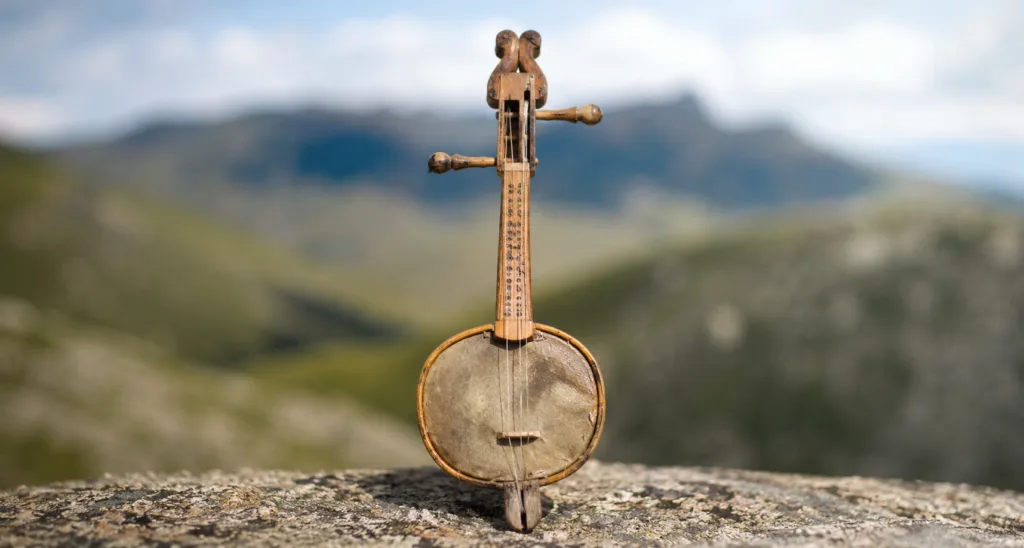
Instrument Snapshot
The Karakalpak kobyz is a two-string bowed instrument made in Karakalpakstan, an autonomous republic within Uzbekistan. Its carved wooden body, leather-covered resonating section, horsehair strings, and horsehair bow support the zhyrau tradition, in which heroic epic narration, singing, and instrumental response form one performance practice.
What the Karakalpak Kobyz Is
The name kobyz, also written qobyz, kobuz, or qobiz in different transliteration systems, can refer to related bowed instruments across Central Asia. The Karakalpak kobyz discussed here is the local form associated with Karakalpak makers and zhyrau performers. It should not be treated as a universal design shared without variation by every community that uses a similar name.
The instrument has an arched profile and two strings formed from prepared horsehair. A leather surface covers part of the resonating body, while a separate bow fitted with horsehair sets the strings in motion. Mulberry and apricot are among the local woods identified in the UNESCO description, although actual instruments can differ in dimensions, decoration, wall thickness, setup, and repair history.
Its musical identity is tied to use rather than shape alone. In zhyrau performance, the kobyz can punctuate spoken narration, reinforce a sung line, sustain a pitch beneath the voice, or carry a short instrumental passage while the performer breathes or shifts between episodes. A decorative object built in the same outline may look convincing yet lack the response, balance, and string setup required for this work.
Common Confusion: The 2025 UNESCO inscription concerns the art of crafting and playing the kobyz in Karakalpakstan. It does not declare every instrument named kobyz identical, and it does not create one official set of measurements, one tuning, or one approved decorative pattern.
Anatomy, Materials, and Working Function
The instrument’s parts operate as a connected acoustic system. The wooden shell holds the structure and enclosed air space. The leather-covered section responds to string energy. Horsehair provides both the vibrating strings and the friction surface of the bow. Changes in any one part can alter attack, resistance, projection, and the balance between a stable pitch and audible bow grain.
| Part | Typical Material | Working Role | What Can Vary |
|---|---|---|---|
| Body and neck | Local wood, including mulberry or apricot | Provides the outline, internal cavity, neck support, and much of the instrument’s physical balance | Length, wall thickness, cavity shape, carving style, and surface finish |
| Resonating cover | Leather | Receives vibration from the strings and contributes to a dry, direct, membrane-colored response | Leather type, thickness, tension, age, and repair condition |
| Two strings | Prepared horsehair bundles | Produce pitch while retaining audible friction and a broad, textured spectrum | Hair count, cleaning, alignment, tension, and replacement practice |
| Bow | Wood and horsehair | Controls note start, sustain, pulse, pressure, and shifts between vocal and instrumental phrases | Curve, weight, hair tension, grip, and contact point |
| Pegs and attachments | Wood and binding materials | Hold string tension and allow the performer to adjust the setup | Peg fit, string anchoring, tuning stability, and later repairs |
| Decoration | Carving, patterned surfaces, or applied finishes | Expresses maker identity and local visual practice without replacing acoustic workmanship | Motifs, density of carving, pigments, finish, and condition |
Why the Leather Description Must Stay General
Some local accounts identify a particular animal hide on a particular instrument, while the official UNESCO description uses the broader term leather. A museum example, workshop instrument, or family-owned kobyz may therefore document a material that should not be presented as mandatory for every Karakalpak kobyz. The same caution applies to wood species, dimensions, decorative motifs, and restoration materials.
Why Horsehair Is Not Just a Historical Detail
A horsehair string is a prepared bundle rather than a single filament. Selection, cleaning, grouping, tying, alignment, and tension all affect how the bow catches the string. Uneven or contaminated hair can produce unstable response, while excessive tension can reduce flexibility and place additional stress on fittings or the resonating cover.
Replacing horsehair with a modern string may make an object easier to maintain, but it also changes mass, surface friction, elasticity, and the way a note begins. A converted instrument can remain musically useful, yet it should not automatically be described as acoustically equivalent to a traditional setup.
From Wood to a Playable Instrument
Kobyz making is not a sequence of decorative tasks followed by string installation. Each stage limits the choices available at the next stage. A maker must balance strength, weight, cavity size, membrane tension, peg function, string resistance, and the physical needs of a performer who may hold the instrument for an extended epic recital.
Selecting and Preparing the Wood
The maker examines grain direction, cracks, knots, dryness, and the amount of material available for the body and neck. Poorly seasoned wood may twist or split after carving, while hidden defects can weaken the peg area or the thin walls around the cavity.
Establishing the Profile
The arched outline, body depth, neck transition, and head are laid out before fine carving begins. Traditional practice allows maker variation, so surviving instruments should not be forced into one modern measurement chart.
Shaping and Hollowing the Body
Material is removed to create the external form and resonating space. Thick walls may feel durable but respond slowly; walls made too thin can deform, crack, or lose structural support. The maker works toward a usable balance rather than maximum thinness.
Preparing the Leather Cover
The leather is cut, fitted, and tensioned over the resonating section. Its behavior changes as it dries and ages. Uneven tension can produce a lopsided response, while a poorly judged replacement can alter both sound and historical integrity.
Fitting Pegs and Horsehair Strings
Pegs must turn without slipping and hold tension without splitting the surrounding wood. The horsehair bundles are prepared, attached, and adjusted as part of the playing setup rather than added as a visual finishing detail.
Making and Matching the Bow
Bow weight, curve, hair quantity, and tension influence how easily the strings speak. A bow that is too stiff, too loose, or poorly matched can make a sound instrument feel resistant or unstable.
Testing, Adjusting, and Finishing
The maker listens for reliable attack, usable sustain, tuning stability, mechanical noise, and balance in the player’s hands. Decoration and finish should not seal moving parts, overload thin surfaces, or hide structural cracks.
How the Karakalpak Kobyz Produces Sound
Sound begins when bow hair grips and releases the horsehair strings in rapid cycles. The vibrating string system transfers energy into the body and leather-covered resonating area. The cavity and surfaces then reinforce some frequencies while allowing bow noise, string grain, and short transient sounds to remain audible.
The result is not expected to imitate the polished response of a modern violin. A Karakalpak kobyz can have a woody center, a dry membrane edge, and a coarse or grainy layer around the pitch. That texture is musically useful because it can merge with the zhyrau’s vocal color rather than sitting apart as a smooth orchestral line.
The note can begin with audible bow friction before the pitch settles. Pressure, bow speed, hair condition, and contact point change this response.
The bow can maintain a pitch beneath a held syllable or extend an instrumental tone between lines of narration.
Horsehair strings and a leather-covered resonator tend to preserve grain, dryness, and a narrow buzzing edge around the note.
Projection depends on setup, room, membrane condition, and playing pressure. Loudness alone is not a reliable test of authenticity or quality.
After the bow stops, the sound usually falls away faster than that of many metal-string concert instruments, though the exact decay varies by build and tension.
The instrument can support, double, answer, or briefly replace the vocal line, creating a shared contour rather than a separate accompaniment track.
What Most Changes the Tone
Wall thickness and cavity shape influence how quickly the body responds. Leather thickness and tension affect dryness, focus, and sensitivity. String-bundle mass changes resistance under the bow. Peg stability affects whether a performer can maintain a usable setup during a long recital. These variables interact, so one material cannot be credited with the entire sound.
Playing Position, Bow Control, and Setup
The Karakalpak kobyz is commonly played in an upright or near-upright position. The performer stabilizes the instrument against the body or lap while keeping enough freedom for bow movement and left-hand pitch control. Exact posture differs among performers and instrument shapes, especially when body length, weight, or neck angle varies.
The two strings do not imply a narrow musical role. A limited string count can support drones, repeated tones, melodic fragments, vocal doubling, short responses, and rhythmic bow gestures. In epic performance, timing and articulation may matter more than a wide scalar range.
Pitch Control
Pitch is shaped through left-hand contact with the strings, but related Central Asian bowed instruments do not all use identical fingering. Photographs alone cannot show pressure, nail contact, hand angle, or the amount of string displacement. A playable technique should therefore be learned from a tradition bearer or a teacher trained in the Karakalpak practice rather than copied from violin fingering or another kobyz tradition.
Tuning Is a Performance Setup, Not a Universal Pair of Notes
No single tuning should be presented as mandatory without documenting the performer, instrument, repertory, and local teaching line. The useful relationship between the strings may depend on vocal range, the selected dastan passage, string tension, and the response of the leather surface. Museum display labels and modern ensemble arrangements may record tunings that do not represent every zhyrau setup.
Bow Technique Serves the Narrative
A sustained bow can hold tension beneath a long vowel. Repeated strokes can reinforce a pulse or mark a change in narrative energy. A short instrumental phrase can bridge spoken and sung delivery. Silence also has a function: the kobyz may stop so that a spoken passage lands without tonal support, then return at a vocal entrance.
The Zhyrau Tradition
A zhyrau is not simply a vocalist holding an old bowed instrument. The role joins heroic epic narration, poetic memory, musical timing, vocal technique, and the authority to interpret inherited repertory. Spellings such as jyrau, jirau, and zhirau appear in English-language catalogues because Karakalpak terms have been transliterated through different writing systems.
In a common description of Karakalpak epic practice, zhyraus perform heroic dastans with kobyz accompaniment, while baqsy or bakhshi performers are more closely associated with lyrical or romantic dastans accompanied by the dutar. The distinction helps explain why replacing the kobyz with any available string instrument changes more than timbre: it crosses into another performance line with its own repertory, vocal delivery, and social history.
Heroic Dastan as Performed Knowledge
A dastan is not preserved fully by storing its words on a page. Performance includes pacing, melodic formulas, changes between speech and song, recurring musical signals, vocal color, breath planning, and decisions about how much of a long narrative to present. A written transcript can protect language and plot while losing the relationship between line length, bow movement, vocal sustain, and audience response.
Alpamys is among the best-known heroic epics associated with Karakalpak oral tradition, but the zhyrau repertory should not be reduced to one title. Different performers may preserve different episodes, melodic patterns, textual variants, and approaches to dramatic timing.
How Voice and Kobyz Divide the Work
The zhyrau advances events in speech-like delivery. The kobyz may remain silent, add punctuation, or prepare the return to song.
The instrument can follow part of the melodic contour, reinforce a recurring formula, or support the voice with repeated tones.
Repeated bowing can support a held note without requiring the instrument to imitate every change in the voice.
A short phrase can mark a new scene, give the performer time to breathe, or separate two narrative units.
Transmission Requires More Than Memorization
Students learn repertory, vocal production, bow control, instrument handling, and the social conditions of performance. They also learn how an inherited narrative can be shaped without losing recognition. This education may happen within families, through master–apprentice teaching, in small groups, or through organised workshops. Recordings can assist memory, but they cannot correct grip, pressure, tuning response, or the timing decisions made in a live exchange.
How It Differs from Related Bowed Instruments
Names and outlines overlap across Central Asia, yet repertory and playing context remain decisive. A Karakalpak kobyz used by a zhyrau belongs to a particular bond between craft, heroic narration, and vocal delivery. Related instruments can share horsehair strings or a skin-covered body without serving the same musical task.
Two horsehair strings, leather-covered resonating body, and a close connection with zhyrau performance of heroic dastans. Measurements and tuning are not fully standardized.
A related bowed instrument within Kazakh traditions. Repertory can include instrumental küy, and modern concert forms may use altered materials, construction, or string systems.
A two-string bowed instrument with its own regional construction, repertory, posture, and teaching practice. Visual resemblance does not make it interchangeable with the Karakalpak form.
A stage-oriented development that may use standardized dimensions, modern strings, fingerboard changes, or ensemble tuning. It should be identified separately from a zhyrau instrument.
Why “The Oldest Bowed Instrument” Needs Caution
The kobyz is often described with very early dates or legendary origins. Such statements may express cultural memory, but they do not by themselves establish an archaeological date for the surviving Karakalpak form. Organic parts such as leather, horsehair, bindings, and wood rarely survive in a complete sequence that proves uninterrupted construction from a precise century.
It is safer to describe the kobyz as a long-established Central Asian bowed-instrument tradition and then separate legend, written record, museum evidence, and living practice. The 2025 UNESCO decision did not certify a claim that it is the first or oldest bowed instrument in the world.
UNESCO Safeguarding and the 2025 Inscription
During the twentieth session of the Intergovernmental Committee for the Safeguarding of the Intangible Cultural Heritage in New Delhi in December 2025, Art of crafting and playing Kobyz was inscribed on the List of Intangible Cultural Heritage in Need of Urgent Safeguarding. The entry concerns the living knowledge held by makers, performers, families, teachers, and communities in Karakalpakstan.
The official UNESCO committee decision identifies two horsehair strings, a leather-covered body, local woods such as mulberry or apricot, a horsehair bow, community use, and transmission through family and master–apprentice learning. It also calls for educational measures that support playing techniques and transfer between generations.
What the Listing Means: The Urgent Safeguarding List records a living practice whose continued transmission faces serious pressure. It is not the World Heritage List, not a design patent, and not a declaration that the tradition is already secure.
The element was included in the national and local inventory of the Republic of Karakalpakstan, according to the UNESCO committee decision.
A five-day training session in Karakalpakstan developed skills for inventorying and documenting kobyz and zhyrau traditions with artists, community members, masters, and other participants.
Fieldwork identified and documented practices connected with kobyz making and zhyrau performance while giving participants direct inventory experience.
Practical training in Nukus brought together young professionals, singers, artisans, and heritage workers for instrument-making and performance activities.
A Nukus workshop considered how kobyz and zhyrau knowledge could be carried into education without separating it from practitioners.
The documentary Melodies of the Ancestors: Kobyz and Zhyrau was presented in Tashkent as an educational and public-awareness resource.
The craft and playing practice entered UNESCO’s List of Intangible Cultural Heritage in Need of Urgent Safeguarding.
Why an Urgent List Was Used
The UNESCO safeguarding project identified a decline in skilled makers, low awareness among parts of the younger generation, and difficulty transferring knowledge. These risks affect both sides of the tradition. Training performers without supporting makers leaves students without suitable instruments; preserving objects without sustaining repertory leaves the instruments silent.
Safeguarding Does Not Mean Freezing the Instrument
A living practice can adapt to schools, recordings, concerts, and new teaching settings. The danger lies in change that removes the knowledge needed to recognise the tradition: replacing long apprenticeship with a brief demonstration, reducing a dastan to a costume segment, producing only decorative kobyz outlines, or documenting performers without recording their names, repertory, permission, and teaching line.
What Is at Risk
The endangered element is not a single antique. It is a chain of decisions and relationships. Wood must be selected and carved. Leather and horsehair must be prepared. Pegs, strings, and bow must be adjusted into a responsive setup. A performer must learn how that setup supports voice and narrative. A community must still recognise occasions where the repertory has meaning.
When only a small number of experienced makers remain, one retirement can remove knowledge about carving thickness, membrane fitting, repair, and string preparation.
An increase in souvenir objects does not prove that responsive instruments are available for students, recitals, or long-term teaching.
Short festival excerpts can remain visible while longer narrative episodes, melodic formulas, and local variants disappear from active memory.
Epic performance needs listeners who understand its language, pacing, themes, and social setting. A stage audience alone cannot replace every local function.
Old instruments may survive physically but become unplayable when no one can assess leather tension, horsehair condition, peg fit, or earlier repairs.
A video without performer identity, location, repertory title, language, date, permission, and instrument details has limited value for future teaching.
What Effective Safeguarding Looks Like
Useful work joins documentation with repeated practice. Makers need students, materials, workshop time, and opportunities to repair real instruments. Zhyraus need long-term learners, places to perform more than short excerpts, and recordings that retain language and context. Schools can assist when practitioners shape the teaching instead of appearing only as occasional guests.
Progress can be judged through living outcomes: apprentices who continue beyond introductory workshops, new playable kobyz instruments, repaired older instruments, younger performers who know extended repertory, community-led cataloguing, and recordings reused in teaching. The number of uploaded clips or displayed objects alone does not measure transmission.
Collector, Museum, and Care Considerations
A Karakalpak kobyz can be valued as a working instrument, a family-held cultural object, a museum piece, or a recent decorative production. These categories can overlap, but they should not be assumed from age, ornament, or seller description. An older object is not automatically more playable, and a heavily decorated object is not automatically a zhyrau instrument.
- Confirm the maker, place, approximate date, ownership history, and intended use whenever documentation exists.
- Identify whether the strings are horsehair bundles, later replacements, or display substitutes.
- Check the leather for tears, detachment, severe deformation, staining, brittle edges, or repairs that restrict vibration.
- Inspect the peg area for splits, oversized holes, slipping pegs, adhesive residue, and forced modern fittings.
- Look for movement at string anchors and other load-bearing points before bringing strings to tension.
- Keep a removed original part with the object’s records rather than discarding it after replacement.
- Avoid tightening a dry or damaged instrument merely to test whether it makes sound.
- Consult a conservator and a maker familiar with skin-covered horsehair-string instruments before cleaning, rehairing, refinishing, or replacing the membrane.
Storage Conditions
Rapid humidity change can move the wooden body and alter leather tension. Heat can embrittle organic materials, while damp storage can encourage distortion, staining, corrosion of later metal parts, or biological growth. The instrument should be supported so that pegs, bow, strings, and decorated edges do not carry its weight.
Cleaning and Restoration
Dry dusting with controlled tools may be suitable for some stable surfaces, but leather, horsehair, pigments, adhesives, and aged finishes react differently. Water, oil, alcohol, household polish, and general leather conditioner can darken surfaces, loosen material, attract dirt, or leave residues. Restoration should preserve evidence of making and use rather than making an old instrument appear newly manufactured.
Mini FAQ
Is the Karakalpak kobyz the same as the Kazakh qyl-qobyz?
They are related bowed-instrument traditions and may share horsehair strings and skin-covered construction. Their repertory, local craft practice, performance roles, setup, and modern development should still be identified separately. The Karakalpak form discussed here is closely tied to zhyrau performance of heroic dastans.
How many strings does a traditional Karakalpak kobyz have?
The UNESCO description identifies two strings made from horsehair. Individual museum objects or altered modern instruments should be documented on their own terms rather than used to redefine the traditional form.
What wood is used to make the instrument?
Mulberry and apricot are named among the local woods used in the craft. Wood choice can vary by maker and available material, and species alone does not determine quality. Dryness, grain, structural condition, cavity shape, and wall thickness also matter.
What does a zhyrau perform?
A zhyrau is associated with heroic epic narration and singing, traditionally supported by the kobyz. The role includes repertory memory, vocal delivery, instrumental timing, and interpretation rather than instrumental accompaniment alone.
Did UNESCO place the kobyz on the World Heritage List?
No. In 2025, the art of crafting and playing the kobyz was inscribed on the List of Intangible Cultural Heritage in Need of Urgent Safeguarding. The entry concerns living skills and transmission, not ownership of the instrument or protection of one monument.
Does UNESCO status mean the tradition is now safe?
No. The urgent listing recognises that makers, performers, repertory, education, and transmission remain under pressure. Its value depends on continued community participation, teaching, playable instrument production, repair knowledge, and performance opportunities.