
Songs of the Steppe: Storytelling with the Morin Khuur
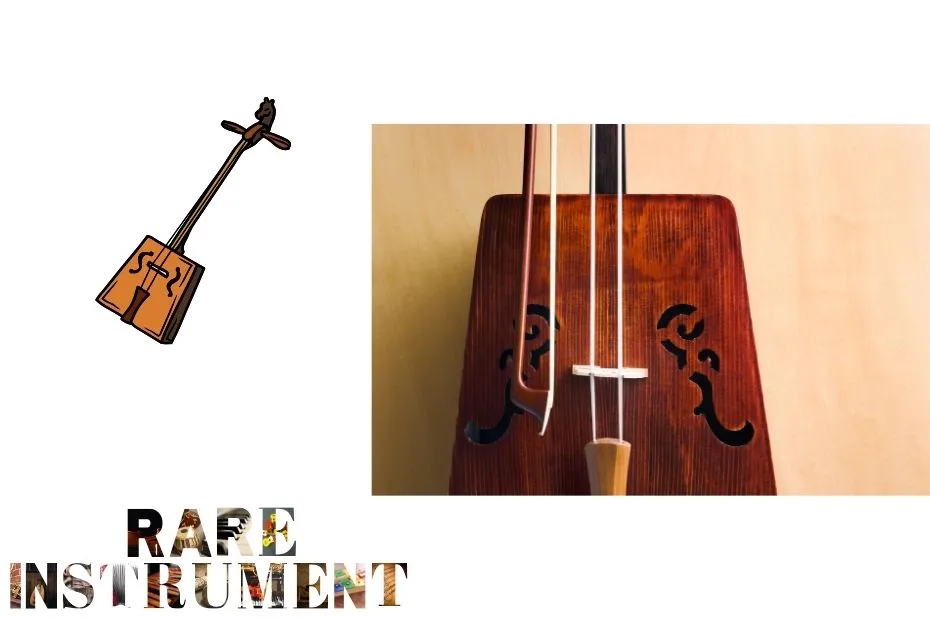
The morin khuur, usually translated as the Mongolian horse-head fiddle, is a two-string bowed chordophone with a long fretless neck and a trapezoidal soundbox. Its traditional construction connects the instrument directly with pastoral life: horsehair forms the strings and bow hair, and the neck ends in a carved horse head. It accompanies long song, dance, epic narration, ceremonies, and musical practices associated with horses.
| Feature | Description |
|---|---|
| Instrument family | Two-string bowed, unfretted chordophone with a long neck and trapezoidal resonator |
| Traditional soundbox | Wooden frame with an animal-skin soundboard; modern concert instruments may use an all-wood body with sound holes |
| Strings | Traditionally bundles of horse-tail hair; modern instruments may use manufactured string materials |
| Bow | Horsehair bow whose tension can be controlled by the player during performance |
| Playing position | Held vertically with the lower part of the soundbox supported between the knees |
| Traditional roles | Solo playing, long song, dance, epic and mythical narratives, ceremonies, and livestock-related repertory |
| Heritage status | Traditional music of the Morin Khuur was proclaimed by UNESCO in 2003 and inscribed on the Representative List in 2008 |
Horsehair, Skin, Wood, and the Trapezoidal Body
The traditional morin khuur has a hollow trapezoidal soundbox connected to a long fretless neck. UNESCO documents an animal-skin soundboard, horsehair strings, and a horsehair bow as characteristic elements of the older construction. Two lateral tuning pegs sit beneath the carved head at the top of the neck.
Historical and modern instruments do not all use the same soundbox. Skin-covered examples remain important evidence for pastoral construction, while twentieth-century concert instruments increasingly adopted wooden soundboards and, in some cases, f-shaped sound holes influenced by orchestral bowed instruments.
The Metropolitan Museum of Art preserves a morin khuur made in Ulaanbaatar in 2000 measuring 103.5 cm long, 27.5 cm wide, and 15 cm deep. Another instrument by the same maker, dated 2001, is made from wood, hide, horsehair, and polychrome decoration. These museum examples show why a single body-length estimate does not describe the entire instrument family.
What We Know: Traditional construction and modern concert construction can differ materially. A skin soundboard, wooden soundboard, horsehair strings, or manufactured strings should be described according to the individual instrument rather than treated as one universal specification.
How Two Horsehair Strings Produce the Sound
The bow sets one or both strings into vibration while the resonator projects the resulting sound. Traditional strings are not single strands. They are bundles of many horsehairs brought together to form a playable string, creating a surface and response unlike a smooth modern orchestral string.
The morin khuur is fretless, but the left hand does not normally press every note against the neck in the same way as a cello. Traditional fingering can stop the string from the side. The index and middle fingers may use the area near the fingernail from beneath the string, while the ring and little fingers can approach from above with the fingertip or nail area.
This contact method leaves the string relatively free and supports fine changes in intonation, slides, vibrato, and harmonics. The bow remains outside the two strings rather than passing between them.
Bow Tension Is Part of the Technique
Traditional bows carry relatively loose horsehair. The right hand can influence hair tension while bowing, giving the player another way to control response and articulation. Bow pressure, bow speed, the amount of hair contacting the string, and the left-hand stopping method all affect how clearly the note speaks.
Tuning: Fourths, Fifths, and Performance Context
Morin khuur tuning has changed across regions, repertories, and performance settings. Traditional sources and present-day practices include strings tuned a fourth or a fifth apart. Modern concert playing commonly uses a fourth relationship, while older and regional practices can differ.
This variation matters because the tuning affects available drones, fingering patterns, resonances, and the tonal center of a piece. A fixed pair of concert pitches should not be presented as the only historical tuning of the instrument.
UNESCO also notes that stage performance altered some modern tuning practices. Higher and louder setups became useful in concert halls, but those changes could reduce subtler qualities associated with older pastoral instruments.
Written Evidence, Legend, and Historical Continuity
Morin khuur origin legends commonly connect the instrument with the death or spirit of a beloved horse. In one widely told version, a grieving rider creates a fiddle from parts associated with the animal so that its voice can continue through music. Such narratives express the cultural relationship between herder and horse, but they are legends rather than dated construction records.
UNESCO cites written sources from the Mongol Empire of the thirteenth and fourteenth centuries that mention string instruments with horse-head decoration. This provides stronger historical evidence for the broader tradition of horse-headed string instruments in Mongolia.
A morin khuur in the National Museum of Mongolia is catalogued as an eighteenth-century instrument. The same museum also preserves a twentieth-century instrument used by musician S. Tuvden in the 1920s. That instrument retains a hide-covered body and documents the continued use of traditional materials during the period when professional stage practice was developing.
Written sources from the Mongol Empire refer to string instruments with horse-head ornamentation.
Surviving museum examples document recognizable horse-head fiddles with trapezoidal bodies and horsehair strings.
Traditional skin-covered instruments remained in use while professional performance and formal musical institutions expanded.
Concert-oriented makers developed wooden soundboards, stronger projection, standardized teaching approaches, and instruments suited to ensemble performance.
Traditional music of the Morin Khuur was proclaimed a Masterpiece of the Oral and Intangible Heritage of Humanity in 2003 and transferred to UNESCO’s Representative List in 2008.
Documented Morin Khuur Examples
| Example | Date | Documented Features | Collection |
|---|---|---|---|
| National Museum of Mongolia morin khuur | 18th century | Trapezoidal wooden soundbox, horse-head finial, horse-tail-hair strings | National Museum of Mongolia |
| S. Tuvden’s morin khuur | 20th century | Hide-bodied traditional instrument made by Tsambiin Gombo; associated with public performance during the 1920s | National Museum of Mongolia |
| Purevadavaa Baigalgav morin khuur | 2000 | Wood and horsehair; 103.5 cm long, 27.5 cm wide, 15 cm deep; bow length 87 cm | The Metropolitan Museum of Art |
| Ceremonial morin khuur by Purevadavaa Baigalgav | 2001 | Wood, hide, horsehair, and polychrome decoration; made in Ulaanbaatar for ceremonial state use | The Metropolitan Museum of Art |
Long Song, Epic Performance, and Tatlaga
The morin khuur can function as a solo instrument, an accompanist, and a musical narrator. UNESCO records its use with dances, urtiin duu long songs, mythical tales, ceremonies, and daily activities connected with horses.
The connection with long song is especially close because both traditions rely on sustained tone, flexible pacing, ornament, and subtle control of pitch. Smithsonian Folkways recordings preserve morin khuur performances alongside Mongolian long song and other traditional repertories.
Epic performance provides another role. Mongolian heroic epics may combine sung narration, spoken or theatrical delivery, and accompaniment on instruments including the morin khuur and tovshuur.
Tatlaga and Music for Animals
Some traditional instrumental pieces known as tatlaga imitate animals, movement, or episodes from pastoral life. UNESCO specifically notes that parts of the morin khuur repertory were intended to calm or tame animals.
Smithsonian teaching materials use The Gallop of Jonon Khar as an example of instrumental storytelling in which rhythmic figures evoke the movement of a horse. Hoofbeat imitation is therefore better understood as a documented repertory practice than as a generic description of every morin khuur performance.
Traditional Fingering and Expressive Technique
Notes can be produced by contacting the side of the string rather than pressing it onto the neck. Index and middle fingers often approach differently from the ring and little fingers.
Finger motion can vary pitch around a sustained note. The fretless design permits narrow or broad vibrato according to style and phrase.
Continuous movement along the string creates controlled portamento between pitches, useful in long song accompaniment and lyrical solo playing.
Short strokes can articulate dance rhythms or horse-associated patterns, while longer strokes support sustained song-like lines.
The original description of the left hand as simply using “flat finger pads” was too narrow. Traditional fingering involves several contact points, including the fingernail area, and the method changes according to finger and technique.
Traditional and Modern Concert Instruments
The modern concert morin khuur grew from the pastoral instrument rather than replacing it entirely. Traditional examples often use a skin soundboard, while many later professional instruments use a wooden top with sound holes. Stage instruments can also employ higher string tension and manufactured strings for greater stability and projection.
These changes affect more than appearance. Skin responds strongly to humidity and temperature, while a wooden soundboard can provide more predictable behavior under concert conditions. Manufactured strings also behave differently from bundles of horsehair in tension, attack, and durability.
UNESCO has identified this shift as part of a wider movement away from the instrument’s older rural setting. Safeguarding efforts have therefore focused not only on formal performance but also on regional playing styles, master performers, oral transmission, and ritual practices.
A UNESCO-supported safeguarding project carried out from 2004 to 2007 documented regional forms and master players, organized teaching workshops, expanded archival records, and supported competitions and festivals intended to transfer the tradition to younger musicians.
Regional Relatives: Ikhel, Suuh, and Other Bowed Fiddles
The morin khuur belongs to a wider family of Central and Inner Asian bowed instruments. Related fiddles can share two strings, horsehair construction, upright playing position, or animal-head decoration without being identical instruments.
Strongly associated with Mongolia; typically has a trapezoidal body, two strings, fretless neck, and horse-head finial.
A two-string bowed instrument particularly associated with western Mongolian groups including Dorvod, Bayad, Zahchin, Urianhai, Oold, and Myangad communities. It is used for dance music and ceremonies.
A related bowed fiddle associated with Buryat traditions in northern and eastern Mongolia and neighboring regions.
A Tuvan two-string bowed fiddle with its own body form, tuning practices, playing traditions, and cultural context despite clear structural similarities.
Care for Horsehair, Skin, and Wooden Soundboards
Maintenance depends on which form of the instrument is being used. A skin-covered pastoral instrument reacts differently to climate than an all-wood concert model, and horsehair strings behave differently from manufactured replacements.
- Loosen bow tension after playing so the horsehair and bow stick are not stored under unnecessary stress.
- Protect skin-covered instruments from abrupt humidity changes that can alter soundboard tension.
- Keep horsehair strings clean and replace damaged bundles before loose strands interfere with bow response.
- Check bridge position after transport; movement changes string height, response, and pressure on the soundboard.
- Do not assume a modern wooden instrument should be maintained exactly like an older hide-covered morin khuur.
Terminology
Morin khuur: Mongolian horse-head fiddle; a two-string bowed instrument with a long fretless neck.
Urtiin duu: Mongolian long song tradition characterized by extended melodic phrases and prolonged syllables.
Tatlaga: Instrumental repertory that can portray animals, events, movement, or pastoral scenes; some pieces are associated with calming livestock.
Khöömii: Mongolian overtone singing in which a singer emphasizes upper partials above a fundamental tone. It may appear in performance contexts that also include morin khuur.
Ikhel: Related two-string bowed fiddle associated especially with western Mongolian communities.
Horsehair string: String formed from a bundle of horse-tail hairs rather than a single gut, metal, or synthetic strand.
Fretless neck: Neck without fixed frets, permitting continuous pitch adjustment and sliding articulation.
High-Quality Sources
- UNESCO Intangible Cultural Heritage — Traditional Music of the Morin Khuur
- UNESCO Multimedia Archives — Morin Khuur, Mongolian Traditional Musical Instrument
- UNESCO — National Action Plan for Safeguarding Traditional Morin Khuur Music
- The Metropolitan Museum of Art — Morin Khuur by Purevadavaa Baigalgav, 2001
- The Metropolitan Museum of Art — Morin Khuur by Purevadavaa Baigalgav, 2000
- National Museum of Mongolia — Eighteenth-Century Morin Khuur
- National Museum of Mongolia — S. Tuvden’s Morin Khuur
- Smithsonian Folkways — Musical Hooves on the Steppes: The Morin Huur of Mongolia
- Smithsonian Folkways — Mongolia: Traditional Music