Whether you’re outfitting a new drumline or upgrading your school’s inventory, choosing the right Marching Snare Set can transform the sound, look, and feel of your ensemble. From shell materials and drum sizes to carriers, heads, and accessories, this guide walks you through everything you need to make a confident, long-lasting choice—without the marketing fluff. Let’s start with a quick feature snapshot you can scan in seconds.
| Feature | What to Look For | Why It Matters |
|---|---|---|
| Drum Size | 14″×12″ (pro/HS); 13″×11″ (younger/indoor) | Balances projection, weight, and feel |
| Shell Material | Maple (warm), Birch (bright), Carbon Fiber (projecting/lightweight) | Tone, volume, and weight profile |
| Hoops & Tension | Die-cast or reinforced rims; high-tension rods | Stable tuning for Kevlar/aramid heads |
| Snare System | Cable/steel snares; micro-adjust strainer | Articulation and quick response |
| Heads | Aramid/Kevlar batter; thin snare-side | Classic marching “crack” and longevity |
| Carrier/Harness | Lightweight aluminum; vest-style; quick-release | Ergonomics and fast set changes |
| Included Accessories | Stand, sticks, key, case, pad, muffling | All-in-one readiness for rehearsal and travel |
What Is a Marching Snare Set?
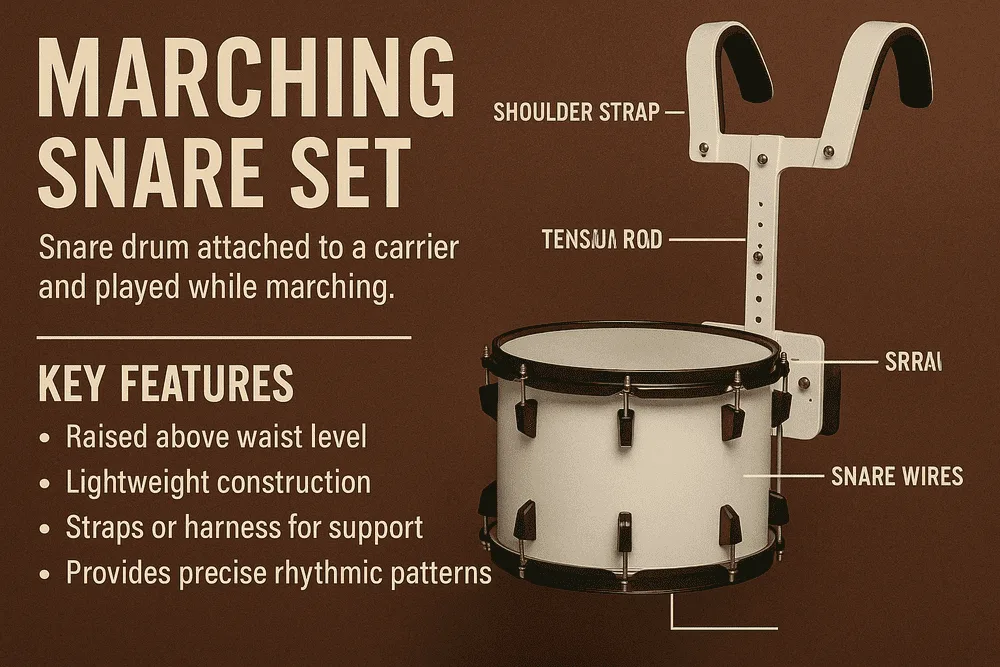
A Marching Snare Set typically includes the drum, a carrier/harness, a snare stand for concert or indoor rehearsals, and basic accessories such as a drum key, sticks, and a protective case. Some sets also include a practice pad and damper system. Unlike concert or drum set snares, marching snares are built for high-tension tuning, increased projection, and durable use on the field, in stadium stands, and during parades.
Core Features and Components
1) Shell Material & Size
- Sizes: The most common specs are 14″×12″ for advanced high school and drum corps, and 13″×11″ for younger lines or indoor ensembles. Slightly shallower options like 14″×10″ can shave weight and tighten response.
- Materials: Maple shells give a round, warm tone; Birch emphasizes attack and focus; Carbon Fiber offers cutting projection with reduced weight—ideal for long marches.
- Construction: Multi-ply wood or composite shells with reinforcing rings resist warping under extreme tension.
2) Hoops, Lugs, and Tension Hardware
- Die-cast hoops and heavy-duty tension rods help keep high-tension heads stable during temperature changes.
- Look for free-floating designs or reinforced bearing edges to protect the shell when cranking a Kevlar head.
- Corrosion-resistant lugs with smooth threads reduce friction and make fine-tuning more accurate.
3) Snare System (Strainer & Wires/Cables)
- Strainer: A micro-adjust throw-off with a precision butt plate enables tiny tweaks that dramatically affect articulation.
- Snares: Marching models commonly use steel or cable snares on the bottom head for a crisp, dry snap. Choose wider cable sets for dry articulation; thinner wires for a bit more buzz.
4) Heads: Batter and Snare-Side
- Batter: Aramid/Kevlar heads are the standard for durability and that signature “crack.” Hybrid aramid/Mylar heads soften feel and reduce rebound for younger players.
- Snare-Side: A thin, responsive head (often 2–3 mil) provides sensitivity at lower dynamics while preserving articulation at fortissimo.
5) Carrier/Harness & Stand
- Carrier: Opt for a lightweight, aluminum carrier with a vest-style or shoulder-bridged design. Quick-release posts make set swaps fast and protect backs during long rehearsals.
- Stand: Height-adjustable stands with rubber feet support indoor rehearsal, protecting rims and preserving tuning.
6) Accessories That Complete the Set
- Sticks: Marching sticks are thicker, with larger beads for articulation and durability.
- Case: A padded, wheeled case safeguards your investment and eases travel.
- Tools & Care: Torque-friendly drum key, small tube of thread lubricant, and rim protectors extend hardware life.
- Practice: Silent pad or insert for warmups and indoor sectional work.
How to Choose the Right Marching Snare Set
- Player Age & Endurance: Younger players often benefit from 13″×11″ to reduce weight and height.
- Performance Environment: Outdoor fields demand projection (consider 14″×12″ with birch or carbon). Indoors may favor slightly smaller or warmer-sounding shells.
- Budget vs. Longevity: Higher-grade hardware and Kevlar heads cost more up front but withstand seasons of high tension.
- Ergonomics: A well-fitted carrier can prevent fatigue and injuries—don’t skimp here.
- Sound Goals: Want dry, articulate taps? Choose birch/carbon with cable snares. Want more warmth? Maple shell with slightly lower tension and hybrid head.
Sizing Guide by Ensemble Level
Middle School / Parade Programs
- Recommended: 13″×9″–13″×11″
- Heads: Hybrid aramid/Mylar for easier rebound and tuning
- Priority: Lightweight carriers, protective cases for transport
High School Field Shows
- Recommended: 14″×12″
- Heads: Full Kevlar batter, thin snare-side for articulation
- Priority: Durable hardware, die-cast hoops, quick-release harness
Drum Corps / Collegiate & Indoor
- Recommended: 14″×12″ or 14″×10″ for weight savings
- Shell: Carbon Fiber or reinforced maple/birch
- Priority: Extreme tuning stability, precision strainer, ergonomics for long reps
Smart Set Configurations
- Essential Bundle: Drum + vest-style carrier + stand + sticks + drum key. Great for programs upgrading from concert gear.
- Performance Bundle: Add a padded/wheeled case, rim guards, spare Kevlar head, extra snare-side head, and cable snares.
- Practice-First Bundle: Include a silent pad insert, stick tape, metronome app integration (phone holder on carrier), and dampening gels.
Tuning, Care, and Longevity Tips
- Seat the head properly: Finger-tighten lugs evenly, then use a star pattern to raise tension in small, consistent increments.
- Use a torque approach: Aim for feel consistency or use a tension watch for repeatable results across your line.
- Snare-side sensitivity: Keep the bottom head tight but not choked; tiny quarter-turn changes impact clarity.
- Snare cables/wires: Align centered; use micro-adjust to eliminate rattle without strangling sustain.
- Maintenance: Lubricate threads lightly each season; check lug inserts; inspect bearing edges and hoop integrity.
- Head replacement: Aramid heads last long under proper tension, but replace when dents, frays, or tonal dead spots appear.
- Weather watch: Heat and humidity affect pitch. Touch up tuning pre-show and at halftime.
FAQ: Marching Snare Sets
Is a marching snare set different from a drum kit snare?
Yes. A marching snare is built for high-tension tuning, extreme durability, and loud projection. The shells, heads, hoops, and strainer system are all reinforced compared to a standard kit snare.
How much does a marching snare weigh?
Depending on size and materials, expect roughly 13–20 lb (5.9–9 kg). Carbon Fiber models save weight without sacrificing projection—ideal for long parades and intense rehearsals.
Can I use a regular snare head on a marching snare?
It’s not recommended. Marching snares are designed for Kevlar/aramid or hybrid heads that tolerate high tension. Regular Mylar heads can fail prematurely under those forces.
Final Thoughts: Build a Line That Sounds as Good as It Feels
A well-chosen Marching Snare Set elevates your entire drumline. Prioritize the right size, durable hardware, a comfortable carrier, and reliable Kevlar heads, and you’ll get the crisp articulation, powerful projection, and consistency judges (and audiences) love. Match the spec to your ensemble’s age, venue, and musical goals, and your snare line will deliver season after season.