
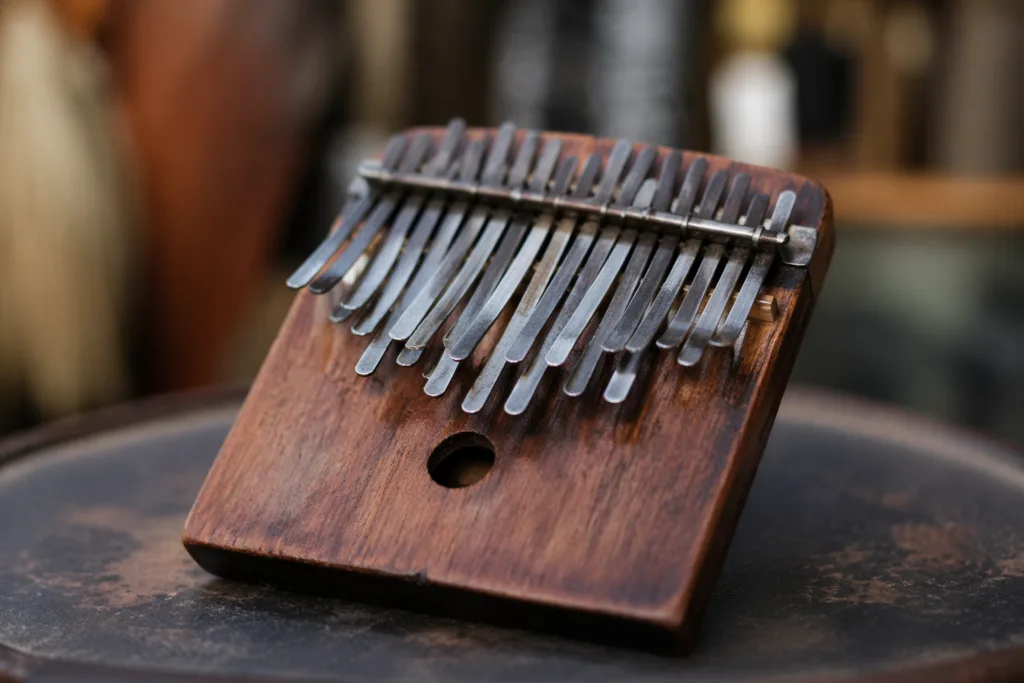
The first thing the ear catches is not volume. It is the shimmer around the note—that light metallic haze, the soft rattle, the bell-like center that stays clear even while the edges seem to flicker.
That is why calling the mbira a “thumb piano” never feels quite large enough. The label is useful, yes, but it misses the board, the forged metal, the gourd, the buzz, the hand position, the cyclical way the music turns back on itself and still keeps moving. On a well-made mbira dzavadzimu, sound is not just struck and released. It blooms, folds, and returns.
| Aspect | What Matters on a Traditional Zimbabwean Mbira |
|---|---|
| Main Form Discussed Here | Mbira dzavadzimu, the Shona “mbira of the ancestors” |
| Typical Build | Wooden soundboard, metal lamellae, pressure bar, bridge, optional deze resonator |
| Key Layout | Usually three ranks, often 22–28 keys on mbira dzavadzimu |
| Tonal Signature | Clear pitch with a bright attack, layered buzz, and a floating decay |
| Musical Logic | Cyclical phrasing, interlocking parts, subtle variation rather than straight linear melody |
| Close Relatives Worth Comparing | Nyunga Nyunga/Karimba and the modern commercial kalimba |
🎼 Pro Tip: When judging an mbira, do not listen only for pitch. Listen for the buzz layer, the balance between bass and upper keys, and whether the note keeps its shape after the first bright click.
What Makes the Mbira Sound Like a Mbira
A plucked lamella does not behave like a guitar string. Its overtone structure is less tidy, and that is part of the charm. The opening attack carries a sharper, more metallic complexity, then the ear settles onto the main pitch a moment later. This is why a good mbira tone can feel both percussive and singing at once.
Short note. Long aftertaste.
The soundboard matters. So does the metal. So does the resonator. And the small rattling devices matter more than many short write-ups admit. On Zimbabwean instruments, the soft buzz from bottle caps, beads, or related fittings is not a decorative extra. It helps shape the voice, adds grain to the attack, and gives the instrument a living edge that a clean, sterile studio tone often lacks.
Board, Bridge and Metal Keys
The classic structure is direct: a wooden board, a set of tuned metal tongues, a bridge, and a pressure bar that fixes the keys while still allowing tuning by sliding them to change vibrating length. The design looks simple—deceptively so. A millimeter or two in key length, bridge pressure, or upward bend can change response under the thumbs in a very obvious way.
Metal choice shapes feel as much as tone. Spring steel tends to give a crisp attack and a steady return under the finger. Iron can feel a touch earthier and less even from key to key, which many players actually like. Brass, used on some instruments, often rounds the edge slightly and can make the upper register feel less sharp. None of these traits exist in isolation, though. Board density, bridge seating, and key thickness all pull on the final sound.
The Deze and the Buzz That Complete the Voice
A traditional deze—usually a half calabash resonator—does more than make the instrument louder. It throws the note outward, widens the low end, and lets the buzz sit around the pitch instead of merely on top of it. Without that chamber, an mbira can sound intimate and direct. Inside a well-matched deze, it starts to breathe differently.
The buzz is part of the note.
Where This Instrument Sits in Zimbabwean Tradition
The mbira belongs to the African lamellaphone family, yet the Zimbabwean forms—especially mbira dzavadzimu—hold a very distinct place. The instrument is tied to Shona musical life, family transmission, song memory, and ceremony. UNESCO recognized the art of crafting and playing Mbira/Sansi in Malawi and Zimbabwe in 2020, which reflects not only the object itself but also the teaching, making, repertoire, and social role that travel with it.
That broader frame matters. An mbira is not only a set of notes mounted on wood. It is also a repertory instrument, a community instrument, and, in many settings, a ceremonial one. Some songs are played in social gatherings. Others sit closer to family lineage, remembrance, and formal occasions. The same instrument can move between those spaces, but the playing attitude changes.
A Longer History Than Many Summaries Show
Descriptions of mbira-like instruments appear in early written records from the late sixteenth century, and archaeological evidence of iron strips resembling lamellae in southern Africa reaches much earlier still. That does not mean every modern Zimbabwean mbira looked exactly the same across every century. It does mean the design logic—metal tongues on a resonant support, tuned by length, played by hand—has deep roots.
And that age is audible. Not in a romantic way. In a practical one.
Mbira Dzavadzimu Vs. Nyunga Nyunga Vs. Modern Kalimba
| Form | Build and Layout | Sound and Use | Best For |
|---|---|---|---|
| Mbira Dzavadzimu | Usually 22–28 keys, three ranks, separate resonator often used | Dense, layered, buzzy, rhythmically interlocking, tied to classic Shona repertoire | Traditional song forms, ensemble work, serious study of Zimbabwean mbira music |
| Nyunga Nyunga / Karimba | Often 15 keys, lighter layout, developed in the 1960s for music education | More compact, easier first layout for many learners, still authentically Zimbabwean | Beginners, school settings, clear entry into cyclic playing |
| Modern Kalimba | Often box-style, equal-tempered, central-note layout, cleaner production uniformity | Cleaner, sweeter, less grainy, easier fit with Western chord-based playing | Singer-songwriters, casual melody playing, portable home practice |
These instruments overlap, but they are not interchangeable in feel. A modern kalimba often gives immediate comfort to players used to diatonic layouts and neat interval spacing. A mbira dzavadzimu asks for a different ear. It wants the hands to think in patterns, not ladder-like scales. It also asks the player to hear the buzz, the overlap, the push-pull between registers, and the way one phrase leans into another.
Why the Nyunga Nyunga Is Not Just a “Simplified Mbira”
The Nyunga Nyunga, often called karimba in some teaching contexts, is a later educational design linked to Zimbabwean music pedagogy in the 1960s. That matters because it was built to teach, not merely to imitate. It gives learners a cleaner way into cyclical logic while still keeping them inside Zimbabwean lamellaphone practice.
So yes, it is easier to enter. No, it is not a toy version.
🪵 Collector’s Note: Older or workshop-built mbira dzavadzimu pieces with hand-shaped lamellae often show tiny irregularities in key width, bend, and spacing. Those details can look rough beside factory-made kalimbas, but they often help explain why the tone feels more alive and less uniform.
How the Hands Actually Meet the Instrument
- The right little finger commonly anchors through the hole at the lower corner of the board.
- The right thumb works the right-side upper keys.
- The right index finger often plucks upward from below on the high register.
- The left thumb handles the two left-side rows.
- The grip is firm, but it should never choke the board.
For new players, the layout can look backward. The low notes are not always where a keyboard-trained brain expects them to be. Many mbiras place weight near the center and split upper tones outward in ways that serve the hands rather than visual symmetry. Once that logic lands, the design stops looking strange and starts feeling efficient.
Why the Layout Feels Odd and Then Starts Making Sense
A keyboard teaches left-to-right progression. A mbira teaches rotational touch. The thumbs pivot. The index finger slips in from below. Repeated cells loop through the hands in a way that makes a straight scale less important than a stable pattern. That is why a person can feel lost when naming notes yet sound surprisingly musical once the physical cycle settles in.
Very mbira, that.
How Cyclical Playing Shapes the Sound
Many pieces are built from repeating cycles rather than long, one-way melodic lines. In classic Shona mbira playing, two interlocking roles are often described as kushaura and kutsinhira. One begins or leads; the other answers and locks into it. When these parts meet, the ear starts hearing implied lines that no single thumb played alone.
This is where many brief instrument profiles stop too early. They describe the mbira as a thumb-plucked melody instrument and leave it there. But the real magic of the form comes from overlap: one line crossing another, high notes cutting through bass ostinato, and the pulse staying steady even while the surface keeps shifting.
Why Solo Practice Should Still Think Like Ensemble Playing
Even when one person practices alone, it helps to hear both roles in the mind. Do not practice only “the notes.” Practice where the second part would sit. Leave space for it. Feel the returning pulse. That change in approach can make a beginner sound more grounded in a week than months of random scale work.
- Keep one short cycle steady before adding ornament.
- Let the left thumb carry pulse and weight.
- Treat the right hand as a color voice, not constant lead.
- Sing the phrase softly while playing if the pattern keeps slipping.
How Wood, Metal and Resonator Choice Change the Voice
A mbira is small, but its material decisions are not. Dense hardwood boards often hold the note together with a firmer front edge and a stronger sense of sustain. Lighter boards can sound drier and quicker, with less tonal mass under the attack. Neither is “wrong.” They simply point to different musical use.
Dense Hardwood Vs. Lighter Board
If the board is dense and well-cut, the lower register usually feels more planted. Bass notes keep their body, and the upper register does not turn thin too quickly. A lighter board may answer faster under a soft touch, which some home players enjoy, but it can also make the instrument feel a bit papery when pushed.
Iron or Spring Steel Vs. Brass-Like Warmth
Keys made from tougher, spring-like metal often return with a snappier attack and a slightly cleaner pitch center after the initial click. Brass-toned lamellae or softer-feeling metals can smooth the edge, which some ears hear as warmth. On upper keys, that can be welcome. On bass keys, too much softness can blur the note before it fully speaks.
Gourd Deze Vs. Built-In Box Resonator
A half-calabash deze gives the tone air around it. It widens the bloom and gives the buzz a place to sit. A built-in box resonator, common on many kalimbas, often sounds neater and more contained. Better for some settings, less persuasive for others. If the goal is classic Zimbabwean presence, the gourd resonator remains hard to beat.
Tuning, Pitch and Why Exact Western Note Names Tell Only Part of the Story
Traditional mbira tunings do not always line up neatly with equal-tempered Western expectations. Players usually talk about tunings by name and lineage rather than by treating the instrument like a small chromatic machine. That is not vagueness. It is a different musical habit.
In practice, tuning on an mbira means listening for interval shape, tension between registers, and how the whole cycle settles. Slide a key slightly and the entire phrase can feel more open, more weighted, or more settled under the fingers. The note number changes. The character changes too.
Why Tuning Is Also a Touch Issue
The better the key sits against the bridge and pressure bar, the better it speaks. A beautifully pitched key that feels stiff, shallow, or rattly in the wrong place is still a poor result. Builders know this well. Good tuning is heard, but it is also felt in the thumb.
How to Start Playing Without Fighting the Instrument
- Choose one short repeating pattern instead of trying to map the whole keyboard.
- Hold the board so the thumbs work freely and the wrists stay loose.
- Play quietly first; mbira tone collapses when a beginner forces it.
- Let the left thumb settle the pulse before asking the right hand for decoration.
- Listen for evenness of attack, not speed.
- Add singing or soft counting only after the motion feels stable.
That order helps because the mbira rewards consistency more than display. A clean cycle at a modest pace sounds right. A rushed, over-hit pattern does not.
And yes—many kalimba players need a few days to stop over-plucking. Perfectly normal.
What to Check Before Buying One
- Layout: Confirm whether it is mbira dzavadzimu, nyunga nyunga, or a commercial kalimba.
- Key Response: Each lamella should speak cleanly with light pressure.
- Buzz Quality: Gentle grain is good; uncontrolled rattle is not.
- Bass Body: Lower notes should feel grounded, not thin.
- Tuning Stability: Keys should sit firmly and not drift after light use.
- Resonator Match: If a deze is included, check whether it actually helps the note bloom rather than merely adding loudness.
If the goal is authentic Zimbabwean repertoire, buying by appearance alone is risky. Better to ask what tuning family it uses, how many keys it has, whether it is meant for mbira dzavadzimu songs or nyunga nyunga teaching pieces, and whether the instrument was built to be played with a resonator.
FAQ
Is it hard to learn mbira if I already play kalimba?
It helps, but the habits do not transfer perfectly.
A kalimba player already understands plucked lamellae, light touch, and resonance. The adjustment comes from the mbira layout, the stronger role of cyclical patterning, and the use of buzz and resonator as part of the final sound. Many players adapt quickly once they stop thinking in straight scales and start thinking in repeating hand shapes.
How do I know if an mbira is made for traditional repertoire or classroom use?
Check the key count, layout, and instrument name first.
Mbira dzavadzimu usually has a larger, three-rank layout and is tied to classic Zimbabwean song forms. Nyunga Nyunga or karimba is usually more compact and is widely used for teaching. If a seller only says “thumb piano,” ask for the exact form, tuning name, and whether the instrument is used with a deze.
Why does the buzz matter so much on a real mbira?
Because the buzz is part of the tone, not just an effect.
The gentle rattle from bottle caps, beads, or related fittings adds texture to the attack and helps the note sit in a fuller acoustic field. On a strong instrument, that layer works with the main pitch instead of covering it. Remove it completely, and the sound can become flatter and less convincing in traditional style.
Should I start with mbira dzavadzimu or nyunga nyunga?
Start with the one that matches your musical goal.
If the aim is classic Zimbabwean ceremonial and ensemble repertoire, start with mbira dzavadzimu. If the aim is a clearer first layout and a gentler entry into Zimbabwean lamellaphone practice, nyunga nyunga is often the easier starting point. Neither choice is lesser; they simply serve different paths.
What kind of mbira sound is best for solo playing at home?
A balanced tone with clear bass, clean upper keys, and controlled buzz usually works best.
For home playing, an instrument that speaks easily at low volume is often more useful than one that is only loud. Look for a stable low register, upper notes that do not turn brittle, and a buzz layer that adds life without turning harsh. If you plan to play alone often, a well-matched resonator can make the instrument feel much fuller.