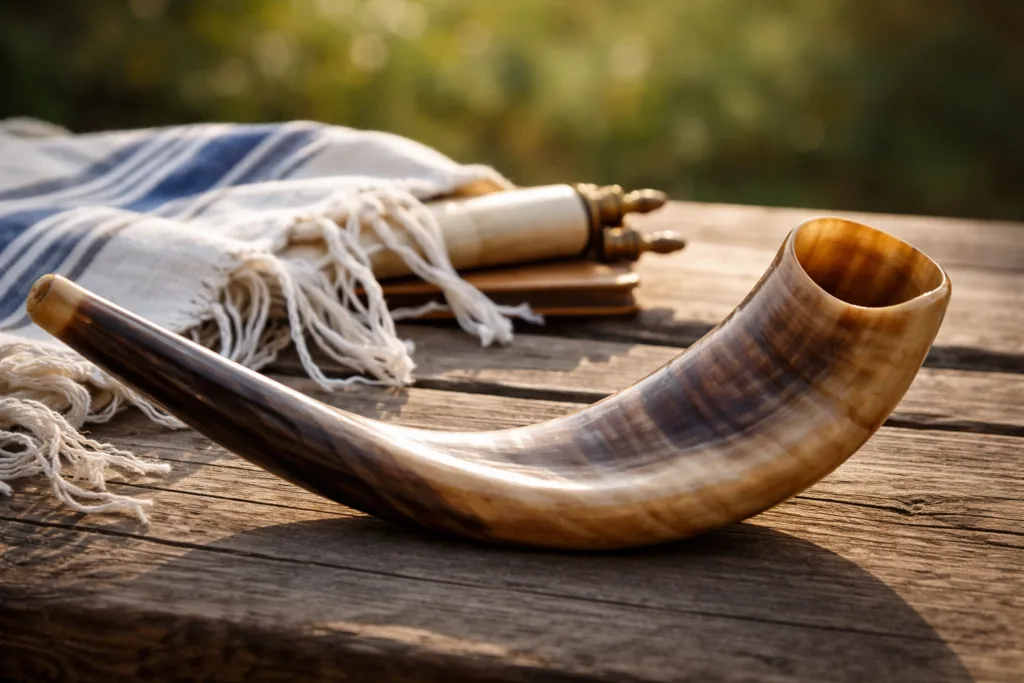
On a quiet bench, the shofar 🐏 feels less like an “instrument” and more like a living piece of material that learned to sing. It is simple in construction, yet stubbornly honest in sound. No valves. No keys. Just breath, lip tension, and a horn that pushes back.
It does not forgive a sloppy embouchure.
What A Shofar Is and Why It Sounds the Way It Does
- Type: natural animal horn wind instrument 🌀
- Core idea: a lip-reed (your lips vibrate; the horn amplifies)
- Pitch control: done by embouchure and air, not mechanics
- Typical use: blown in Jewish ritual settings, especially around Rosh Hashanah and at the close of Yom Kippur 📜
The shofar behaves like a raw, ancient bugle. Your lips create the vibration, and the horn’s shape decides which overtones bloom. Because there is no mouthpiece cup like a trumpet, the horn’s own rim and opening define the feel. This is why two shofars that look “similar” can play completely differently—one opens up with a warm, steady core, while another spits a bright, restless edge.
Expect personality.
Material and Geometry: How Horn Becomes Voice
| Horn Type (Common) | Shape | Timbre Tendency | Playing Feel | Collector Angle |
|---|---|---|---|---|
| Ram’s horn 🐏 | Curved, compact | Warm core, textured “grain” | Medium resistance, quick response | Classic tradition, broad availability |
| Kudu horn 🦌 | Long, often spiral | Brighter edge, dramatic projection | More backpressure, needs steadier air | Striking display piece; tradition-specific use |
| Other kosher animal horns 🐐 | Varies | Can range from mellow to piercing | Highly individual | Verify provenance and suitability for your context |
- The horn’s outer shell is keratin (the same basic family as nails), which helps explain the shofar’s dry, organic bite.
- More curve usually adds a sense of “spread” to the sound; straighter profiles often feel more direct.
- A narrower throat can create higher resistance; a more open bore can feel freer but harder to center.
Think of the shofar as a balance between surface and air column. The keratin wall carries a faint, woody rasp—almost like a whisper of the animal’s growth rings—while the internal taper decides how cleanly the partials lock in. That’s why the same player can sound noble on one shofar and edgy on another, even at the same volume.
If you test multiple shofars, start with a soft attack (gentle air, relaxed corners). A good horn will still “catch” and speak. If it only speaks when you force it, the mouth opening may be too sharp or the bore may feel overly tight.
Under the Hands: Resistance, Backpressure, and Control
- Seal: set the rim gently, like you would a bugle—firm enough to hold, soft enough to vibrate.
- Air Path: aim for a steady, warm stream (not a hiss).
- Centering: tiny lip adjustments find the “slot” where the horn resonates.
- Stamina: short sessions beat long battles; the shofar rewards consistency.
The first surprise is the resistance. A shofar often pushes back harder than it looks like it should. That backpressure is not a flaw—done right, it gives you a stable platform for long blasts. When the horn is well-formed, you feel a gentle “spring” against the lips, and the sound blooms forward instead of collapsing into air noise.
Good resistance feels supportive. Bad resistance feels like a blockage.
Making and Finishing: From Raw Horn To Ritual Instrument
- Selection: dense, healthy horn with a strong wall and no hidden splits 🔍
- Separation: inner core is removed; the playable body is the horn’s outer material
- Forming: controlled heat helps reshape and open the bore without cracking
- Mouth opening: the tip is cut and shaped into a clean rim
- Finish: natural texture preserved or lightly polished, depending on tradition and taste
A shofar is not “carved” like wood; it is coaxed into voice. Heat can soften the keratin enough to adjust bends and open the airway, but too much heat dries the wall and invites micro-cracks. The best makers treat forming like bending a fine rib of wood—slow, even, and patient—except the material here is horn, and it remembers stress in its own way.
Vs. Antique-Style Finishes and Modern Workshop Finishes
- Antique-style: more natural ridges left intact, less sanding, a matte, tactile grip. Often feels “alive” in the hands.
- Modern polished: smoother outside, sometimes slightly brighter response. Easier to clean, more uniform feel.
- What changes the sound most: not the shine, but the mouth rim geometry and internal bore consistency.
If you want a shofar that speaks with minimal effort, prioritize a rim that feels comfortable and a bore that looks evenly opened. If you want an object that reads like history, a lightly finished surface carries the horn’s original topography—and that texture can subtly color how you hold and angle the bell when you play.
Timbre Notes: Tekiah, Shevarim, Teruah, and Their Color
| Call | Shape | What It Reveals About The Horn |
|---|---|---|
| Tekiah 🔔 | Single steady blast | Centering, stability, and core tone |
| Shevarim 🌬️ | Three broken pulses | Response speed and how cleanly the sound re-starts |
| Teruah ✨ | Series of short staccato bursts | Articulation clarity and breath efficiency |
- On a strong horn, tekiah stays solid even when your air relaxes slightly.
- Clean shevarim needs a rim that “re-grips” quickly.
- Crisp teruah is a test of both player control and horn response.
The shofar tone is not “pretty” in the modern orchestral sense. It is direct, full of natural overtones, and sometimes pleasantly gritty. That grit often comes from the rim’s micro-edges and the horn’s internal surface. When everything aligns, the sound carries with a focused brightness, yet still feels like wind moving through a living material.
Over-polishing can make a shofar look uniform, but it can also erase the horn’s natural ridges and age cues. If you care about period feel, look for honest texture and a finish that does not look overly glassy or artificially tinted all the way through.
Vs. Modern Brass Horns: Why The Shofar Feels Different
Shofar 🐏: rim is horn, bore is organic, response is less standardized. You “negotiate” with it.
Trumpet/Bugle 🎺: engineered mouthpiece and metal bore, response is predictable, pitch slots feel cleaner and more repeatable.
- Brass often rewards precision with clean sparkle.
- The shofar rewards steadiness with raw authority.
- On shofar, small lip shifts can change timbre more than you expect.
Metal instruments tend to reflect energy quickly, giving a crisp attack and a bright top end. Horn absorbs and releases energy in a different way. The result is a tone that can feel fibrous—not weak, just organic. When you play, you may notice the sound “opens” a fraction after the attack, like the horn is catching up and then locking in.
Vs. Ram’s Horn and Kudu Horn: Choosing The Right Voice
- Ram’s horn: classic curve, often easier for beginners to speak cleanly.
- Kudu horn: longer air path, strong presence, can demand more breath management.
- Tradition matters: some communities strongly prefer specific horn types for ritual use.
If your priority is steady, dependable sound under pressure, a ram’s horn shofar is usually the most forgiving place to start. If you want a horn that feels visually monumental and can project with a dramatic edge, a kudu horn can be thrilling—just expect more backpressure and a steeper learning curve. For ritual contexts, align your choice with the practice you follow so the instrument fits the setting as naturally as it fits your hands.
Pick the shofar that helps you play the sound, not the one that only looks the part.
Choosing One: Player Focus Vs. Collector Focus
- Player-first 🎶: comfort at the rim, quick response, stable long blast, controlled articulation.
- Collector-first 🏺: surface integrity, natural character, credible provenance, minimal “cosmetic overwork.”
- Both: avoid hidden cracks, check bore cleanliness, confirm the horn feels structurally confident.
A shofar that plays well has a mouth rim that feels kind to the lips and a bore that does not fight you. You do not need perfection, but you do need consistency. On the collector side, the biggest value-killers are structural: spider cracks near the mouth opening, dry splits along stress points, or repairs that look like they were meant to hide damage rather than stabilize it.
- Run a finger lightly along the rim: it should feel smooth, not sharp.
- Look down the bore: it should appear evenly opened, not pinched or jagged.
- Gently tap the body with a knuckle: listen for a clean “tick,” not a dull rattle that may hint at internal issues.
Care and Storage: Keeping The Horn Stable
- Store in a dry, stable room—avoid heat sources and direct sun ☀️
- Keep it clean inside; moisture left in the bore can cause odor and buildup
- Do not use harsh solvents; gentle cleaning methods are safer for keratin
- Handle with calm hands—drops can create cracks that are hard to fully stabilize
Horn is tough, but it can dry out and stress-crack if treated like metal. After playing, let the shofar air out. If you need to clean, use mild methods and keep water exposure minimal. A well-kept shofar can hold its voice for years, and the material will keep that subtle organic resonance that makes it special.
Stable storage is sound preservation.
FAQ
Is It Hard To Learn Shofar?
It can feel challenging at first because the shofar has no standard mouthpiece. Most people improve quickly by practicing short, calm attempts and focusing on steady air. A well-made horn with a comfortable rim makes the learning curve far smoother from day one.
How Do I Know If A Shofar Is Good Quality?
Look for a clean, comfortable mouth rim, an evenly opened bore, and a body free of visible cracks. A quality shofar speaks with gentle air and keeps a steady tone without forcing. The best sign is easy response paired with a stable long blast.
What Size Shofar Should I Choose?
Choose based on comfort and control. Smaller to mid-size ram’s horn shofars often feel easier to center and hold for longer sessions. Larger horns can offer a bigger presence but may need more breath support and may feel heavier in the hands.
Does A Polished Shofar Sound Better Than A Natural Finish?
Not automatically. Polish mostly changes feel and appearance. Sound depends more on rim geometry and bore consistency. A natural finish can keep a wonderful, textured voice, while a polished horn can feel smoother under the hand. Prioritize playability over shine.
Can I Clean The Inside Of A Shofar Safely?
Yes, with gentle methods. Avoid harsh chemicals that can stress keratin. Keep moisture minimal, let it dry fully, and focus on removing buildup rather than trying to make the bore look “new.” Clean care helps keep the tone open and the material stable.